
Tea Knowledge
Buying Art for the First Time: Budget, Preference and Documentation
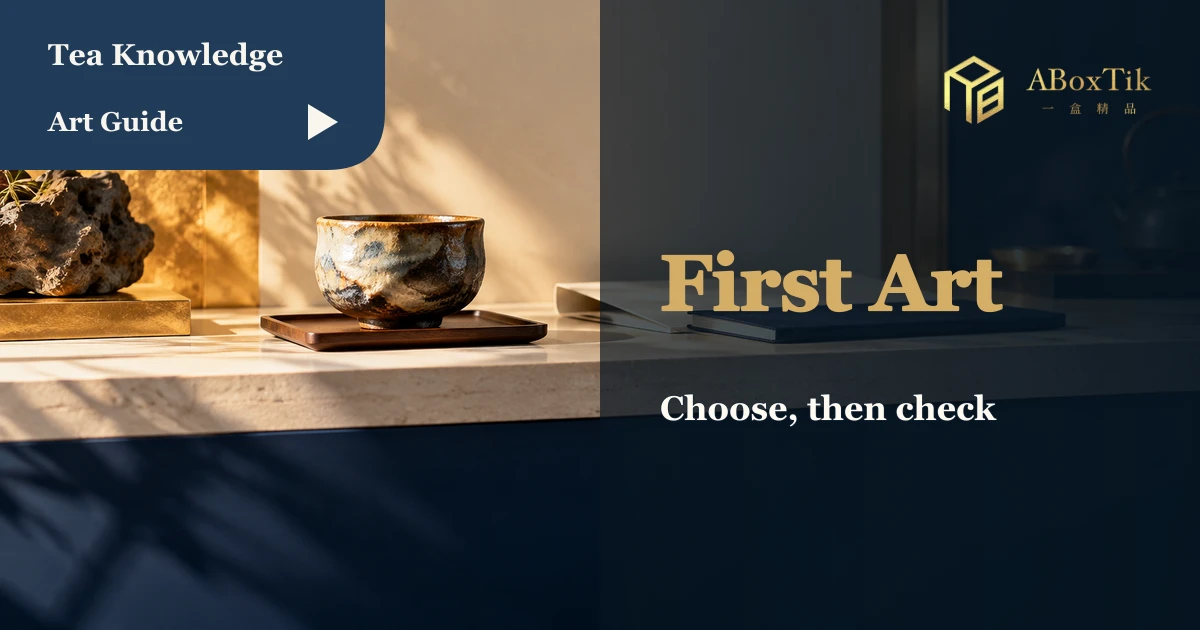
A closer look gives a favourite work room to belong.
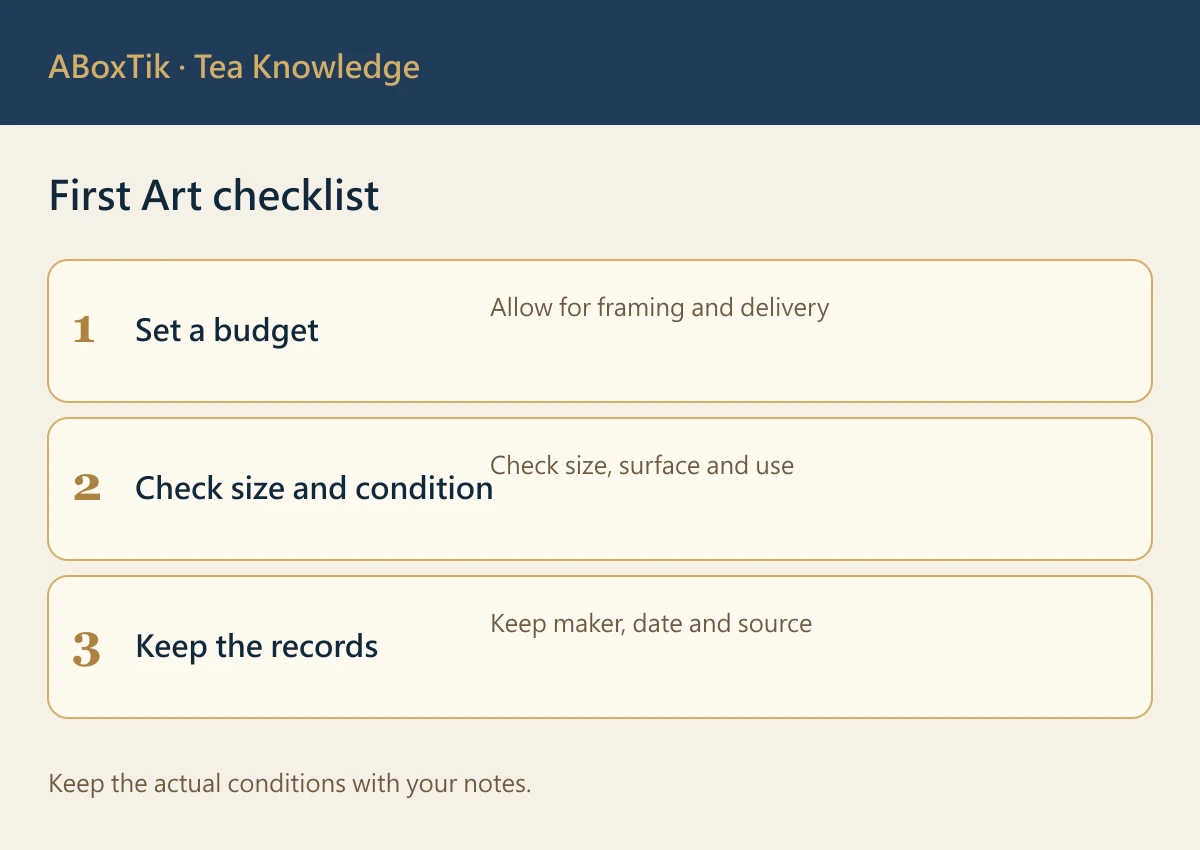
For a first art purchase, begin with what you like, an affordable total budget, the object's actual condition and the information available about it. Confirm the artist, title, medium, dimensions, date and seller; ask about ownership history, condition, delivery and care. Keep the answers with your payment record. Documents can support further research, but a certificate alone does not guarantee authenticity or future value.
An unfamiliar gallery or craft fair can present many new terms at once. Give yourself time to look without buying. Choose one work you would like to see again, note a detail you enjoy, and ask the seller a few specific questions. A first collection does not need an expensive standard answer. Looking carefully at this particular object is already a useful beginning.
Decide whether you will display or use it
A painting for a wall, a ceramic sculpture for a shelf and a cup intended for daily use have different needs at home. Measure the intended space, including the doorway, shelf depth and room around the object. For glass or ceramics, consider the stability of the base, moving and cleaning. A beautiful work does not need to compete for space on an already crowded shelf.
If a vessel is intended for food or hot water, ask the maker or seller about its intended use, cleaning, temperature and handling limits. A display work and a daily tea vessel can have different design purposes. Appearance or the fact that a material was heated during production does not establish that the finished object is suitable for every use. Letting a work do its intended job makes it easier to care for.
Write down the complete budget
The displayed price is one line, not necessarily the entire cost. Ask whether framing, delivery, packing, installation, tax or other confirmed charges are additional. For a cross-border purchase, request the actual delivery terms and cost information from the seller. Add the amounts you know; leave uncertain fields open until they are answered. The total should remain comfortable for you, even if someone else at the fair makes a quicker decision.
Group candidates into “affordable now”, “save for later” and “research first”. Waiting does not disqualify you from enjoying the exhibition. Record the artist, title and questions, then revisit your notes at home. If the reasons for liking the work remain clear, arrange the next step at your own pace.
Five groups of questions before buying
Start with identification: who made the work, what is its title, medium, dimensions, date or edition? Keep the work card, images and listing. Then ask about ownership history: how did the seller obtain it, and are earlier exhibitions, publications or owners documented? Keep the sources and dates that can be supplied.
Ask about condition: has the work been repaired, and are there cracks, damage or other known details? Request a written condition description and photographs where appropriate. For use and care, ask whether the work is for display or daily use, and how it should be cleaned, moved and placed. Finally, confirm total cost, payment, packing, delivery and the terms agreed by both parties. Save the quotation, conditions and proof of payment.
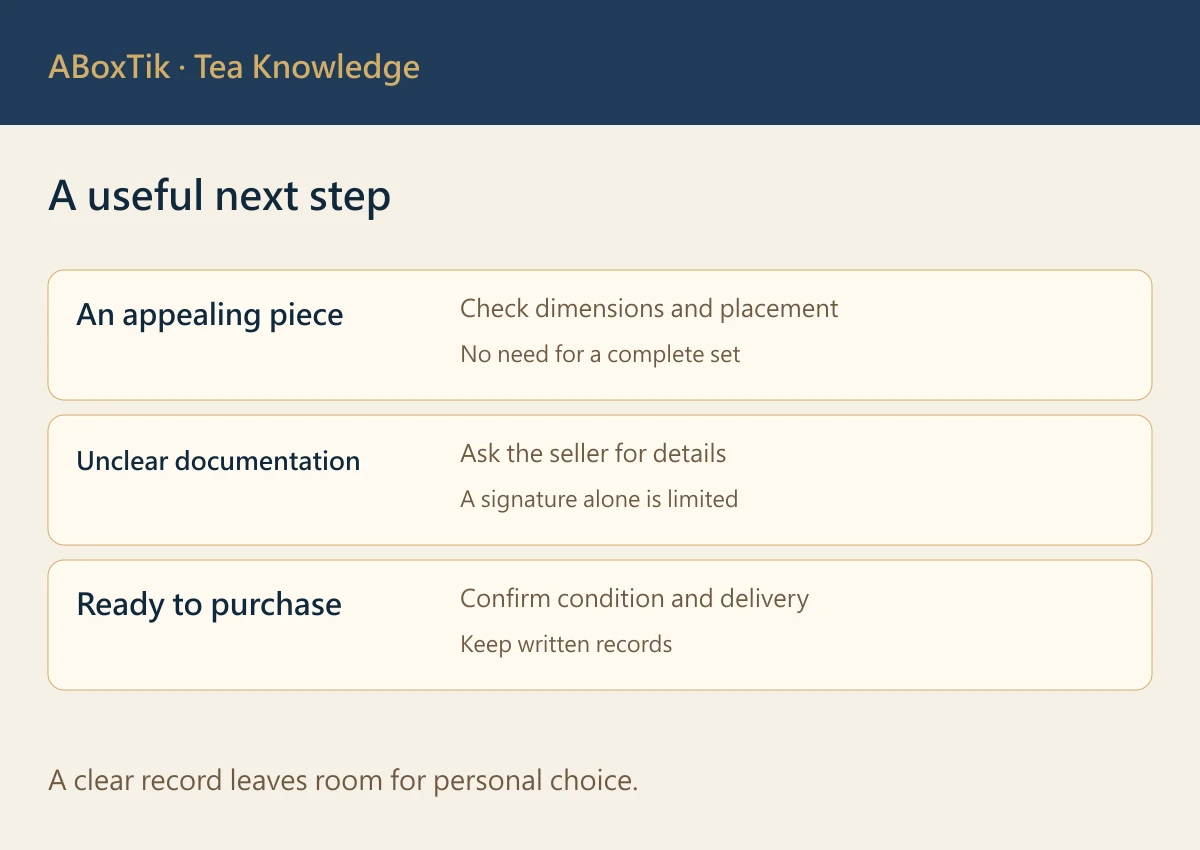
You do not need to conduct a cross-examination in one breath. Choose the two questions that matter most and ask for help understanding the answer. If information is unavailable, record the gap and decide whether to investigate further or wait. A clear “to be confirmed” is more useful than filling a missing period with an attractive story.
Provenance, certificates and authenticity are related questions
The Smithsonian American Art Museum explains that researching an artwork’s earlier location and ownership can involve exhibition guides, catalogues, inventories and archival records. Research may involve previous owners, exhibitions, publications and other records. Ask which specific work a document describes, who supplied it and when, and whether its photograph, dimensions, edition or signature correspond to the object. If records differ, ask the seller to explain; do not invent a conclusion for a missing period.
A certificate can contain information about an artist, work or transaction, but its usefulness depends on the issuer, content and what can be checked. Keep the original or documents agreed for the transaction and photograph relevant identifying details. When expert assessment is needed, look for an independent professional suited to the medium and type of work. A pile of papers does not automatically authenticate an object, and an ownership note does not guarantee its price.
For a print or another work produced in multiples, ask about the edition, number, medium and any statement supplied by the artist. For a unique craft object, ask whether there is a related series and how this individual work is identified. These questions connect the records to the object; they do not rank one form above another. If a term is unfamiliar, ask for a plain explanation before adding it to your notes.
Inspect the condition with the seller's help
Where permitted, look at the front, back, edges, base or joins. Do not dismantle or touch a fragile work without permission. Ask whether it has been repaired, which marks are known and whether they are described in the written information. Photographs help with later comparisons but a phone image cannot show every detail. Ask someone familiar with the material when the condition is unclear.
For ceramics, questions may concern the glaze, rim, foot or cracks. For glass, ask about edges, joins, bubbles or lines. A bubble or apparent hand-made mark does not by itself establish how an object was made or what it is worth. The work card and maker's explanation provide better context. If the object is damaged, ask about appropriate care rather than trying household cleaners as a repair.
Check the transaction and the journey home
Before paying, confirm the seller, total price, payment method, delivery date and responsibility for transport. If return or cancellation terms are offered, ask for them in a form you can keep. Arrangements vary by seller, platform and work, so read the actual terms for this purchase. If a spoken promise matters to your decision, ask for written confirmation.
Packing and delivery deserve attention before purchase. Does a large work need a specialist installer? Who arranges protective packing for a fragile material? If the outer box arrives damaged, whom should you contact and how should you document it? Keep contact details, packaging and transaction records until the object has been checked. Gallery lighting may be lovely, but the work still has to pass through a lift, a vehicle and your front door.
Keep a simple object file at home
Put photographs, dimensions, medium, artist and title, purchase date, seller, payment record and care instructions together. If provenance, certificates or condition reports are supplied, record their sources and dates as well. You can keep paper and digital copies and note where the originals are stored. When new information arrives, retain the earlier version and date so that the history remains traceable.
After placement, check stability, risk of knocks and any maker's advice about light, humidity or cleaning. If damage occurs or specialist cleaning is needed, consult a professional appropriate to the work. Materials differ; a routine used for an everyday tea cup is not automatically suitable for an artwork.
Make a decision in words you understand
Reduce the notes to three sentences: “I like…”, “I have confirmed…”, and “I still need to ask…”. If the only reason left is that someone else says the work is worth buying, give yourself time to look again. If information and costs are clear, you can decide without rushing. Art can accompany daily life without being presented as a guaranteed financial return.
If familiar materials help, begin with the stories of Taiwanese ceramic craft or Hsinchu glass, then return to the artist, intended use and documents for the object in front of you. Make a familiar cup of tea while organising your exhibition notes. A first work does not have to define a lifetime of collecting; it can simply be something that makes you want to stop and look again.
| Area | Keep with the object record |
|---|---|
| Preference and space | What you enjoy; measured display or use space |
| Identity | Artist, title, medium, dimensions, date or edition |
| Condition | Known damage, repairs and dated photographs |
| History | Document sources, dates and unresolved gaps |
| Complete cost | Work, packing, delivery and other confirmed charges |
| After purchase | Contact, agreed terms and care instructions |

Related reading and tea choices
Sources
Sources checked: 29 October 2026.