
Tea Knowledge
Maocha and Refined Tea: Understanding the Processing Journey
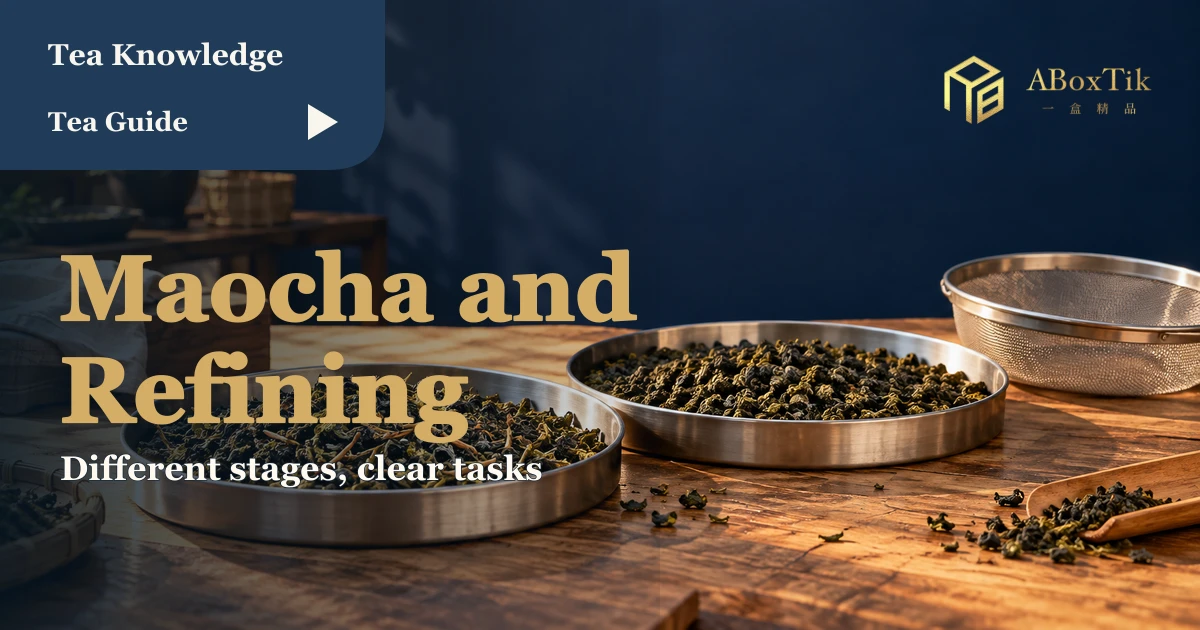
Each stage of a tea’s journey deserves a clear question.
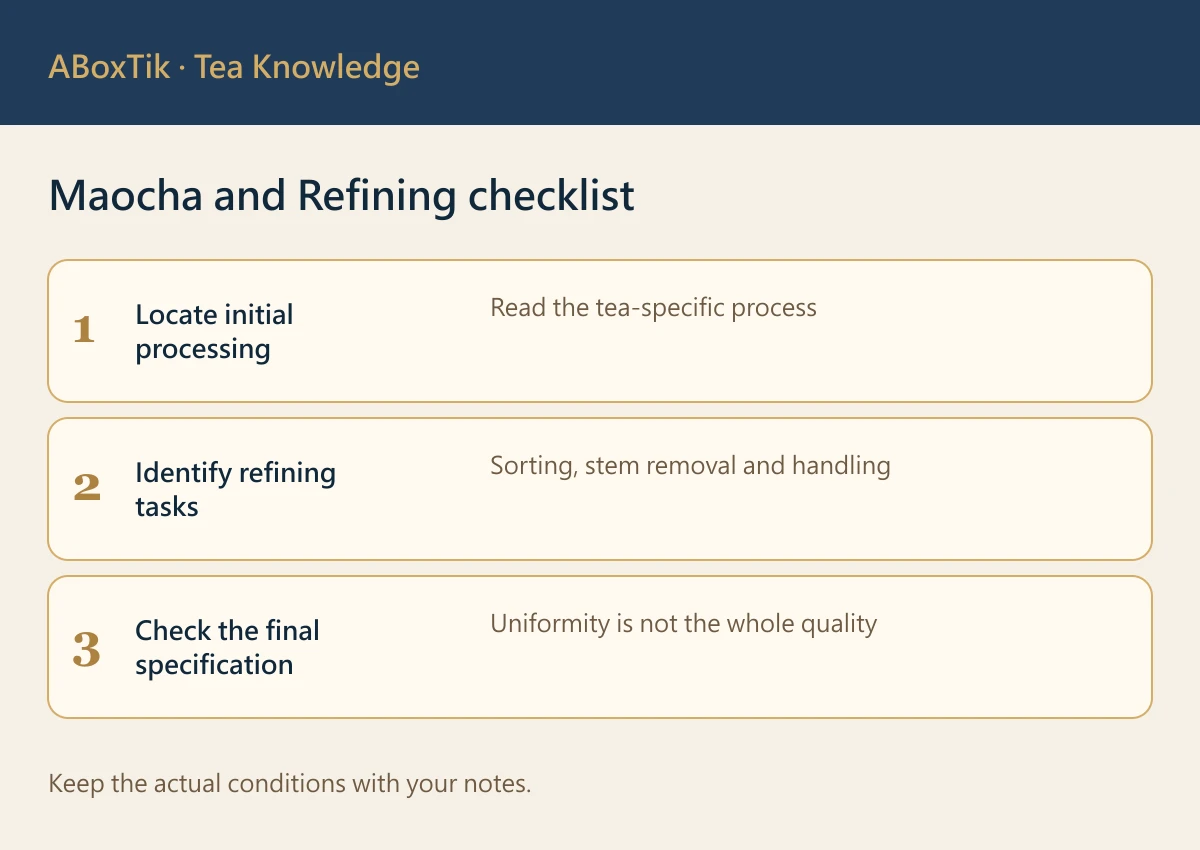
Coarse tea, often called maocha, generally refers to tea that has gone through initial processing and drying. Refining means further work on tea according to the needs of a particular product and supply chain. That work may include sorting, removing unwanted material, blending or further drying and roasting, but the actual steps depend on the batch. Maocha is not a freshly picked leaf, and “refined” is not a magic label that guarantees everyone will prefer the resulting cup.
Imagine a relay rather than a single machine. Fresh leaves go through the initial process appropriate to the tea style. The resulting tea can then be handed on for any additional sorting, finishing and packaging needed for that product. Who does each part, and which steps are used, vary. This map helps you ask better questions; it is not a compulsory checklist for every tea factory.
Fresh leaf, coarse tea and a finished product
Freshly harvested shoots and leaves are the raw material. Green tea, oolong and black tea follow different processing sequences, which may involve withering, leaf agitation, heating, rolling, oxidation, shaping and drying. Taiwan’s Tea and Beverage Research Station describes coarse tea as the result of processing and drying the fresh material in its guidance on tea packaging and storage. The order of operations differs by tea style; a black tea process should not be forced into an oolong flow chart.
| Term | A useful starting description | Next question |
|---|---|---|
| Fresh leaf | Recently harvested material | What cultivar and picking conditions? |
| Coarse tea or maocha | Tea that has undergone initial processing and drying | What further work is planned for this batch? |
| Refined tea | Tea that has undergone further preparation or sorting | Which steps were actually used? |
| Packaged product | Tea offered in a particular final form | What are the contents, batch information and storage directions? |
Terminology can vary by tea type, region and business. If a supplier uses the words differently, ask them to describe the actual steps and the condition of the tea. A clear description does more work than a debate over the most elegant label. Coarse tea has already been processed; whether a particular material is intended for direct consumption should be confirmed with its supplier and product information.
Initial processing starts with the intended tea style
A simplified map of Taiwanese tea production can include withering, agitation or other steps in making oolong, heating, rolling and drying. Black tea has a different oxidation and drying sequence. The work is connected: the state of the leaves entering a step affects what the maker can do next. No single diagram is a universal production recipe.
Several focused guides make the map easier to read. Leaf agitation concerns a particular part of making some oolongs; fixation uses heat to affect enzyme activity; drying reduces moisture. They are not simply three names for “making the leaf dry.” Reading each step separately helps explain why a tea has already travelled a considerable distance before it is described as coarse tea.
The initial process also does not freeze flavour forever. Later heating, packaging, storage and brewing can all influence what appears in the cup. When a producer describes one stage of their work, treat that account as a part of the story and ask whether it refers to this particular batch or to a general tea style.
What can refining involve?
Further handling can take several forms. Sorting may group leaves by observable characteristics. Removing unwanted material may address parts that do not belong in the intended product. Blending can combine teas for a chosen product direction. Further drying, re-firing or roasting may serve moisture management or flavour goals. These are possible operations, not a sequence every tea must complete.
The choice depends on the leaf, equipment, intended style and the people responsible for the work. One maker may complete the early and later steps; another supply chain may pass the tea to a separate finishing or packing operation. A consumer description may mention only some steps. Seeing the word “refined” does not prove that a tea was blended, heavily roasted or completely free of stems. Ask what happened to the batch you are considering.
Likewise, a product that does not use the word “refined” is not automatically lacking in care. Names can describe different stages or marketing conventions. The most helpful questions concern the tea’s identity, intended use and available processing information. Let the details do the talking rather than asking one word to certify an entire production history.
Sorting is not a flavour score
Sorting can help a producer organize material for a product, but the presence of a sorting step alone does not tell a drinker exactly what the tea will taste like. Leaf size and appearance are observations; flavour also reflects the original leaf, processing, storage and preparation. A uniform appearance can be useful to describe, but it should not stand in for a complete quality assessment.
If you are comparing two teas, record what the seller actually says about the materials and preparation. Do not assume that a visually different leaf was handled carelessly, or that a tidy appearance proves a particular production method. If more detail is important to you, ask whether the producer can explain how this batch was sorted and what the product description means.
Blending and roasting: ask about this tea
Blending describes combining teas. It may serve a product style, a batch plan or another purpose; whether a tea was blended, and what it contains, are questions for its actual product information. A single garden or single batch can be valuable information for someone seeking traceability, but neither term automatically guarantees a preferred flavour. Another drinker may enjoy the balance of a blend. The question may be about provenance, style, price or personal preference, and those are not interchangeable.
Roasting is also a specific operation, not a synonym for all refining. Later heat treatment can adjust a tea’s state and flavour, but not every refined tea needs a heavy roast. Drying and roasting can both involve moisture and heat while having different emphases and arrangements. A grain-like note in the cup is not enough to reconstruct a machine setting, temperature or duration. Record the note, then ask whether the producer has batch information they can share.
A tea’s colour or aroma alone cannot supply the entire production chain. Cultivar, fresh leaf, previous processing, packaging, storage and brewing all remain part of the picture. If a description is general rather than batch-specific, keep that distinction in your notes. A useful explanation can be modest and still help a reader choose.
Five questions to take shopping
First, what are the stated region, cultivar and tea style? Second, is a harvest season or batch identified? Third, has the seller described any sorting, blending or roasting for this tea? Fourth, what contents and storage instructions appear on the package? Fifth, what preparation does the producer recommend as a starting point?
Not every seller can disclose every detail, and a missing detail should stay marked as unknown. Do not fill the gap with a charming story that the available record cannot support. If traceability or a particular processing method matters to your decision, explain that priority and ask what evidence is available for the current product.
When the tea arrives, begin with the package directions and record the vessel, leaf, water, time and your impressions. If you compare two teas, fresh portions and consistent brewing conditions make your observations easier to describe. They still cannot reveal an entire factory history from taste alone. Tea can be enjoyed without also having to act as a production camera.
Follow one term back to the cup
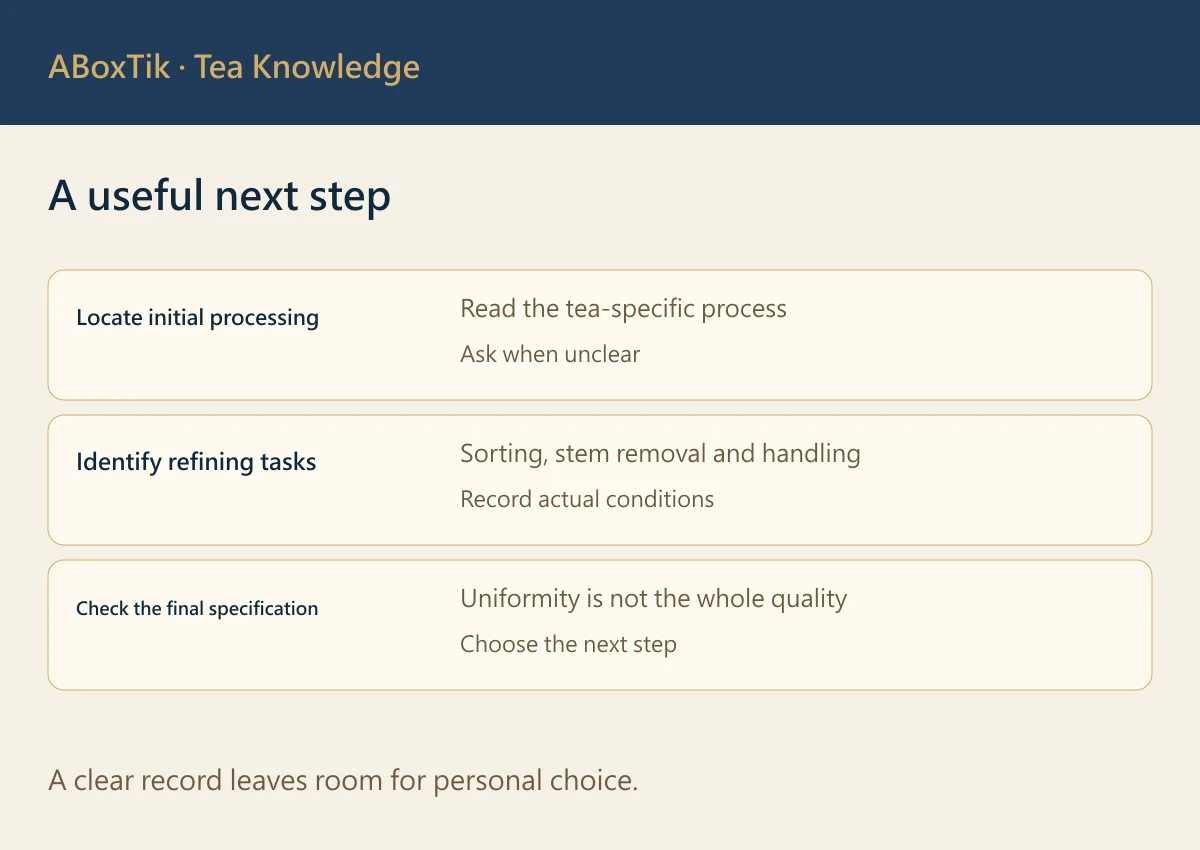
The difference between coarse and refined tea is an introduction to different stages and jobs in a supply chain. Remember that coarse tea has already undergone initial processing, then ask which further work was carried out for the specific batch. Keep documented information, sensory impressions and unanswered questions in separate places.
If you would like to keep exploring, read the guides to drying, roasting and tea storage. Each gives one part of the story its own space. Then return to the tea in front of you: use the producer’s instructions, make a small note and allow your preference to develop one cup at a time.

Related reading and tea choices
Why does one batch contain different sizes?
A batch of finished dry tea can contain leaves and fragments of different shapes, sizes and degrees of completeness. A producer may separate some forms during later processing to suit a particular product or subsequent operation. Whether a given batch is screened, which equipment is used and what happens to each fraction are questions for that producer. A Tea Research and Extension Station equipment note describes picking stems and screening powder as part of refining before further drying. It is an example of connected tasks, not a universal screen size or grading formula for every tea.
| Question | What separation may do | What it cannot establish alone |
|---|---|---|
| Different leaf sizes and shapes | Group selected forms for a specification | Which portion everyone will prefer |
| Small fragments and powder | Separate or allocate them for a product’s needs | That all small pieces are waste |
| Stems and leaves | Support a separate sorting operation | That a visible stem proves poor quality or unsafe tea |
| Consistency | Help organize material for an appearance or process | Origin or quality from screen opening alone |
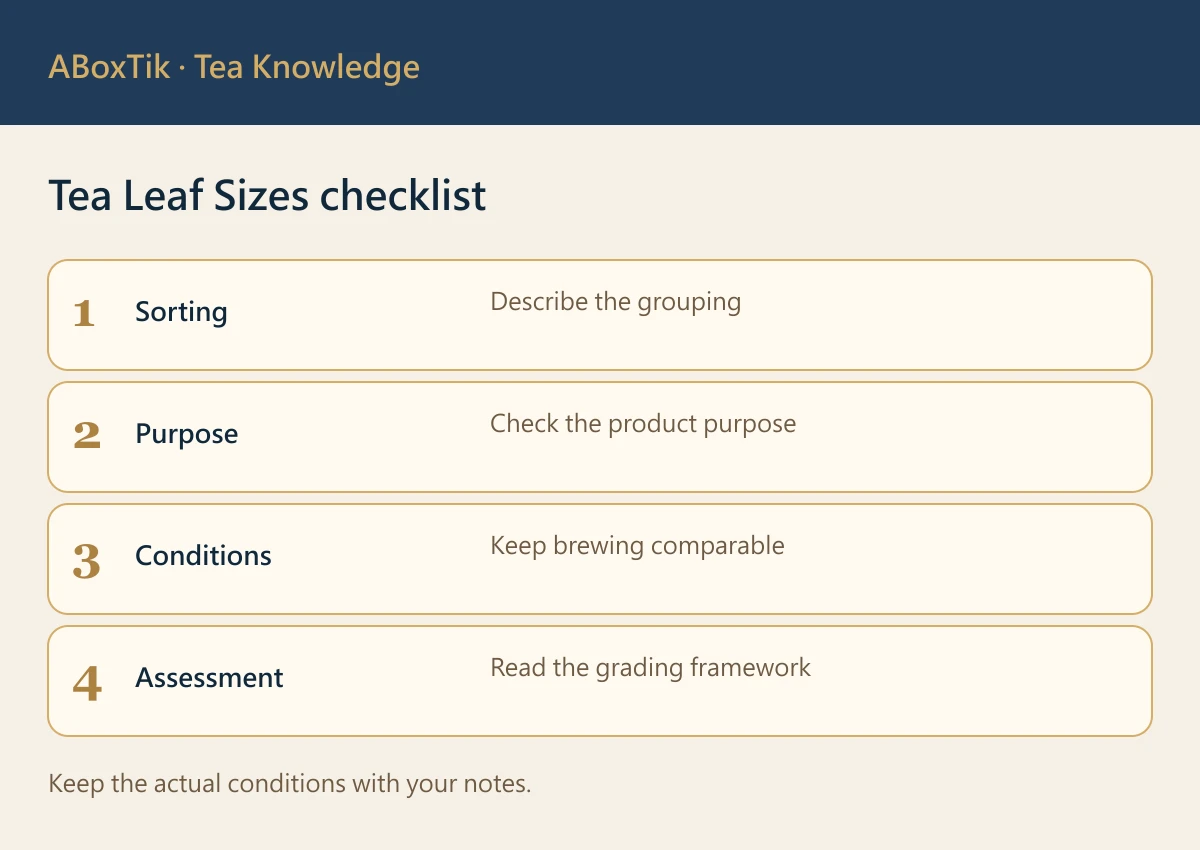
A screen opening is a property of the equipment. Whether a particular piece passes through also depends on its shape, orientation, how leaves lie together and the operation. A long leaf and a tightly rolled piece can behave differently even when their weights are similar. “Particle size” is a useful shorthand here; it does not mean every leaf can be described completely by one diameter as though it were a round bead. Screen figures from different tea types or devices should not be treated as a league table.
The word grading needs a second question: grading for what purpose? Physical sorting groups material according to an operational specification. Taiwan’s tea assortment and grading system, TAGs, is a separate framework that includes product classification and sensory evaluation within its particular program. The guide to tea labels and evaluation explains the context. A larger leaf or smaller fragment does not by itself earn an evaluation grade. If a product claims participation in a particular program, check the document and the product to which it applies.
For a quiet observation at home, spread a small amount of dry tea on clean, dry white paper and note the visible shapes, fragments and identifiable stems. There is no need to crush the leaves to make a point. To compare the cups, take fresh portions from the same batch, weigh each and record water, vessel and time. The portions may still differ in composition, so a preference describes that particular tasting. It does not prove a single chemical cause, a machine setting or a universal rule. Keep the package and batch information if an object cannot be identified, and ask the supplier before using it.
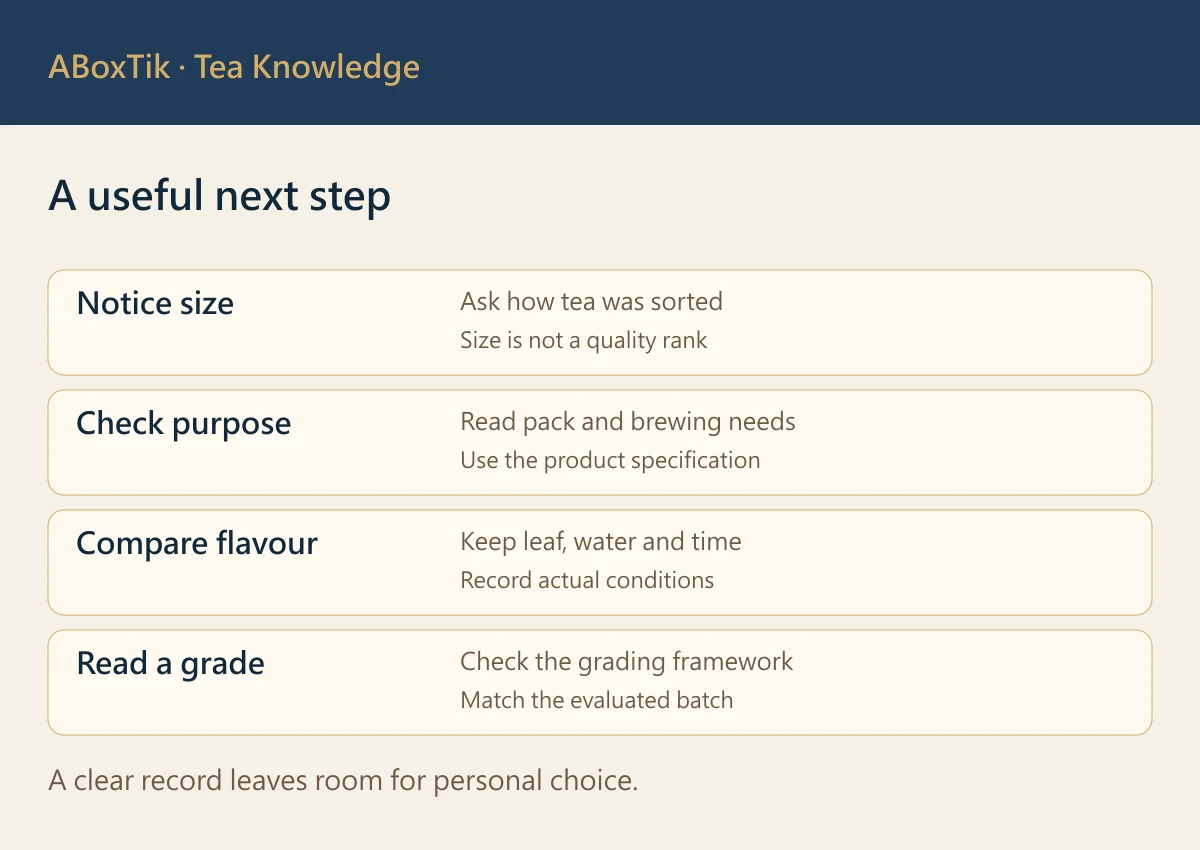
When the tea looks uneven, ask what the product is intended to be, what sorting was done and what information the producer can share. Then return to the cup and record the experience under known brewing conditions. Stem sorting discusses another visible component, while rolling and leaf shape places shaping earlier in the process. Each operation has its own job; a screen does not have to issue the final verdict on the whole cup.
Sources for this addition
Sources
- Tea and Beverage Research Station: Tea packaging and storage
- Tea and Beverage Research Station: Introduction to classification and processing of Taiwan specialty teas
Sources checked: 30 October 2026.