
Tea Knowledge
Tea Leaf Rolling: Shape, Flavour and the Pace of Brewing
A dry leaf holds its shape until warm water begins to open it. There is no need to judge it in a hurry: leave a little room for its form and flavour to tell their separate stories.
Tea leaf rolling uses movement, friction and pressure to curl leaves and disrupt their tissue, bringing juices to the leaf surface. It helps create both the finished shape and the way flavour becomes available during brewing. Ball-shaped oolong usually undergoes further cloth wrapping and shaping. If strip-shaped and tightly curled teas look unfamiliar, start by treating their forms as clues to processing rather than a contest in roundness.
What does tea leaf rolling change?
Taiwan’s Tea and Beverage Research Station describes two related functions of rolling: curling the leaf into a twisted form and releasing leaf juices onto its surface. Shaping and brewing are therefore connected. Rolling is more than making a leaf look tidy; it changes the leaf’s physical structure and helps its contents enter the infusion.
It does not create a tea’s entire character on its own. The raw material, withering and moisture management, oxidation, fixation, drying and roasting also matter. Putting rolling back into that sequence is more useful than assuming that stronger rolling always means stronger or better tea. For the wider setting, Taiwanese tea, place and craftsmanship offers a gentle introduction.
Tossing, rolling and ball shaping: where do they belong?
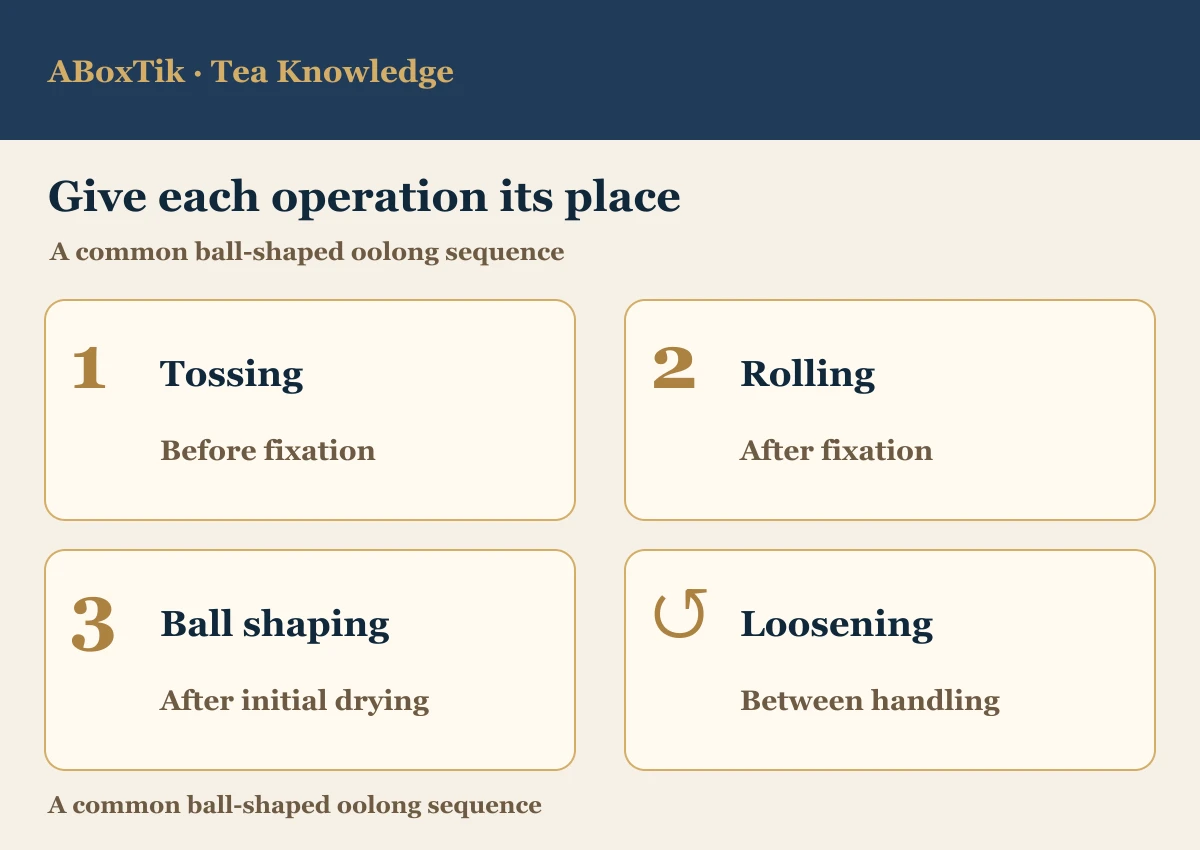
All three involve moving leaves, so the terms can blur together at first. In a common Taiwanese ball-shaped oolong sequence, tossing accompanies indoor withering before heat fixation; rolling follows fixation; further shaping follows initial drying. This is a useful map for one familiar tea style, rather than a universal sequence for every tea.
| Operation | Common position and purpose | What to keep separate |
|---|---|---|
| Tossing | During indoor oolong withering, alongside rest, to manage moisture and oxidation conditions. | It is not the later ball-shaping stage. |
| Rolling | After fixation in a common oolong process, to curl leaves and act on their tissue. | Other tea types can place rolling differently. |
| Cloth wrapping and ball shaping | After initial drying, through repeated wrapping, shaping and loosening. | A finished ball is not made in one simple squeeze. |
Black tea makes the difference easier to remember. It is commonly withered and rolled before oxidation is completed and the tea is dried. The oolong order cannot simply be transferred to it. The six tea categories explain the larger distinctions; our articles on oolong tossing and oolong oxidation explore the earlier stages in more detail.
How does ball-shaped oolong take form?
The Station’s processing guidance describes a repeated cycle after initial drying: warming the leaves, gathering them in cloth, shaping with equipment and loosening the bundle. Gradually, the leaves become tightly curled. Loosening is part of the work, too. Separating clumped leaves allows heat to disperse and helps the next handling stage reach them more evenly.
The maker must work with leaf flexibility, moisture, the amount being processed and the intended shape. A seller’s explanation of cloth rolling can help bring the process into focus. The number of cycles, however, is not a quality score. A pressure setting or timing that suits one batch cannot be treated as a ready-made recipe for every leaf.
Does tighter rolling mean better flavour?
No. Tightness, evenness and twisted appearance describe a tea, but they do not decide whether it will suit a particular palate. Strip-shaped Baozhong and ball-shaped oolong have different forms because of their processing styles. They do not need to compete. When comparing light and roasted Taiwanese teas, keep roast character separate from shape in your notes.
Rolling’s effect on tissue is relevant to extraction, but a concentrated cup cannot reveal how firmly its leaves were rolled. Leaf weight, water temperature, time, broken pieces and storage can all influence the result. ABoxTik’s approach is to read the cultivar, origin, processing and brewing information first, then return to the cup. Our tea price and value guide follows a similar approach to understanding craft.
Unfurling and flavour release are different observations
A tightly curled leaf gradually opens in water, but the cup may already have flavour before the leaf fully unfolds. Equally, an open-looking leaf has not necessarily given up everything it can contribute. “Balls brew slowly, strips brew quickly” is a question to investigate, rather than a rule for setting every infusion time.
Watch two things separately: how open the leaves look after pouring, and how concentrated the cup tastes. If the second infusion is much stronger than the first, check whether it also lasted longer or used hotter water. The leaves may now be more open as well. None of these observations requires an immediate verdict that something is wrong with the tea.
A spoon adds another small complication. Curled and strip-shaped leaves occupy different volumes, so equal spoonfuls need not have equal weights. If a scale is available, start with a measured weight. Without one, practise with the same tea and a consistent spoon-filling method. For the other variables, see our guides to oolong water temperature and steeping time.
A small brewing card for an easier next cup
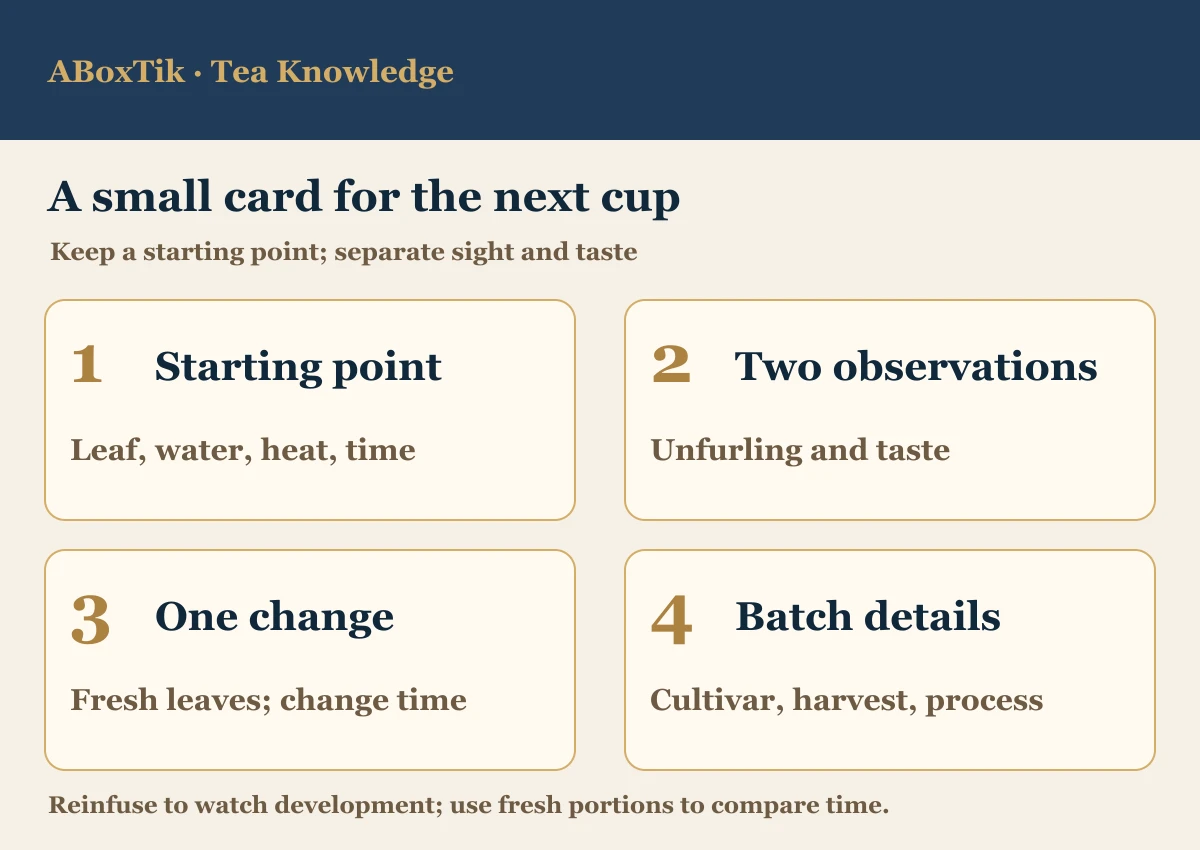
The following is an ABoxTik editorial exercise. Begin with one tea and compare two fresh portions, using the package guidance as a starting point. It is a clearer way to explore timing than comparing unrelated teas and assigning every difference to rolling. If tea is being shared with family, even one useful note—“a slightly shorter steep felt more comfortable”—is enough.
- Keep a starting record: note the vessel, water volume, leaf weight, temperature and time.
- Separate sight from taste: take a leaf photograph after pouring, then record openness, concentration and any drying sensation separately.
- Change time alone: use another fresh portion of the same weight. Shorten the steep a little if it feels too strong; extend it slightly if it feels thin.
- Add batch details: record cultivar, harvest and processing information so the next purchase is easier to compare.
Repeated infusions of the same leaves answer a different question: how one portion develops across a brewing session. Those leaves have already been changed by the previous infusion, so a second steep is not a clean comparison of timing alone. Use fresh portions to compare one timing change; keep the same leaves to watch continuous unfolding. There is no need to do both exercises today.
A gaiwan or daily teapot can both work. If aroma becomes the next point of interest, our dry, warm and cool aroma guide provides a natural next step. Finding a comfortable strength is already worthwhile progress.
Questions about tea leaf rolling
Is rolling the same as cloth ball shaping?
Not quite. Rolling curls the leaf and acts on its tissue. Cloth wrapping and repeated ball shaping are related later operations in ball-shaped oolong production.
Is hand rolling always better than machine rolling?
The method alone cannot decide quality. Equipment and the maker’s judgment must suit the material and intended style. Look for clear origin and processing information, then assess the tea itself.
Does leaf shape still matter in a tea bag?
It can be useful to observe. Portion size, room inside the bag and leaf form all deserve attention. Start with the package directions and look at the leaves after brewing if you are curious.
Follow ABoxTik
Read Taiwanese craftsmanship through one leaf
Understanding tea leaf rolling adds a practical way to read a tea: notice its form alongside its processing, and its unfolding alongside its taste. There is no need to remember every production term at once. Match the brewing guidance to the cup at hand, and preferences become easier to describe. Our ABoxTik story continues that interest in Taiwan’s craft.
- Dong Ding Oolong: use the current processing and brewing information to record roast character, strength and successive infusions separately.
- Honey Red Oolong: explore another processing direction through its product information, beginning with a vessel and rhythm that suit daily life.
Sources
Editorial sources reviewed: 7 October 2026.