Tea Knowledge
Yilan Tea Guide: Yulan, Suxin and Local Tea Names
Yilan tea is easier to explore when the names are placed on a map. Yulan is associated with Datong, Suxin with Dongshan, Shangjiang with Sanxing and Wufeng with Jiaoxi. These local names offer a place to begin, while the cultivar, style and harvest details of a particular tea still need their own labels.
There is no need to memorise every name before choosing a cup. Start with the style you enjoy, then look for the information that describes the actual tea: where its leaves were grown, what cultivar was used, how it was made and when it was harvested. A place name opens the door; it does not tell the whole story on its own.
Four local names at a glance
| Local name | Place in Yilan | A useful next question |
|---|---|---|
| Yulan tea | Datong Township | What cultivar and tea style does this batch use? |
| Suxin tea | Dongshan Township | Is this particular tea a black tea or another style? |
| Shangjiang tea | Sanxing Township | Who produced it, and what harvest details are available? |
| Wufeng tea | Jiaoxi Township | What does the seller mean by this name on this product? |
The Yilan County Government associates these four names with their respective townships. Taiwan's agricultural education material also discusses Yulan and Suxin within the wider Lanyang tea context. These names are useful cultural and geographic starting points, but they do not imply that every tea from each place shares the same cultivar or processing method.
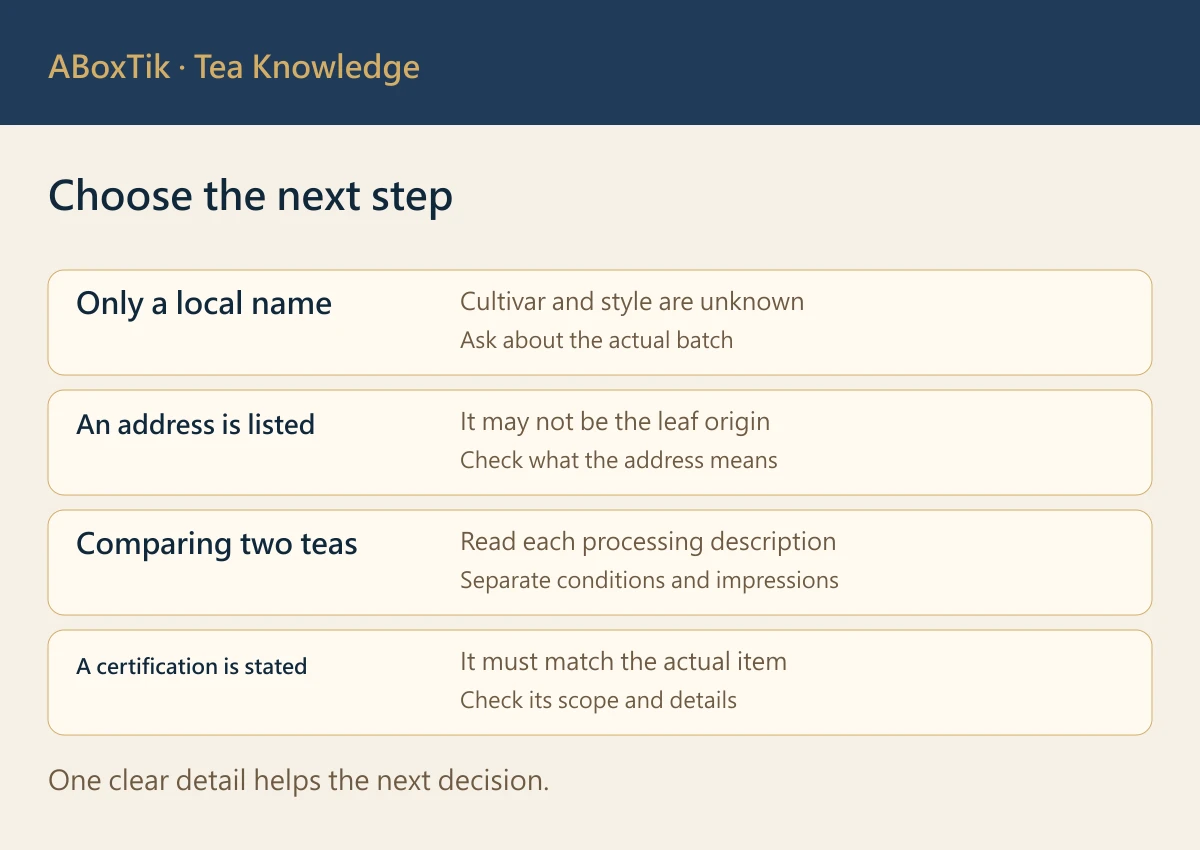
Imagine a package mentioning Yulan, Jin Xuan and oolong. Read those as separate clues: a local name, a cultivar and a tea style. If one of those fields is missing, leave it open and ask about the specific product and batch. A clear blank is more helpful than a confident guess.
Getting to know Yulan and Suxin
Yulan is in Datong Township. Official agricultural information describes the Yulan leisure agriculture area and its tea gardens. The local name helps locate a tea-growing community; it is not itself a cultivar. When comparing products, look for the type of tea, the shape of the leaves and any explanation of roasting or processing.
Suxin is a local name associated with Dongshan. Taiwan's Tea and Beverage Research Station identifies cultivars grown in Yilan including Tai Cha No. 12, commonly called Jin Xuan, Tai Cha No. 13, known as Tsui Yu, and Qing Xin Oolong. It also describes Suxin black tea made from small-leaf cultivars. That is a useful introduction to the region, not a substitute for the label on an individual package.
For Shangjiang and Wufeng, the same habit helps: keep the local name, cultivar, tea style, harvest and producer in separate fields. If details are missing, a short question gives a seller room to answer: “Where were the leaves for this batch grown, and what cultivar and processing style were used?” Include the product name and batch if available so the answer refers to the right tea.
Does rainy weather determine the flavour?
Rainfall, humidity, temperature and terrain provide context for a tea garden. Cultivar, harvest, withering, oxidation, drying and roasting also play a part in the finished tea. Gardens and seasons differ, so Yilan's rainy setting alone cannot predict one fixed flavour or quality for every tea made there.
Begin with the producer's description, then make room for your own observations. Use a consistent vessel and brewing approach when comparing two teas, and note the aroma, strength and changes you would like in the next cup. If the teas differ in cultivar or roasting, write that down too. Weather has an interesting role in the story; it need not take credit for every difference in the cup.
For a simple comparison, prepare only as much as you want to drink. Follow each tea's own directions first, then record the amount, water, vessel and steeping time. If the result is stronger than expected, change one condition in the next preparation and record it. A lighter cup can make it easier to notice aroma, while a longer infusion may suit someone who prefers more intensity. Those are choices for the next cup, not tests that prove origin or grade.
When two packages describe different harvests, keep each label with its notes. A spring harvest from one producer and a winter harvest from another contain several differences at once. Enjoy the contrast without assigning it to one cause; the record becomes more useful as details accumulate over time.
A label-reading checklist
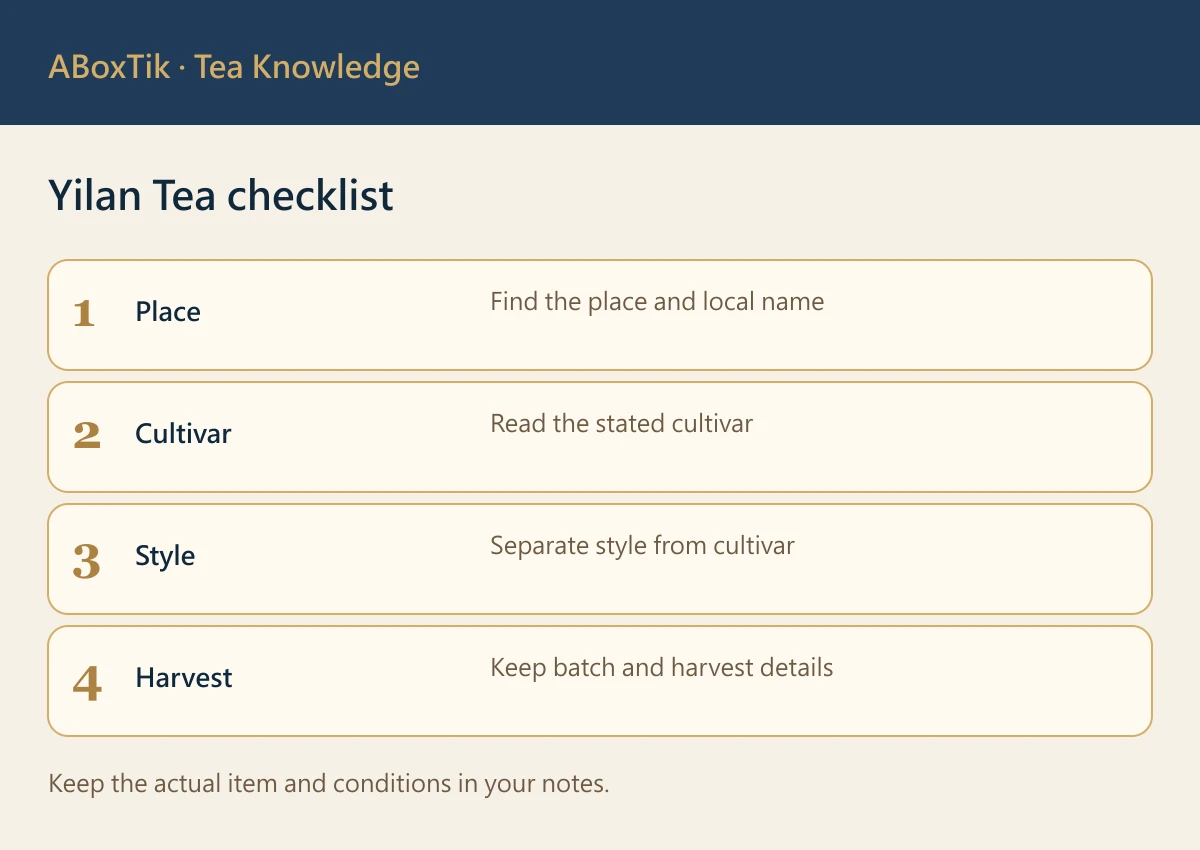
- Place: Does the package name Taiwan, Yilan, a township, a local tea area or a producer? A packing or dispatch address is not necessarily where the leaves grew.
- Cultivar and style: Jin Xuan and Tsui Yu are cultivar names. Black tea and oolong describe tea styles. Keeping the two fields separate makes comparisons easier.
- Harvest and batch: If a year, season or batch number is provided, save the full details alongside the product name.
- Processing and storage: A description such as lightly roasted can help frame expectations. Once opened, follow the package directions and protect the tea from moisture, sunlight and strong odours.
- Supporting evidence: If a product makes an organic or origin claim, check the documents or official lookup relevant to that particular item. A place name is not a certification.
Rather than buying every local name at once, start with a manageable quantity of a tea whose information is clear. Someone who enjoys a fresh, floral direction might ask for a lightly processed option; someone who prefers roast or black tea can ask what is currently available. The goal is a cup that suits the table, not a complete collection of labels.
Make a four-field tea card
Take a package and fill in four spaces: place name, cultivar, tea style or processing, and harvest or batch. Add a fifth: one question to ask. Leave unknown fields blank until the package, producer or an applicable traceability source supplies an answer.
After brewing, keep tasting notes in a separate space: “The aroma reminds me of ___; the strength is ___; next time I would ___.” Everyday words are welcome. Keeping facts and personal impressions side by side makes the next purchase easier without asking either to do the other's job.
Frequently asked questions
Is Yulan a tea cultivar?
Yulan is a local tea name associated with Datong in Yilan. Check the individual product for its cultivar.
Is every Suxin tea a black tea?
Official sources describe Suxin black tea, while Suxin is also a local name. Read the particular product's tea style and processing details.
Do all Yilan teas taste alike?
No single flavour follows from the place name alone. Cultivar, season, processing and brewing all shape the result. Compare the information provided and make a note of what you enjoy.
Is Yilan tea automatically organic?
Yilan has examples of organic tea farms, but that does not establish certification for every tea from the county. Check the claim and relevant evidence for the specific product.
Let a place name lead to a better question
One local name can lead to a township, a producer, a cultivar and eventually a cup with its own character. The next time a Yilan tea reaches the table, take a moment to notice its aroma and write down one detail worth asking about. That small record is a comfortable place to begin a personal map of Taiwan tea.
Related reading