
Tea Knowledge
Fair Tea Trade: Questions About Direct Sales and Purchasing Terms
Between garden and table, people do the work and carry responsibilities. Clear questions about prices, payments and cooperation give a thoughtful purchase somewhere practical to begin.
Fair tea trade involves looking beyond the sales route. Buying directly can make it easier to learn who grows your tea, but the word “direct” does not by itself establish that a transaction is fair. Ask who trades with whom, what level a price refers to, when payment is made, and who bears the costs or risks of processing, delivery and returns. “Support small farmers” is a warm invitation; specific questions give that warmth somewhere useful to go.
Not every individual contract will be public. A good starting point is the product’s origin, the relationship between partners and the information they can share. A supplier may have limits on disclosing individual commercial terms. Keep track of what is known and leave the remaining fields open rather than guessing.
fair tea trade: Direct describes a route; fairness depends on the terms
“Direct” might mean a grower ships to the customer, or that a brand buys from a grower and then arranges processing, packaging or delivery. Ask what the term means for the specific tea. Processing, transport, quality work and sales may involve different people and costs. Counting the number of hands in a chain is not enough to judge its fairness.
Imagine one arrangement in which a farmer packs and ships an order, and another in which a partner handles packing and logistics. Even if the shelf prices match, the work, expenses and payments may differ. This is a comparison of questions, not a description of any particular brand’s agreement.
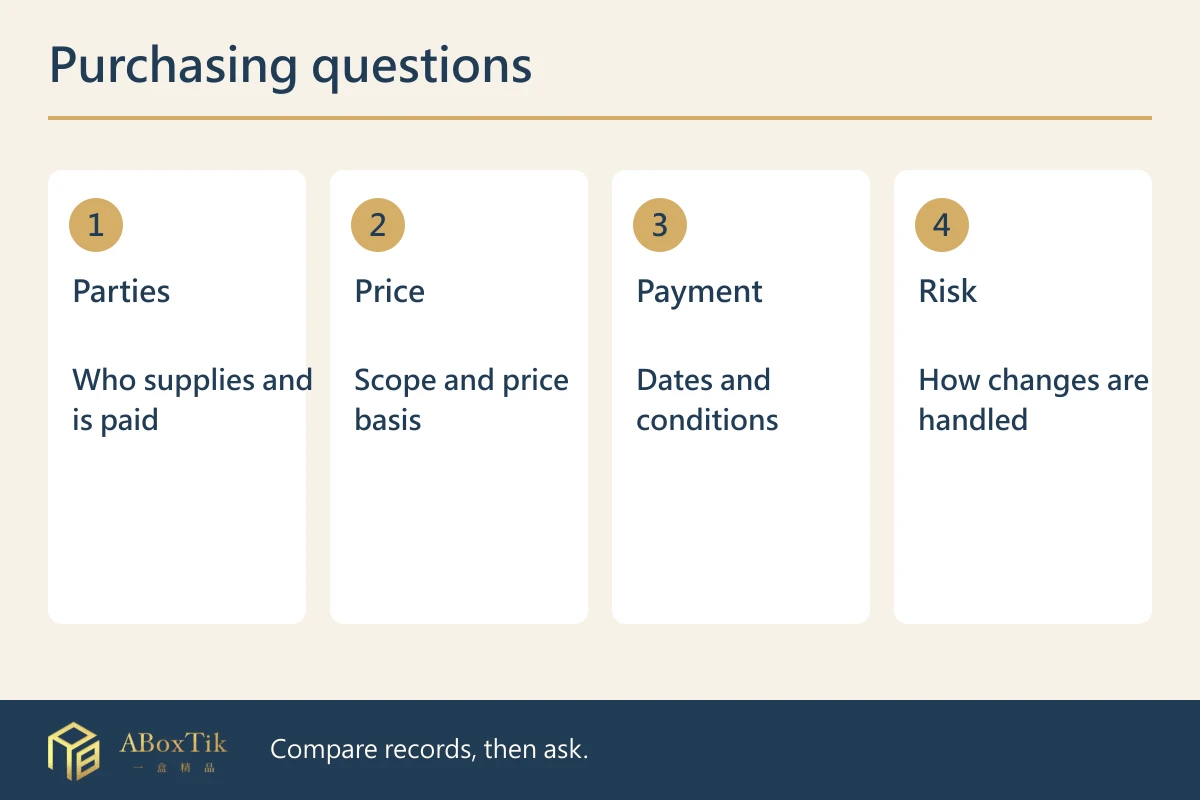
A practical trading-terms question card
| Question | Why it helps | What to note |
|---|---|---|
| Who trades with whom? | Growers, makers, producer organisations and sellers can be different parties | The transaction level and each party’s work |
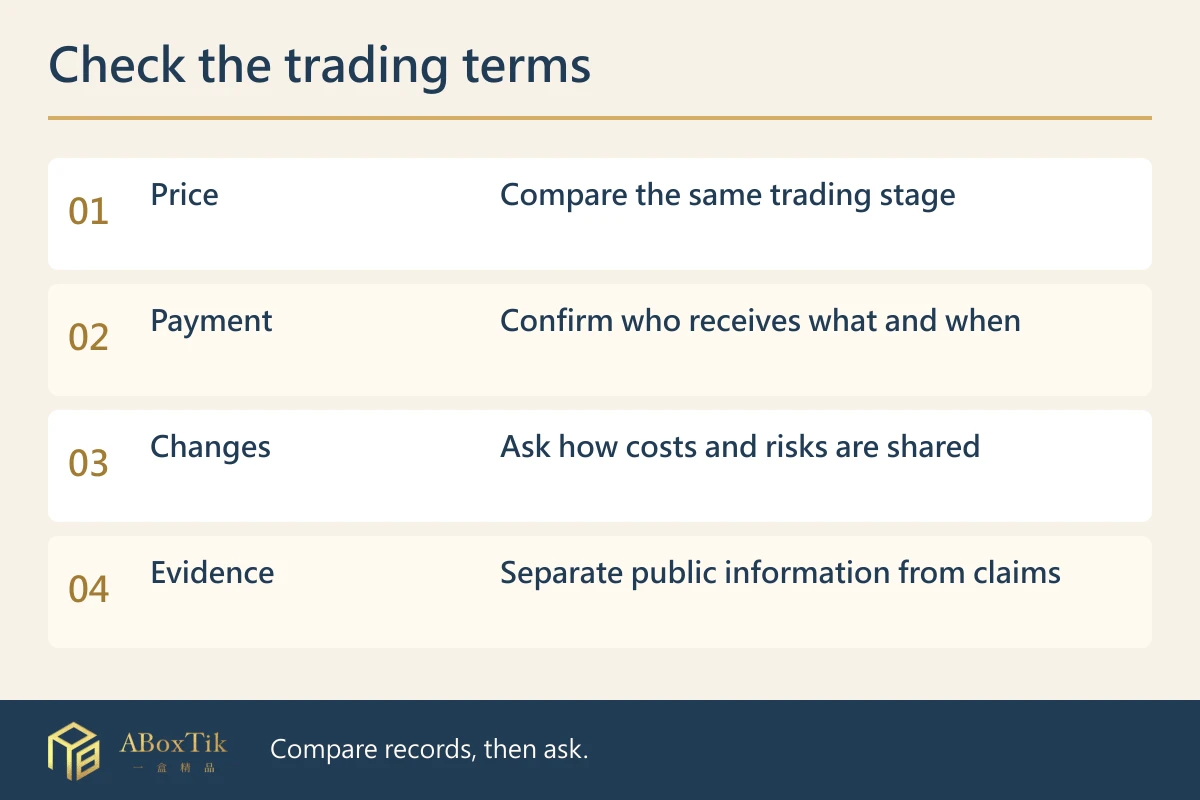
| What does the price refer to? | Retail price, payment to an organisation and individual farmer income are different figures | Product, unit, date and point in the chain |
| When is payment made? | Timing affects the producer’s planning | The agreed timing and method |
| Who bears which costs? | Processing, packaging, freight and returns may be allocated differently | Tasks, costs and responsibilities |
| How are quantity and quality agreed? | Changes, acceptance and unsold quantities need prior discussion | Agreed terms and how changes are handled |
| Which batch does the information cover? | One arrangement may not describe every product | Product, batch and date of information |
The card helps make questions answerable; it does not ask a shopper to grade a private contract. If a supplier can explain some fields, you have a more useful basis for comparison. Where detail cannot be shared, record the limit instead of filling it with assumptions.
Does a higher retail price mean the farmer receives more?
The shelf price alone cannot tell you. Making, packaging, logistics, retail and other work can sit between the garden and the customer. If a price is disclosed, check the product, unit and transaction point, and what expenses are included.
Fairtrade’s living income reference price FAQ distinguishes farm-gate and export-level prices because they cover different costs. It is a useful reminder not to equate figures from different points in a chain. That explanation concerns a particular pricing tool; it does not mean every tea uses the same price or scheme.
What can a label tell us?
When a product claims third-party certification, check the name, the product covered and the relevant valid information, then read what that particular scheme requires. Schemes do not all mean the same thing. Without a label, you can still ask about sourcing and trading terms; its absence alone does not establish unfairness. Nor can a beautiful garden photograph answer every question about a transaction.
For the separate question of origin and product information, explore our tea traceability guide. For environmental claims in purchasing, see corporate ESG tea gifts. Origin, environmental claims and trading terms are connected, but each answers a different question.
Take one clear next step
Choose a tea you would enjoy, read how the product page describes its origin, and ask a specific question if you want to learn more: “Who grows and makes this tea, and who supplies it?” Note the product and date when you receive an answer. Use what can be confirmed and return to the open questions later.
A conversation about fairness can begin over tea without reaching a verdict on an entire supply chain before the cup is empty. Clear questions leave room for the people and work behind it.
Compare two direct-sale arrangements by the work involved
In one hypothetical arrangement, the producer takes the order, packs the tea and sends it. In another, the producer supplies tea while a partner handles packaging, customer service and dispatch. List the work in each arrangement before comparing the route to the customer. An additional participant does not by itself establish unfairness, just as fewer participants do not remove the extra work a producer may have taken on.
Before comparing money, align the weight, product form, transaction stage and period. Unfinished tea, refined tea and a finished retail gift box include different work. If one figure is a payment received by a producer organisation and another is a retail box price, keep them in separate fields. They are not enough to calculate an individual farmer’s share. Missing cost and distribution information cannot be supplied by a product photograph.
Sort a reply into confirmed, open and unsupported conclusions
Keep the product, date, source and scope with each reply. If the information confirms which organisation supplies and dispatches a batch, retain that specific statement. If payment terms were not supplied, leave them open. Confirmed origin information does not automatically establish labour conditions, income or every aspect of a relationship. Asking about one field at a time can make the conversation easier to continue than sending a long questionnaire without explaining its purpose.
An individual customer and a procurement team also have different jobs. A customer can begin with public product information and one specific question. A business planning to use a purchasing claim in a report, card or product description should have its responsible person check the evidence, product and period first. A supplier may have limits on disclosing individual commercial information. Record that scope; if a field is essential to the project, explain what information is needed and who will review it.
For a procurement project, keep corporate tea-gift quantity records, tea-gift budget fields, customisation versions and approvals and a procurement handover beside the source questions. tea origin and growing context and labelling and traceability provide different kinds of background. gift formats and recipient needs and sharing different tea styles help decide how the tea will actually be used.

Follow ABoxTik
A clear next step towards a cup
Start with a tea whose flavour and format suit the person who will use it, then read the source information and ask the question that matters to the choice. ABoxTik offers Taiwanese tea in formats for everyday drinking and sharing. Clear product information helps the conversation begin; any further sourcing question should be answered for the actual product and scope involved.
Related recommendations
Sources
, accessed 4 November 2026: Fairtrade International: Trader Standard; Fairtrade: Living Income Reference Price FAQ.