
Tea Knowledge
Corporate Gift Card Messages: Bilingual Examples and Tone

A small card gives a thoughtful gift a clear voice.
An effective corporate gift card answers three questions: why the gift is being sent, what the sender wishes to express, and who it is from. For a bilingual card, establish one shared meaning first, then write naturally in each language. The note does not need to summarise the entire business relationship; it only needs to help the recipient understand the thoughtful gesture in front of them.
Start with the occasion. Is the gift a year-end thank-you, a seasonal greeting, or a gesture for a first meeting? Each calls for a different level of familiarity. Check the recipient organisation's gift policy through the appropriate contact before arranging delivery. Confirm names and titles rather than guessing: a small card has quite enough work to do already.
Four fields for one clear message
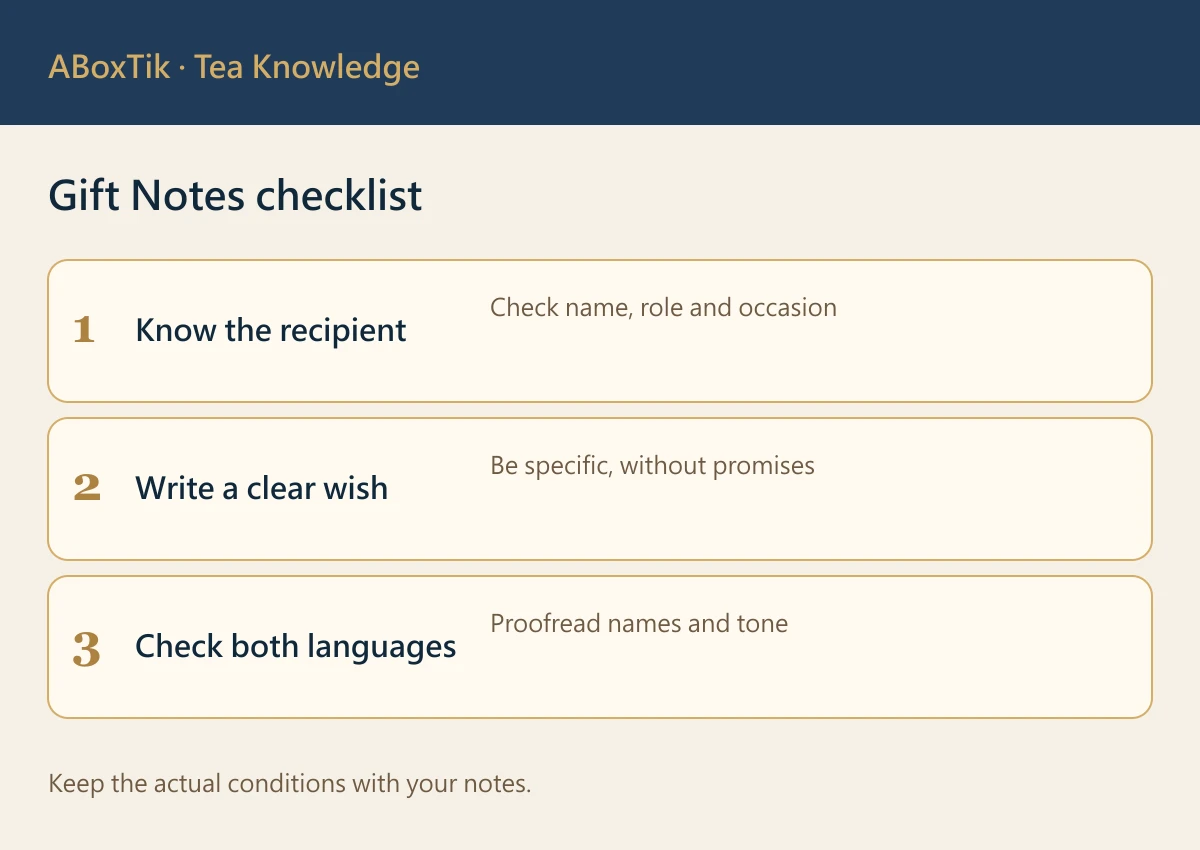
Use four fields: the recipient's preferred form of address; the occasion or a specific shared experience; one genuine sentence of thanks or good wishes; and the approved company or team signature. Both languages should communicate the same occasion and relationship. They do not need identical word counts. If the parties have only exchanged introductions, thank them for the conversation rather than describing a partnership that has not yet begun.
Three situations to adapt
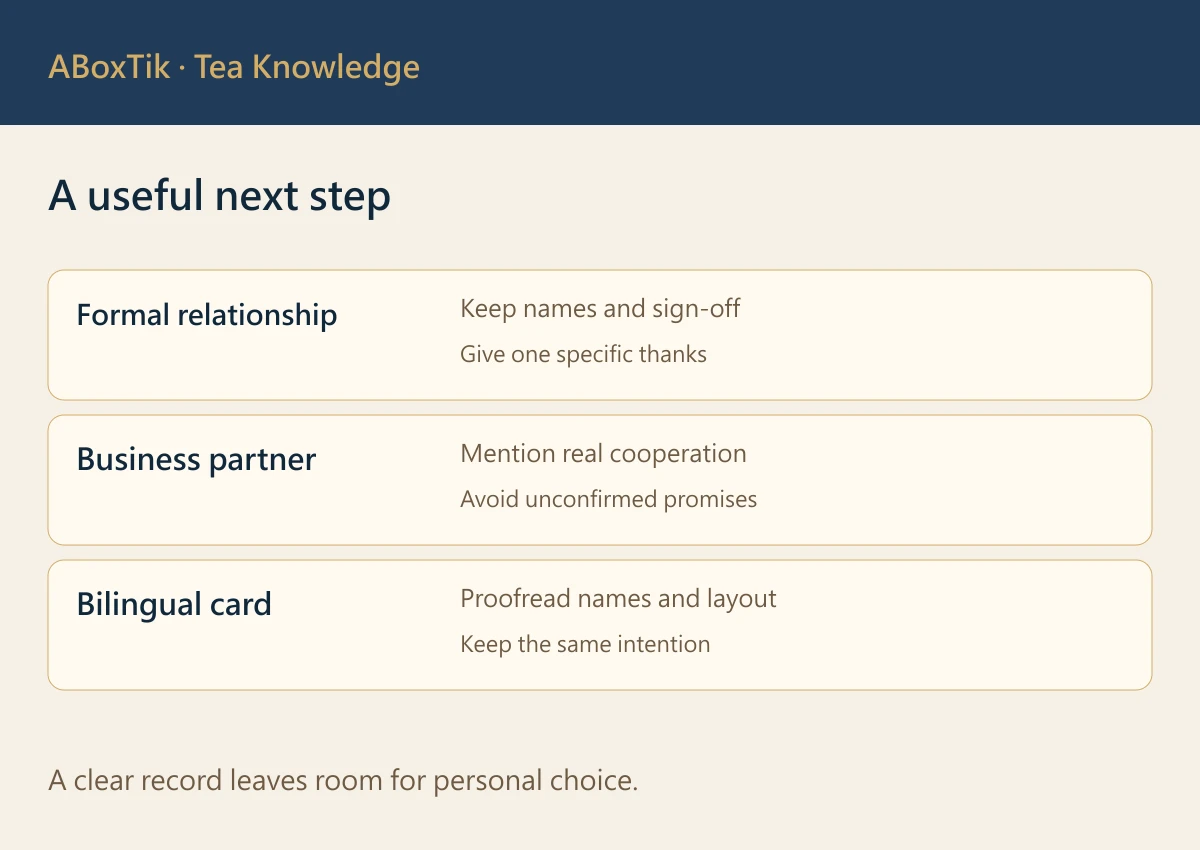
For year-end thanks, consider: “Thank you for the conversations and collaboration this year. Please enjoy this selection of Taiwanese tea, with our warm wishes for the year ahead. From the team at [company].” Use “conversations” alone if there has been no collaboration. The corresponding Chinese version can thank the recipient for the actual interaction and offer a simple wish for the coming year.
For a seasonal greeting: “Wishing you and your team a lovely holiday season. We hope you enjoy this tea together. With warm regards, [company].” Check the occasion and the recipient's context first. A neutral seasonal greeting can be more suitable for a mixed international audience than a specific holiday assumption.
For a first meeting: “It was a pleasure meeting your team. We hope you enjoy this Taiwanese tea and look forward to staying in touch. Warm regards, [company].” If the meeting has not happened yet, change the first sentence to reflect the actual timing. A template should never supply a fact the sender has not confirmed.
When a specific shared moment is appropriate, replace generic praise with one detail both parties recognise: a discussion, a visit, or an agreed project milestone. Check with the relationship owner before naming a client or revealing project information. If the detail is confidential or uncertain, a warm general sentence is perfectly sufficient.
Give both languages room
Give each language enough space to stand alone. Separate the salutation, body and signature. In English, “With warm regards” or “From the team at…” can lead naturally into the approved organisation name. Have someone familiar with each language read the final card aloud. Check that the meaning is consistent, the tone suits the relationship, and names, capitalisation and punctuation match the approved records. Translation software can help with a first pass, but the responsible team should confirm the final wording.
For multiple recipients, assign a version code to each message and match it to the controlled recipient list. For example, version A may contain a shared seasonal greeting and version B a project-specific note. Record personal names separately, nominate one approved proof, and check a sample of printed cards against the list before packing. The aim is not to create a new administrative project; it is to make the right note easy to find at the right moment.
Fill facts, not assumptions
Turn the template into an approved card by dividing blanks into three groups: information that must be supplied, details that are optional, and facts that must never be guessed. The company name belongs in the first group; a reference to a particular meeting may be optional; an unverified title or assumed project milestone belongs in the last. Mark missing information for the relationship owner to check. This allows a team to reuse a structure while keeping each personalised detail traceable.
Imagine a batch of gifts for two teams. One helped with an exhibition; the other exchanged introductions for the first time. The first note might mention assistance during the exhibition. The second could say it was a pleasure to have the conversation. The tea can be the same while the notes differ. The English and Chinese versions should reflect the same distinction; a neat layout is not a reason to copy one team's history onto another team's card.
Choose a signature that matches the sender. A company-wide gift should use the approved company name. A department can include its name alongside the organisation when appropriate. An individual sender should be identifiable to the recipient. A team signature such as “From the team at [company]” can be both clear and warm; there is no need to invent an impressive-sounding title for the English side.
Check the proof at its actual size
Ask the printer for the actual card dimensions, usable area and any text limits. Chinese and English occupy space differently, and English line breaks can change a layout considerably. Put both languages into a proof at the intended size and check the type, spacing and signature for legibility. If the text is too long, remove repeated wishes first and retain the occasion and sender. Tiny type is a poor substitute for a shorter, thoughtful sentence.
A simple version table can record the code, language, approved wording and approval date. Keep recipient names and version codes in the controlled recipient list. If each card includes a personal name, proof a sample before printing the batch. When wording changes, issue a new version and tell the packing team when to stop using the old one. A version code helps the correct note travel with the correct box; it does not need to expose a private recipient list to everyone involved.
Match the card to the box
During the final check, put a sample card beside its gift box and shipping label. Compare the recipient, message version, signature and orientation. If a name is unconfirmed, set that gift aside and ask the list owner to resolve it. A short pause before packing is kinder than asking the recipient to discover a mistake while opening a gift.
For recipients in several regions, check how each team actually writes its name and how it prefers to be addressed. If an individual form of address is uncertain, ask the relationship contact whether the team name is suitable. A card intended for a shared office can be addressed to the team, while the delivery label carries the separately verified recipient details. Each piece of information then has a clear purpose.
Keep the approval record useful after printing. Save the final wording, version code, date and person who approved it with the campaign materials, according to the organisation's own retention practices. When the next occasion arrives, use it as a starting point rather than automatically reusing last year's reference. A new message should describe the relationship and event as they stand now.
Let a thank-you stay a thank-you
Read the finished card once more for unintended pressure. If the purpose is to say thank you, there is no need to ask for an immediate response or promise a future result. Confirm the tea selection, quantities and delivery separately against current product information and the recipient's circumstances. A clear card lets the recipient understand where the gesture came from before the box is even opened.
| Field | Confirm before printing |
|---|---|
| Recipient | Approved name, title or team |
| Reason | An actual meeting, occasion or collaboration |
| Message | One sincere wish; no invented promise |
| Sign-off | Confirmed company, department or sender |
| Version | Approved wording, language and date |
Related reading and tea choices
Sources
Sources checked: 29 October 2026.