
Tea Knowledge
Corporate Tea Gift Quotes: A Like-for-Like Comparison
Put each figure beside its conditions, and thoughtful gifting becomes easier to discuss.
A corporate tea-gift comparison sheet should align contents, quantities, customization, tax, freight and delivery conditions before ranking totals. A low unit price that excludes cards, proofs or distribution is not directly comparable with an inclusive quote. Ask all three suppliers to answer the same fields, then let the team decide which differences matter.
Opening three quotations can feel like being offered three different pots of tea, each described as “about the same.” The buyer does not need to guess which description is closest. Give each number a unit, scope and version, and the discussion becomes much easier to follow.
Write one common requirement before comparing suppliers
Begin with the project purpose, delivered quantity, recipient situation, desired arrival date, number of locations and essential contents. If quantity remains uncertain, request the same comparison bands from each supplier. A large-volume price should not compete silently against another supplier’s small order. The quantity planner and budget guide can establish those inputs.
Separate essentials from options. A bilingual card may be necessary while printing the outer box is optional. If both sit in a vague “customization” field, suppliers can price different versions without realizing it. The aim is to compare delivery of the same need, while preserving meaningful differences between gifts.
Put three quotations into one sheet; blank does not mean free
| Common field | Each supplier fills in | Comparison check |
|---|---|---|
| Tea and inner packs | Tea names, net weight, bag count and inner packaging | Separate boxes, bags and grams. |
| Box and accessories | Box, carrier bag, card and instruction language | Check whether photographed accessories are included. |
| Custom work | Print location, colors, dimensions and proof rounds | A logo request can represent different work. |
| One-off charges | Design, samples and setup | Record any reuse terms. |
| Delivery | Locations, freight and allocation packaging | Central delivery differs from multiple addresses. |
| Tax and payment | Tax basis, payment milestones and invoice requirements | Use the written quotation. |
| Timing and validity | Starting conditions, arrival and quote expiry | Artwork, approval and payment can affect the start. |
| Exclusions and questions | Item, owner and reply date | An omission is not a zero-cost promise. |
For tea bags, check whether “two” or “four” describes box positions or individual bags. The assortment guide helps interpret the units. The whole-leaf tea bag guide and gift selection guide add context about form and use. Weight and count answer quantity questions; they do not establish quality on their own.
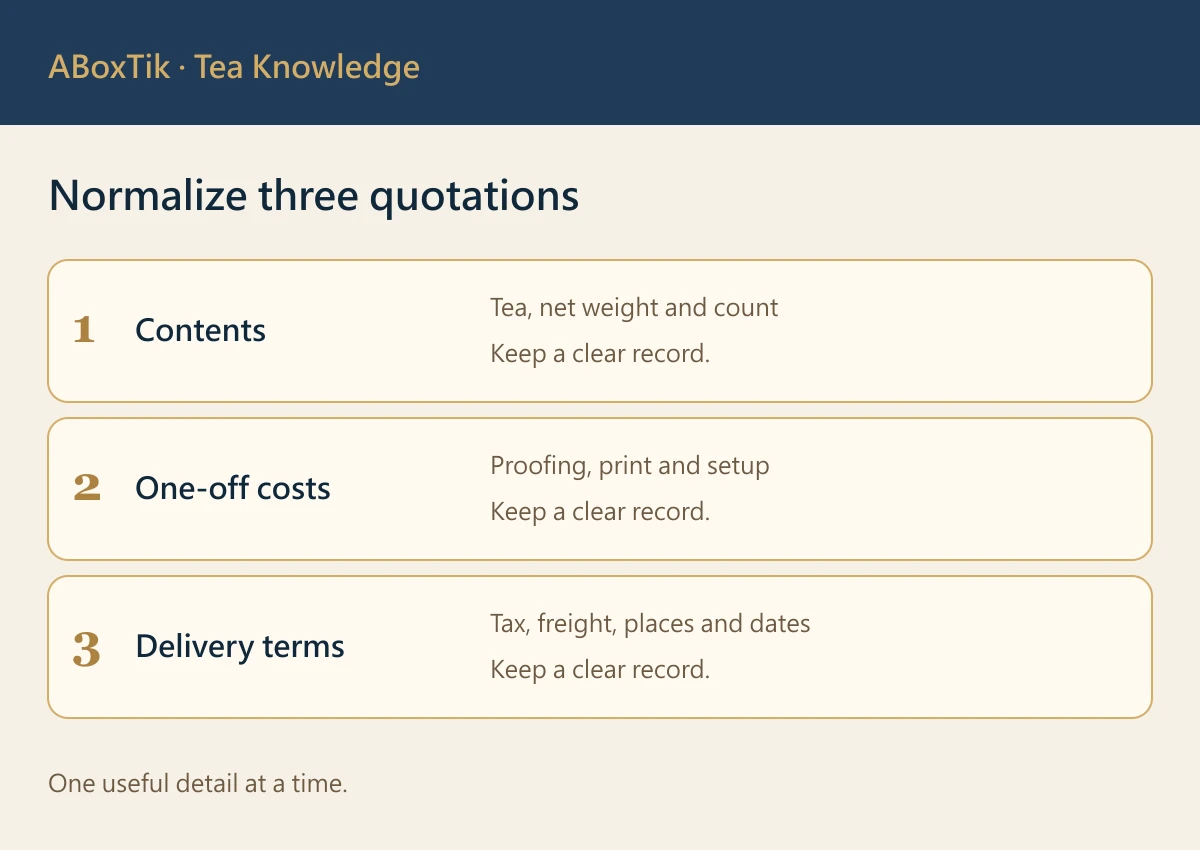
Calculate total cost first, then cost per delivered gift
The first calculation is a comparable project total: gift subtotal plus confirmed customization, proofing, freight and other charges. Establish whether tax is already included before adding it, so the sheet does not count it twice. The second calculation divides that full total by the actual delivered quantity. Leave unresolved items visible rather than entering zero to make the spreadsheet look complete.
Here is an arithmetic example only. Suppose one hundred gifts have a subtotal of thirty thousand dollars, with three thousand in one-off charges and two thousand in delivery. If all those illustrative amounts use the same tax basis, the project total is thirty-five thousand and the cost per gift is three hundred and fifty. These are invented worksheet inputs, not a market quotation. A lower competing total that omits cards needs a written supplementary figure before comparison.
If a setup charge might be reused, include the real expenditure in this order first. A separate future-order scenario can show the possible effect of reuse without discounting today’s bill with orders that do not yet exist. The customization timeline and logo guide help connect charges with the work being requested.
Ask what starts the delivery clock
“Production begins after confirmation” needs a subject. Is that confirmation of tea, quantity, artwork, a proof or payment? Put the latest internal approval date beside the desired arrival date, then request feasible milestones in writing. Production days alone may omit the time spent exchanging proofs and arranging freight.
For multiple addresses, ask about the data deadline, allocation labels, quantities per batch and project contact. A comparison can begin with regions and address counts; there is no need to distribute every recipient’s personal details merely to obtain an initial estimate. Supply only the information needed at the appropriate delivery stage.
The overseas corporate gift guide covers additional cross-border questions. Domestic delivery conditions cannot simply be copied into an international project. Record the actual destination and the party responsible for confirming the applicable arrangements.
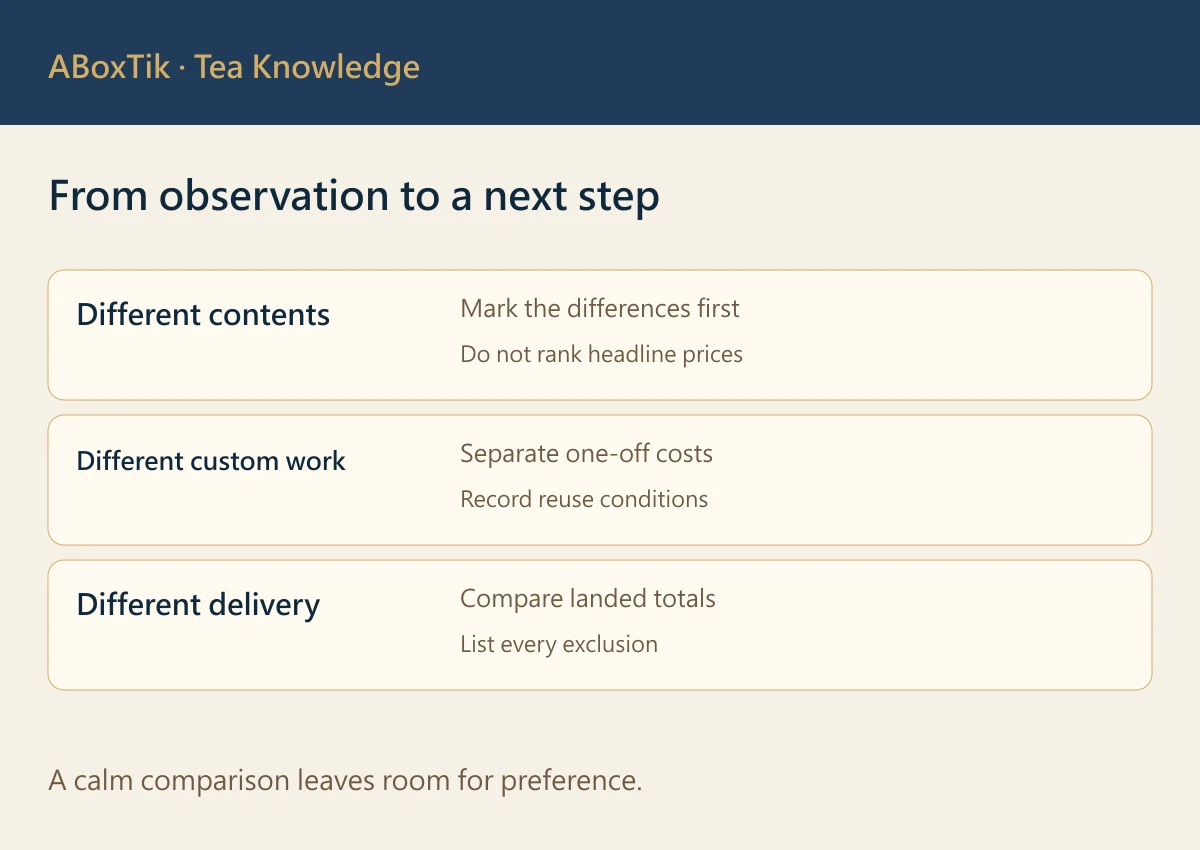
Use the final questions to create a decision record
A short follow-up can say: “For a like-for-like comparison, please confirm whether this total includes ___. If quantity becomes ___, which charges change? Which approval starts the lead time?” Resolve the blanks together rather than repeatedly asking only whether the price can come down.
Save each reply with its date and version. Mark proposals that do not meet essentials and explain why, then compare the remaining contents, timing, working arrangements and cost. The selected proposal may not be the cheapest, but the team should be able to explain what the additional spending provides.
A useful record also identifies who accepted each trade-off. If one box style is preferred despite a longer approval process, write that decision beside the deadline. If the team chooses centralized delivery, remove obsolete multi-address assumptions from the final request. Otherwise, an old attachment can quietly reverse a perfectly sensible meeting decision.
Before confirming an order, read the chosen version from top to bottom as though you had not attended the discussions. Do the quantity, card language, print scope and destination still agree? A comparison sheet supports judgment; it should not leave the supplier to reconstruct the project from several conversations.
Pause for a version check when the offers change
Suppose one supplier includes a standard printed card, another a blank card, and the third bilingual layout work. All three might write “card included.” Describe the work in the difference column before requesting a common basis. If a blank card actually meets the requirement, additional layout can remain optional rather than becoming a service purchased only to make the table symmetrical.
Quantity changes need the same care. Moving from one hundred gifts to ninety does not mean every charge falls by ten percent. Some costs follow quantity, some cover fixed work, and others depend on packaging or delivery. Ask for an updated written version and mark the old attachment as superseded so a colleague does not forward it accidentally.
Leave two sentences in the decision record: “We chose this option because ___” and “We still need ___, with a reply from ___ by ___.” That is more helpful than a supplier name alone. When the project changes hands, the next person can understand the reasoning without reopening three emails and starting the guessing again.
Follow ABoxTik: explain the thought and the scope together
For a starting format, review ABoxTik’s Classic Taiwan tea selection and two-box tea gift, then take the actual requirements to the contact team. The Taiwan tea introduction may help define what the gift should communicate.
Filling one sheet and circling three open questions is already a useful next step. Common assumptions give the numbers a fair basis and give thoughtful gifting a clear route through the attachments. The person managing procurement deserves a cup they can finish, too.

Related reading and tea choices
Sources
- ABoxTik: current product and project enquiries
- Tea and Beverage Research Station: packaging and storage context
Sources checked: 24 October 2026.