
Tea Knowledge
How to Read Oriental Beauty Tea Regions: Hsinchu, Miaoli and Taoyuan
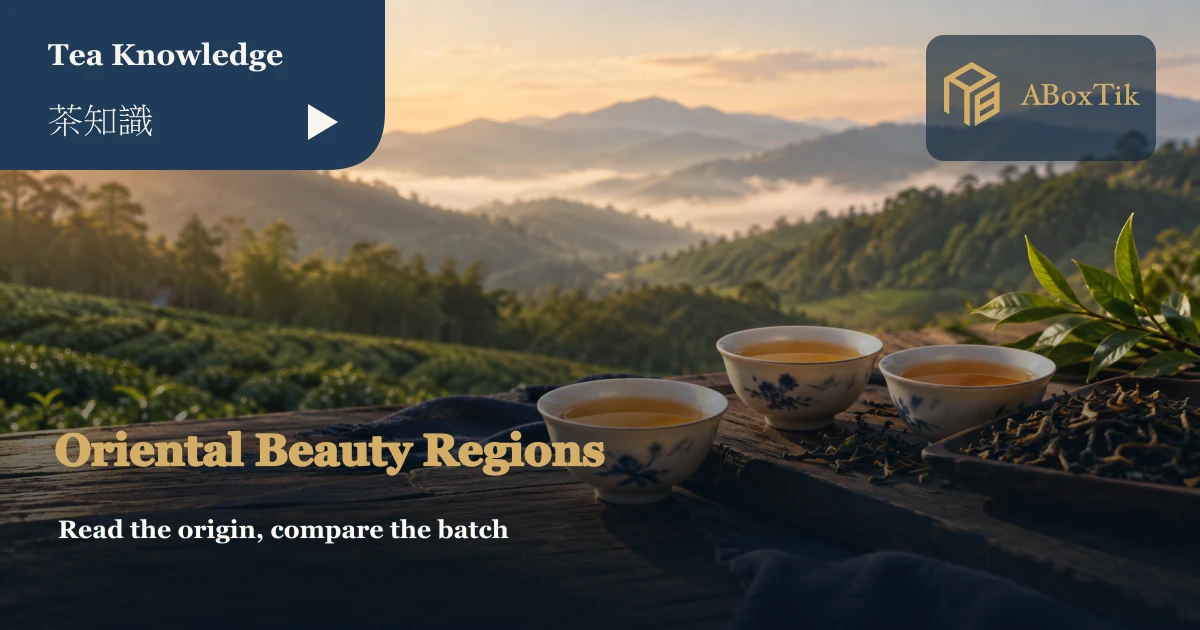
A region is a starting point for a tea conversation, not a shortcut to a verdict.
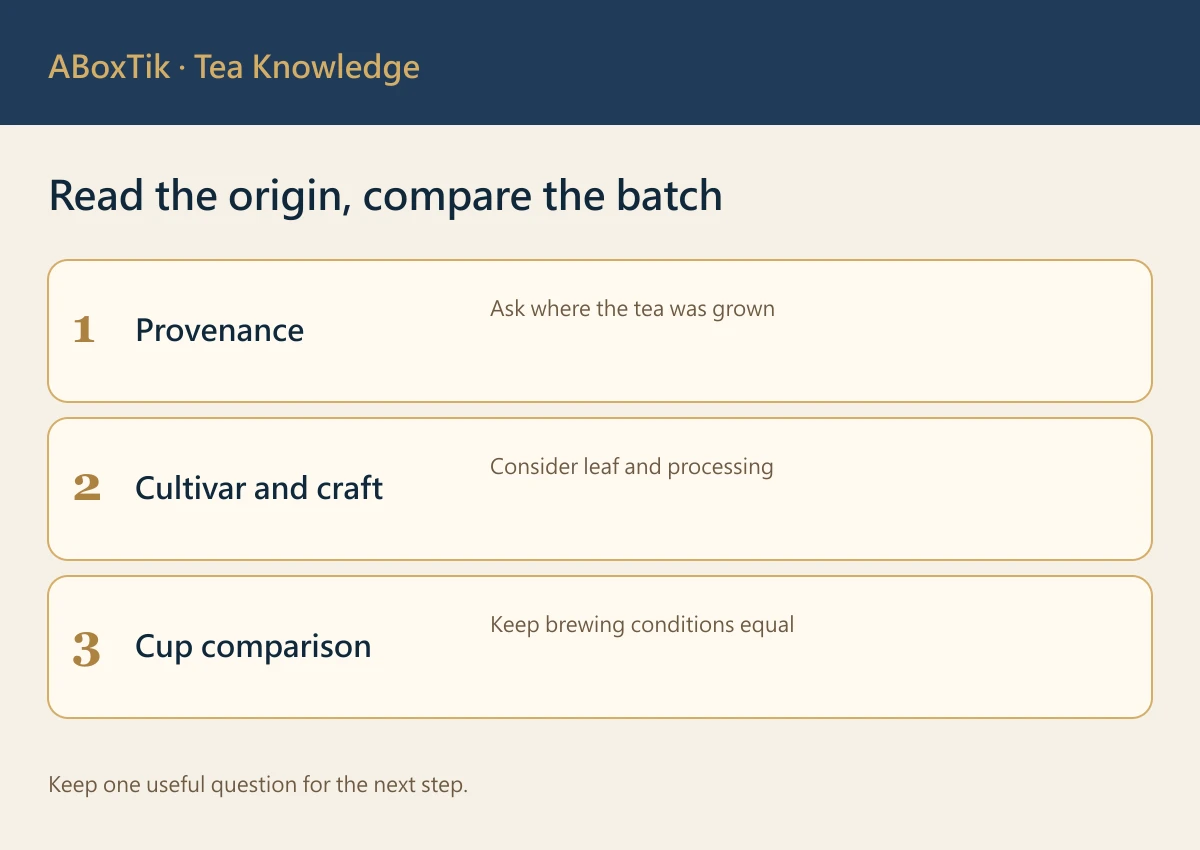
Oriental Beauty tea regions are best read as a set of useful questions, rather than a fixed ranking of Hsinchu, Miaoli and Taoyuan. Ask where this lot was grown, which cultivar and season it carries, and who made it. The Taiwan Tea Research and Extension Station names Longtan in Taoyuan, Beipu and Emei in Hsinchu, and areas around Toufen and Tongluo in Miaoli among the principal production areas. Those names locate a tea; they do not guarantee that every packet will taste alike.
For a first purchase, write down the origin printed on the pack, any cultivar or garden information, and a lot or seasonal note. That modest record leaves room for a better next cup. It also stops a single impressive adjective from doing the work of an entire tea garden.
Read “region” and “this lot” as separate facts
Oriental Beauty, also called White-tip Oolong or Peng Feng tea, is commonly associated with Qing Xin Da Mao. Leafhopper-affected tender shoots, substantial withering, agitation and finishing all matter to the finished tea. Garden aspect, weather, leaf condition and the maker’s timing still vary from one lot to another.
A county name is therefore a beginning. When Beipu, Emei, Toufen, Sanwan, Tongluo or Longtan appears beside a cultivar, producer and season, the label becomes more useful for comparison. If those details are absent, leave the unknown field open instead of inventing a hillside in the mind.
A regional label works best when it helps you notice what is present in this tea today, including information the producer has chosen to share. That makes preference more practical and less theatrical.
| Pack wording | Useful question | Avoid inferring |
|---|---|---|
| Hsinchu Oriental Beauty | Which township and lot? | It is automatically finer |
| Miaoli Oriental Beauty | Which season and producer? | Every lot tastes identical |
Hsinchu: begin with Beipu and Emei
Hsinchu County’s Agriculture Department identifies Emei and Beipu as the county’s principal Oriental Beauty areas, and the Tea Research and Extension Station also lists them among the main regions. Their place names carry geographical and Hakka tea-culture significance, which makes them worth recording accurately.
Within either township, gardens and processing approaches can still diverge. Hsinchu appraisal information notes that entries may disclose single or multiple cultivars. A seller who can share cultivar, locality and lot information offers a practical basis for choosing; a waterfall of aroma words is pleasant, but less useful on its own.
A careful comparison does not require a grand verdict. It needs a clear note, a repeated brewing condition and enough patience to let a later cup disagree pleasantly.
Miaoli: make a broad label more precise
Miaoli is not a single cup. The Tea Research and Extension Station calls out areas around Toufen and Tongluo, while recent county appraisal information includes entries from Toufen, Sanwan, Tongluo, Gongguan, Touwu, Shitan, Sanyi and Tai’an. A county label has value, but township and producer bring it closer to the tea in hand.
An appraisal notice can show where named producers entered a particular year’s competition. It cannot endorse an unrelated packet. When a label says only “Miaoli,” keep it as a broad origin, then ask for the lot, garden or season and decide through a small tasting whether it suits your own routine.
Keep the place name, the maker’s details and your own sensory note in separate columns. They can sit beside each other without being forced to say the same thing.
Taoyuan Longtan: use a product note as a starting point
Longtan is also listed as a principal production area by the Tea Research and Extension Station. The Longtan Tea Promotion Website describes one Farmers Association Oriental Beauty through Qing Xin Da Mao shoots, leafhopper interaction and summer production. It suggests 80–85°C water and about 60 seconds for a first infusion.
That instruction belongs to a particular product, so it is a generous starting point rather than a law of nature. Another Longtan maker may specify a different leaf quantity or time. Use the pack’s own guidance first, make a small test infusion, then adjust one condition at a time. The cup need not pass an exam.
If the information on the pack is short, ask one focused question before asking for another aroma description. Specific answers are easier to remember and more useful on a return visit.
Honeyed character has more than one cause
It is tempting to give a place name full credit for a honeyed or ripe-fruit impression. The Tea Research and Extension Station instead connects leafhopper-affected shoots, withering, agitation, re-moistening and other processing choices with the finished leaf and liquor. Geography is one chapter in the story, not the entire book.
Perceived sweetness also changes with temperature and balance. “At a warm temperature I noticed a ripe-fruit-like sweetness” is a sturdy tasting note. “This county is always sweet” is a promise that one cup cannot make. Keeping those two sentences separate is rather like keeping tea leaves out of a keyboard: it avoids a surprising mess later.
The point is not to make tasting solemn. It is to give a good cup enough context that the next choice feels easier, even on an ordinary busy afternoon.
Compare two small samples fairly
A useful regional comparison begins by keeping other variables steady. Use the same gaiwan or pot, a similar leaf-to-water ratio, the same water temperature and a matched infusion time. Smell dry leaf, hot liquor and the cooling cup before deciding what the tea is trying to say.
If the two samples differ in cultivar or season as well as location, the contrast can still be enjoyable. Call it a comparison of these two teas rather than of two counties. That small choice gives each producer’s lot proper attention and stops one elegant cup from becoming an ambassador with an impossible workload.
When two variables change together, enjoy the result but avoid assigning all of it to geography. A notebook is allowed to say “interesting” before it says anything stronger.
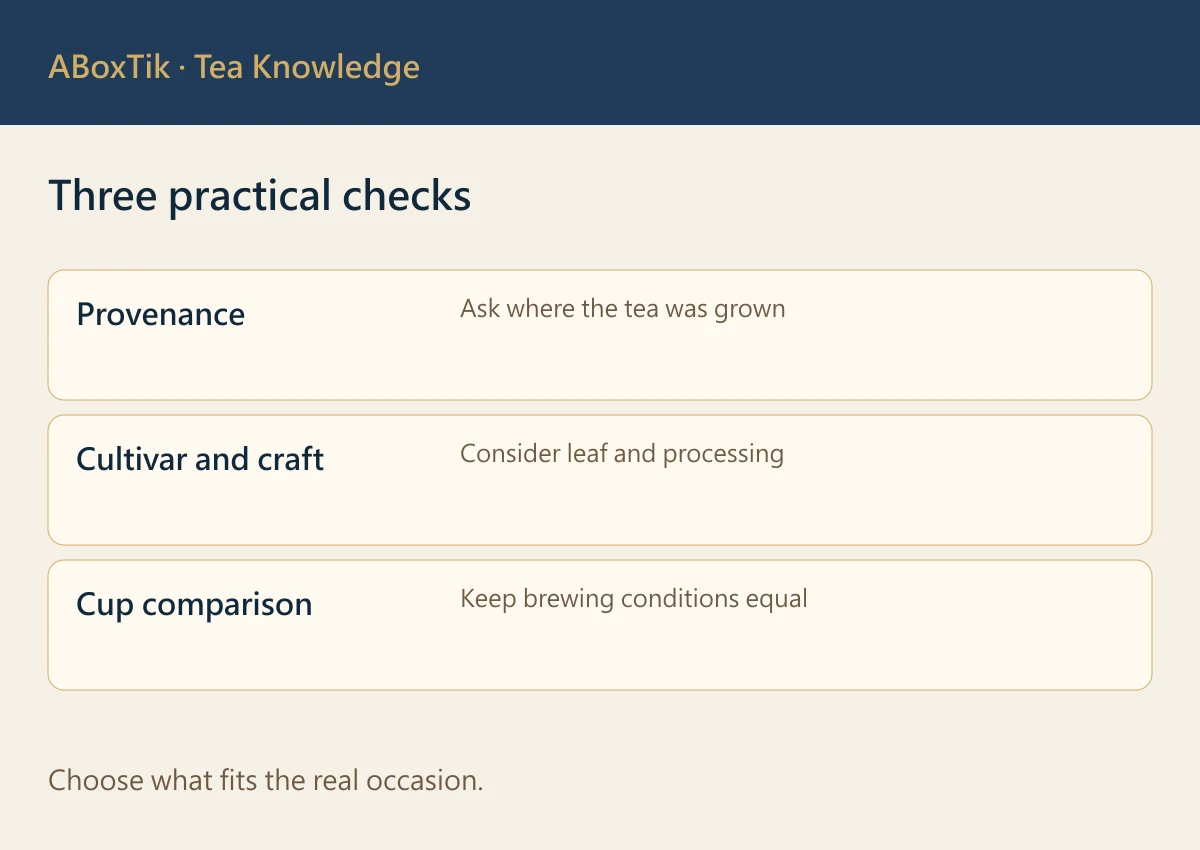
Bring three short questions to the counter
Ask a seller which township this lot is from, what cultivar and season were used, and what first infusion the maker recommends. These are brief questions, but each asks for something that can be checked. Once the answers are clear, consider quantity, storage and whether the tea works with the equipment already at home.
ABoxTik’s Oriental Beauty introduction adds tea-type and processing context, while the leafhopper and honey-aroma guide separates leafhopper interaction from flavour language. Keep one line for the label and one for the experience. The next purchase will then begin with recognition instead of detective work.
A seller’s brewing advice is a welcome first map. Your vessel, water and preferred strength will still draw the final route through the cup.
| Question | Helpful answer | If missing |
|---|---|---|
| Where from? | County plus township or garden | Record broad origin only |
| How to brew? | Product-specific guidance | Test a small infusion |

Follow ABoxTik
Let regional information lead gently to the next cup
At ABoxTik, a region gives tea a clearer beginning, not a fixed order. Start with a name, then connect cultivar, lot and your own experience.
Continue with Taiwanese tea terroir and craft and leave one question with the seller and one line in your notebook.
Related reading
- Meet White-tip Oolong through Oriental Beauty
- Separate leafhoppers, feeding and honeyed aroma
- Turn smelling into personal tasting notes
Sources
- Taiwan Tea Research and Extension Station: Oriental Beauty Tea
- Hsinchu County Government Agriculture Department: Summer Oriental Beauty tea appraisal
- Miaoli County Government: 2026 Oriental Beauty tea appraisal
- Taoyuan Longtan Tea Promotion Website: Farmers Association Oriental Beauty
Sources checked 21 October 2026.