
Tea Knowledge
Regenerative Tea Gardens: Soil Health in Practice
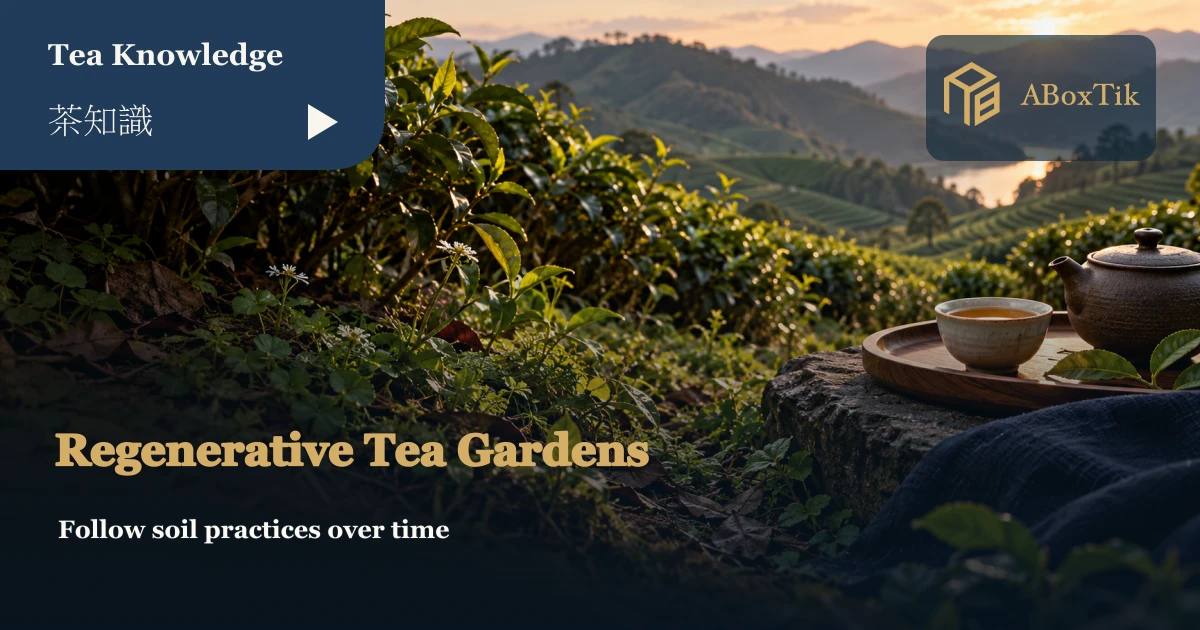
The story of a leaf can begin with a patient question about the soil beneath it.
Regenerative agriculture can inform questions about soil cover, unnecessary disturbance, nutrient management and diversity in tea gardens. Practices still need to fit slope, climate, crop and management capacity. To understand a claim, ask what was done, where, for how long and how it was assessed; a photograph of green groundcover cannot answer all four.
This guide helps readers examine management information and evidence. It is not a universal cultivation prescription or a shortcut from a term to certification. Concern for land can begin with one practical question: how is this particular practice observed and maintained?
Begin with the management direction
FAO presents regenerative agriculture as a holistic approach concerned with restoring land, soil and biodiversity. In a tea garden, that offers a direction for questions, but the actual practices still need describing. The term does not supply an outcome for every field by itself.
Regenerative, organic, friendly and low-carbon language may appear together while requiring different supporting information. Reading low-carbon tea information and tea garden biodiversity explore separate questions. Grass between rows should not automatically add several unverified labels to a product.
A consumer need not qualify as a soil scientist before asking. Translate an abstract term into an ordinary question about ground management or records of change. That gives the conversation a concrete place to begin.
Soil cover: ask about material and maintenance
Living cover and plant-residue cover are different arrangements. FAO’s conservation agriculture information relates cover to soil-surface protection, water and nutrient cycling while also discussing management and competition. An arbitrary mass of vegetation should not therefore be assumed to complete a suitable system.
Slope, drainage, working routes, tea plant needs and labour all belong in a real garden’s plan. The tea station’s establishment guidance discusses practical drainage and cover considerations too. Managers need field-specific advice; visitors should not remove plants, add material or walk into planting rows on their own initiative.
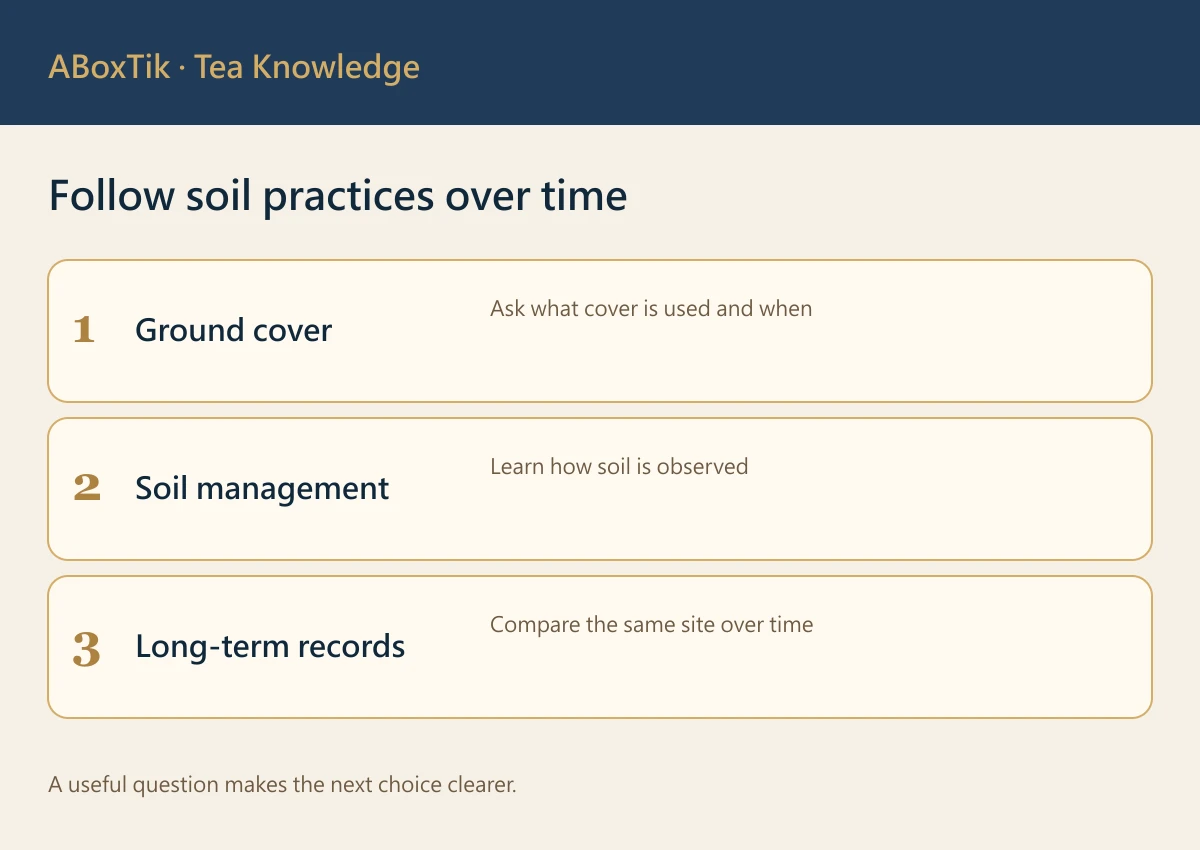
A photograph can prompt a note about where cover is visible, followed by questions about material, season and maintenance. It is an opening observation rather than a long-term soil report. Attractive grass need not stand in for every measurement the picture cannot show.
Disturbance and nutrients: ask which problem is being addressed
Reducing unnecessary disturbance is worth discussing, but that does not mean every garden can dispense with all soil work. Ask which problem the manager faces, which operation is chosen and how other risks are considered. That is clearer than treating a no-till slogan as a complete plan.
Nutrient management needs testing, crop requirements and field conditions. Different fertilisers and organic materials have their own constraints. “Natural” does not mean unlimited application or identical effects, and a general tea article should not prescribe one application table for all gardens.
Where lower inputs are reported, ask what baseline and period were used and whether plant growth and production were recorded as well. Keeping the operation separate from the result makes it easier to understand how the practice works in place.
Long-term production includes the people doing the work
Soil management takes time and someone able to keep doing it. Alongside environmental aims, ask whether the work can be sustained and whether tea plant and production observations are retained. Less of one input does not automatically mean improvement in every part of the system.
For a reported result, identify whether it compares the same field over time, different fields or a single observation. Weather, harvest, plant age and other operations can change simultaneously. Not every result can be assigned to one practice without further evidence.
Provenance information and regional context locate the story. An answer with a period and clear conditions can be a more useful invitation to learn than a promise to improve everything at once.
A reader’s card for tracing claims
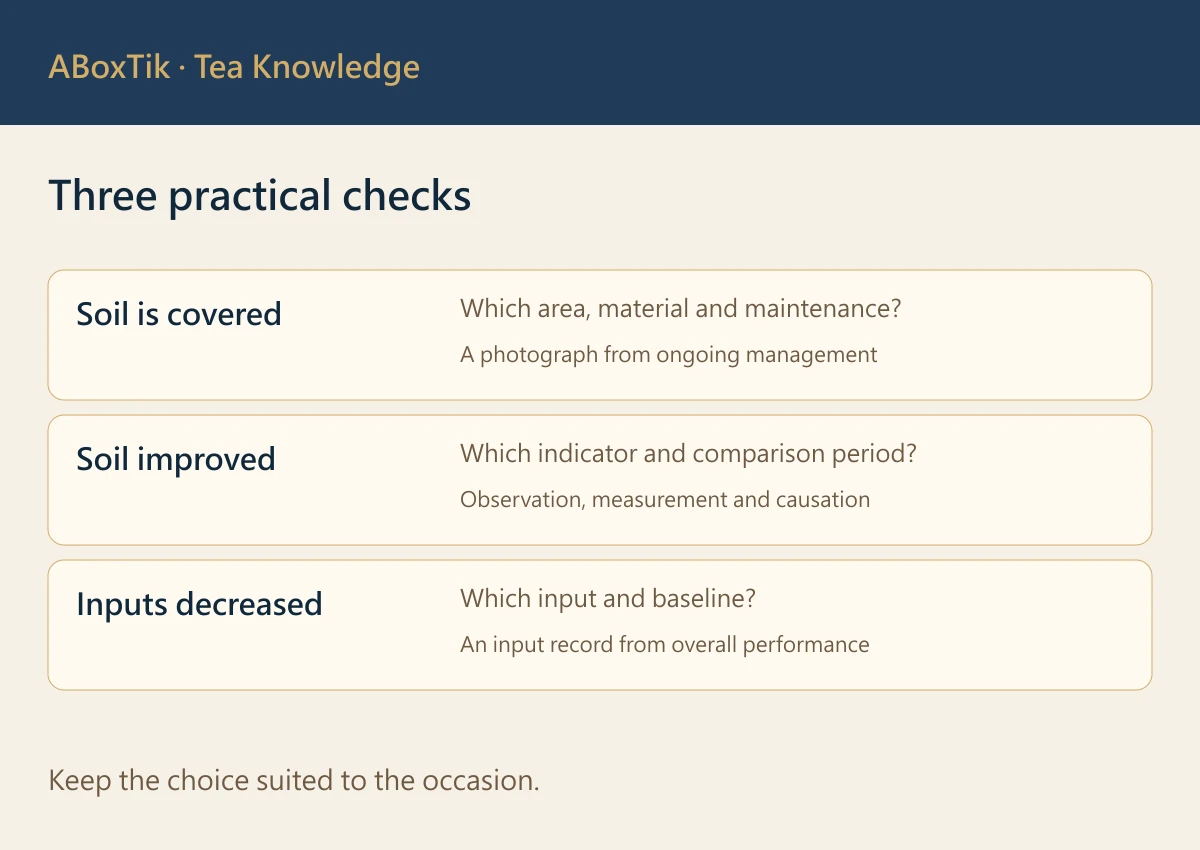
| Claim | First question | Distinguish |
|---|---|---|
| Soil is covered | Which area, material and maintenance? | A photograph from ongoing management |
| Soil improved | Which indicator and comparison period? | Observation, measurement and causation |
| Inputs decreased | Which input and baseline? | An input record from overall performance |
| Verified | Which scheme, entity and product? | A management description from documentation |
The card helps understanding; it does not demand that every small grower immediately produce a thesis. Ask about practices and records they can share. Leave unanswered fields open rather than filling them with the outcome you hoped to find.
The term regenerative does not itself establish absence of pesticides, a constituent level or a health effect. Tea value comparisons also benefits from reading price, story, provenance and actual product information separately.
Make one question practical when visiting or buying
Confirm permitted areas and guiding arrangements before a visit. Do not take samples, enter planting rows or substitute another garden’s photographs as evidence. Tea-region observation offers a useful way to keep place, explanation and personal impressions apart.
For a purchase, record actual origin, tea type, cultivar and batch, then keep field-management information in its own column. Taiwanese tea landscapes and craft and tea categories leave space for what is in the cup as well. Caring about land and enjoying flavour can coexist without guaranteeing one another.
Choose one management practice and write four fields: action, location, period and record. Add another answer when it becomes available. A gradually clearer question can leave more lasting understanding than memorising every sustainability term at once.

Tea, one box at a time
Ask one layer deeper, with a little patience for the answer
At ABoxTik, understanding tea includes being willing to ask about its source and how work is done. Learn how one practice is maintained and recorded; concern can then move from an adjective towards a useful detail.
For everyday tasting, see the current teas in the Classic Taiwanese Tea Four-Box Set and read each product’s own origin information. Confirm any specific management or verification claim item by item. A good question can develop gradually; one cup need not answer for an entire hillside.
Related reading
- Understand tea garden biodiversity
- Practise reading provenance
- View the Classic Taiwanese Tea Four-Box Set
Sources
- FAO: regenerative agriculture
- FAO: soil organic cover
- Tea and Beverage Research Station: tea garden establishment and planting
Sources checked 20 October 2026.