
Tea Knowledge
Where Does Tea’s Carbon Footprint Come From? A Life-Cycle Guide

A leaf reaches the cup through more than one journey. Lay out growing, making, packaging and brewing, and a carbon number begins to have a place you can understand.
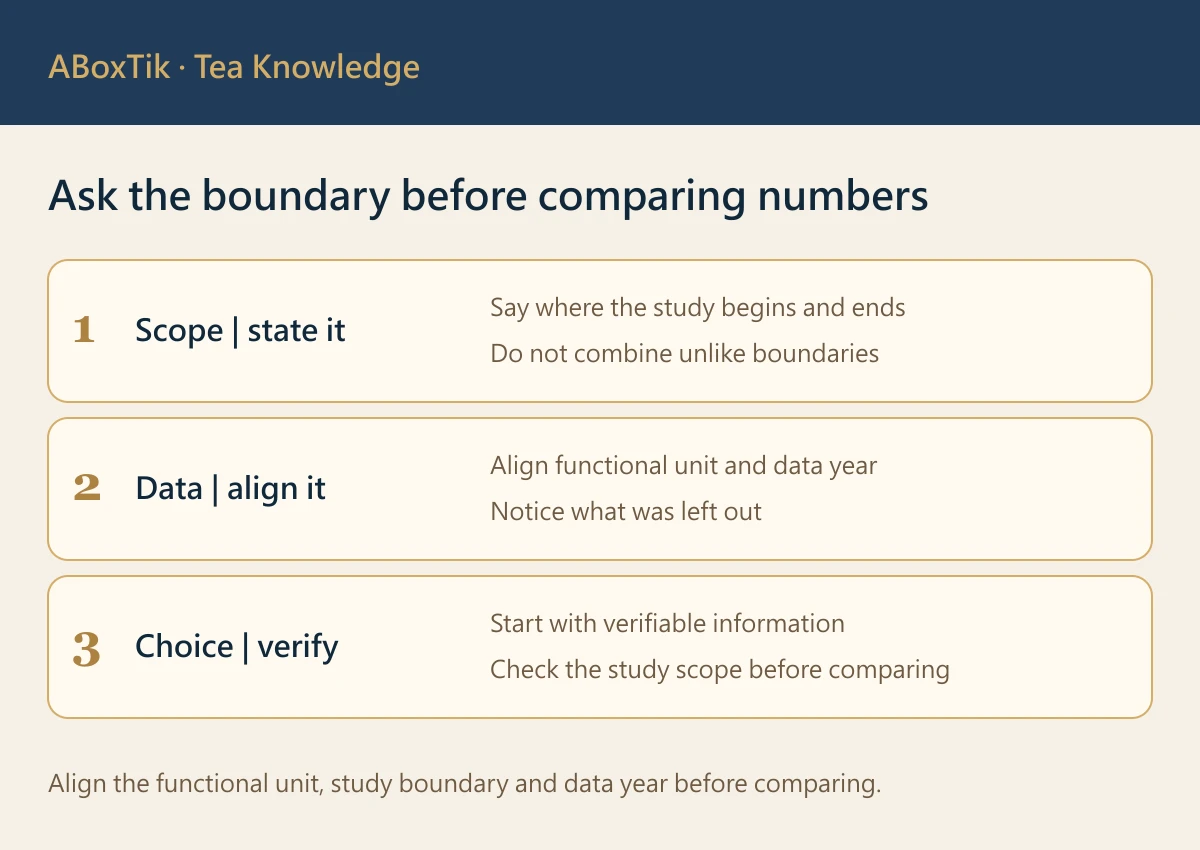
A tea carbon footprint may include growing inputs, processing energy, packaging, transport, brewing and end-of-life treatment. Which stages are included depends on the study boundary. Before comparing results, align the functional unit, scope, data year and method. A number on its own does not tell you whether it describes a kilogram of dry tea, a packaged product or one defined cup.
If carbon figures and abbreviations seem to require another course before breakfast, start with five questions instead. This article explains emission stages and how to read their context. For purchasing documents and packaging questions, the ESG corporate tea-gift guide takes that separate discussion further. One cup does not have to hold every sustainability topic at once.
Tea carbon footprint: read the unit and boundary first
Think of the functional unit as the amount of product or service the comparison describes, such as a kilogram of dry tea or a clearly defined serving. The boundary says where counting begins and ends: at the factory gate, after delivery or through use and disposal. Taiwan’s agricultural tea example distinguishes raw materials, manufacture, transport, use and waste, reminding readers that a lifecycle can extend beyond a parcel’s journey.
Even two results described as per cup may assume different tea doses, water volumes or further infusions. A per-kilogram figure cannot simply be divided by an imagined cup count to create a comparable answer. Write the unit, starting point, endpoint and data year before reading the total. The tea price and value guide separates financial value; price and carbon data answer different questions and should not substitute for each other.
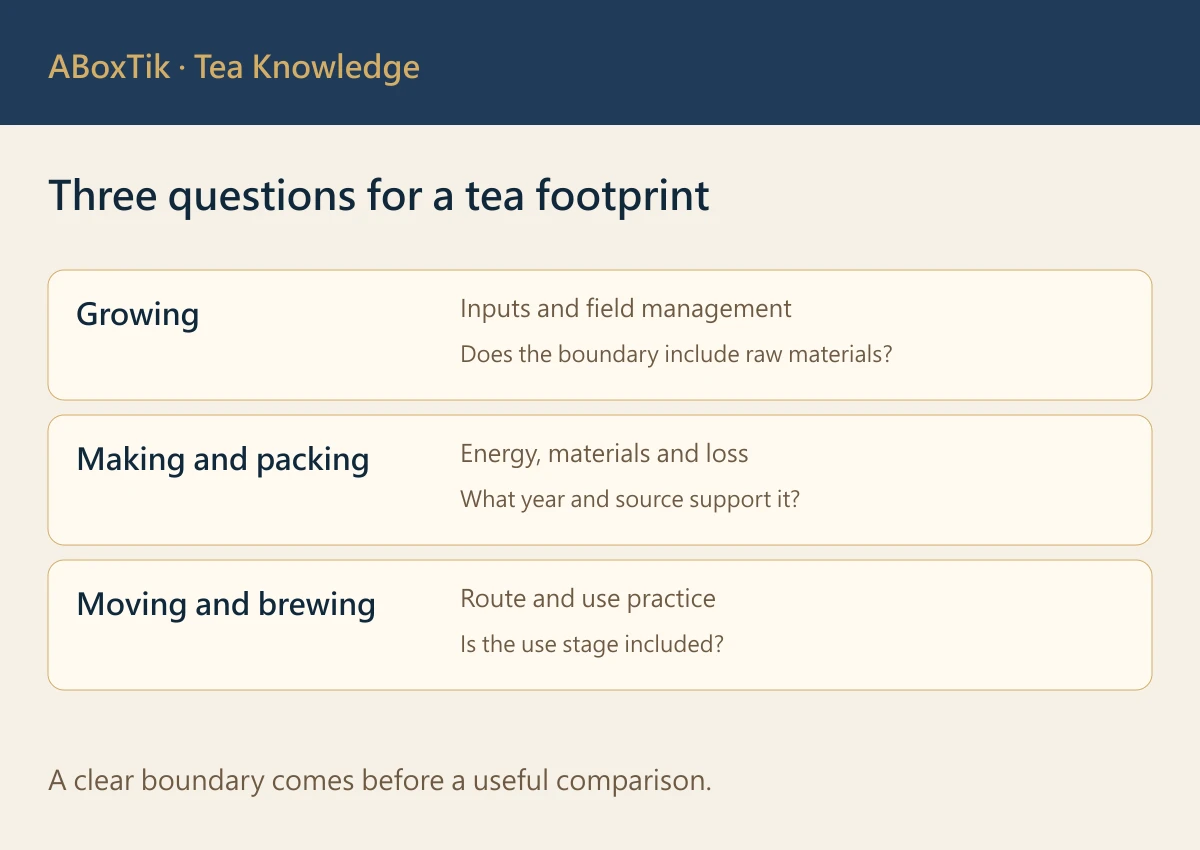
Read the garden’s inputs and activities
Depending on scope, raw-material production may include fertilizer, materials, electricity, fuel, irrigation and other field activities. The Tea and Beverage Research Station includes cultivation and harvesting among the stages whose information needs to be assembled. When a study refers to the garden stage, ask which activities, place and period its data cover. A beautiful photograph can introduce a location, but cannot complete those fields.
Match the origin, cultivar and management background to the actual product under discussion. The Taiwan tea-region guide and Taiwanese tea and craft introduction help with context without turning a place name into an emissions calculation. Divide your notes into included, excluded and unspecified items. An attractive natural-looking setting is not a reason to fill an unspecified field with an assumption.
Connect processing energy with actual operations
Tea making uses different mechanical and thermal operations according to tea style, equipment and production choices. The oolong oxidation guide, rolling guide and drying guide explain the process background. In a footprint study, look further for which energy sources and activities were counted, and whether the information came from measurements, bills, estimates or a database. The length of a process description is not an energy reading.
A more roasted tea does not, by itself, establish a higher footprint across the entire lifecycle. Equipment performance, energy supply, batch size and other stages may differ. To compare a change over time, check the product, output basis and method as well as the dates. Processing stages help formulate questions; the result still needs corresponding data. The color of a cup has not quietly taken a second job as an electricity meter.
Unpack packaging and transport before judging them
Separate the display box, inner packs, labels, carry bag, shipping carton and protective materials. Check the material, weight and scope for each. One study may count packaging within manufacture while another lists it separately. Find where it appears before adding totals, so it is neither omitted nor counted twice. The tea-bag materials guide addresses a different packaging question; a disposal description cannot replace an overall emissions result.
For transport, read origins and destinations, modes, routes and the conditions assumed in the study. A shorter distance is useful information but cannot independently rank two supply chains. If several transport legs are included, organize them using the same boundary. Where loading or distribution assumptions are unspecified, record the gap and ask for clarification rather than supplying a precise-looking decimal from imagination.
Check whether brewing and treatment are included
When a study includes the use stage, water volume, heating practice, equipment and further-infusion assumptions can affect how it is calculated. Treatment of spent leaves and packaging also depends on scope. These items do not appear in every result, so look for the boundary before comparing. The steeping guide, further-infusion guide and storage guide can help describe your actual routine clearly.
At home, prepare a suitable amount of water and heat it according to drinking-water conditions and equipment instructions, avoiding repeated heating of more water than you need. Choose a tea quantity that fits your pace and close the packet after taking a portion. These are practical use suggestions. To claim a particular emissions saving would require recording the actual conditions and calculation; a useful habit does not come with an automatic percentage attached.
Use five questions to read any tea footprint
First, is the unit a weight of dry tea, a packaged item or a defined cup? Second, where does the study begin and end? Third, which region, year and product do the data describe? Fourth, are packaging, transport, brewing and treatment included? Fifth, can the method be aligned with the other result? Ask these before circling the smaller number as the preferred answer.
For example, study A may stop at the factory while study B includes brewing. Different totals would not establish that A describes the lower-emission product. Draw the two boundaries and look for information covering the same scope. If it is unavailable, retain the two results as answers to different questions. The example needs no invented product figures: its purpose is to practice reading conditions. A clearly recorded unknown is easier to revisit than a confidently guessed answer.
Keep a link or document title beside each answer, including the date you read it. If the study changes, that reference makes the difference easier to trace. Where a stage has not been included, label it excluded; where the document is silent, label it unspecified. Those two notes are different and should remain so.

Follow ABoxTik | Ask a clear question and make the next choice with useful information.
Let clearer information support the next cup
Understanding a tea carbon footprint can begin with one study’s boundary before moving to possible improvements. For choosing tea, start with flavor, quantity and use. Explore the actual contents of the Classic Taiwanese Tea collection or two-box tea-bag set, looking for an amount you will comfortably enjoy rather than leaving unused.
Next time a tea carbon number appears, write down its unit and endpoints first. Being able to answer those two questions provides a clear beginning for everything that follows, without making the everyday pleasure of tea into an exam.
Related reading
- ESG corporate tea gifts: extend the discussion to purchasing information.
- Tea-bag materials and disposal: separate another packaging question.
- Classic Taiwanese Tea collection: choose actual quantities and flavors.
Sources
- Ministry of Agriculture: a tea lifecycle footprint example
- Tea and Beverage Research Station: tea production stages and footprint inventory
Sources checked 15 October 2026.