
Tea Bag
How Taiwan Tea Competitions Work: A Buyer’s Guide
A competition tea may sound intimidating. It begins, though, as a carefully prepared sample on a judging table. Once you know the path, you can decide calmly whether its flavour is one you want to meet.
A Taiwan tea competition commonly announces eligibility and sample-entry rules, assigns blind codes, brews samples under controlled conditions, then uses sensory assessment of appearance, liquor colour, aroma, taste and infused leaf before announcing grades or awards. Details vary by tea, region and year. For buyers, the useful next step is to check the organizer, season, tea category, award wording, seal or batch, and your own taste.
You do not need to memorise award names before opening a competition tea. This guide walks beside a first-time buyer through the process and its limits. For stories about specific 2022 local winners, see Taiwan Champion Tea; this article is about how judging works and how to read the result.
What is a Taiwan tea competition actually comparing?
Competitions and evaluations can encourage craft, present a regional tea style and compare samples within one defined class. The Tea and Beverage Research Station’s sensory-evaluation material describes attention to dry appearance, liquor colour, aroma, taste and leaf base. The judgement is a connected reading, not a search for the strongest aroma alone.
An award is the result for a particular sample under a particular event’s rules. It cannot guarantee that every drinker will like it, replace storage or origin information, or answer every quality question. That boundary lets an award stay meaningful without asking it to do too much.
From entry to announcement: five common stages
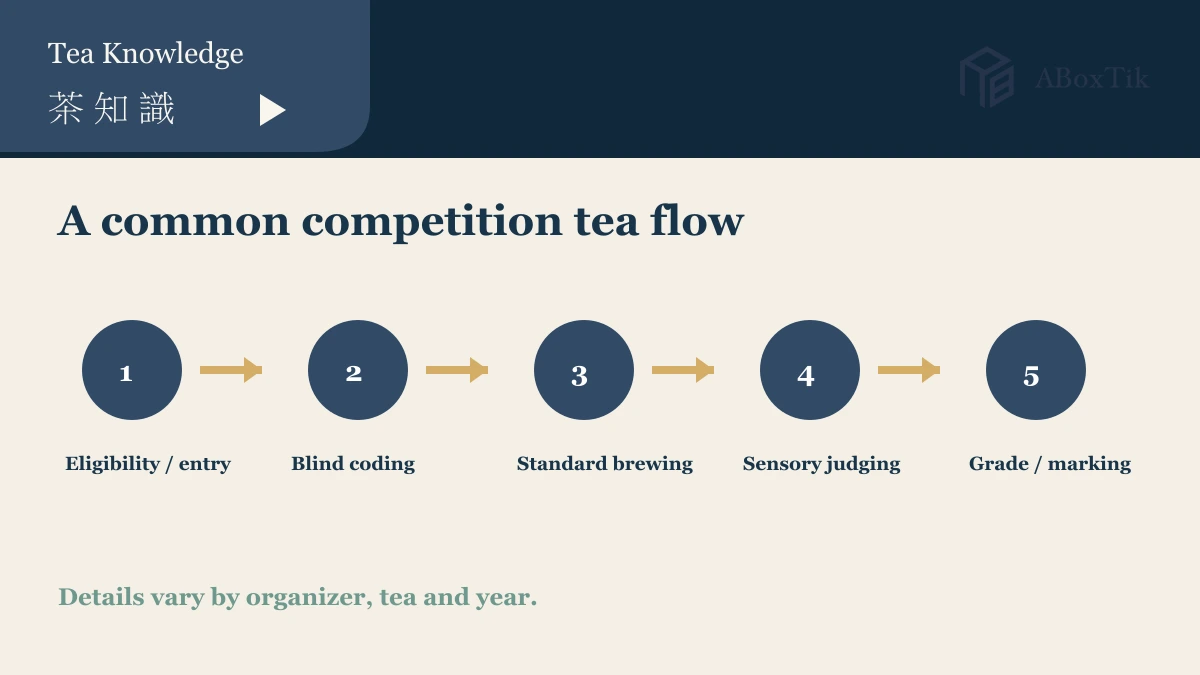
- Eligibility and entry: organizers may define classes by origin, tea type, cultivar, season or producer. Entry, source or test requirements belong to that year’s rules.
- Blind coding: samples are identified by codes, helping the panel attend to the tea rather than a familiar name or package.
- Standard brewing: each event specifies equipment, leaf-to-water ratio, temperature and time. A home brew does not need to copy a competition number.
- Sensory assessment: appearance, colour, aroma, taste and infused leaf are considered together.
- Grades, results and marking: awards follow the event rules. Some local events use unified packing or seals; that is not a Taiwan-wide rule.
This is why one published score sheet should never be applied to every Taiwanese tea. Brewing times, classes, award names and selection rates can change, even at the same event. Historical Ministry of Agriculture material gives useful industry context, not a universal current rulebook.
How do judges taste? Five sensory clues
| Area | What may be observed | A helpful buyer translation |
|---|---|---|
| Appearance | Shape, colour, uniformity and broken leaf | Read it in the context of the tea style, not as a beauty contest. |
| Liquor colour | Brightness, clarity and hue | Dark is not automatically better. |
| Aroma | Clarity, naturalness, balance and persistence | Start with broad families: floral, fruity, sweet or roasted. |
| Taste | Body, harmony, finish and unwanted notes | Preference is valid; practise notes with our aroma guide. |
| Infused leaf | Evenness, colour and condition after brewing | It is one part of a whole assessment. |
Name what you notice first; ask about the award second. Tea becomes closer, not more stressful.
TAGs, tests, seals and awards answer different questions
The Research Station’s guidance on bringing TAGs into tea grading evaluations and its traceability TAGs evaluation provide safety, origin, classification, grading, flavour-description and system-specific information. A competition award is an event result; a seal may identify an event-managed product; a test record needs its sample, date, items and scope checked. They may sit on the same package, but do not replace one another.
A prize does not mean every batch has the same test record, and traceability does not promise a flavour you personally prefer. Read source information through our traceability guide; read price through the premium tea value guide. An award can be part of a price story, never its whole proof.
Six things to check before buying competition tea
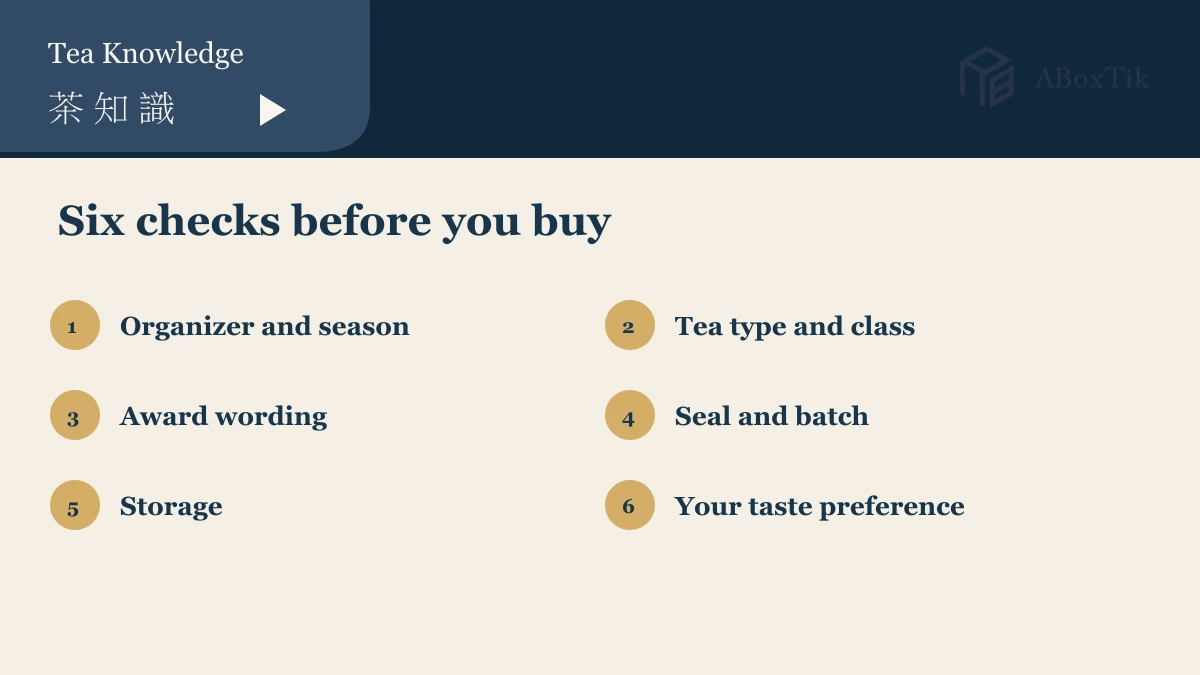
- Who organized it? Can you identify the organizer and the year’s notice?
- Which season and year? Awards have a time context.
- What tea and class? Region, cultivar or tea class changes the comparison.
- What is the award called? Keep the original wording; different names are not automatically equivalent.
- Are the seal, batch and storage instructions clear? Match package information and store as directed.
- Does it suit your moment? You may prefer floral freshness, roast, richness or easy daily brewing.
Bring competition language back to your own cup
Brew a competition tea by its package guidance first; its award does not make it too precious to brew. Notice one aroma family and the texture in the first infusion, then watch the second infusion change. If you share it, let each person write three words before comparing notes. It is a gentler and often more revealing exercise than searching for one correct answer.
Keep the setup modest: matching cups, the same water, and two small notes are enough. Rather than trying to sound like a judge, ask whether the aroma feels clear, whether the flavour invites another sip, and whether the next infusion becomes more balanced. These observations do not compete with an award; they turn it from a distant label into a useful invitation to taste.
If a seal, batch or award label is unclear, keep the package and ask the seller before filling gaps with a social-media story. Clear information makes comparison kinder and more accurate. That is why ABoxTik prefers a stated limit to an oversized promise when we introduce Taiwan tea.
A result may also help you choose what to explore next. A reader drawn to a floral local competition tea may compare it with pouchong or a lightly oxidised oolong; someone who prefers a warmer finish may try a more roasted style. The useful comparison is not “which award is higher?” but “which tea, brewed in a similar way, gives me the experience I want today?”
There is room for a tea to be excellent in a panel’s conditions and simply not be your everyday favourite. Your water, cup, meal, season and mood can all alter what feels most enjoyable. Keeping that freedom is part of becoming a confident tea drinker, and it makes a well-documented competition result more useful—not less.
For the wider map of Taiwanese origin, cultivar and craft, read Why Taiwanese Tea Is Special. If international awards are your interest, see World Champion Tea. Neither needs to decide whether today’s cup is right for you.

Follow ABoxTik
Read the package well, then enjoy the tea
ABoxTik believes competition tea should not feel like a vocabulary test. When its organizer, tea style, season and information are clear, you can return to what matters: whether its aroma, texture and sharing moment invite another infusion. Browse Taiwan tea, or make a relaxed side-by-side tasting with the Classic Taiwan Tea Set.
Sources
- TBRI: How to introduce TAGs into tea grading evaluations (checked 2026-09-11)
- TBRI: Traceability TAGs classification and grading evaluation (checked 2026-09-11)
- TBRI: Tea sensory evaluation (checked 2026-09-11)
- Ministry of Agriculture: first National Quality Tea Competition and Champion Tea Auction record (checked 2026-09-11)