
Tea Knowledge
What Does Tea Withering Do? Sun, Indoor Rest and Water Movement
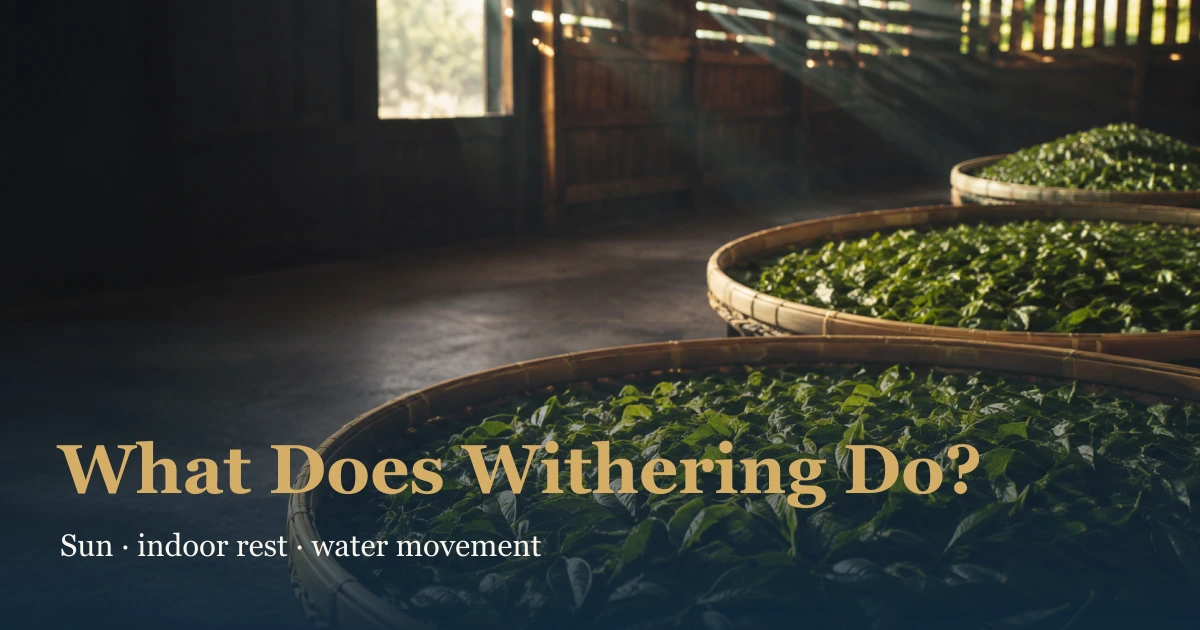
Once a leaf leaves the bush, it begins to release water. In that quiet interval, the direction of aroma begins to appear.
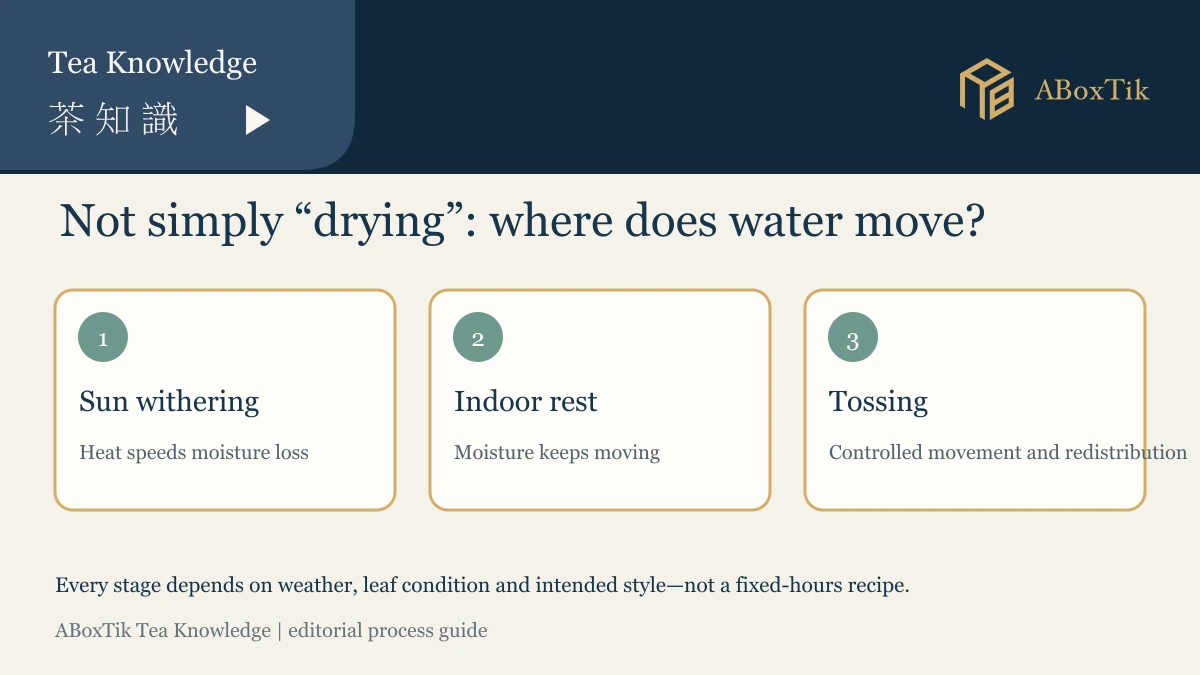
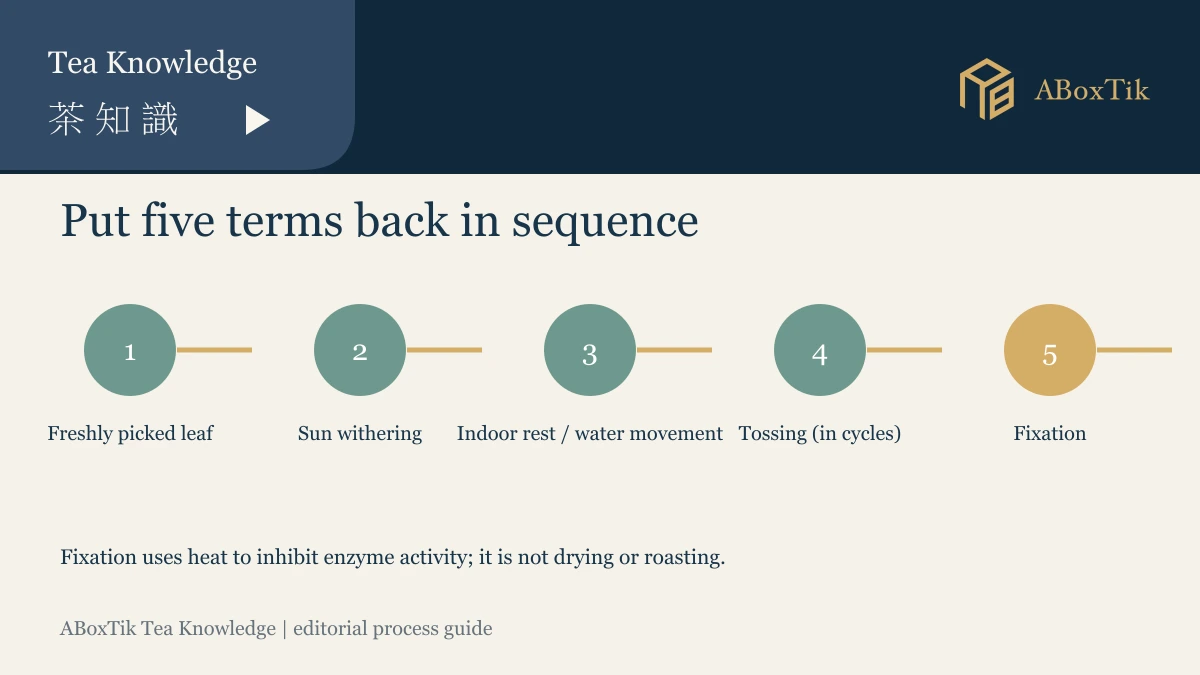
Tea withering is not simply “drying tea leaves in the sun.” For partially oxidised tea, freshly picked leaf first loses some moisture in sun or warm-air withering, then continues resting indoors. Water keeps leaving and redistributing through the leaf; Taiwanese tea makers often call that movement zou shui, literally “water movement.” Tossing may be interspersed. Together these actions prepare conditions for aroma, flavour and subsequent enzyme-driven oxidation. Fixation, applied later with heat, inhibits enzyme activity.
The terms are easy to collapse into one vague idea. They answer different questions: withering manages moisture and leaf texture; water movement describes redistribution; tossing is an operation; the industry’s “fermentation” is principally enzymatic oxidation; fixation stops that trajectory. For the larger oolong sequence, see our oolong oxidation and processing guide. This article deliberately zooms in on the withering interval.
Withering first makes fresh leaf workable
Taiwan’s Ministry of Agriculture explains withering as sun (or warm-air) and indoor stages. As moisture dissipates, leaf weight, volume and hardness decrease, while changes related to aroma and flavour can proceed. More moisture loss does not automatically mean better tea. Maturity of the leaf, weather, layer depth, airflow and the intended tea style all change the decision.
That is why a maker is not merely following a timer. Taiwan’s tea research station uses the phrase “make tea by watching the weather; make tea by watching the leaf.” It is a useful warning against copying a fixed number of hours, temperatures or tosses outside the original material and equipment.
Sun withering: heat starts moisture loss
Sun withering uses solar heat to accelerate the loss of moisture. It is a familiar starting point for many partially oxidised teas, but not a contest to give leaf the strongest possible sun. Light, leaf temperature, wind and humidity affect the pace. The tea research station also notes that warm-air withering can substitute when sunlight or timing is unsuitable. The better question is whether the leaf enters the next stage under control—not simply whether it saw the sun.
Indoor rest: water continues to move
Moving leaf indoors is not an intermission. It continues to lose moisture while water redistributes among stem, veins and leaf tissue. Think of zou shui first as this movement toward a more even condition, rather than as a separate tea type or a claim that can be judged only by a dry-looking surface.
Temperature, humidity, airflow and how the leaf is spread change the rhythm. A cup’s floral, sweet or leaf-base aroma should therefore be read as the joint result of cultivar, origin, picking, withering, oxidation, drying and possible roasting—not as a guarantee supplied by one stage.
Tossing: controlled movement, not oxidation itself
Indoor withering for partially oxidised tea can include regular tossing. Official equipment guidance says early tossing promotes moisture redistribution; later, measured friction can affect leaf edges and make conditions more favourable for enzymatic oxidation. “Measured” matters. Tossing is a maker’s way to adjust water movement and pace; it is not a command to turn leaf as much as possible, nor is it synonymous with oxidation.
For the same reason, a red-edged green leaf cannot by itself be a verdict on quality. It may reflect controlled edge action and oxidation, but the final aroma depends on the whole sequence. To practise separating fragrance from taste after brewing, visit the tea aroma guide.
Oxidation develops; fixation interrupts
Tea makers often call this “fermentation,” but the more precise description here is oxidation involving leaf compounds and enzymes—not microbial fermentation like yoghurt or wine. Withering and tossing establish conditions; they should not all be labelled oxidation.
At the selected point, fixation uses heat to inhibit enzyme activity, so oxidation no longer continues at the same pace. The leaf also softens for later rolling. Fixation is neither final drying nor roasting: rolling, shaping, drying and possible roasting follow it.
How to read withering as a cup-side clue
Do not use withering to predict that a tea must taste floral, fruity or milky. Keep the vessel and brewing conditions consistent; smell dry leaf, then the infused leaf, then note aroma separately from texture on the palate. Across teas of different origins, cultivars and roast levels, this makes it easier to avoid attributing every difference to one processing word. For another useful separation of origin, leaf and method, see Taiwanese tea versus Taiwanese-style tea.
Leave room for the invisible water in a cup of tea

Taste along with ABoxTik
Learning about withering is not a way to reduce every cup to one answer. Sun begins moisture loss, indoor rest lets it continue, tossing adjusts the rhythm, and fixation holds a chosen moment. To compare teas further, explore Jin Xuan oolong, the Taiwan tea regions guide and the tea collection. Current availability, flavour notes and brewing directions belong to each live product page.
Sources
- MOA Knowledge Portal: Taiwan specialty tea classification and processing (accessed 2026-09-06)
- Taiwan Tea and Beverage Research Station: withering-environment monitoring (accessed 2026-09-06)
- Taiwan Tea and Beverage Research Station: common tea-making equipment (accessed 2026-09-06)
- Taiwan Tea and Beverage Research Station: tea-making machinery (accessed 2026-09-06)