
Tea Knowledge
Whole-Leaf vs Broken-Leaf Tea: Brewing, Flavour and Everyday Choices
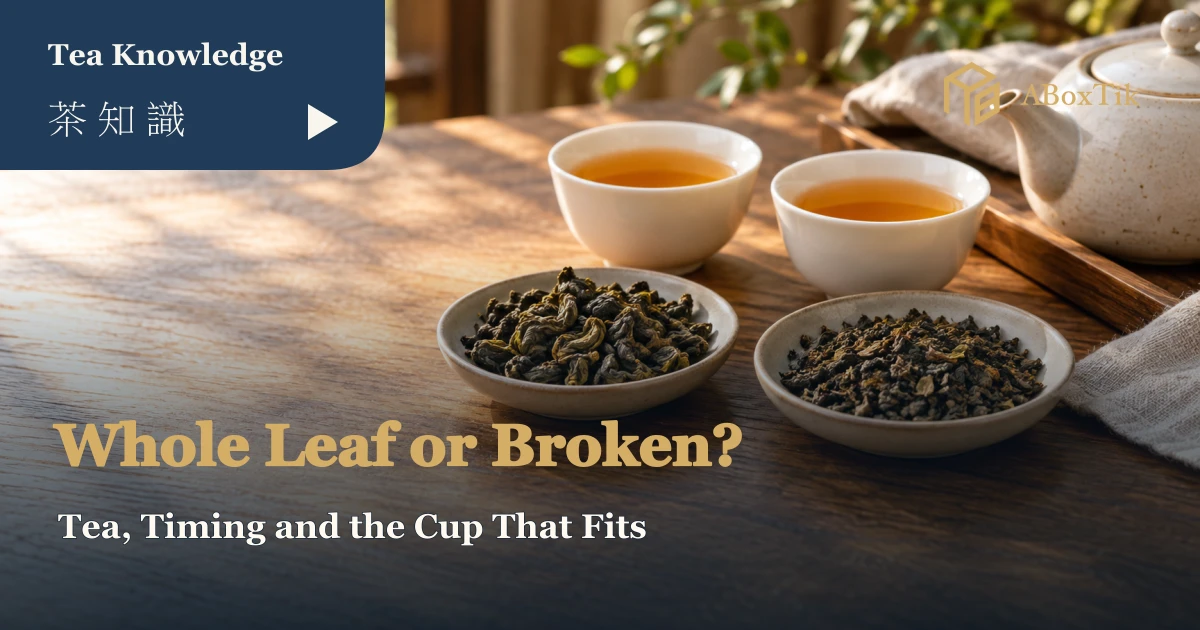
Some leaves unfold slowly; smaller pieces speak sooner. Give each a little room, listen to the cup, and choose the pace that fits the moment.
Whole-leaf and broken-leaf tea differ mainly in leaf size and the pace of brewing. Larger, more intact leaves offer an easier view of the wet leaf; smaller pieces generally release flavour more quickly. Choose by the cup you want and the time you have, then check the tea, processing and storage. Leaf size alone cannot rank quality.
One packet holds curled leaves; the other holds little pieces. It is tempting to give the tidy leaves first prize before the kettle has even boiled. Let the cups have a say. This guide compares the tea itself, whether loose or bagged. For packaging and buying value, continue with the whole-leaf tea bag buying guide.
Whole leaf, broken leaf and tea bags describe different things
Whole-leaf tea is commonly used for finished tea that retains more recognisable leaves or larger leaf shapes. Those leaves may be rolled into balls or twisted into strips. They need not lie flat, and a packet can still contain some fragments. Look again after brewing, when the leaf has opened.
Broken leaf describes smaller pieces, including deliberately cut leaves. Fragments may also arise during processing, sorting, packing and handling. Their sizes vary. Broken tea is not spent tea, and the term does not identify one single manufacturing method. Nor should small leaf pieces be confused with tea powder intended to be whisked into water and consumed.
Loose leaf and tea bags describe how tea is supplied and brewed. A bag can contain larger leaves or smaller pieces; loose tea can be fragmented too. Keeping content and format separate makes labels easier to understand. For the work behind rolled shapes, see the tea leaf rolling guide.
Why does smaller leaf usually brew more quickly?
Breaking a leaf changes the conditions for water contact and movement through the leaf. Particle-size research has observed faster infusion from smaller tea particles. A separate study comparing full and broken leaves found differences in aroma extraction early in brewing. These findings support checking a smaller-leaf brew sooner; they do not promise that every broken tea is more aromatic or more bitter.
Water temperature, leaf weight, water volume, processing, movement and equipment still matter. Comparing a floral oolong with a broken black tea introduces more than a size difference. It is a little like comparing a walk and a train ride when they go to different destinations: interesting, but not a clean test of speed.
For a useful comparison, choose teas with similar style and processing and keep brewing conditions steady. Larger leaves are not automatically slow either. Tightly rolled, twisted and open leaves hydrate differently. Treat brewing pace as a practical clue, then follow the product’s instructions before making small changes.
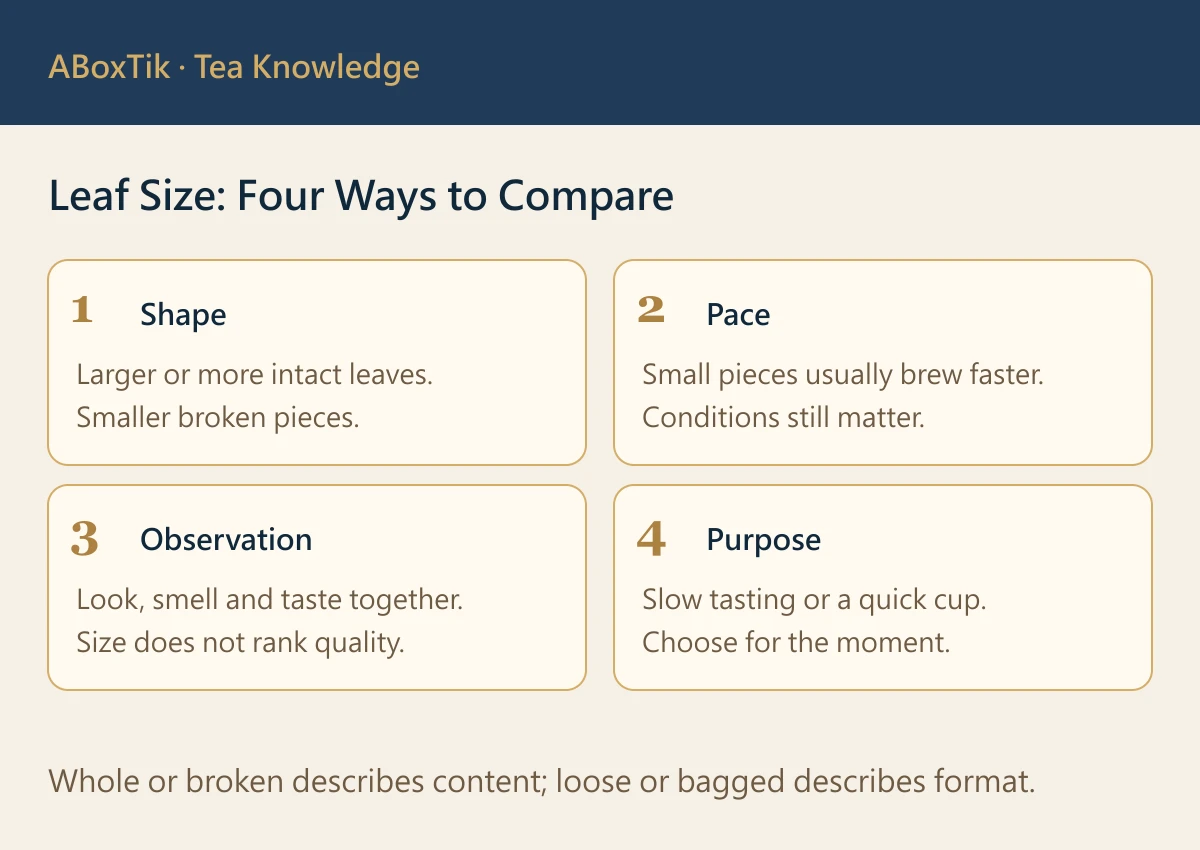
Whole-leaf versus broken-leaf tea: a practical comparison
| What to compare | Larger, more intact leaves | Smaller pieces | What to check |
|---|---|---|---|
| Wet-leaf observation | Easier to observe shape and opening | Harder to reconstruct a leaf outline | Appearance is one part of the information |
| Brewing pace | Some shapes need time to open | Usually reach strength sooner | Compare equal weights and water volumes |
| Cup character | Useful for exploring successive infusions | Useful for watching a quick build in strength | Tea style and processing still matter |
| Filtering | Needs suitable drainage and filtering | May need a finer filter | Easy removal helps stop the infusion |
| Everyday use | Unhurried tasting and shared brewing | Quick cups and adjustable drink bases | Choose for the occasion, not a hierarchy |
These are directions to explore, not seating arrangements for a tea class system. A darker cup is not automatically better, or even a reliable way to compare strength across different tea types. Note aroma, taste and the feeling after swallowing alongside colour.
Choose for the moment: slow tasting or a quick cup?
Time for several infusions
Larger leaves are a useful starting point if watching them open is part of the pleasure. Give them space and a vessel that drains easily. With a friend, compare the first cup with a later one and describe what changed. Decide whether another infusion is worthwhile from its actual flavour, rather than entering the leaves in an endurance contest.
A short office break
Think first about removing the tea on time. A smaller-leaf tea may reach your preferred strength quickly, but the next email can easily steal attention. A suitable infuser or bag, a timer and a small dish for the used tea can be more helpful than elaborate equipment. The desk does not need to become a ceremony to make a good cup.
A milk tea or mixed drink
If you need a tea base that keeps its presence after milk or ice is added, smaller leaves may offer convenient preparation. Whole leaves can make a drink base too. Brew and taste the plain tea first, then add other ingredients gradually. Milk can soften a recipe, but it should not be assigned the job of rescuing every overly harsh base.
These choices can coexist. A quick morning cup and a leisurely weekend brew serve different needs. Buying tea for the time you actually have is kinder than buying it for an imagined routine that never arrives.
Adjust brewing one variable at a time
Start with the water volume, temperature and time on the packet. When moving from larger leaves to smaller pieces, keep your cup, water volume and leaf weight steady, but check the brew earlier rather than copying a familiar long steep. Remove the leaf when the cup reaches the strength you enjoy. Instructions already designed for that tea remain the best first reference.
- Too strong or noticeably harsh: shorten the next infusion while keeping the other settings steady.
- Still too strong: try less tea in a separate round and record the change.
- Too light: check the actual water volume, then extend the time a little.
- Pieces escape into the cup: use an appropriate filter that still drains smoothly.
No single timing chart covers every tea and shape. Use the first-infusion timing guide to develop a first-brew routine. If “bitter” and “drying” keep appearing as the same note, the bitterness and astringency guide helps separate taste from astringent mouthfeel. Naming the sensation clearly makes the next adjustment easier.
Near the end of a container, the proportion of small fragments may differ from the first scoop. If the last cups seem stronger, observe the leaves and weigh them instead of relying only on spoon volume. A neatly stored tea and a repeatable measure often help more than replacing the entire brewing set.
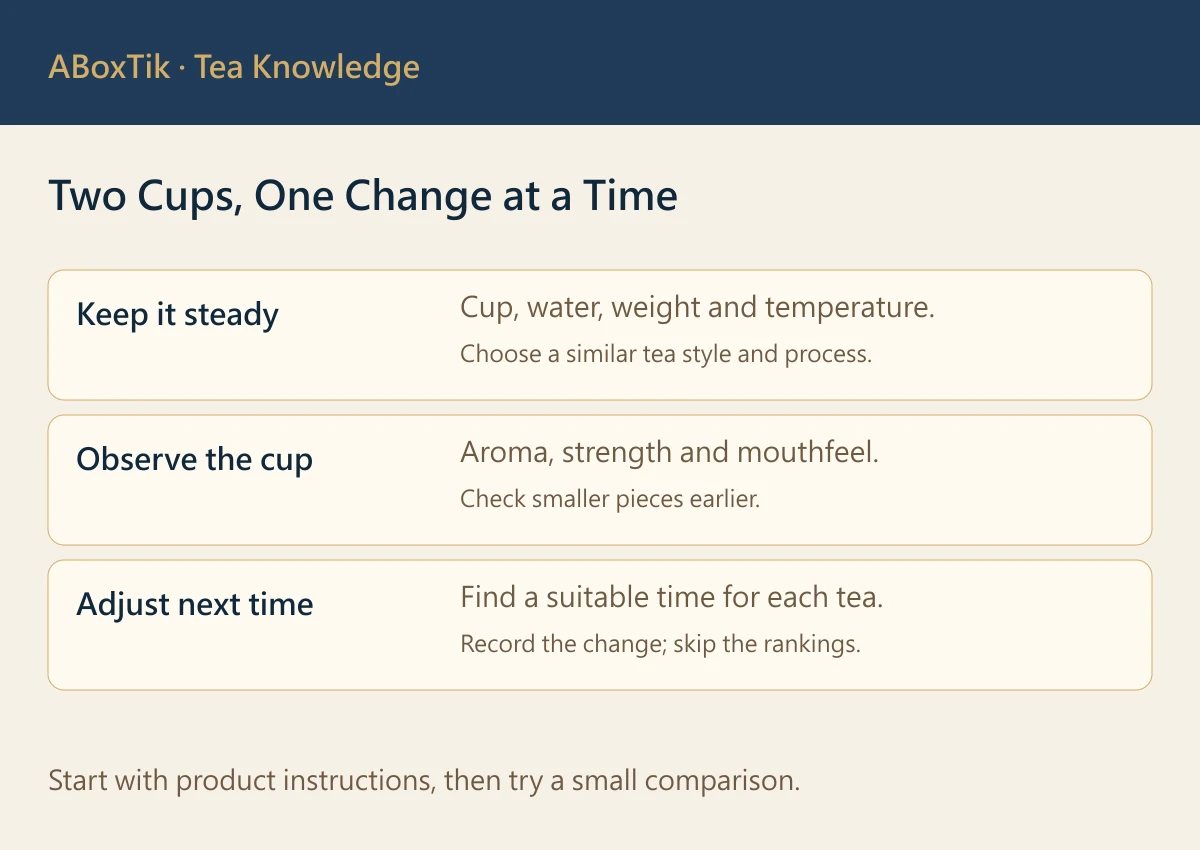
A two-cup exercise: speed, unfolding or something else?
Choose two teas with similar style and processing but different leaf sizes, plus matching cups or infusers. This is an editorial exercise for observation, not a competition. If the origins or roasting also differ, record those differences and treat the result as a comparison of these two teas rather than proof about size alone.
- Weigh equal portions. Use the same water, water volume and temperature, and note each product’s instructions.
- At matching observation times, take small samples to compare. For a stricter comparison, brew fresh pairs for each time point so sampling does not substantially change the remaining water.
- Smell the tea, then taste after it cools to a comfortable temperature. Make three columns: aroma, strength and mouthfeel.
- In another round, give each tea its own suitable brewing time. Check whether this changes your preference.
Ask one final question: “When would I like to drink this?” Before work, after lunch and during a weekend conversation are all useful answers. A tea does not need to win every round to earn a place in the cupboard.
Common questions about leaf size and choosing tea
Is whole-leaf tea always better?
No. Origin, processing, storage and how the brewed cup feels all deserve attention. Whole leaf provides information about shape, not a complete quality assessment. To explore Taiwan’s varieties and craft in context, continue with the guide to Taiwanese tea.
Can broken tea be brewed again?
There is no universal ban. The amount of leaf, water and time used in the first infusion affects what remains. If another cup still has appealing aroma and flavour, enjoy it. If it is thin, start fresh. A repeat-infusion count is not a target you must meet.
Can a tea bag contain whole leaves?
Yes. Read the contents, then consider room for the leaves, ease of removal and instructions. Bag shape is a separate question. the whole-leaf tea bag buying guide turns this leaf-size comparison into practical buying questions.
Keep a little curiosity for the next cup
For a starting point in Taiwanese styles, explore the four-box Taiwanese pure tea gift and choose a flavour description that interests you, such as Ying Xiang, Jin Xuan, Dong Ding or honey red oolong. Begin with one tea and record it using a familiar cup. If adjusting loose-leaf portions is more your style, browse the brand’s tea shop. Let leaf size help arrange the pace; let the cup decide what stays.
Sources
- Sánchez-López et al. (2020): aroma extraction, leaf size, temperature and water
- Farakte et al. (2016): particle size and tea infusion
Sources checked: 2026-10-10. Brewing exercise: editorial guidance.