
Tea Knowledge
How Long Should the First Brew Take? Taiwanese Tea Steeping Time

“Will another moment make it more fragrant?”
“Perhaps. It may simply make it stronger. Let’s pour a cup and see.”
Let the timer remember the seconds, so you can remember the conversation.
Taiwanese tea steeping time has no universal number. Follow the tea’s instructions for quantity, water, temperature and equipment first. An official Taiwanese tea booklet uses about 60 seconds for the first infusion in its pot-brewing example, together with leaf-volume guidance. Tea bags and large mugs need their own instructions. If your next fresh first brew needs to be lighter, shorten the time slightly; if it is thin, extend it a little while keeping other conditions steady.
For a beginner, the most nervous moment often comes after the lid goes on: “Can I pour now?” You only need a repeatable starting point, not a perfect performance. Our basic brewing guide covers equipment and preparation. Here, we focus on the clock, the pour and the conversation about what tastes comfortable.
Taiwanese tea steeping time starts with the brewing method
The Tea and Beverage Research Station’s Taiwanese Tea teaching booklet gives about 60 seconds for the first pot infusion, adding 15–20 seconds for later rounds. It also discusses leaf volume and temperatures for different teas. The number makes sense with those conditions attached; it is not a recipe for every cup.
| Method | First-brew starting point | Check alongside the time |
|---|---|---|
| The booklet’s tea-art pot method | About 60 seconds in that example. | Usually around 1/4–1/3 of the pot in leaf volume; its fluffy Baozhong and Oriental Beauty examples use 1/2–2/3. Avoid overfilling with tightly rolled leaves; use the appropriate temperature. |
| Tea bag or mug with a removable infuser | The minutes specified for that tea. | Number of bags or grams, water volume, temperature and when to remove the leaves. |
| A high-leaf, short-infusion recipe | The producer’s complete short-brew recipe. | Leaf and water quantities must match. Do not invent a very short time without those conditions. |
| Professional sensory assessment | A separate comparison procedure. | The Farmers’ Academy lists 3 g, 150 ml and boiling water, with 5 minutes for strip-shaped tea and 6 for rolled tea. |
The last row comes from the Farmers’ Academy sensory-assessment competency standard. Its purpose and setup differ from everyday pot brewing. Seconds and minutes can both be reasonable when they describe different methods. If a friend uses 30 seconds and you use 60, ask “How much tea and water?” before declaring a winner.
Our oolong water-temperature guide and gaiwan-versus-teapot comparison add context. For this first timing exercise, keep the equipment you already have.
Record the pour, not only the waiting time
Steeping begins when water touches the leaves. Pressing “stop” does not end that contact if liquid remains in the pot. Instructions may count from the start of filling or from the end; follow their definition when supplied. Otherwise, state your own convention clearly so that two notes saying “one minute” mean the same thing.
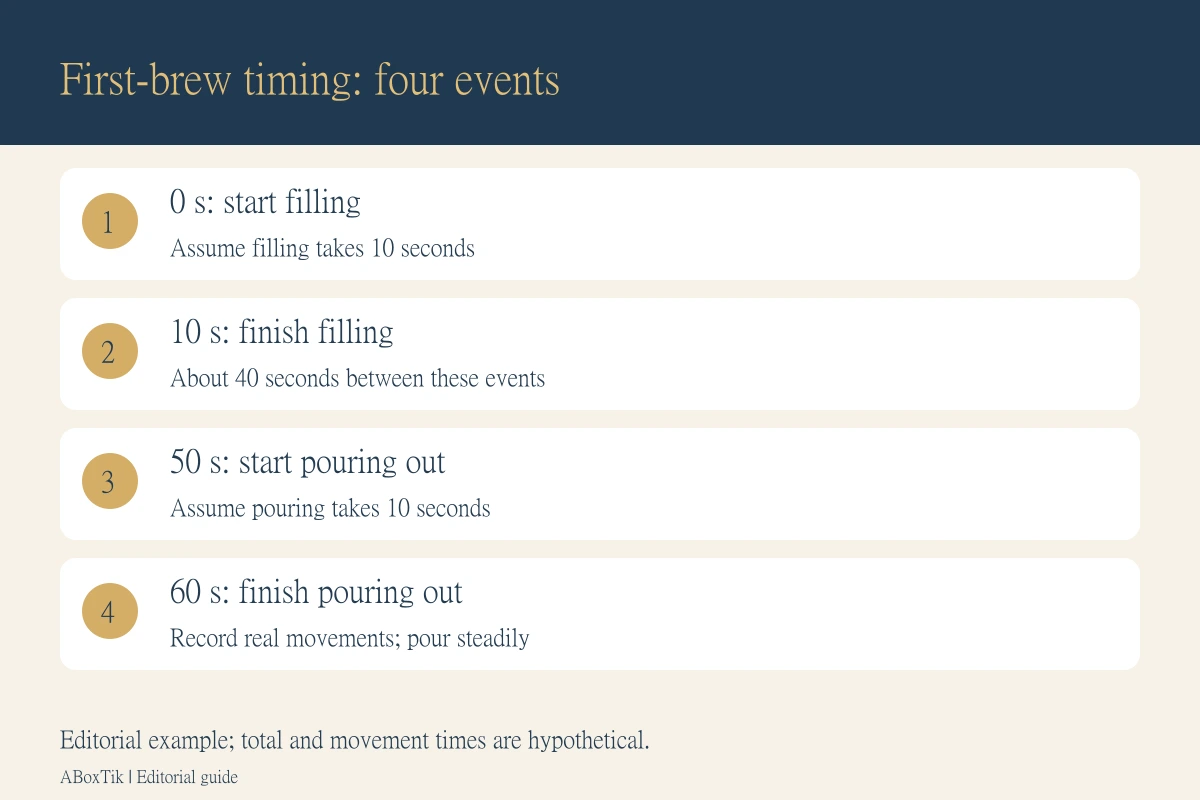
Record four events: start filling, finish filling, start pouring out and finish pouring out. Here is an editorial exercise: a total of 60 seconds from starting to fill until finishing the pour, with 10 seconds for filling and 10 for pouring. You would start pouring at about 50 seconds, leaving around 40 seconds between filling and pouring. These are hypothetical values, not a reinterpretation of the official booklet’s 60 seconds. Individual leaves do not necessarily have identical contact times.
Try pouring cold water from the empty pot to learn its pace. There is no need to shake hot equipment just to beat a timer; a steady pour is a nicer table companion than a miniature waterfall. See our beginner gaiwan practice and teaware material guide for handling context.
A small adjustment for the next fresh first brew
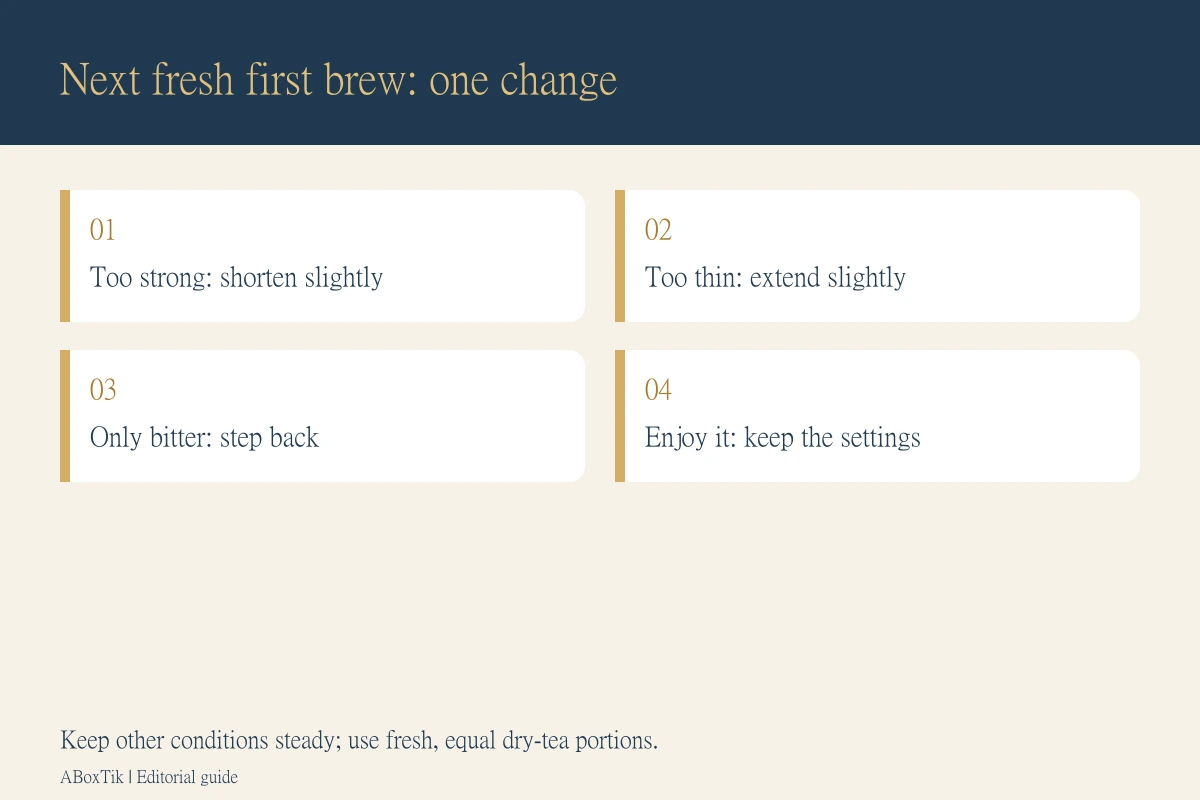
Next time = current time + a small adjustment. Add a little if the cup feels thin; subtract a little if it is too strong or becomes bitter and astringent too soon. This is a decision note, not a physical formula for concentration. Twice the time does not promise twice the flavour.
Keep the same batch, dry-leaf quantity, water volume, temperature and equipment. Compare the first infusion using a fresh, equal portion of dry tea next time. That makes timing easier to assess than changing several things together.
| This cup | Try next time | Keep steady for now |
|---|---|---|
| Too strong for your preference | Shorten slightly; check that the pot is drained. | Tea, water, temperature and equipment. |
| Fragrant but thin | Extend slightly, then taste and record. | Do not immediately add a handful of leaves. |
| Longer only made it more bitter | Return to the last comfortable time; test another variable separately. | Do not treat longer as the only answer. |
| You already enjoy it | Repeat those conditions once. | No need to match a friend’s number. |
With a personal 60-second trial, you might compare 50 or 70 seconds next time. For a minutes-long mug brew, a roughly 30-second step may be convenient, within the tea’s instructions. These increments are editorial examples, not validated optimum steps for every tea. “A little strong for me” deserves “We can shorten it,” rather than a lecture on proper taste.
The second infusion is a different starting state
Leaves used again are already wet. The booklet’s additional 15–20 seconds offers a reference for its method, but it cannot establish mandatory times for every tea and every round. Reinfusion also changes the leaves’ state, so it is not a comparison that changes timing alone.
If the second cup is noticeably stronger, try a shorter infusion. If later rounds become faint, extend gradually. Do not wait for rolled leaves to open completely when the cup is already stronger than you enjoy. Drain between rounds without forcefully shaking the vessel.
Keep reinfusion notes separate from fresh-first-brew comparisons. Our aroma observation guide, floral aroma vocabulary and roasted aroma guide can help describe the changes. One clear observation is enough.
Tea bags, mugs and flasks need an end to leaf contact
The teaching booklet recommends a removable insert for cup brewing to avoid overly prolonged contact. Remove a tea bag according to its instructions and rest it on a small dish. For tea to take with you, remove the bag or strain the leaves before transferring it to a suitable container. A phone alarm cannot make the leaves stop working inside a flask.
Use a mug of known capacity and record the bag count, water, temperature and time. Our whole-leaf tea-bag guide and pyramid tea-bag introduction explain the formats; neither means that all bags need the same minutes.
Topping up a half-finished mug changes water volume and contact conditions together. It can be an enjoyable habit, but it does not isolate the best first-infusion time.
Write notes that another person can understand
Keep the tea name, quantities, temperature, equipment, four timing events, taste and next adjustment. Then ask “Would you like it lighter or fuller?” rather than “Isn’t this an impressive brew?” Preference is useful information.
An imagined exchange might be: “The aroma is lovely; I’d enjoy it a little lighter.” “Got it. Ten seconds less next time—the tea stays, and so does the company.” These are editorial dialogue examples, not customer testimonials or brand test results.
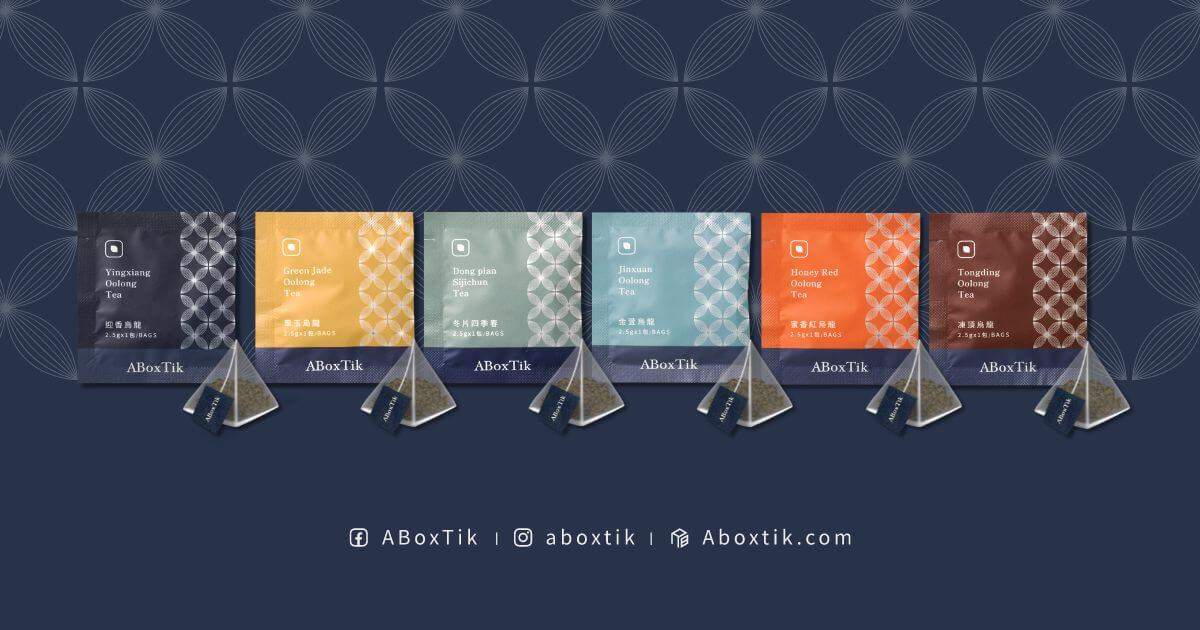
Start with a tea you want to drink regularly. Read the current instructions for Yingxiang Oolong, Tongding Oolong or Honey Red Oolong. If a product is sold as tea bags, use its tea-bag instructions rather than a loose-leaf pot-volume recipe. Specifications and availability depend on the current listing.
Share a cup with ABoxTik: let timing serve the gathering
Taiwanese tea steeping time deserves a note, but it need not become an examination at the table. Start with clear conditions, pour steadily and let the person drinking finish describing the cup. Asking for lighter tea helps shape the next brew; it does not diminish the care behind this one.
ABoxTik brings Taiwanese tea craft closer to daily life. Explore what makes Taiwanese tea distinctive, or talk with us about a current tea’s instructions. Including the tea name, vessel and water volume gives that conversation a helpful beginning.
Related recommendations
- Classic Taiwanese tea-bag set: read each tea’s instructions, then choose one to practise.
- Oolong water-temperature guide: explore temperature after your timing comparison.
- Gaiwan and teapot comparison: consider pouring and handling together.
Sources
- Tea and Beverage Research Station: Taiwanese Tea teaching booklet, September 2024 (page 2, brewing methods; Chinese)
- Farmers’ Academy: tea sensory-assessment competency standard (T1.4 and T1.5; Chinese)
Accessed 2026-10-04. Timing diagrams, adjustments and dialogue are editorial examples, not brand testing. The AI hero illustrates a tea setting, not an actual product photograph.