
Tea Knowledge
Honey Aroma vs Fruity Aroma in Tea: A Tasting Guide
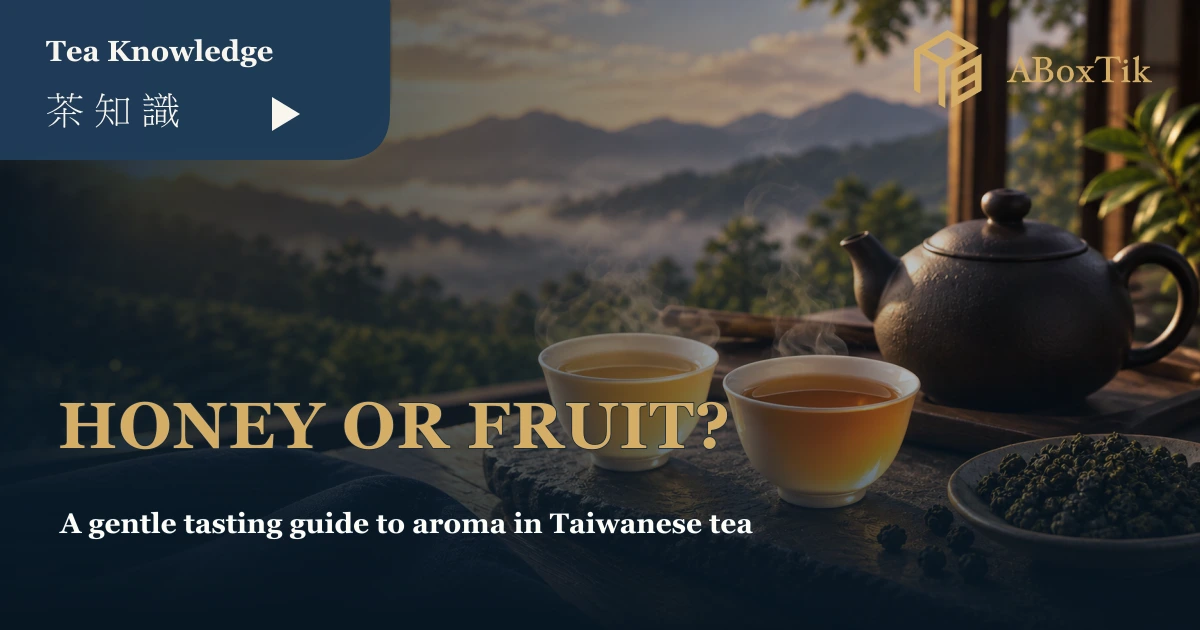
Some aromas melt slowly like afternoon honey; others open like ripe fruit. Listening for both need not turn a cup into a test.
Honey aroma and fruity aroma are not opposites, and neither proves that honey or fruit was added to tea. They are sensory associations. Honey notes often feel warm, rounded and sweet; fruit notes may read as green, citrus-like, stone-fruit, ripe or dried-fruit. Oriental Beauty and Red Oolong make a generous two-cup practice: identify the family first, then notice when it appears, how clearly it speaks and how long it stays.
Descriptors are a language, not an ingredient list
“Honey” is not a recipe claim, and “peach” is not a laboratory result. Leaf material, cultivar, harvest condition, processing, roast, storage and brewing all shape a cup. Taiwan’s specialty-tea flavour wheel places sweet and fruit families in a shared vocabulary. It helps a drinker describe an experience; it does not require every tea to match a fixed list.
Begin broadly. Honey may suggest nectar, molasses, cane sugar or a warm sweetness. Fruit may feel fresh and citrus-led, rounded and ripe, or closer to dried fruit. A note such as “a clean, ripe-fruit sweetness remains as the cup cools” is already useful. Naming one exact fruit is optional, never a test.
Why compare Oriental Beauty with Red Oolong?
Oriental Beauty can offer layered sweet and fruit associations; official Taiwan references include peach, citrus, pineapple, mango and lychee as possible vocabulary, not a promise for every lot. Honey Red Oolong and other Red Oolongs may present riper fruit, a rounded liquor and sweet aroma. Both families can meet in either tea, which makes them better for learning overlap than for assigning a single label.
Do not infer leafhopper activity, origin, cultivar, price or quality from honey aroma alone. The Tea and Beverage Research Station describes a relationship between tea green leafhopper feeding and the natural honey character of honey-aroma teas, but a cup cannot document a particular garden. Read what honey-scented tea means for that wider context, then keep the tasting note honest to the tea at hand.
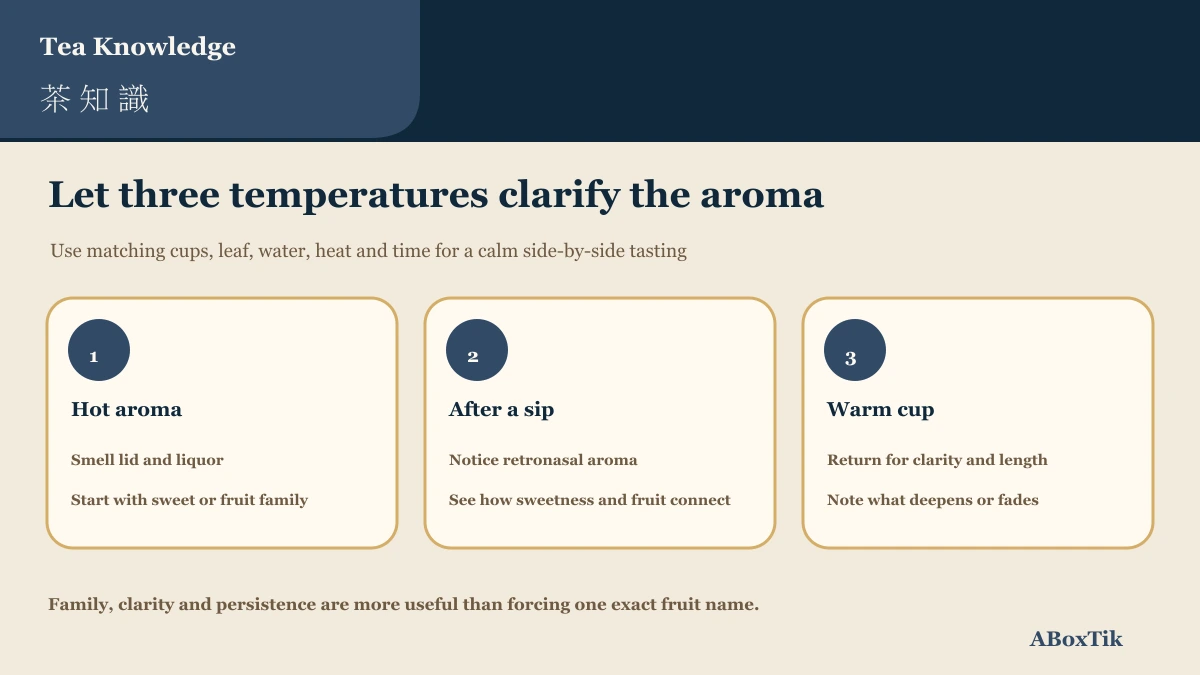
A calm three-stage comparison
Use the same vessel, leaf amount, water amount and close brewing conditions for both teas. First, smell the hot cup and record only a family: sweet-honeyed, bright-fruity, floral, roast-led. Second, notice retronasal aroma after a sip: does fruit become riper, does sweetness become more molasses-like, or does the tea change direction? Third, return when the cup is warm rather than hot. Is the aroma still clear, softer, or already gone?
This adapts the framework in ABoxTik’s tea aroma smelling guide without turning tea into an exam. Holding conditions steady simply gives the two cups a fair stage. If a later session changes water temperature or infusion time, change one thing and let the notes show what moved.
Two layers of notes
Layer one is family: sweet, fruit, floral, roast or vegetal. Layer two is behaviour: where it appears, whether it is clear or softly enveloping, and whether it persists. “Bright fruit in the hot cup, sweeter after sipping, clean when warm” gives more care to a future choice than “very fragrant.” A tea whose aroma is quiet has not failed; heat, roast or body may simply be carrying the conversation differently.
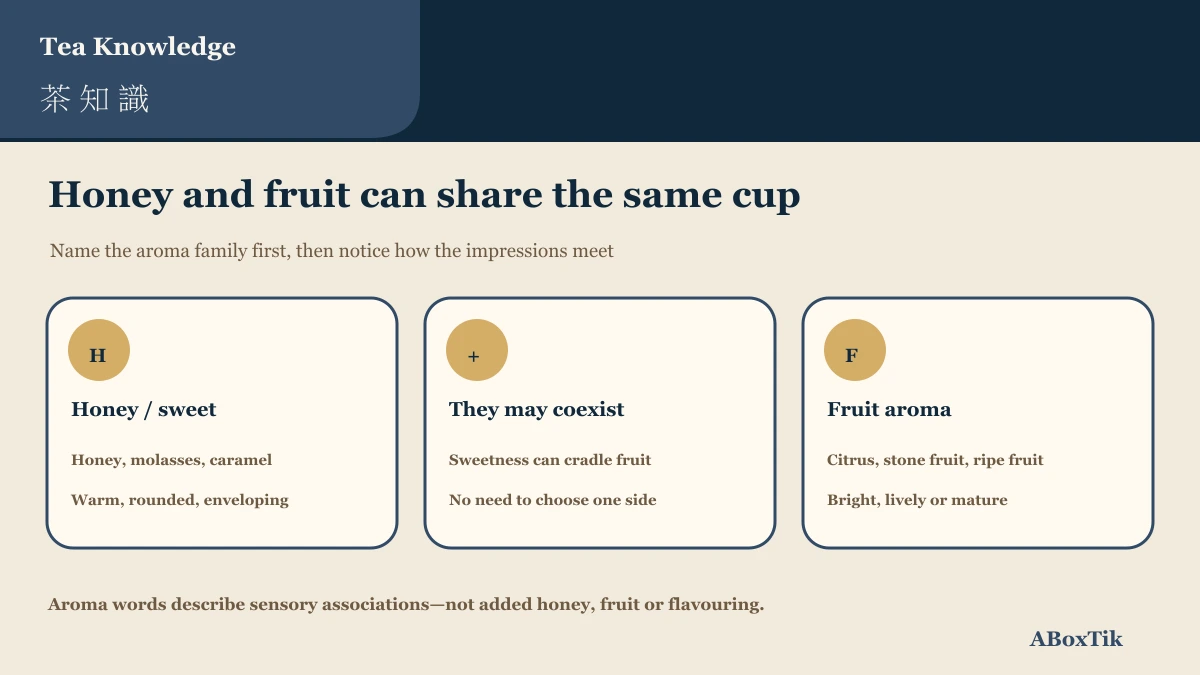
Three easy confusions
Sweetness is not automatically honey aroma. A sweet liquor or returning sweetness can exist without a honey-like nasal note. Ripe fruit is not automatically honey. The two may sit together in Red Oolong or stand apart. A product descriptor is not a guarantee. “Honey,” “ripe fruit” and “peach” are helpful style clues; live product details remain the source for the actual lot.
Official Red Oolong material describes a more oxidised, roasted oolong with ripe-fruit character, orange-red liquor and smooth body. A 2024 winter evaluation could describe plum, preserved plum, peach, honey and cane sugar in the same samples. The useful lesson is coexistence, not a checklist. For a separate look at roast and oxidation, see light versus roasted Taiwanese tea.
Let the observation guide a choice, not a verdict
A brighter fruit-led cup and a warmer honey-led cup are styles, not a ranking. The floral aroma guide adds another useful family, while the Taiwan tea regions guide gives place its proper context without treating origin as a flavour fingerprint. Browse the ABoxTik tea collection, six tea types, and why Taiwanese tea is special when a little more context feels welcome.
Keep the note for the next infusion
If the two cups feel close at first, there is no need to force a distinction. Return as they cool, or shorten both infusions a little in a later session. The aim is to make one change that can be noticed, not to make aroma perform more loudly. A date, the tea name and one certain impression are enough to make a future choice more considered. This is the quiet generosity of tasting: a vocabulary can grow slowly, without needing to be perfect on the first afternoon.
When language stays provisional, comparison remains generous: the cup is allowed to change, and the drinker is allowed to return tomorrow with fresh attention.
A gentle comparison can also be divided across two quiet sessions. In the first, note only the hot aroma and what returns after a sip. In the second, give attention to the warm cup and the cleanest lingering impression. This keeps a delicate tea from being rushed simply because an exact fruit name does not arrive at once. One person may favour a clear citrus lift, while another feels more at home with soft, honeyed depth; neither preference needs to displace the other.
If the water, vessel or pace of the day makes the result uncertain, “not sure today” is a perfectly useful note. It preserves honesty and makes room for a fairer return under similar conditions. Thoughtful service in tea is often this simple: prepare the comparison carefully, leave space around the experience, and let the guest’s own preference become visible without being told what it should be. That is enough care for one unhurried cup.
Common questions
Does honey aroma mean honey was added?
No. Here it is a sensory descriptor; ingredient and product information should always be checked on the live listing.
Can honey aroma prove leafhopper activity?
No. It can be part of a wider tea-making context, but a cup alone cannot prove farm conditions.
Is stronger fruit aroma always better?
No. Balance, clarity, flavour and overall harmony matter; preferences for bright or ripe styles are personal.
Theme recommendation: a two-cup starting point
Compare clearly described Taiwanese teas without rushing to settle every word. Current specifications, flavour notes and availability belong to the live product pages.
Sources
- Tea and Beverage Research Station: Taiwan specialty tea flavour wheel (checked 2026-09-28)
- Tea and Beverage Research Station: Honey-aroma tea (checked 2026-09-28)
- Tea and Beverage Research Station: Red Oolong tea (checked 2026-09-28)
- Tea and Beverage Research Station: 2024 winter Red Oolong evaluation (checked 2026-09-28)