
Tea Knowledge
Taiwanese Tea vs Taiwanese-Style Tea: Origin, Leaf and Process
A familiar tea-making style can travel far. Where the leaf grew still deserves to be named clearly.
Taiwanese tea vs Taiwanese-style tea is not a contest of quality. The two phrases answer different questions. Taiwanese tea is about where the leaf was actually grown, harvested, and made. Taiwanese-style tea can describe a familiar cultivar, set of machines, or processing approach—but it does not necessarily state where the leaf was grown. Read a tea label in three parts: leaf, growing origin, and process.
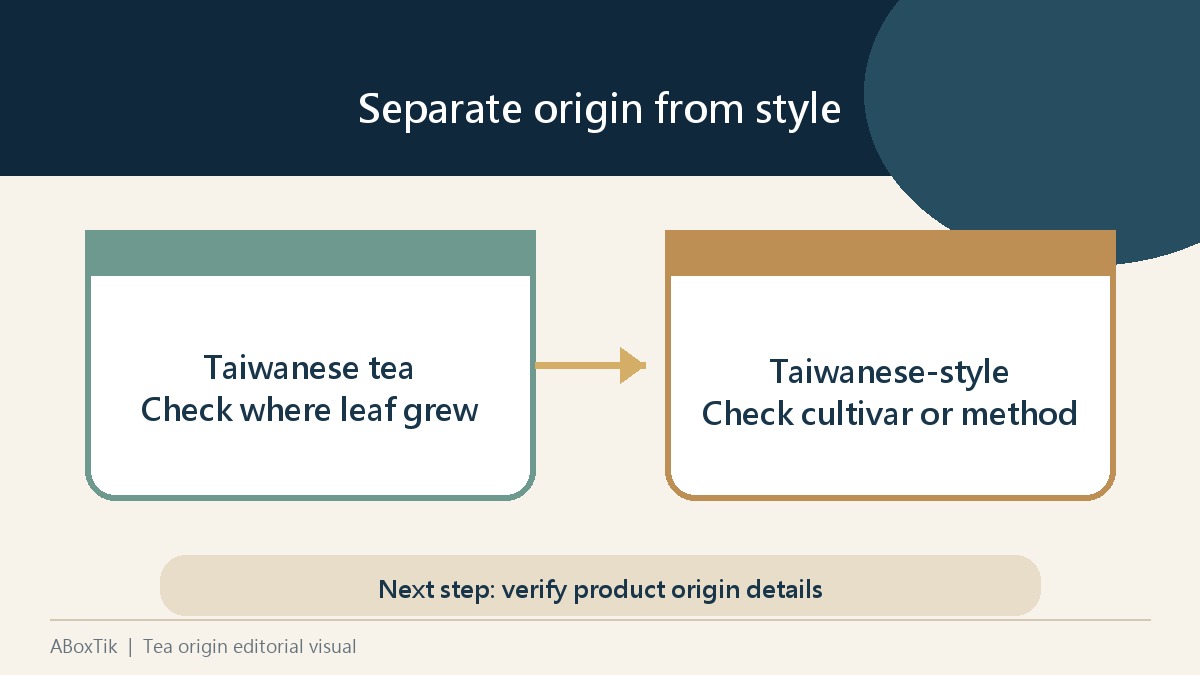
Taiwan’s Tea and Beverage Research Station explains that producers outside Taiwan may use Taiwanese tea cultivars, machinery, and techniques to make what it calls Taiwanese-style oolong. Where cultivars and methods overlap, origin cannot simply be decided by taste or DNA. This is not a judgement on a style; it is a reason to keep style and provenance separate.
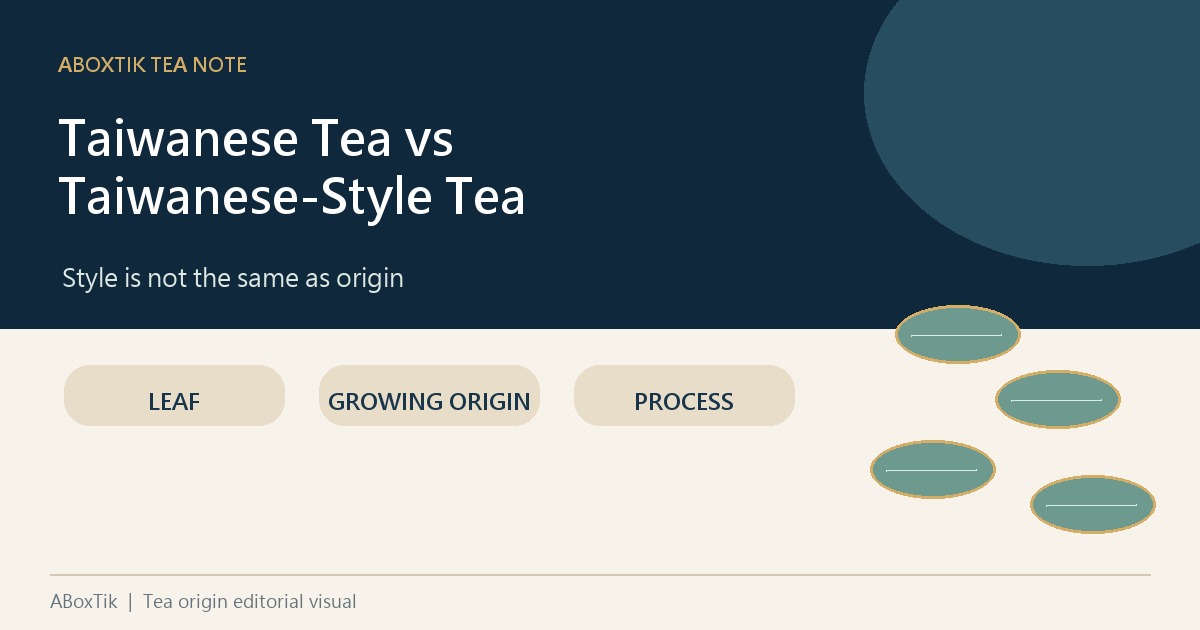
Origin tells you where; style tells you how
| Label wording | What it may describe | What to check next |
|---|---|---|
| Taiwanese tea | Leaf and production origin | Is there a specific region, producer, or lot? |
| Alishan, Lishan, Sun Moon Lake | A tea region or geographical clue | What cultivar, harvest, and process are stated? |
| Taiwanese-style oolong | A cultivar, machine, or processing style | Where did the leaf actually grow, and where was it made? |
In this guide, “Taiwanese tea” is a shopper-friendly origin description, not a certification for every package. For an introduction to the island’s regions, see our Taiwan tea regions guide. Here, the goal is narrower: do not let a familiar style phrase do the work of an origin statement.
The leaf: a cultivar is a clue, not a passport
Qingxin Oolong, TTES No. 12 (Jin Xuan), and TTES No. 18 (Ruby) identify cultivars or breeding lines. They can hint at suitability and character, but do not answer where a particular harvest grew. TTES No. 8, for example, is a cultivar name—not another name for Sun Moon Lake. Read our guide to TTES No. 8, origin, and black-tea style for a useful example.
When the same cultivars and methods can be used outside Taiwan, trying to “taste proof” an origin is not a reliable consumer method. Treat the cultivar as the first question; look for the growing origin and responsible producer next.
The place: read a region from broad to specific
Alishan is a tea-region name, not one cultivar or one fixed process. The Tea and Beverage Research Station groups Meishan, Zhuqi, Fanlu, and Alishan Township within Greater Alishan; Qingxin Oolong and TTES No. 12 are common there, and semi-ball-shaped partially oxidised tea is representative. A place name gives useful context, but cannot replace batch and maker information.
Start broad, then become specific: Taiwan; a county or tea region; the grower, maker, or packer; then a harvest or lot. More detail does not guarantee that every drinker will love the tea, but it makes comparison possible. For the different jobs of QR codes, traceability systems, and origin marks, see how to read Taiwan tea traceability.
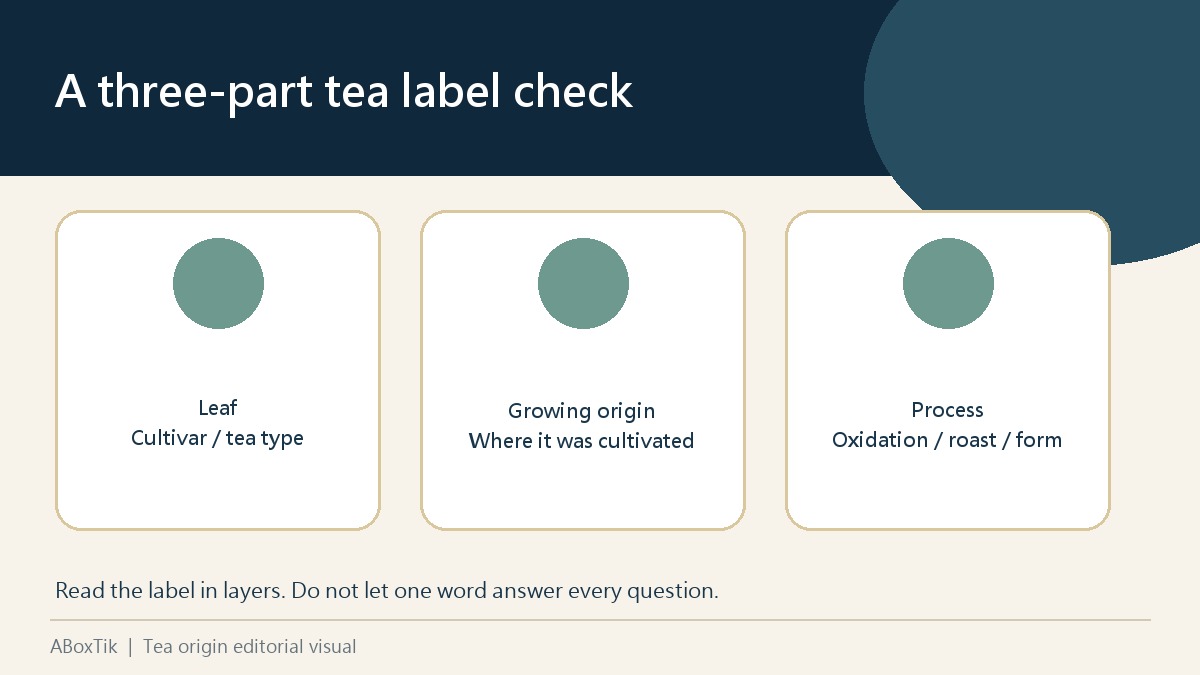
The process: vital to flavour, not proof of provenance
Withering, tossing, fixation, rolling, drying, ball-rolling, and roasting shape appearance, aroma, and taste. The Tea and Beverage Research Station describes Taiwanese specialty teas as the result of climate, cultivar, and processing working together. Process matters deeply—but it answers “how was it made?”, not “where did the leaf grow?”
Two oolongs may share similar leaf material but taste different after different oxidation and roasting choices. Explore oolong oxidation and processing or our tea aroma guide to understand style; neither can supply a missing origin claim.
A five-point label check before you buy
- Leaf: Is a cultivar or tea type identified, rather than only flavour language?
- Growing origin: Where was the leaf cultivated and harvested? Are growing, making, and packing locations distinguished?
- Process: Does the label explain the tea type, oxidation, roast, or form?
- Producer and lot: Is there enough information to ask a follow-up question?
- Do not use taste as a verdict: Floral notes, roast, or a rolled shape can signal style; they cannot alone establish origin.
Choosing a gift calls for one more layer: the recipient’s equipment, routine, and flavour preference. Our tea gift box guide can help turn clear information into a thoughtful choice.
Common questions
Is Taiwanese-style tea lower quality?
No. It describes style, not a quality grade. Judge a tea with its disclosed origin, leaf, process, storage, and your own preference.
Does a Taiwanese cultivar mean the tea is Taiwanese?
No. A cultivar identifies plant material. The growing and harvesting location still needs to be stated.
Can I tell origin just by tasting a high-mountain style oolong?
That is not reliable. The official research station notes that shared cultivars and methods cannot simply be separated by sensory judgement or DNA.
Does a QR code prove Taiwanese origin?
Not on its own. QR systems and marks have different purposes; check the corresponding record, product, responsible party, and date.
Clear origin makes style more meaningful
“Taiwanese-style” is not a phrase to dismiss. It can describe how knowledge and flavour travel. “Taiwanese tea,” however, asks for the leaf and place to be stated clearly. Once cultivar, region, and process are read separately, the story in a cup becomes more specific and more trustworthy.
ABoxTik begins with Taiwanese tea and believes a good introduction should not replace provenance with vague adjectives. For the wider picture, read why Taiwanese tea is special. Product contents, origins, and availability always follow the current product page.
Too many tea names? Give your shopping list three columns
A package may show a region, a cultivar and a tea style together. Instead of memorising the whole string, give each kind of information its own place: tea type, where the leaves were grown, and cultivar. Leave a field blank when the label does not answer it; products differ in the detail they provide.
| Column | What to record | What to check |
|---|---|---|
| Tea type and process | Oolong or black tea, with a separate note for roast or style | Keep a flavour description separate from the tea type |
| Leaf origin | The stated region or more specific location | Whether growing, processing and packing locations are distinguished |
| Cultivar | The cultivar stated for this product | Cultivar alone does not establish origin or finished flavour |
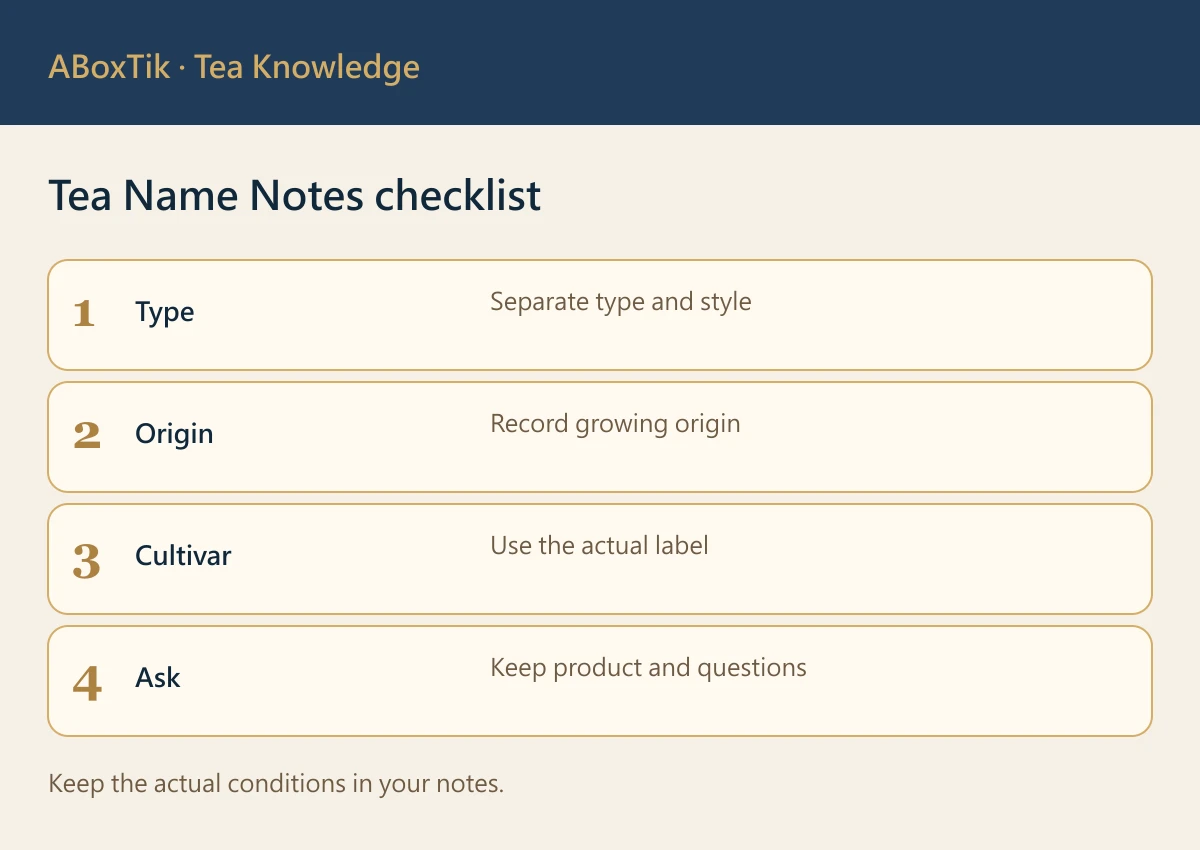
For example, a package might mention Alishan, Jin Xuan and oolong. Record these as a regional clue, a cultivar clue and a tea type, then check what the specific product says about where the leaves were grown. Do not fill in a garden or batch from a familiar place name. When asking a seller, include the complete product name, size and a picture of the label so the answer can be matched to the right item.
Two more notes make the list useful: net weight and price, followed by your own brewing conditions and impressions. Compare the same net weight and consider packaging or service separately. A blank marked ‘to confirm’ is more useful than a guess; the goal is a clearer next question, not a perfect memory test.
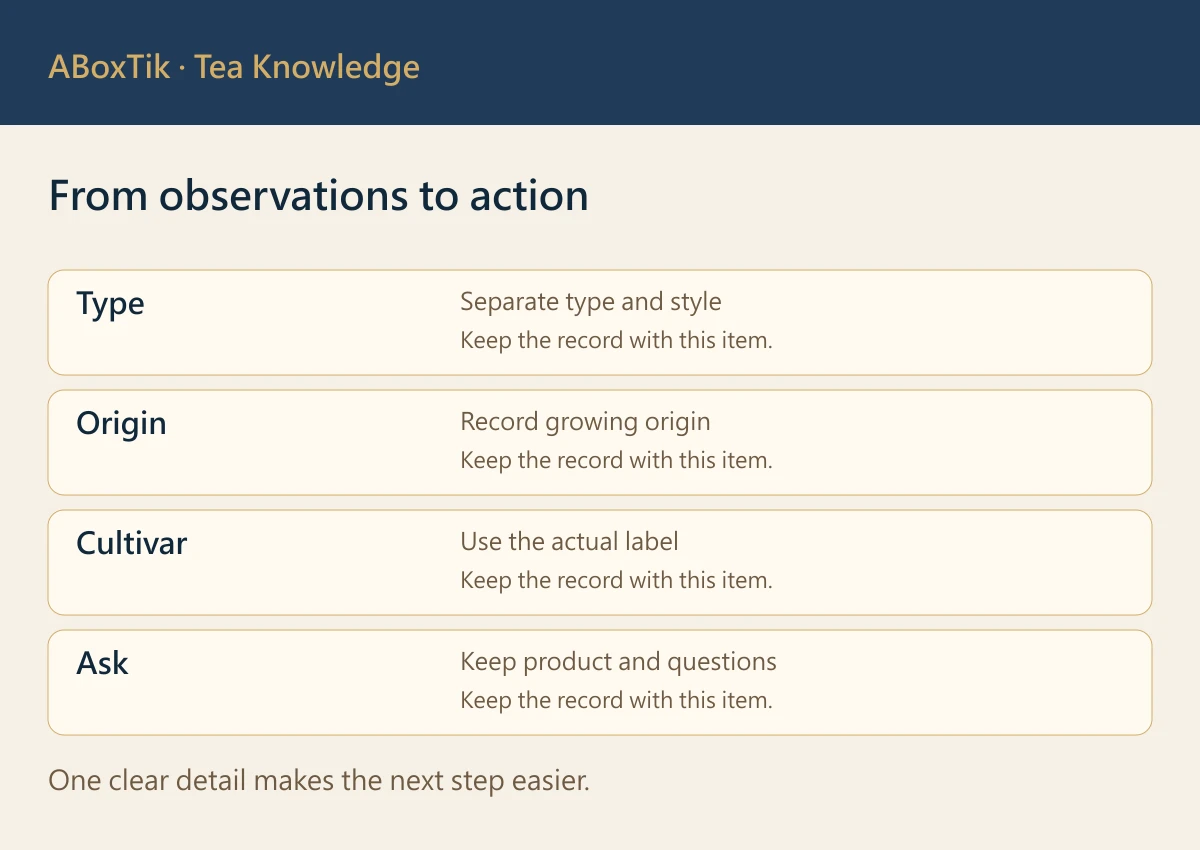
Give each product its own row: full name, tea style, leaf origin, cultivar and batch. Next to each field note whether it came from the package, the product page or an unanswered question. If two descriptions of the same product differ, keep both versions and dates and ask the responsible seller; do not select whichever answer sounds most appealing.
Before comparing two teas, decide what you want to understand. Is it a similar style from different places, or your preference between different processes? You can enjoy teas that differ in several ways, but keep the conclusion specific to those products. Record the amount purchased and whether the package can be resealed. If you buy slowly, a smaller format may make comparison easier to manage, while the original label remains available for storage and brewing details.
After drinking, note the actual preparation beside your impression: vessel, leaf, water, temperature and time. A memorable name may help you find the tea again, but it cannot replace those conditions. A blank is a useful reminder to ask, not a flaw in the table.
Sources for this addition
Sources
- Tea and Beverage Research Station: Tea Origin Identification Technology (accessed 2026-09-02)
- Tea and Beverage Research Station: Taiwanese Specialty Tea Classification and Processing (accessed 2026-09-02)
- Tea and Beverage Research Station: Characteristics of Central and Southern Tea Regions (accessed 2026-09-02)