
Tea, Tea Knowledge
What Is TTES No. 8? The Assam Roots and Malt Character of Sun Moon Lake Black Tea
The dark glow of black tea holds more than sunlight: it carries the story of a tea plant that crossed the sea and grew into a new name on an island.
TTES No. 8 is a Taiwanese black-tea cultivar selected from Indian large-leaf tea and officially named in 1973. Often marketed as Assam black tea, it is known for a bright red liquor, a gentle malt note and a substantial, full-bodied taste. It is a cultivar—not a place name—and it is not the same tea plant as Ruby Red, TTES No. 18.
At Sun Moon Lake, you may see “Assam black tea” on the front of a package and “TTES No. 8” in the details. Do those names always mean the same thing? They often point to the same cultivar, but careful labeling still matters. Rather than retelling the entire factory story, this guide follows the tea plant itself: where its lineage came from, why it became important in Yuchi, and what its name can—and cannot—tell you about the cup. For the regional history, begin with ABoxTik’s guide to Sun Moon Lake tea factories and Assam black tea.
TTES No. 8 is a cultivar, not a geographical origin
Numbers such as TTES No. 8 identify tea cultivars that have gone through selection, evaluation and formal naming in Taiwan. A cultivar is not a manufacturing method, a quality grade or proof of one particular origin. According to Taiwan’s Tea and Beverage Research Station, No. 8 was selected from an Indian large-leaf tea population. It is a large-bud cultivar suited to black-tea manufacture and was approved for naming in 1973. The station’s cultivar table records the selection as Jaipuri and notes that the line had been selected as early as 1941.
This distinction resolves a common misconception. No. 8 has Assam-type Indian ancestry, yet decades of selection and cultivation in Taiwan made it a formally named Taiwanese cultivar. It does not mean “tea imported from India and packed in Taiwan.” Conversely, a black tea grown around Sun Moon Lake should not automatically be assumed to be No. 8. If you are still separating black tea from oolong and other families, see ABoxTik’s introduction to the six major tea types and its explanation of tea oxidation and processing.
A cultivar gives tea its frame; terroir and craft give it breath. The same name can still speak with a different weight from one lot to the next.
Why is TTES No. 8 so closely associated with Sun Moon Lake?
Yuchi and Puli are among Taiwan’s historically important black-tea districts. Current information from the Tea and Beverage Research Station identifies TTES No. 8 and No. 18 as the area’s principal cultivars, with smaller plantings of No. 21. That local concentration explains why “Sun Moon Lake Assam” and No. 8 so often appear together. The region contributes climate, soil and a community of growers and makers; the cultivar contributes its leaf form, growth habits and suitability for black tea. Neither term replaces the other.
It helps to separate the three labels:
| Label | What it mainly identifies | What still needs checking |
|---|---|---|
| TTES No. 8 | A formally named tea cultivar | Origin, harvest, maker and lot |
| Assam black tea | Often black tea made from Assam-type large-leaf plants; market usage can be broad | Whether the cultivar is specifically TTES No. 8 |
| Sun Moon Lake black tea | A geographical and product identity centered on Yuchi and the surrounding area | The actual cultivar may be No. 8, 18, 21 or another tea plant |
To place Yuchi on the island’s wider tea map, read the Taiwan tea regions and terroir guide. For a wider view of the category, continue with seven representative Taiwanese black teas and ABoxTik’s overview of well-known Taiwanese teas.
Five useful sensory clues for recognizing TTES No. 8
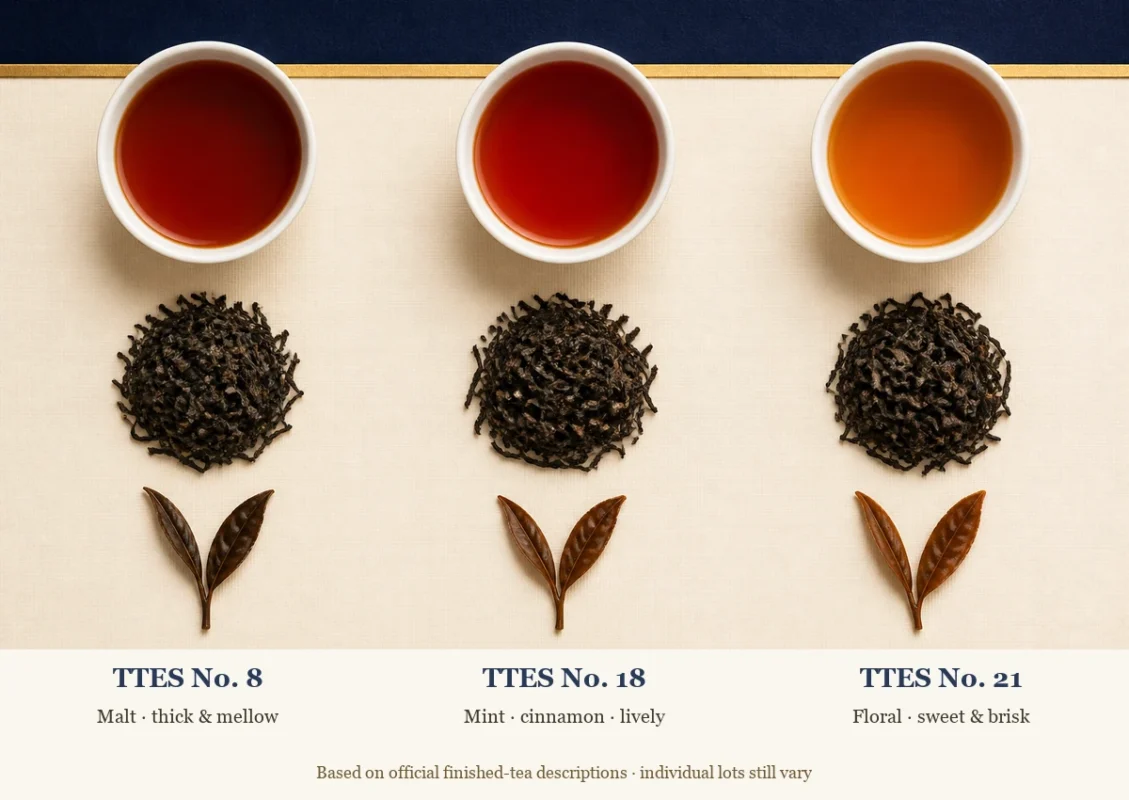
The Tea and Beverage Research Station describes No. 8 black tea as having relatively large twisted leaves, an oily black appearance with some pale tips, a bright red liquor, a light malt aroma and a thick, mellow taste. These are credible reference points, but they are not a promise that every package will taste identical.
- Dry leaf: Material from a large-bud cultivar may produce substantial-looking twists, although picking standard and rolling have a strong effect on size.
- Liquor: Expect a red to deep amber cup. Water, leaf-to-water ratio and infusion time can make the color noticeably lighter or darker.
- Aroma: A gentle malt note is the official sensory cue. Some lots may also remind a drinker of brown sugar, ripe fruit or grain, but these are perceptions rather than added ingredients.
- Structure: No. 8 often has body and briskness. “Strong” does not have to mean harsh; over-extraction is what most readily magnifies astringency.
- Use: It can work as a straight tea and has enough structure to meet milk or spices. Suitability for milk tea still depends on the particular lot and the drinker’s preference.
A cultivar creates tendencies, not a fixed flavor script. Season, garden management, leaf maturity, withering, rolling, oxidation, drying and storage can all move the final tea in different directions. That is also why a cultivar name alone is never enough when evaluating a rare or premium tea.
TTES No. 8 vs. No. 18 and No. 21
| Cultivar | Official breeding record | Official finished-tea description | A helpful starting point |
|---|---|---|---|
| TTES No. 8 | Selection from Indian large-leaf tea; named in 1973 | Light malt aroma; thick and mellow | For drinkers who enjoy substantial black tea, straight or with milk |
| TTES No. 18 / Ruby Red | Cross between Burma large-leaf tea and Taiwan wild tea; named in 1999 | Mint and cinnamon notes; rich and lively | For drinkers drawn to distinctive cooling spice |
| TTES No. 21 / Hong Yun | Descended from Indian large-leaf and Keemun breeding material; named in 2008 | Delicate Rutaceae-family blossom note; sweet and brisk | For drinkers who prefer a floral-fruit direction and a lighter sweetness |
These are not first-, second- and third-place teas. They are three different cultivar directions. ABoxTik’s complete guide to TTES No. 18 Ruby Red explains the breeding and its characteristic mint-cinnamon profile. When tasting the cultivars side by side, choose teas of similar season, processing and storage wherever possible; otherwise, a manufacturing difference may be mistaken for a cultivar difference.
How to brew TTES No. 8
The following figures are adjustable editorial starting points, not universal rules. If the grower or maker provides directions for the specific lot, use those first.
| Style | Starting ratio and temperature | Time | How to adjust |
|---|---|---|---|
| Western-style straight tea | 3 g per 150 ml, 90–95°C | About 2.5–3 minutes | If too astringent, shorten the time before lowering temperature; if weak, add leaf |
| Small-pot brewing | 5 g per 150 ml, 90–95°C | About 40–50 seconds for the first infusion | Add roughly 10–20 seconds as the leaves open |
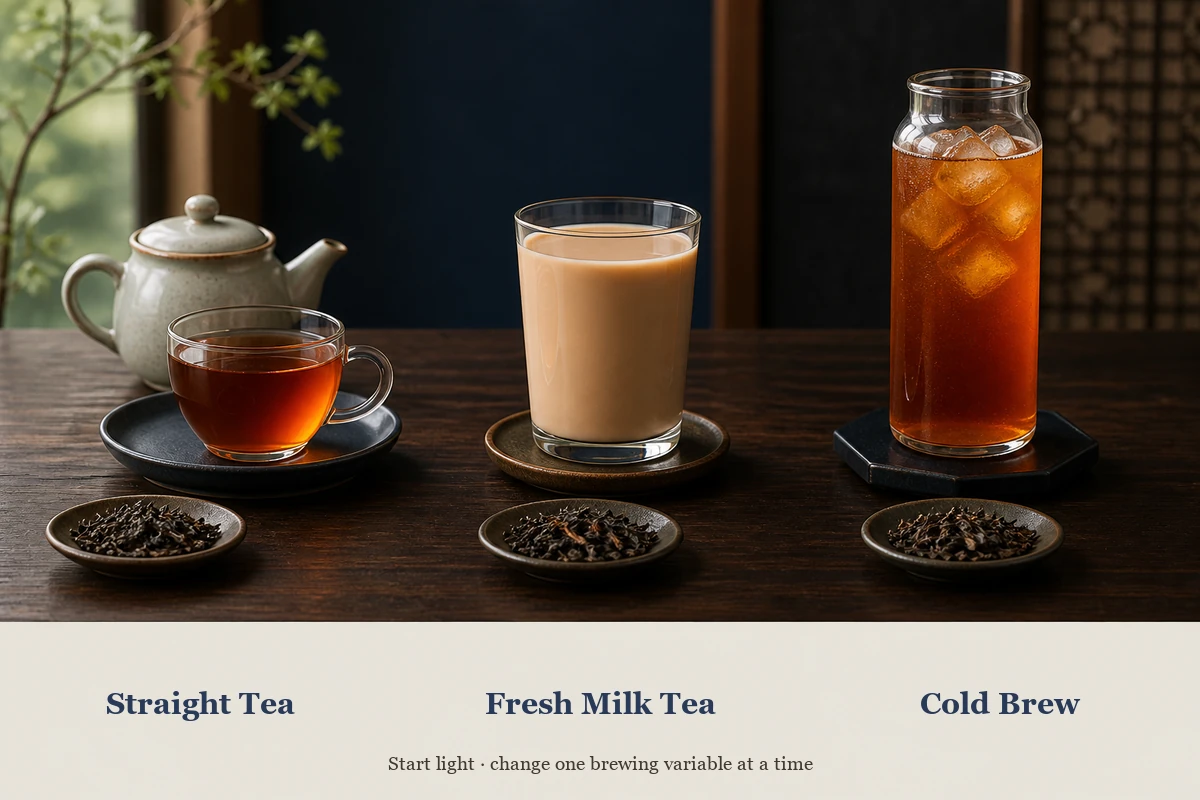
| Fresh milk tea | Use more leaf or a slightly longer infusion to make a concentrated base | Adjust by lot | Add milk gradually so the malt character and tea structure remain visible |
For a repeatable routine, consult ABoxTik’s guide to tea amounts, temperatures and brewing steps. No. 8 can also be cold-brewed, although a low-temperature infusion presents aroma and briskness differently. The cold-brew tea ratio and timing guide provides a practical starting point; begin lighter, then adjust one variable at a time.
Six label details to check before buying TTES No. 8
- Explicit cultivar: “Sun Moon Lake black tea” or “Assam black tea” alone does not prove that the tea is No. 8.
- Specific origin: Look for Taiwan, Nantou, Yuchi or more detailed producer information; scenery on a package is not traceability.
- Harvest and lot: Season, year and batch make differences easier to understand and a good tea easier to buy again.
- Leaf format: Whole-leaf twists, broken tea and tea bags extract at different rates and should not be brewed with identical timing.
- Sensory language: Malt or brown-sugar notes are tasting descriptions, not evidence of added sugar or flavor. Added ingredients should be declared separately.
- Responsible business information: Check the maker or distributor, storage directions, best-before date and any available origin-traceability details.
If a single-origin No. 8 is not currently available, there is no need to market another cultivar as a substitute. You can build a Taiwanese cultivar reference through teas such as TTES No. 12 Jinxuan Oolong, TTES No. 13 Green Jade Oolong, or the ripe-fruit sweetness of Honey Red Oolong. To compare more than one style, check the current selection in the two-tea gift box; product composition and stock should always follow the live page.
Frequently asked questions about TTES No. 8
Is TTES No. 8 the same as Assam black tea?
No. 8 comes from Indian Assam-type large-leaf tea and is often sold as Assam black tea in Taiwan. However, “Assam black tea” can also be used more broadly. Check the cultivar details rather than relying on the product name alone.
Is TTES No. 8 the same as Ruby Red?
No. Ruby Red is TTES No. 18, bred from Burma large-leaf tea and Taiwan wild tea. No. 8 was selected from Indian large-leaf tea. Their official naming dates and characteristic aroma descriptions also differ.
Does TTES No. 8 always come from Sun Moon Lake?
No. TTES No. 8 is a cultivar, while Sun Moon Lake identifies a region and product tradition. Yuchi and Puli are important growing areas for No. 8, but the origin of any package must be verified from its own label and traceability information.
Is TTES No. 8 good for milk tea?
Its typical body and malt character can stand up well to fresh milk. Because leaf form and strength vary between lots, brew a concentrated but balanced base first and add milk gradually.

Follow ABoxTik
A cultivar number that reveals the depth of Taiwanese black tea
The appeal of TTES No. 8 is not that one number guarantees one flavor. Its story matters because an Indian large-leaf tea came to Taiwan, passed through selection, cultivation and craft, and found a lasting place in Yuchi’s black-tea tradition. Once cultivar, origin and finished tea are separated, malt is no longer just an adjective—it becomes a clue that can be checked, compared and remembered.
ABoxTik wants Taiwan’s finest products to be understood as well as seen. Continue with why Taiwanese tea is special and the ABoxTik story. To see how tea and local craft can travel together, explore the limited-edition tea box and Taiwanese craftsmanship.
Sources
- Taiwan Tea and Beverage Research Station: Black-tea cultivars developed by the Central Branch (checked 2026-08-22)
- Taiwan Tea and Beverage Research Station: Characteristics of central and southern tea districts (checked 2026-08-22)
- Taiwan Tea and Beverage Research Station: Table of formally developed tea cultivars (checked 2026-08-22)