
Tea Knowledge
Office Tea Supply Procurement: Usage, Reordering and Gift Boundaries
Office tea supply procurement starts with recurring use, a reorder point and a named owner. Corporate gifts need a separate recipient, occasion and delivery brief. Divide those jobs before choosing a format that the office can comfortably prepare and replenish.
The pantry mystery is usually not who drank the final cup. It is why everyone thought someone else would replace it. A transparent estimate and a small responsibility table can solve more than another urgent message.
Separate pantry supply from a gift brief
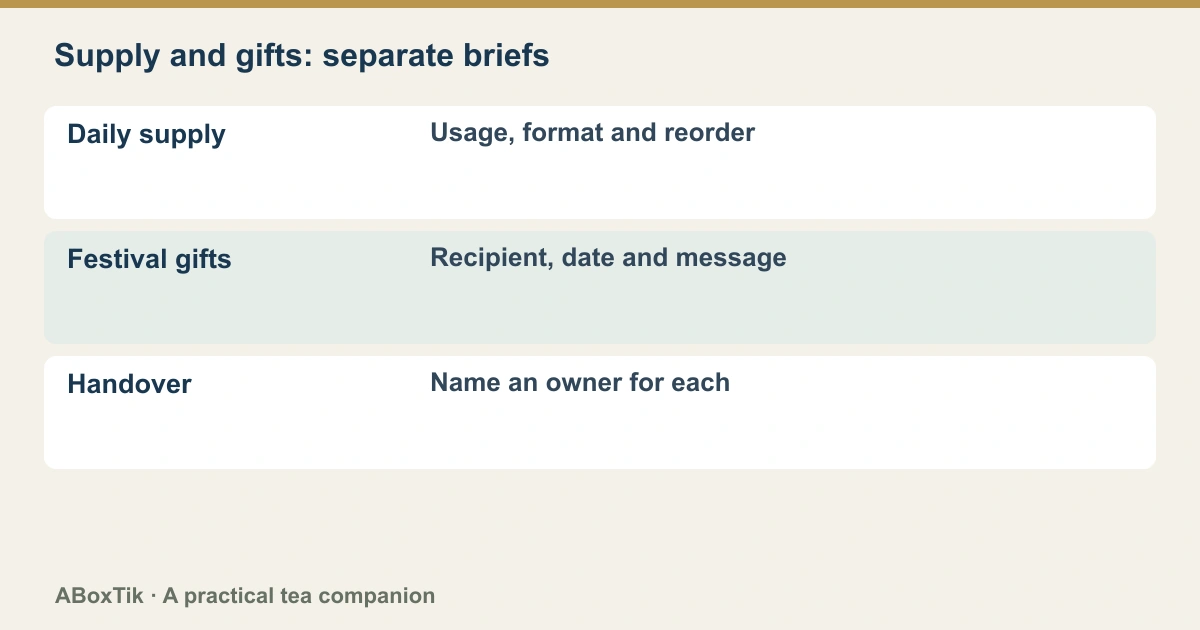
Office tea supply procurement is recurring service: who drinks, who checks stock and what happens when it is low. A corporate gift is a one-time presentation: recipient, message, date and delivery. Tea appears in both, but the decisions differ.
Separating the briefs prevents a pantry refill from quietly consuming a recognition budget.
For recurring supply, completion means tea is easy to find, preparation is clear and someone knows when to buy again. For a gift, it also means the intended message and delivery reach the recipient. Put the purpose at the top of each sheet so an approver can see which task the purchase serves.
Make the monthly estimate visibly hypothetical
Use an explicit planning formula: active drinkers × portions per person per week × work weeks. Label every input as an assumption, then revise it after one month of observed use.
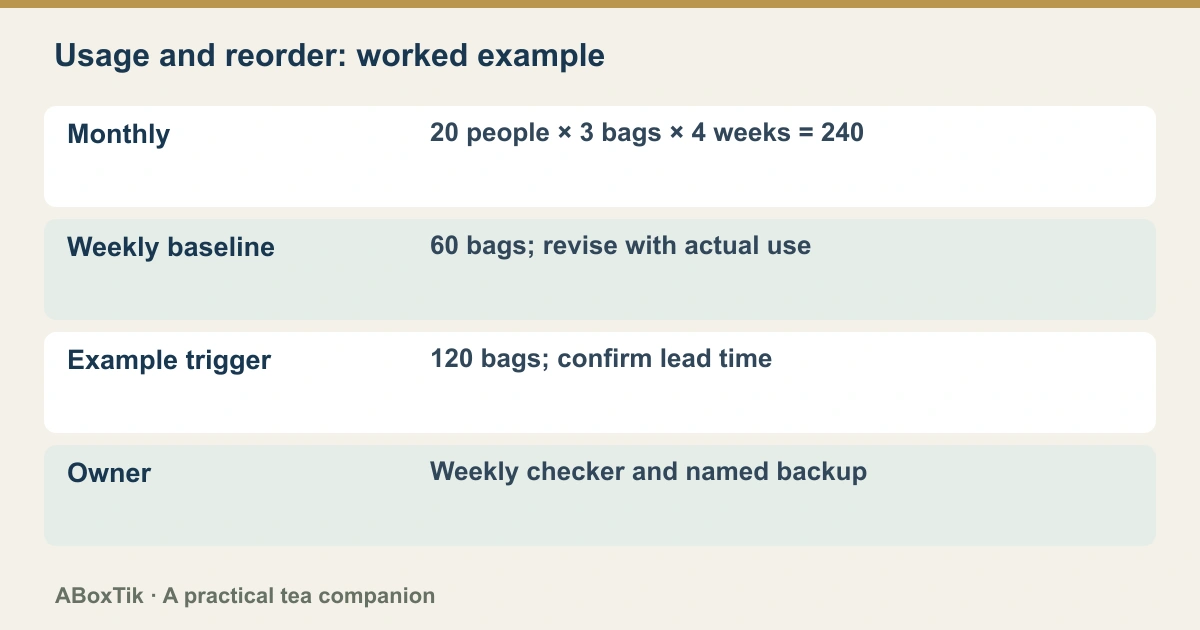
For example, 20 people × 3 portions × 4 weeks gives a 240-portion planning baseline, not a claim about any product pack or real consumption.
Define a portion before multiplying. In this example, one portion means taking one bag once; possible later infusions are not counted in advance. Put guest service on a separate estimated line. For shared pots, record how many bags go into a pot instead of silently treating cup count as bag count. Revise the estimate with actual opened packs and remaining bags.
Set a reorder trigger and an owner
A useful trigger can be “reorder at two weeks of baseline stock.” Name the checker, purchaser and backup person. It does not require a tea committee; it requires a visible handoff.
Use four columns: item, baseline assumption, reorder point and accountable role.
The trigger also needs a confirmed lead time. At the example baseline of 60 bags a week, two weeks means 120 bags. That is a worked example, not a universal threshold. If the supplier needs longer, adjust the lead-time and buffer assumptions. A visible order date and expected arrival can prevent two helpful colleagues from ordering the same stock.
| Item | Planning baseline | Example trigger | Role |
|---|---|---|---|
| Daily tea bags | 60 a week | 120 remaining; check lead time | Admin checks weekly; named backup |
| Guest service | Separate estimate | Check before each meeting | Host confirms; admin orders |
Choose a format the office can actually finish
Individual cups, guest service and a named preparer are different needs. For brewing detail, see the office tea workflow; this article stays with procurement.
Check the current Classic Taiwan Tea listing before using it as a planning input. A gift set count is not automatically a serving count.
The current Classic Taiwan Tea listing describes four packs of ten bags, or 40 bags in total. Against the hypothetical 240-bag baseline, 240 ÷ 40 gives six sets. This is a quantity conversion, not a reason every office needs six gift presentations or an offer of a refill programme. Consider whether that packaging fits the routine, and ask about the available purchase formats.
For format, labelling and colleague preferences, read the office tea-bag selection guide. This page keeps the usage and reorder responsibilities together.
Open a separate brief when the purpose becomes thanks
For a festival, client or milestone, record recipient, quantity, date, delivery and message separately. Those are not refill variables.
Use the tea gift guide for that job, so a gift retains its presentation and the pantry keeps its baseline.
A company can have both needs while keeping their quantities and dates separate. A pantry sheet does not need a card message; a gift brief does not need the office monthly consumption. The corporate tea gift enquiry template helps with the latter. Keeping the jobs distinct makes both easier to review.
Ask, then confirm
For formats, lead time or business requirements, use Contact Us with the purpose, estimated users, start date and questions. Separate recurring pantry supply from festival delivery so the shop can answer the right request.
Use the current product listing for items that can be selected directly. Give any pending quotation or condition a named follow-up owner, and record enquiry and order dates separately. That lets a colleague see the current stage without guessing.
A useful enquiry might read: “This is recurring office tea for about 20 active drinkers. Our planning assumption is 240 bags a month, starting in [month]. Please confirm available formats, quotation, lead time and later reorder options.” Bring the confirmed response back to the stock sheet so colleagues do not have to search an old conversation for the latest answer.
Review four real questions monthly
What was used? What remained? What was inconvenient? Who checks next? These four questions correct an assumption faster than a polished forecast.
Write “not yet observed” where there is no evidence. It is more useful than inventing office habits.
Count unopened packs and loose remaining bags separately, grouped by tea. If overall stock is adequate but one style regularly runs out first, change the mix. If use is below the baseline, reduce the next order. Before assuming a remaining pack is unpopular, also check whether colleagues can find it and understand how it is prepared.
Keep the system human-sized
A good supply routine means colleagues can find tea, the owner avoids emergency shopping and gifts still feel intentional.
The best pantry KPI may simply be fewer messages saying the tea disappeared again.
For a handover, keep the items, owner, backup and sheet location together. A colleague covering leave should be able to handle the next stock check and see orders already placed without restarting the whole investigation. Office tea supply procurement works best when a cup is easy to find and replenishment rarely becomes a conversation.
Office tea supply procurement becomes manageable with a defined portion, a realistic reorder trigger and a visible handover. Review actual use at month end and keep festival gifts in their own brief. Less confusion in the sheet leaves a little more room for an ordinary, enjoyable cup.

The pantry can be replenished without panic and a gift can keep its occasion; browse gifts, articles and current selections without asking one spreadsheet to wear every hat.