
Tea Knowledge
What Is Forest-Understory Tea? Taiwan Native Tea Explained
Begin with the forest as the part of this tea story that deserves careful attention.
Forest-understory tea is an informal description. In Taiwan’s official framework, the policy is the forest-understory economy, and the listed native tea item is Taiwan mountain tea, Camellia formosensis. The framework brings forest functions, lawful land use, review and management conditions together. A tree-filled setting alone does not establish that a tea comes from this system.
For a drinker, the useful first questions concern the actual product: its tea identity, origin, batch and the people responsible for growing, managing the land, processing and selling it. Clear information makes a choice easier without asking a poetic forest name to answer every question. This guide follows the current official consumer context rather than offering cultivation instructions.
An everyday name and an official framework do different jobs
The Forestry and Nature Conservation Agency describes the forest-understory economy as small-scale, non-excessive management of forest by-products beneath the canopy while maintaining forest vegetation and functions. The forest remains part of the managed system. The idea is not simply to turn a wooded site into another neatly arranged agricultural field.
In everyday conversation, “forest-understory tea” can be a convenient starting phrase. When reading official information, look for the policy term 林下經濟 and the listed tea item 臺灣山茶. One names the managed-use framework; the other identifies the native tea item within the current technical conditions. Keeping both in view helps prevent high-elevation tea, shaded tea and forest-themed marketing from sliding into the same category.
TTES No.24 Shanyun introduces a separate cultivar and product question, while Taiwan tea regions helps interpret place names. Neither substitutes for the identity of the tea in a particular packet. When several names sound similar, a smaller question is useful: what does this product actually say it is? A clear label is often a better starting companion than an imagined mountain story.
Retaining forest functions comes before the tea story
Canopy and existing vegetation remain important to the official framework. That is why it cannot be reduced to permission to plant or gather tea anywhere in a forest. Current rules involve qualifying land, lawful use relationships, review and site inspection. A consumer does not need to master an application form, but knowing that these conditions exist gives the product description a clearer context.
The current rules also address maintaining forest vegetation and prohibit herbicides, insecticides and chemical fertilizer within the approved forest-understory operation. These are management conditions in that framework. Organic status or another product verification has its own evidence; the management description alone does not assign that status to a retail tea.
This distinction makes shopping less mysterious. Look for the facts the seller can connect to the actual product, and keep verification information in its own column. A cultivation story, a batch number and a product-specific mark each answer different questions. If one detail is unclear, ask about that detail rather than trying to infer every land-use and business relationship from the front of a box.
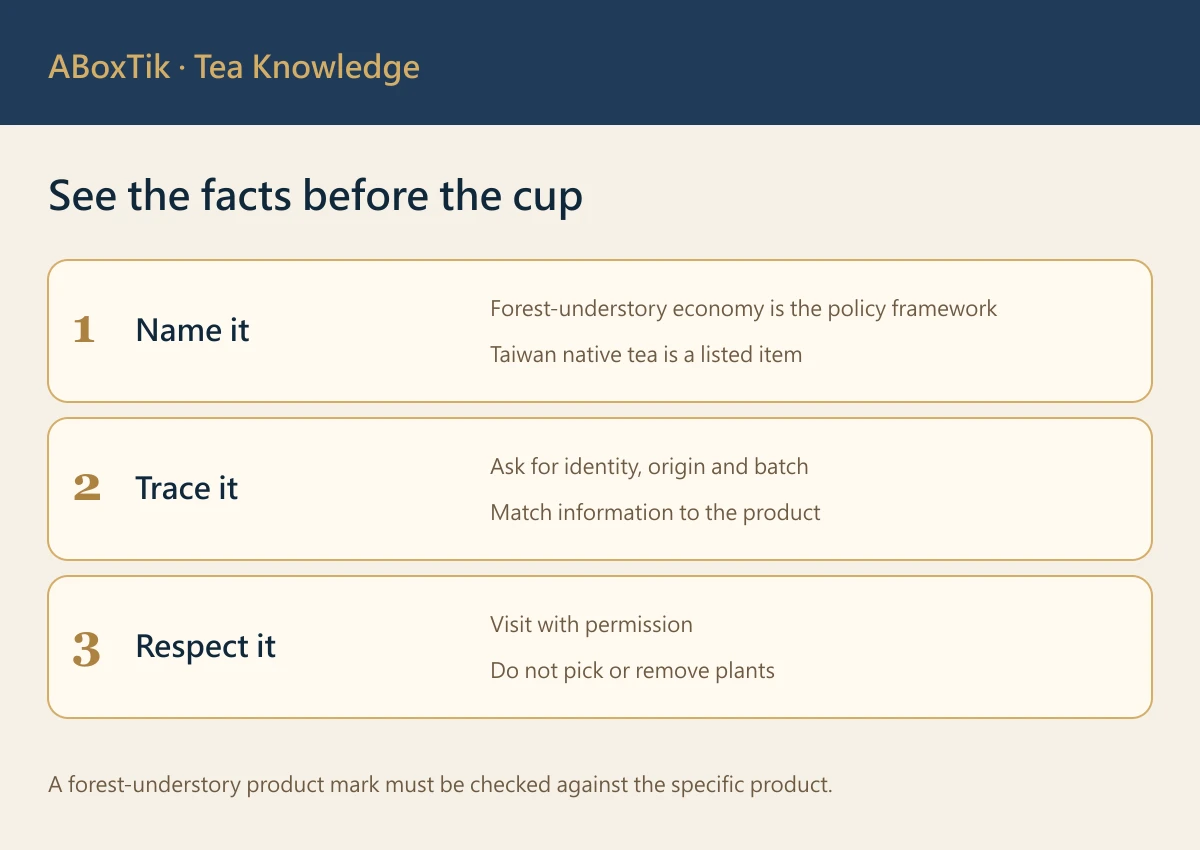
Native tea, high-mountain tea and shade descriptions are different clues
High-mountain tea is commonly used as an origin or style description associated with elevation. Shade-growing can describe a growing environment. A wild or forest name may be part of a product narrative. None of those descriptions alone establishes that a tea is the Taiwan mountain tea item within an approved forest-understory operation.
The current technical conditions connect planting location and planting material to native provenance. Read this as part of protecting diversity in the policy context. It is more specific than a general promise that every tea with a mountain name belongs in the same drawer. The terminology helps ask better questions; it does not arrange the teas into a universal ranking.
| Description | What it may tell you | What to ask next |
|---|---|---|
| Official forest-understory Taiwan mountain tea | Policy item and provenance conditions | Actual product identity, source and responsible parties |
| High-mountain tea | Origin or elevation-related style | Cultivar, process and actual source |
| Shade or forest imagery | Growing context or narrative | Specific supporting product information |
Understanding high-mountain tea quality extends the origin question. Traceability and certification separates source information from verification. Each question has its own useful answer; the table simply keeps them from borrowing one another’s clothes.
Ask about provenance, batch and responsible roles
An exact tea name, production area, harvest year or season, batch and processor give a buyer something concrete to return to. The information need not read like a research paper. It needs to be specific enough to connect with the product. If a later cup is especially enjoyable, those details help identify what to ask for again.
The grower or land manager, processor, project partner and retail brand may be different people or organizations. Where information is supplied, keep their roles separate. Understanding who did what follows the tea’s actual route more closely than concentrating every story into one brand name. A retailer’s name by itself does not establish the land-use status of a growing site.
Reading single-origin Taiwanese tea and Tea quality labels provide useful background for the next packet. Keep source, batch and verification as separate entries. A batch number provides traceability context; a particular verification claim needs its own supporting information.
If a seller claims the official forest-understory product proof mark, ask for label or verification information that corresponds to that specific product. The agency describes the mark as a separate product proof mechanism involving third-party verification. Connecting the evidence to the product gives careful production information the clear place it deserves.
Let the actual cup describe its flavour
A forest setting can create an expectation before the kettle is filled. The finished tea still reflects material, processing, storage and preparation. Rather than deciding in advance that it must taste sweeter, wilder or better, begin with what is present: a fresh, developed, woody or other familiar aroma association, followed by an impression of the liquor’s texture.
For a first tasting card, keep three entries: identity and batch from the packet, one aroma association, and one question to revisit. Tea aroma observation offers everyday words, while Tea mouthfeel and strength observation helps separate weight and movement. They offer language rather than an answer everyone must find.
Prepare different teas according to their own package guidance, then compare the same small question. If one cup changes as it cools, add the tasting moment to the note. Comparing too many things at once can leave only a memory of washing cups. A slower round gives the tea a better chance to be remembered.
Preference can remain simple. “I would like another cup” is useful information even before an elaborate description arrives. Pair that preference with a source and batch note, and the next purchase becomes easier to discuss without turning a personal impression into a claim about every forest-grown tea.
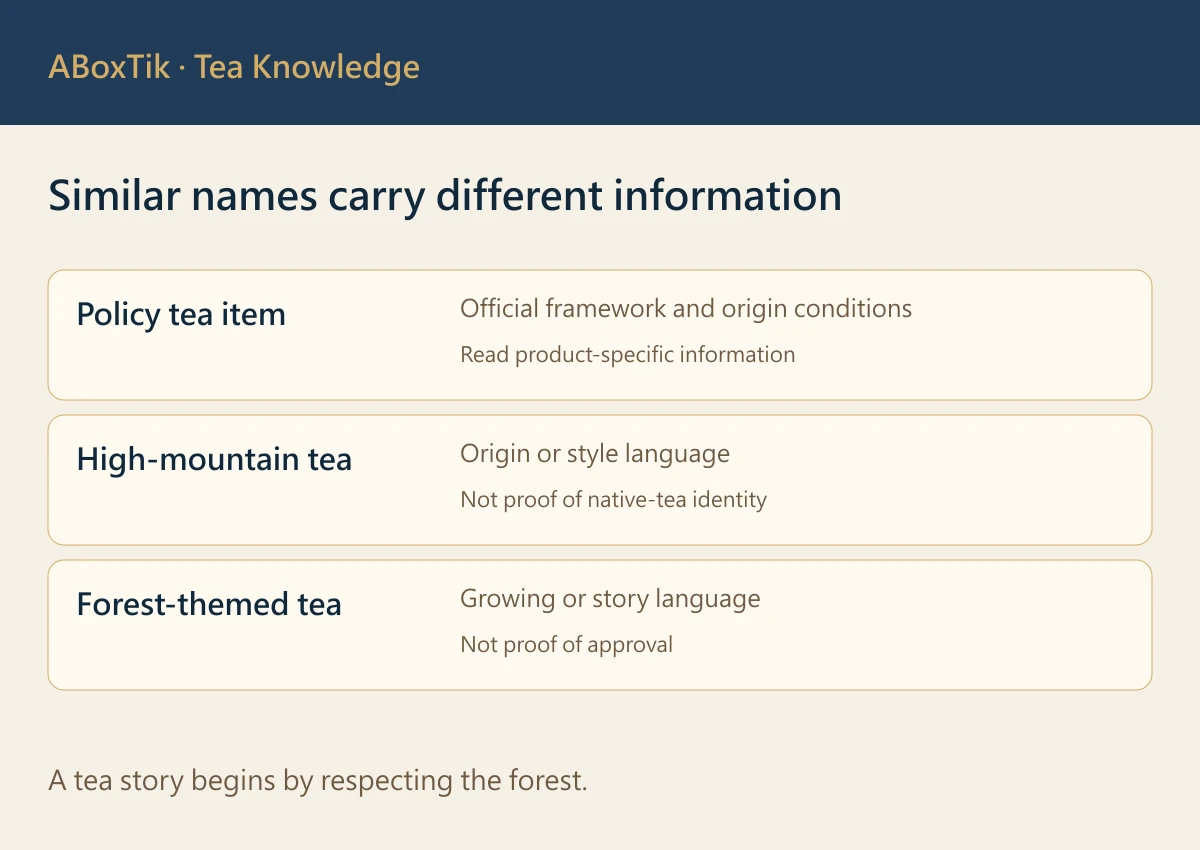
Put permission before the camera on a visit
Forest-understory production is not an invitation to public gathering. Visit through an announced arrangement or with permission from the land manager or organizer, and follow the instructed route and site rules. A place can have an interesting tea story while still being a workplace, managed land or a forest with access conditions.
Leave leaves, branches, seeds, soil and other forest material in place. Do not pick, take cuttings or attempt propagation as a visitor; follow only activities that the operator has expressly arranged and supervises. A visit does not need a leaf in a pocket to prove that it happened.
Listening to a production story, observing the landscape from the permitted route and preparing tea carefully after returning home are enough to carry a place into memory. Ask before photographing work or people, and give the host room to say that a particular area or activity is unavailable.
Preparing tea for a visit develops the observation-card approach, while Tea-garden biodiversity opens another view of tea’s surroundings. Asking, waiting and respecting the answer can be a more useful way into a landscape than trying to bring part of it away.

Follow ABoxTik
Bring a little forest-minded care to the next cup
Clear identity and provenance leave room for quieter curiosity. Read the packet, notice the aroma and keep one reason for enjoying the cup. A forest story becomes easier to understand when its details can be explained.
Continue with Taiwan tea origins and craft, or use the tea gift selection guide to consider how a tea will be shared.
Related reading
Sources
- Forestry and Nature Conservation Agency: Forest-understory economy
- Ministry of Agriculture: Current forest-understory review rules, revised 12 February 2025
- Forestry and Nature Conservation Agency: Current technical attachment
- Forestry and Nature Conservation Agency: Product proof mark
Sources checked 19 October 2026.