
Tea Knowledge
Remote Employee Tea Gifts: A Home Delivery Checklist

A tea gift sent home begins with a choice that is comfortable to receive.
For remote employee tea gifts, confirm whether each person wants to participate, which delivery options are actually available, and what information is needed before preparing the shipment. Some employees may welcome a parcel at home; others may prefer an alternative the company has already confirmed. A thoughtful programme leaves room for different working and living arrangements.
This checklist helps an employer organise individual deliveries. Product availability, price, destinations, shipping arrangements and timing need to be confirmed with the supplier for the actual order. Begin with a clear brief and a contact person, then let employees choose from options that can really be offered.
1. Invite employees to choose
Explain the purpose of the gift, the expected delivery window, the available ways to receive it and how to decline. If the company can genuinely offer an alternative, such as collecting from an office or arranging a later handover, confirm the details before putting it on the form. Nobody should have to provide a personal explanation for choosing not to receive a gift.
A short invitation can do the job: “Our team is preparing a tea gift. Please choose a convenient option by ____. You may also decline. The expected delivery period and use of the information are explained below.” Include a company contact for questions about the gift, address or timing, so employees do not need to share home details in a group chat.
Where choices actually exist, ask about relevant ingredient exclusions or tea and packaging preferences in a proportionate way. Do not collect unrelated health details. If there is no suitable alternative product, explain the available choice honestly and allow the person to decide. A gift remains thoughtful when the recipient can comfortably say “not this time.”
2. Collect the information needed for delivery
Work with the person responsible for your organisation’s information practices to identify the purpose, applicable internal rules, retention period and handover method. Depending on the delivery, a name, phone number, full address and postal code may be needed. Check the actual carrier’s requirements and your company’s process before adding fields. A form’s generous amount of space is not a reason to fill it with unrelated questions.
Use one controlled recipient list with an owner and a version date. Give access to the people who need the information for their work rather than posting the complete list in a broad group channel. Before sharing details with a supplier or carrier, agree on the necessary fields, the delivery channel and the contact person. After completion, follow your organisation’s retention or deletion policy rather than inventing a universal deadline.
For an address change, ask the employee to use the designated contact. Record when the request arrived, its status and the version now in use. If a label has already been made or a parcel handed to the carrier, ask the relevant parties what is possible. Interception and redirection cannot be assumed. A clear status entry is more helpful than three files each called “final latest.”
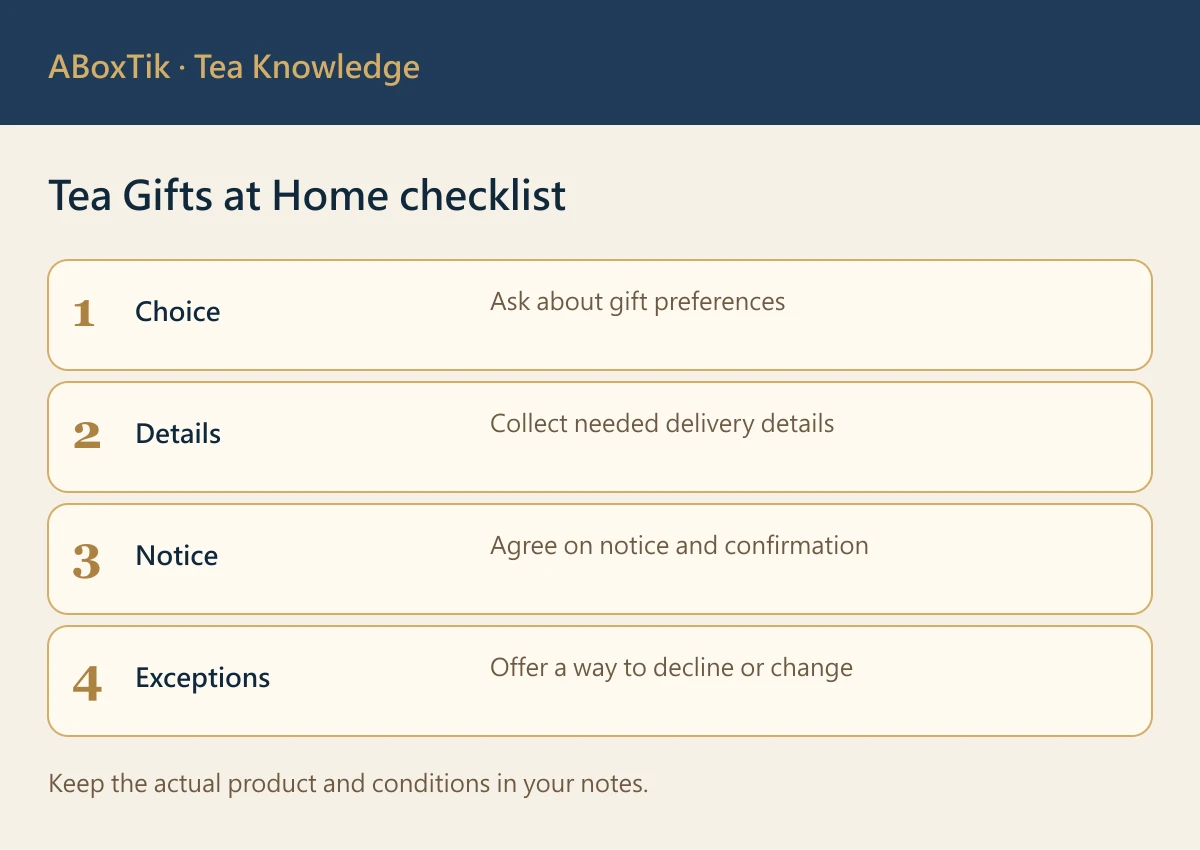
A home-delivery checklist
| Check | Question | Status |
|---|---|---|
| Participation and option | Does the employee want the gift, and are the choices feasible? | _____ |
| Contact details | Are the required name, phone, address and postal code complete? | _____ |
| Timing and access | What delivery window or building restriction needs confirmation? | _____ |
| Gift version | Do the tea, card and recipient group match? | _____ |
| Notice and help | When will the employee hear from us, and who handles a problem? | _____ |
| Information handover | Are the owner, access and version clear? | _____ |
Use “to confirm,” “confirmed” or “not applicable” in the status column. Homes and buildings do not all have the same reception arrangements. Ask about relevant building access or reception hours when needed rather than filling them in for the employee. If a specified time slot or address change is important, first confirm whether the supplier and carrier can offer it and under what conditions.
3. Match the box, card and recipient list
If the order has different contents, give each confirmed version a simple code. Version A might contain one tea assortment and version B another; cards can have their own codes. Connect the employee’s choice, gift version and delivery record, and make sure packing and labels use the same approved information. Record the date and decision-maker for changes, with a clear point at which an old version stops being used.
The card can be brief: “Thank you for your contribution to ____. We hope this tea accompanies a quiet moment. From the ____ team.” Check that the specific reference is accurate. A shared message should not attach one person’s project to every colleague. If the card is bilingual, proofread tone, names and sign-off in each language; the corporate gift-card guide offers more starting points.
Consider how the first cup will be made. Where a colleague’s equipment is unknown, compare tea bags and loose-leaf options, portions and brewing instructions using the current product information. Each format has its own uses. Convenience depends on the recipient’s habits as well as the package, and a gift need not prescribe the same tea ritual for everyone.
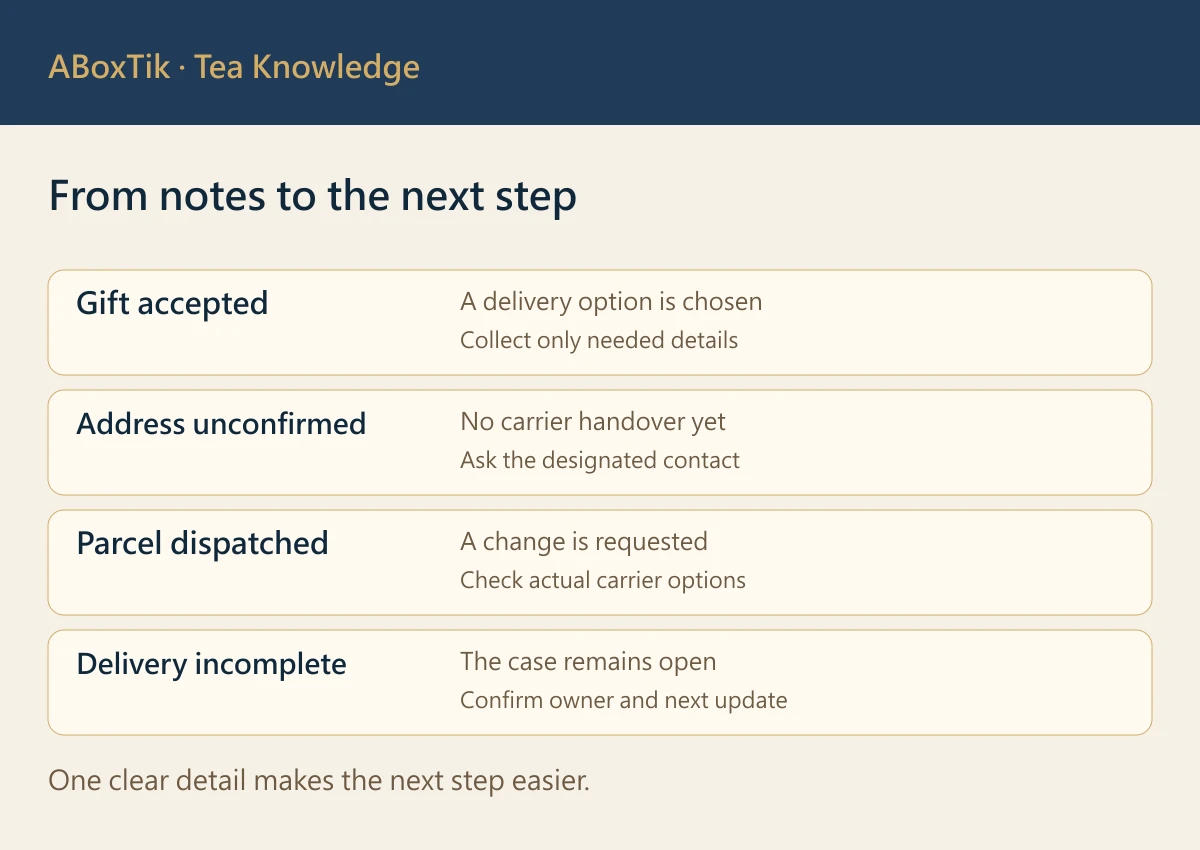
4. Discuss exceptions before shipping
Give the supplier a concise brief: destinations, total quantity, number of versions, desired delivery period and contact person. Ask whether individual addresses can be served, which carrier will be used, when addresses must be final, and how shipping or repeat-delivery costs are handled. For deliveries across borders, ask about the particular products, documents and restrictions. Requirements and carrier services vary by destination and must be checked for the actual shipment.
List possible exceptions while there is still time to decide how to communicate: an employee is away, an address remains unconfirmed, a detail is incorrect, delivery fails, or the wrong version arrives. For each, note who receives the question, whom they consult and when the employee will get an update. Whether a parcel can be redirected, resent or replaced depends on the actual arrangements; put the agreed conditions in writing.
Before sending the whole list, trace one complete example through the process. Do the version code, card, recipient details, label and notice match? If a field remains unresolved, hold that individual entry for the owner to clarify before handover. The rest of the team does not need to guess, and private addresses should not be placed on a public tracking sheet.
5. Notify, follow up and close the loop
Once dispatch arrangements are confirmed, use the agreed company channel to provide the expected window, any available tracking method and a contact for help. Share tracking numbers only as actually supplied. “Dispatched” and “delivered” are different statuses, and an estimated date should be described as an estimate. If someone reports that receiving the parcel will be difficult, check its current status before explaining the next available step.
An internal status sheet can avoid full addresses: awaiting confirmation, handed over, dispatched, receipt confirmed, or assistance needed. The owner can link an order or list code back to the controlled details; authorised people can consult the information needed for an individual case. At the end, reconcile unresolved entries with the supplier and handle the list under company policy.
If quantities and budget are still open, the corporate tea gift budget guide and quantity planner help frame the brief. Multiple addresses, phased deliveries and individual needs may affect the assessment. Include them in the enquiry, and treat an early estimate as a starting point rather than an agreed quotation.
Let the gift arrive with room to choose
A remote team’s gifts travel into different homes and routines. A voluntary invitation, a clear explanation of information use, a contact person and an understandable delivery status all make the tea easier to receive. Complete the most important unanswered field first, then arrange the next step. Nobody needs a logistics examination before their afternoon cup.
Related recommendations
- Plan the gift delivery timeline and version handover.
- Write a corporate gift card with a specific note of thanks.
- Explore a Taiwanese tea gift set and check its current contents.
