
Tea Knowledge
Taiwanese Tea vs Japanese Tea: Styles, Processing and Taste
A little thoughtful preparation makes room to enjoy the tea.
The most useful way to compare Taiwanese and Japanese tea is to choose specific teas rather than imagine that each place makes only one kind. Taiwan produces styles including Baozhong, oolong and black tea; Japan offers sencha, gyokuro, matcha and hojicha among others. Separate origin, cultivar, cultivation and processing, then record aroma, taste and preference alongside the actual brewing conditions. The result is a comparison you can use, not a score for an entire place.
If Taiwanese oolong is familiar and Japanese tea names are new, the labels can seem like a lot to learn at once. Start with two clearly described small packages and a single question. Your cupboard does not need to become an international conference room before you make the first cup.
Start with the fields, not a national stereotype
| Field | Taiwanese examples | Japanese examples | Do not assume |
|---|---|---|---|
| Tea style | Baozhong, oolong and black tea, as well as green tea | Sencha, gyokuro, matcha and hojicha, as well as black tea and oolong | One place has one tea |
| Cultivation | Varies with garden, cultivar and harvest | Some teas, including gyokuro and tencha, use shade cultivation | A place name describes every growing condition |
| Processing | Some oolongs are withered, oxidised, fixed and dried | A sencha example is steamed, rolled and dried | Every Taiwanese tea is roasted or every Japanese tea steamed |
| In the cup | Describe the actual tea’s aroma, taste and texture | Record the actual tea and brewing conditions too | A flavour alone proves origin |
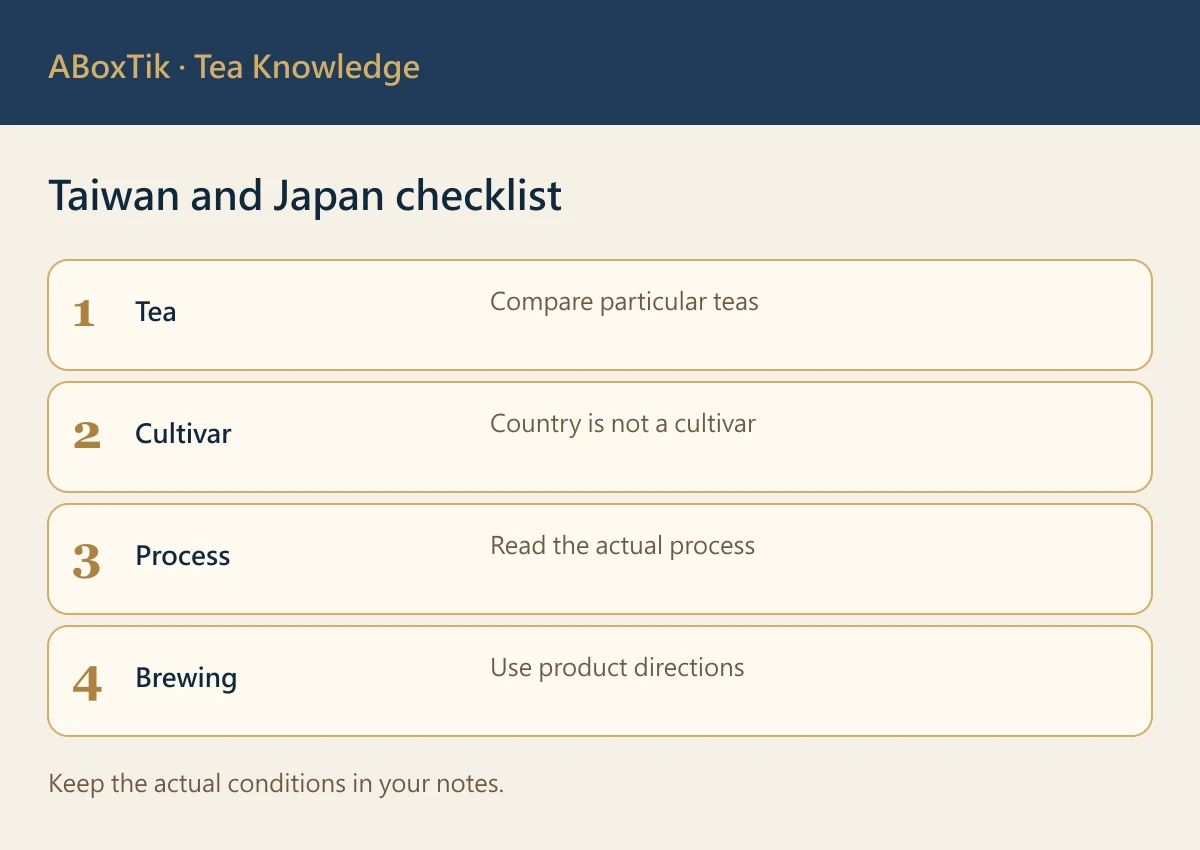
These are starting points rather than exhaustive lists. Japan’s Ministry of Agriculture, Forestry and Fisheries lists pan-fired tea, Japanese black tea and oolong as well as green tea. Taiwan’s tea research station describes green tea, partially oxidised teas and black tea. Read the full name and stated origin of the product in hand before deciding which process it represents.
Different paths through the tea-making process
For some Taiwanese oolongs, fresh leaves are withered and worked through stages that develop oxidation before fixation, rolling and drying. Depending on the tea, shaping or roasting may follow. The Taiwanese tea research station describes several distinctive tea styles and their processing contexts. A rolled leaf or a floral impression alone cannot reconstruct the exact garden or every step used for a particular batch.
Japan’s ministry describes an Uji sencha example in which leaves grown without a cover are steamed, rolled and dried. Its gyokuro and tencha examples use shade-grown leaves; tencha is steamed and dried before further processing into matcha. These are descriptions of specific styles, not one formula for every tea grown in Japan. For a closer look at one Taiwanese process, visit oolong oxidation and leaf working.
Cultivar is not the same thing as tea style
A cultivar identifies plant material; names such as Baozhong, oolong, black tea or sencha refer to a tea style or finished product. Jin Xuan, for example, is a cultivar name, not an automatic statement of one tea-growing district or one manufacturing method. The same cultivar can produce different impressions when garden, harvest and processing differ. Japanese tea likewise includes different cultivars and cultivation decisions; no single plant name represents a whole country’s flavour.
When shopping, put the stated cultivar, leaf origin, process and batch in separate fields. If a label provides only a place name, record the place name and leave the cultivar blank. The Separating origin from style helps keep unanswered questions visible; this article brings specific examples from the two places to the same comparison table.
Compare the cups without letting brewing hide the question
First consider brewing each according to its own product directions so that you can understand it in its intended everyday use. Then, if a common-condition comparison would answer your question, record a second round accordingly. Following separate directions is practical but changes both tea and preparation. Using similar conditions gives more control, but a single shared method may not represent how each tea is usually enjoyed. Both approaches can be useful when the choice is written down.
| Record | Taiwanese tea ___ | Japanese tea ___ |
|---|---|---|
| Full name and batch | ___ | ___ |
| Origin, cultivar and style | Copy the label; leave unknowns blank | Copy the label; leave unknowns blank |
| Leaf, water, temperature, time and vessel | ___ | ___ |
| Aroma, taste, texture and finish | ___ | ___ |
| Preference and next question | ___ | ___ |
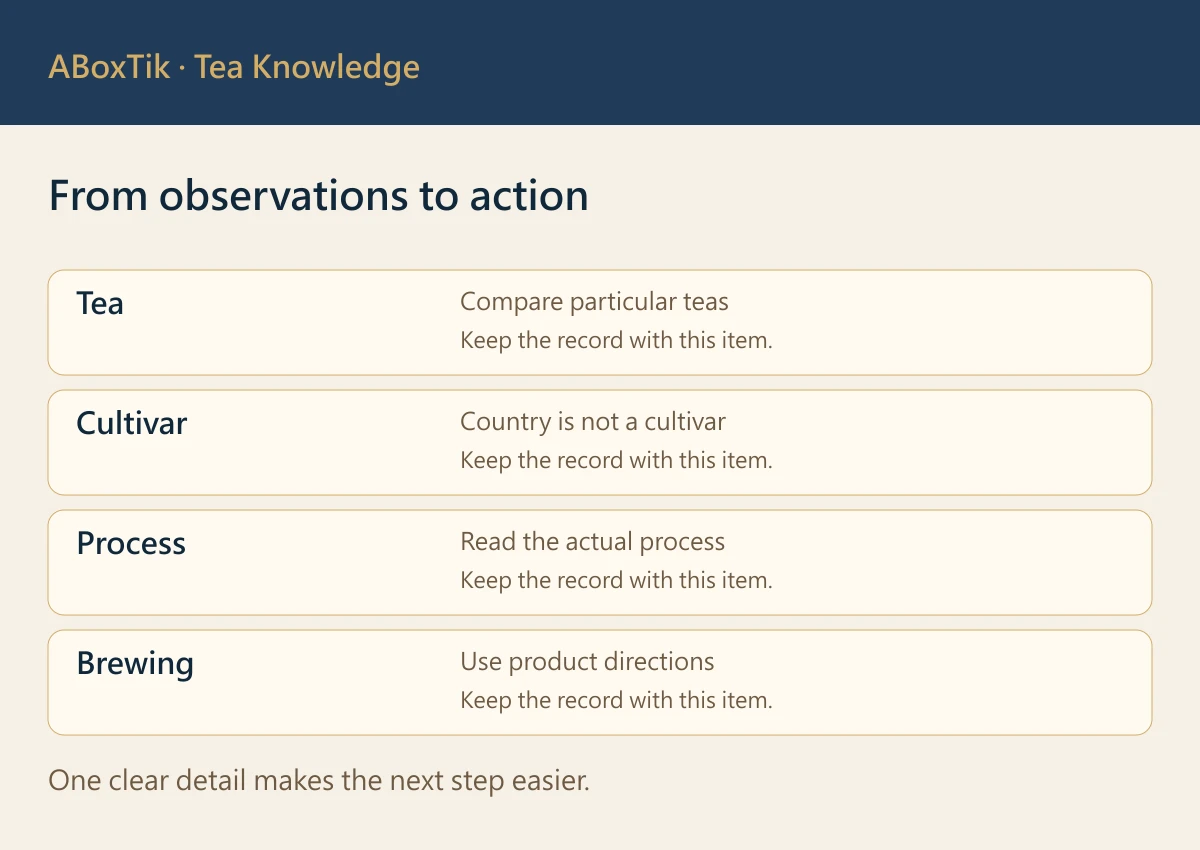
Use words that describe what you actually notice: fresh, roasted, gentle, concentrated or simply unclear. The flavour notes guide can help expand the vocabulary, but a published descriptor need not become a required answer. The result belongs to these cups. Garden, cultivar, batch, processing and brewing may all matter to another encounter.
Choose for the cup you would like today
Someone interested in roasted notes could compare a Taiwanese tea described as roasted with a Japanese hojicha. Someone curious about a fresher direction might begin with a Baozhong and a sencha. These pairings suggest questions; they do not guarantee that two cups will be similar or completely different. Read each product’s description, net weight, storage advice and brewing directions, and start with a quantity that suits your routine.
For a gift, consider the recipient’s equipment and whether the packaging makes the directions easy to find. The tea gift guide and Taiwan tea selection offer formats to explore; check current product details before deciding. Comparing tea traditions does not require awarding one side the best seat at the table.
Questions that often come up
Is all Taiwanese tea oolong?
No. Taiwan also produces green and black teas, and oolong itself includes different approaches.
Is all Japanese tea matcha or sencha?
No. Japan’s ministry also lists gyokuro, hojicha, pan-fired tea, black tea and oolong, among other examples.
Is using hot water enough for a fair comparison?
Also record leaf quantity, water volume and temperature, steeping time and vessel. Say whether you followed each product’s directions. A fair comparison makes conditions visible; it does not pretend that two different teas are identical.
Next time, choose one field to compare and write down one honest observation. Both places offer many paths into tea. Starting with the particular cup in front of you makes it easier to discover what you enjoy.
Use two rounds for two different questions
In the first round, follow each product’s own directions and record how the two teas work in everyday use. In a second round, if you want to compare a common set of conditions, first check that the chosen equipment suits both products, then write down the shared quantities, temperature and time. Keep the rounds separate rather than carrying the first preference straight into the second cup. If one tea is matcha powder and the other is a leaf infusion that must be separated from the water, their preparation methods are inherently different. Use an appropriate method for each and record that difference.
When sharing with friends, write individual impressions before comparing notes. One person may like roast, another freshness; neither choice needs to become a national ranking. For more context on Taiwanese tea, the Taiwan tea origin and craft guide offers a next step. For a Japanese tea, return to the specific product and its origin information, then explore the styles one by one.
Keep the product names and preparation notes together so that a favourite cup can be revisited later.

Related reading and tea choices
Sources
- Japan MAFF: Uji Tea
- Japan MAFF: Japanese Tea Styles
- Taiwan Tea Research and Extension Station: Tea Styles and Processing
Sources checked: 1 November 2026.