
Tea Knowledge
What Is Shanlinxi Tea? Terroir, Flavor Clues and Brewing Guide
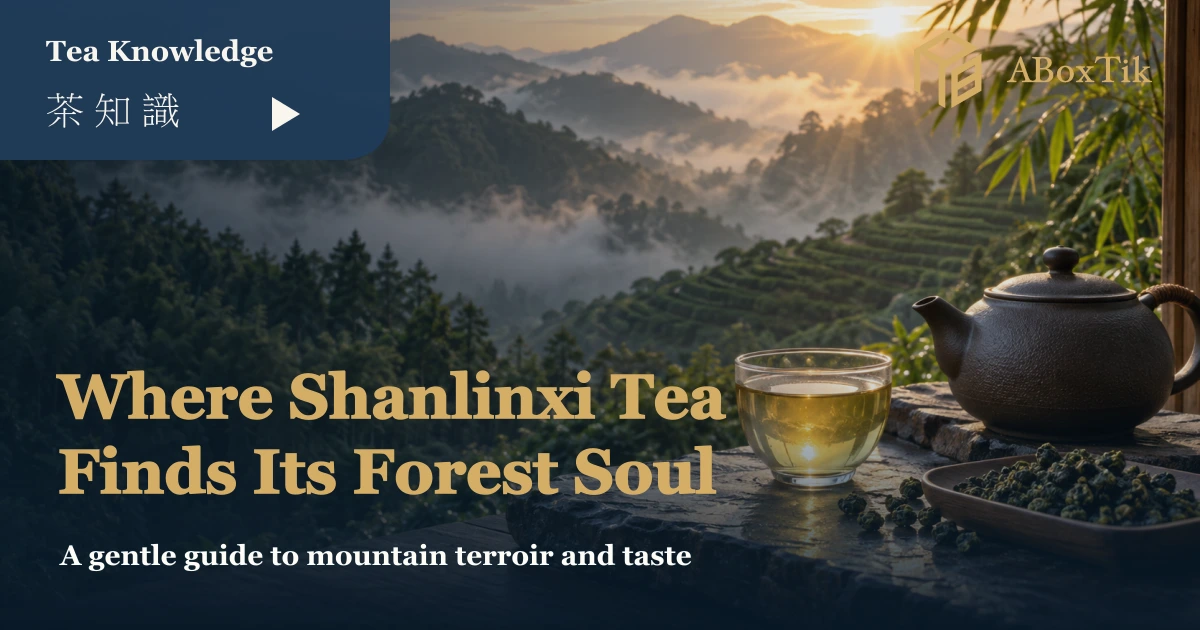
A forest impression is not a promise printed on a packet. Weather, leaf condition and a maker’s choices slowly bring it into the cup.
Shanlinxi tea is often associated with mist, a quiet aroma and a rounded cup. Those are lovely places to begin, but a mountain name cannot guarantee the same aroma or texture in every packet. Taiwan’s Tea and Beverage Research Station places Shanlinxi in the Zhushan tea-region context, where partially fermented tea is a principal production. The tea in hand will still reflect its garden, season, cultivar, leaf maturity, making, storage and brewing.
For a wider map, visit our Taiwan tea regions guide. Here, let’s stay close to Shanlinxi: which clues can be checked, and which impressions are best discovered slowly in the cup.
What does “Shanlinxi tea” describe?
The Research Station’s Southern Branch describes the Zhushan tea area as including Shanlinxi, Longfengxia and Daan among other local names, with partially fermented tea as a main production. In other words, Shanlinxi is not one garden, one cultivar or one making method.
Its regional material describes the Daan area as a later-developed high-elevation tea area and uses quiet aroma and fuller taste as a regional reference. That helps form a picture of place; it does not turn those words into specifications for every lot.
This distinction is reassuring rather than restrictive. A region can offer a meaningful starting point while leaving room for individual gardens and makers to speak in their own voices. Labels that include a smaller locality, harvest or packing reference, maker and processing direction make those voices easier to compare. A label that only says “high mountain tea” may still hold an enjoyable cup, but it offers fewer facts for tracing what made that cup distinctive.
| What you see | What it can tell you | What not to assume |
|---|---|---|
| Shanlinxi tea | A regional/geographic clue | Cultivar, fixed elevation or grade |
| A more specific local name | A reason to ask about garden, maker and lot | Identical flavor from every named section |
| “Forest,” floral or rounded | Directions for a first tasting | A promised result in every brew |
| Oolong or partially fermented tea | A second clue to aroma and texture | That the place name itself is a process |
How can a mountain environment reach the cup?
Cooler conditions, cloud, rainfall, slope and soil all participate in the way a tea plant grows. They are not a simple equation. It is entirely normal for two Shanlinxi-labelled teas to taste different: picking weather, leaf maturity, withering, oxidation, roast and storage may all change the result.
A more useful question than “Will Shanlinxi always taste forest-like?” is: which section is named, when was this lot made or packed, what kind of tea is it, and what does its maker suggest? Put those details beside one tasting note, and the next comparison becomes much calmer and clearer.
The familiar phrase “mountain character” can stay in the conversation—as a personal sensory shorthand. Perhaps it means a cool, lifted aroma in one cup and a quiet, lingering finish in another. Holding the phrase lightly makes space for enjoyment without turning a poetic description into a scientific measurement.
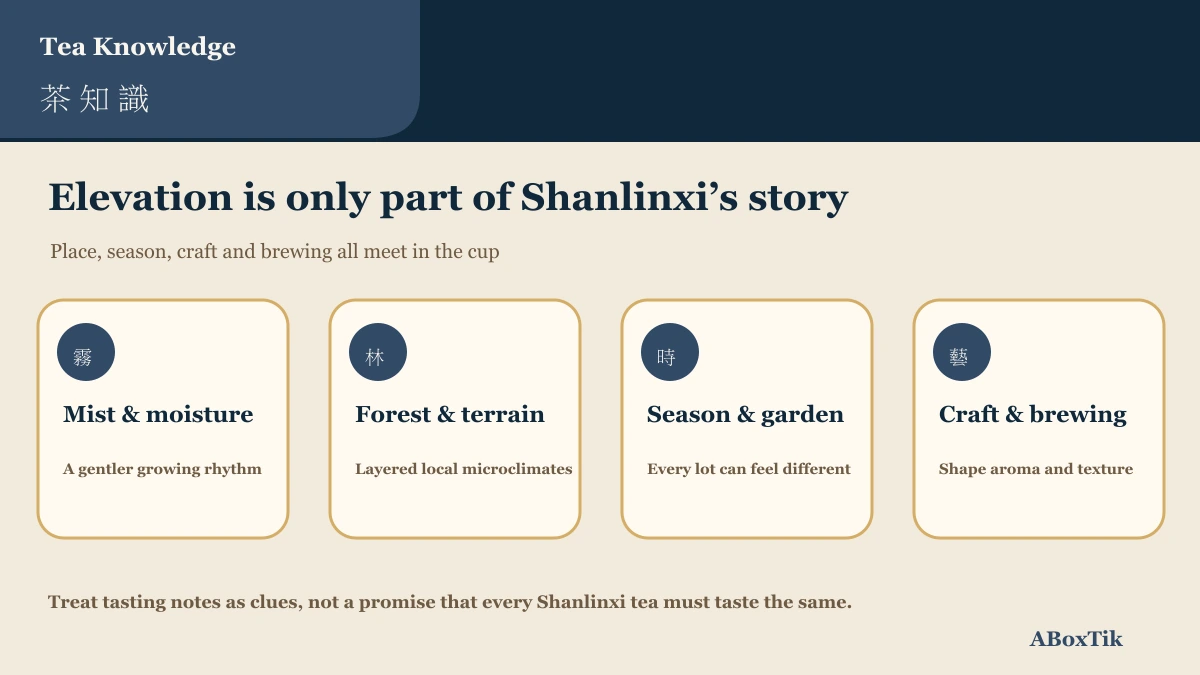
Flavor clues worth noticing
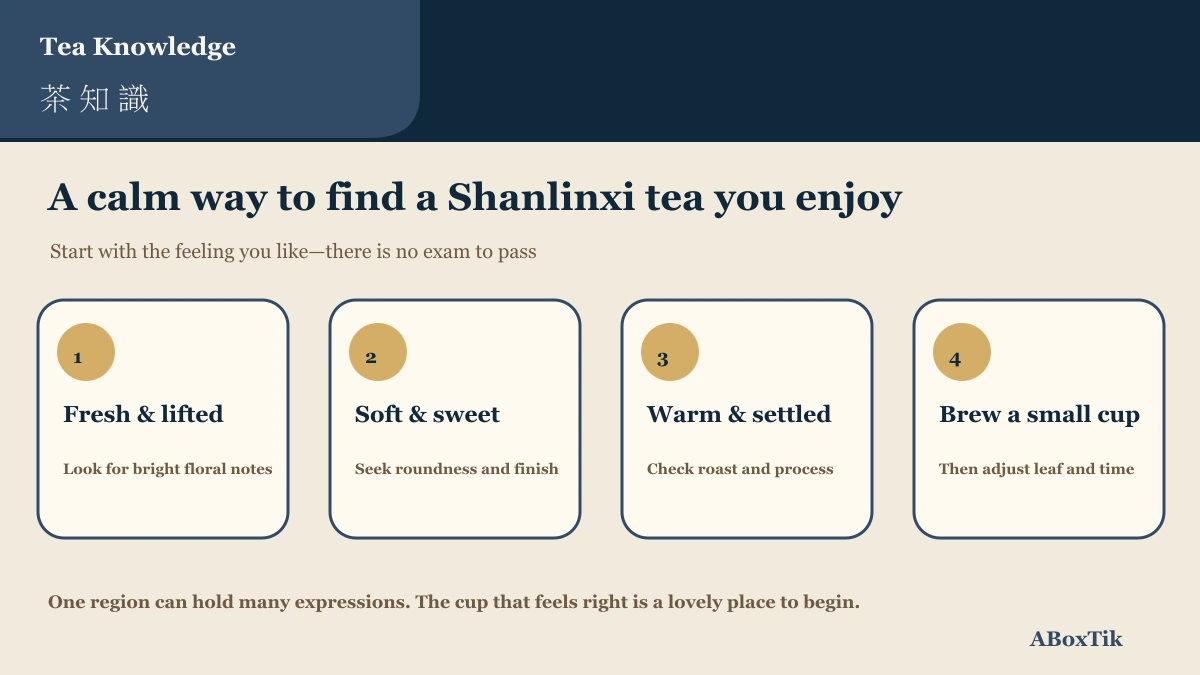
Some drinkers look for a quiet aroma, florals, sweetness, silkiness or a little more body in Shanlinxi tea. These are not a scorecard, and there is no need to find the “right” answer. Start gently: notice whether the aroma feels clean and comfortable; notice whether sweetness, structure and grip feel balanced; then take another sip after the tea cools. A note about the actual cup is more reliable than extending one memory to every Shanlinxi tea.
It can help to use ordinary words first. “Fresh,” “soft,” “warm,” “dry” or “lingering” may be more useful than searching for an impressive aroma term. When the same tea is brewed again, those simple notes reveal whether the change came from time, leaf amount or the tea itself. That small habit turns tasting into a kind conversation with the cup, not a test of expertise.
Our tea aroma guide can help give those impressions names without forcing every cup into one label.
How should I brew Shanlinxi tea?
Follow the packet or maker first. Without a lot-specific instruction, use a calm, repeatable beginning: keep your water and covered porcelain vessel or small pot consistent, make the first cup on the lighter side, and write down leaf amount, time and impression. Next time, change only one thing—perhaps steeping time or leaf amount. This is not a Shanlinxi recipe; it simply keeps a change in equipment from being mistaken for a change in origin.
If a first session feels too light, too brisk or simply unfamiliar, nothing has gone wrong. Let the leaves rest, make one small adjustment and taste again. Water chemistry and vessel size can shift perception more than expected, so a disappointing first cup does not necessarily say anything final about the tea.
| First session | A gentle start | What to try next |
|---|---|---|
| Use guidance | Begin with the packet or maker’s instruction | Do not replace specific advice with a generic rule |
| Set a baseline | Keep water, vessel, leaf and time steady | Note aroma, body and finish |
| Adjust once | If strong or astringent, shorten; if weak, extend slightly or add a little leaf | Change one variable only |
How can I check Shanlinxi origin information?
The Research Station notes that “Shanlinxi Tea” has a registered origin-certification-mark system, while the quality-tea database lists specific users and planting sections. A mark is therefore a route to check a defined scope; it is not something to assume from ordinary marketing copy. When a packet has a mark or traceability record, check the issuer, user and scope. When it does not, read the place, lot, processing and responsible-business information actually supplied.
- How precise is the place information?
- Is there a year, packing date or lot code?
- Does it name tea type, roast/oxidation direction and storage advice?
- Is a maker or seller clearly identified for follow-up questions?
These checks do not name one universally “best” tea. They simply make a choice feel more grounded. For comparisons, continue with our Lishan tea guide and Alishan tea-region comparison.
Price can be considered alongside the same evidence. A more specific origin record, careful lot information and clear storage guidance may explain part of a difference, but a higher price alone does not prove a preferred flavor. Starting with a smaller amount is often the kindest way to learn: enough tea for two or three consistent sessions can say more than a long list of prestige terms.
Shanlinxi tea FAQs
Will Shanlinxi tea always have floral or forest-like aroma?
No. Those are possible impressions, not guarantees; season, garden, cultivar, making, storage and brewing all matter.
Does the name prove one altitude?
No. It is first a regional clue. Garden and lot information are closer to the tea in front of you.
Does an origin mark guarantee I will like the flavor?
No. It helps check defined origin conditions, not personal preference.
Let the cup tell its own forest story
Shanlinxi tea does not need to be reduced to one fixed answer. Start with its place in the Zhushan tea region, then bring place, lot, making and brewing into the same picture. When a cup feels just right, keep the conditions. There is no need to chase a mountain name; it is enough to get closer to the aroma and pace that suit the moment.
Related recommendations
- Taiwan tea regions guide: see the wider map.
- Tea aroma guide: keep track of favorite notes.
- ABoxTik tea collection: explore current product information.
Sources
- Tea and Beverage Research Station: Southern Branch (checked 2026-09-25)
- Tea and Beverage Research Station: Characteristics of central and southern tea regions (checked 2026-09-25)
- Tea and Beverage Research Station: Tea origin certification marks (checked 2026-09-25)
- Taiwan Quality Tea Production and Marketing Information Network: origin-mark users (checked 2026-09-25)