
Tea Knowledge
Taiwan Indigo Dyeing: Layers, Patterns and Everyday Use
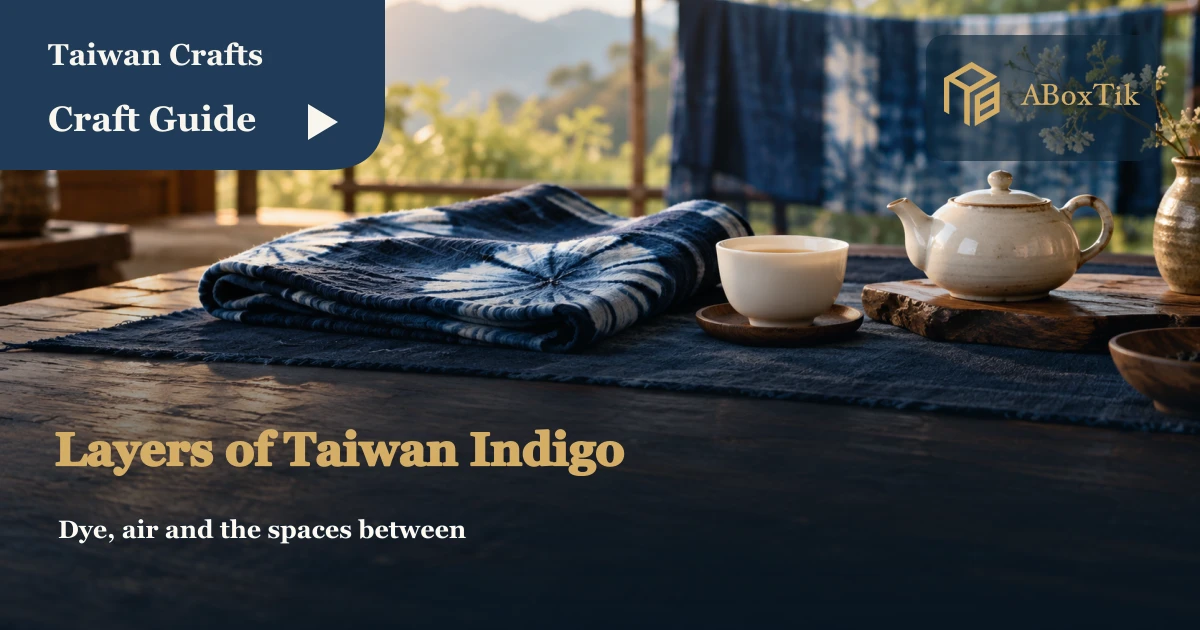
Blue arrives through a conversation between cloth, dye and air. Even the spaces left white carry the work of a pair of hands.
Taiwan indigo dyeing develops its colour and patterns through the fabric, the state of the dye bath, dipping and oxidation, and resist methods such as tying, folding and stitching. Repeated work can build different shades, but the number of dips alone does not rank the quality of a piece.
If a row of blue textiles looks lovely but hard to describe, begin with three questions: how did the blue arrive, how was the white retained, and how would you use the piece? Your eyes can take their time. The shopping bag does not need to start work quite yet.
The journey from a plant to indigo pigment
The National Taiwan Craft Research and Development Institute describes gathering leaves, soaking, processing the colour and settling and filtering material into indigo paste. Leaves supply the starting material, while several operations turn it into a usable dye resource. A green plant and a finished blue textile are separated by work that deserves a little curiosity.
Making the pigment and dyeing the cloth are different stages. Recognising that distinction helps avoid assuming that every dark-blue fabric uses the same plant, origin or process. Ask about the dye source rather than trying to identify it from the colour alone.
This way of looking also suits Hsinchu glass craft and Taiwanese lacquerware. Materials have different properties and working rhythms. In each case, a polished object can hide much of the patience behind it until somebody asks how it was made.
Preparing the vat, dipping and meeting the air
The agriculture ministry’s introduction distinguishes preparing indigo pigment, preparing the dye vat and dyeing. Indigo paste is not simply spread on cloth. The vat needs a usable dyeing state; immersion brings fabric into contact with the liquid, and exposure to air allows the blue to develop through oxidation.
This helps explain why the colour of cloth just removed from a vat is not a final judgement of the finished piece. In a workshop, observe removal, unfolding and waiting under the instructor’s guidance. Follow the supervised process rather than assembling a dye recipe from household cleaning products at home.
Ask how a particular shade was developed instead of asking how many dips make good work. Fabric, bath condition and each operation matter alongside repetition. Dark and pale blue can serve different intentions. Craft value need not be reduced to a scale on which deeper colour always wins.
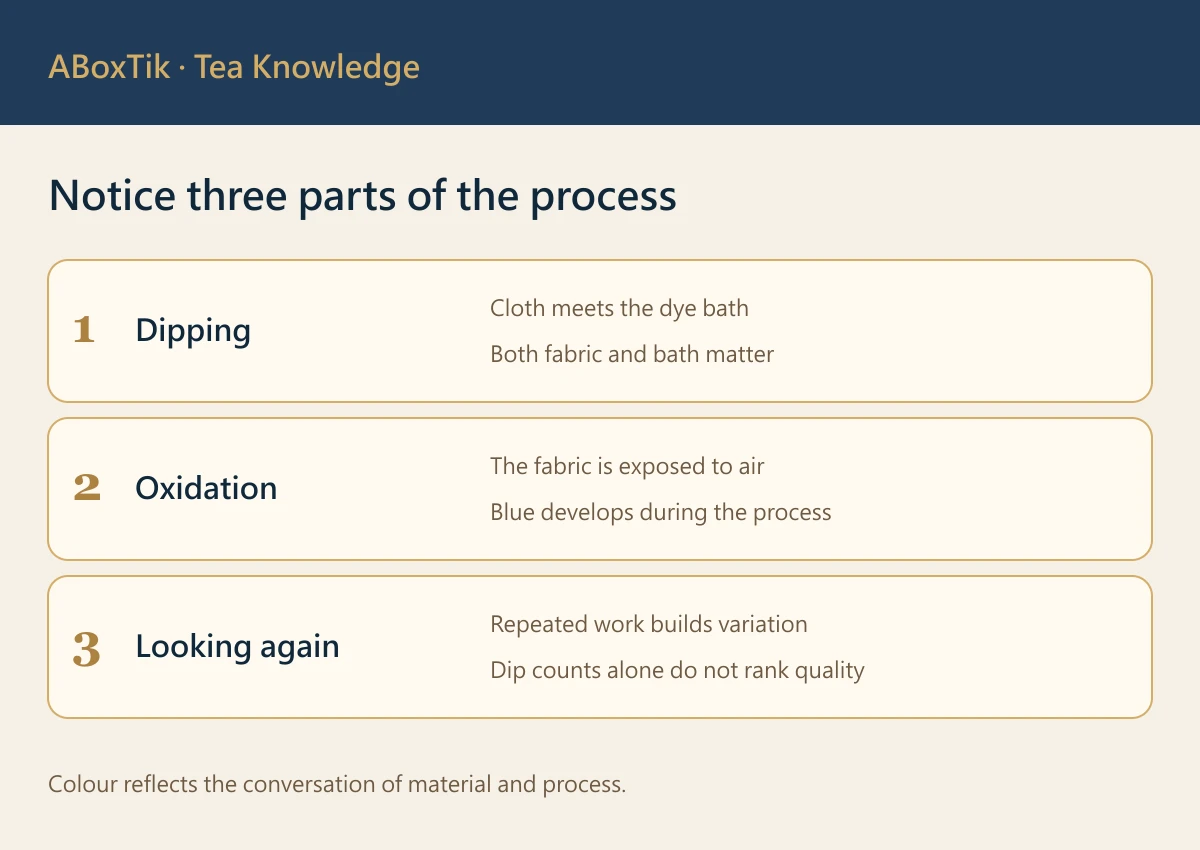
Ties, folds and stitches help create the white
Official craft introductions describe tying, clamping and stitching among the ways to arrange patterns. These operations restrict contact between parts of the fabric and the dye. Opening the cloth reveals light areas, lines and transitions that are not necessarily printed on after dyeing.
Look first at a boundary: is it geometric, softly diffused, rhythmic or irregular? Then consider how white space supports the coloured areas. A difference between two sides is not automatically a fault, but neither is every difference automatically desirable. Judge it against the intended design, construction and use.
| Look at | Ask about | Keep a personal note |
|---|---|---|
| Shade | How was this depth developed? | A favourite area of blue |
| Boundary and white space | Tying, folding, stitching or another method? | Sharp or soft transitions |
| Whole piece and use | How does the pattern unfold? | Where you would use it |
See the piece opened out, then folded or hanging. A complete scarf pattern and a corner on a tea table can have different rhythms. Thinking about use helps the choice move beyond selecting whichever piece appears bluest at first glance.
Ask separately about plant dye, origin and handwork
Whether a textile uses plant-derived dye, where it was dyed, what fibre it contains and which stages were worked by hand are different questions. If natural materials matter to you, ask the maker about dye and process instead of supplying all those details from the word indigo alone.
Natural is also not a complete answer about water, energy, useful life or environmental impact. Each needs its own information and scope. The staged thinking in our tea carbon-footprint guide offers a helpful comparison: naming one material cannot describe a product’s whole life. Appreciation can be warm and still ask clear questions.
For a gift, consider the recipient’s colour preferences, fabric preferences and willingness to follow care instructions. Guides to lacquerware care and glass craft invite the same practical thinking. An object should have a life after its gift box is opened.
Give cloth and water separate jobs on a tea table
For a table accent or display textile, choose a flat, dry position and place hot or dripping vessels on suitable trays. This is an arrangement suggestion: let the cloth contribute colour and texture while appropriate equipment handles heat and splashes. One small textile does not need to take every job at the table.
When sharing a selection of oolong teas or a two-tea set, first choose the tea and format, then consider the cloth’s size and use. The fresh-versus-roasted tea guide can help with tea preferences. Choose blue according to the room and your taste; there is no secret rule requiring one shade to match one aroma.
Photograph your usual table in natural light and record its dimensions before choosing a textile. A gaiwan or teapot needs working room, and the brewing sequence involves moving vessels. Leaving space for a comfortable hand movement can be more considerate than filling every inch with beautiful objects.
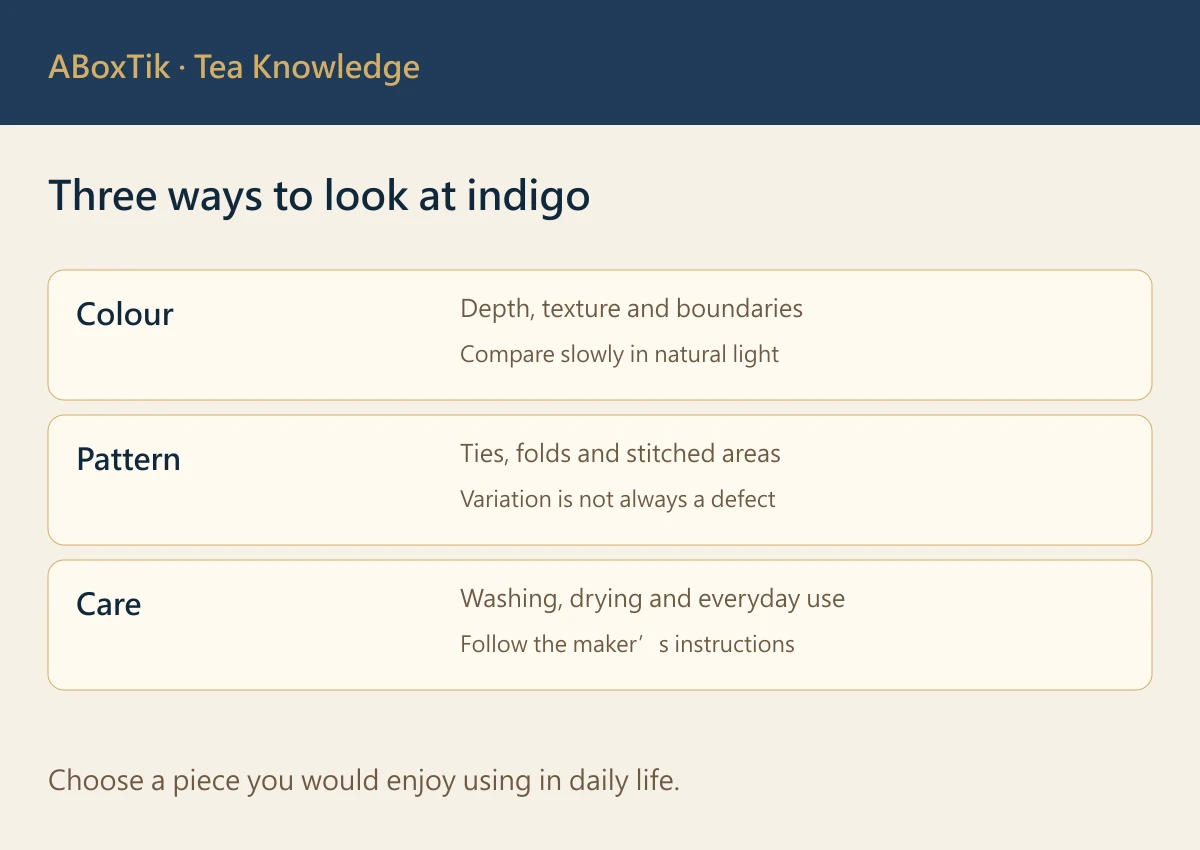
Bring home a care card as well as a textile
Before buying, confirm fibre, size, dye information, washing, drying and any first-use considerations. Follow the maker’s instructions or the actual care label. A convenient tip found online should not automatically become a rule for every indigo textile.
Keep the explanation card and maker details so a later question is easy to direct. If something is uncertain, ask before treating it. The care used in storing tea is not the same as textile care, but both begin by understanding the material rather than asking a high price to make every decision for you.
Finally, choose between the qualities you actually enjoy: deeper blue, lighter blue or more open white space. There is no need to select the answer that looks most knowledgeable. A piece you want to use gives curiosity somewhere to continue, and brings craft a little closer to daily life.
Follow ABoxTik: bring craft details into a life that makes use of them.
Leave time for a blue textile and a cup of tea
Indigo makes material and process visible; tea offers another rhythm through aroma and texture. From Taiwanese tea characteristics to an everyday craft object, the most rewarding details are often specific and approachable.
Next time a blue pattern catches your eye, ask how the white space was made. A conversation can begin there. Both the tea and the object can be understood slowly.
Related reading
Sources
- National Taiwan Craft Research and Development Institute: making indigo pigment
- Ministry of Agriculture: an introduction to indigo craft
- National Immigration Agency: indigo patterns and methods
Sources checked 18 October 2026.