
Tea Knowledge
Cloudy Tea After Cooling: What to Record
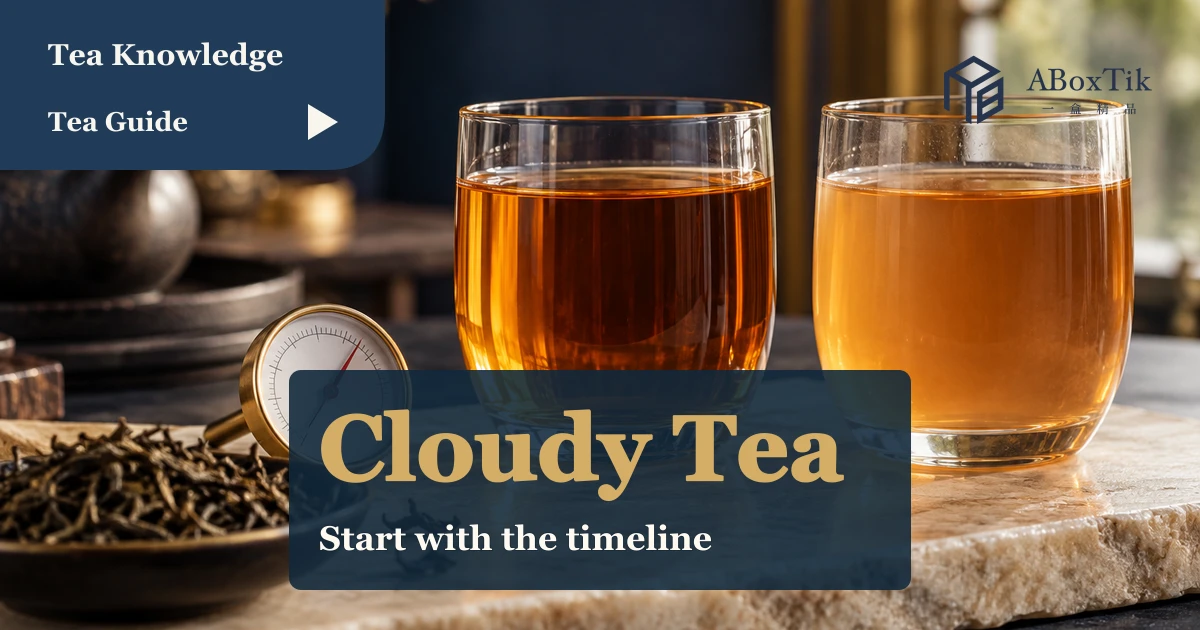
A thoughtful cup begins with a few clear, practical details.
If tea becomes cloudy as it cools, start with the timeline, leaf separation, water, brewing strength and handling history. Some teas develop cold-induced haze known as tea cream, but cloudiness is neither a safety clearance nor a quality certificate. If handling is unknown, contamination is suspected or something is abnormal, stop drinking. Do not use a taste, reheating or a return to clarity as a safety test.
A cup that looked like amber can become misty while attention is elsewhere. That can be puzzling without immediately making it a verdict on the tea. A short record of what happened is more useful than a long stare at the glass. This guide helps organise those observations and decide what information to request next.
Decide whether to continue drinking before investigating appearance
First consider where the leaves and water came from, the condition of the utensils, and how the drink has been handled. If these are uncertain or contamination is possible, set the drink aside rather than investigating through tasting. A clear appearance cannot rule out a problem, and a cloudy appearance cannot identify a particular microorganism.
An unusual smell, suspicious surface change or another abnormal feature is a reason to stop, not an invitation to ask another person to taste it. Retain the package and a basic handling timeline if an enquiry is needed. A supplier or appropriate food-safety authority may help direct that enquiry. Observational notes are useful descriptions; they do not replace testing.
What does tea cream mean?
Tea cream describes aggregation of some components of a tea infusion during cooling, producing a hazy appearance. Research identifies several participating components, including polyphenols, proteins and caffeine, with differences between tea types and experimental conditions. The term does not mean milk has been added. Nor should it be reduced to a rule that more caffeine always produces more haze.
A National Cultural Memory Bank introduction to black-tea creaming also cautions against confusing cooling-related haze with deterioration. At home, describe the circumstances that fit an observation rather than diagnosing from a photograph. Even if warming changes the appearance, that does not establish that a drink has been sanitised or made suitable to consume.
| Observation | Record first | Do not conclude |
|---|---|---|
| Clearer when hot, evenly hazy later | Tea type, cooling history and temperature | Definitely tea cream or definitely safe |
| Fine particles immediately after pouring | Leaf fragments, filtering and utensils | Definitely spoilage or added ingredients |
| A deposit at the bottom | When it appeared and whether the cup was stirred | A quality grade from the deposit |
| A film-like surface | Water, utensils and handling history | A cause from a photograph alone |
| Unknown handling or abnormal changes | Stop drinking and retain useful information | A taste or reheating provides clearance |
Record the cup’s timeline
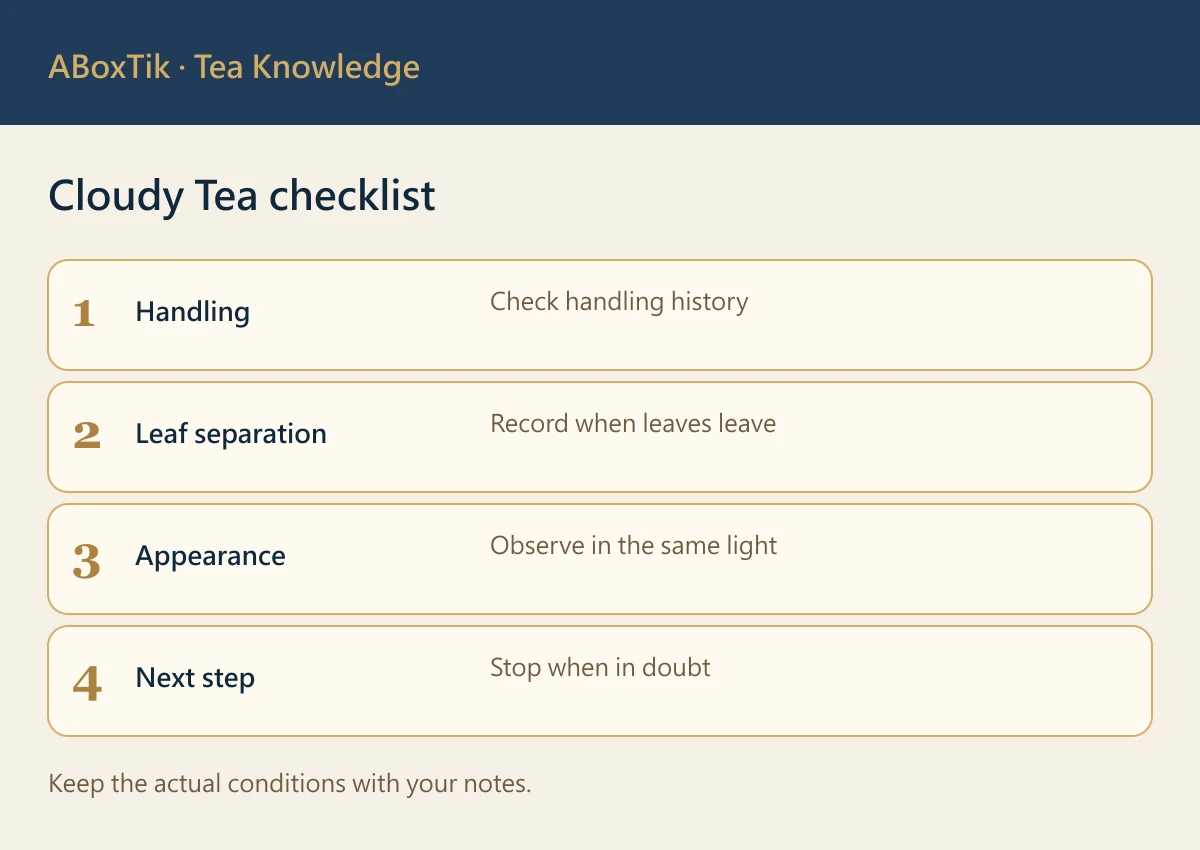
Write down when the tea was brewed, when the leaves were removed, which container received the infusion and when the change was first noticed. Tea still touching its leaves does not have the same starting point as tea that has been separated. Continuing extraction changes the conditions while the tea cools. The mug brewing guide offers ways to make leaf separation easier to manage.
If a thermometer is available, use it according to its instructions and record the reading. Without one, use honest descriptions such as freshly poured, warm or cooled. Keep the clock time and the temperature description in separate fields. A real approximate note is more useful than a precise number invented to make a notebook look scientific.
Also note whether anything was added. Milk, juice, sweeteners or another ingredient create a different drink with different handling considerations. A comparison intended to examine plain tea should begin with plain tea. Do not borrow a conclusion about an unadorned infusion and apply it automatically to a mixed beverage.
Keep water, strength and filtering separate
The same tea can look different when leaf amount, water volume, steeping time or water source changes. Begin by recording the drinkable water used and the brewing conditions. Then note how the leaves were filtered. If changing a strainer also changes the moment the leaves leave the water, more than one variable has changed.
Photographs can help preserve a relative change. Use the same lighting, background and suitable transparent heat-resistant vessels. Do not pour hot tea into an unidentified glass simply to obtain a clearer photograph. A phone image can document a visible difference; its brightness setting is not a calibrated turbidity measurement.
For the next comparison, begin with two fresh portions
Arrange an appearance exercise only with freshly prepared tea from known ingredients and appropriate handling. Follow the product directions for a baseline cup. Brew another fresh portion with one deliberate change, such as steeping time, while keeping water, weights, vessels and observation points as similar as practical.
The second infusion of the same leaves is not a fresh control for the first. Those leaves have already undergone extraction. If the question is about time, use separate fresh portions; if the question is about successive infusions, describe it as that different exercise. Clear questions make even a small kitchen comparison more informative.
If water is the variable of interest, leave it for another comparison and keep the other conditions fixed. Record no obvious change and uncertain results as readily as a visible difference. This exercise improves description. It cannot independently establish chemical composition, additives, geographical origin or food safety.
| Field | Cup A | Cup B |
|---|---|---|
| Tea, batch and fresh dry-leaf weight | ____ | ____ |
| Water, volume and vessel | ____ | ____ |
| Steeping and leaf-separation times | ____ | ____ |
| One deliberate change | Baseline | ____ |
| Observation time and temperature description | ____ | ____ |
| Appearance in the same light | ____ | ____ |
| Handling and storage history | ____ | ____ |
Questions about cloudy tea
Does clarity mean a drink is safe?
No. Ingredients, water, utensils and the complete handling history remain relevant. If there is doubt, stop drinking instead of using visual clarity as a substitute for a safety assessment.
Does cloudiness mean stronger or better tea?
It cannot provide a quality ranking on its own. Concentration may participate in some aggregation processes, but tea type, water and temperature also matter. Personal preference and an explanation of appearance are separate questions.
Can I drink it if reheating makes it clear?
That change alone cannot provide clearance. Reheating is not a method for rescuing tea with unknown handling or suspected contamination, and tasting is not a suitable way to confirm it.
Give the supplier one useful card
Include the tea name, batch, brewing method, the point when a change appeared and whatever handling history can be confirmed. Ask whether there is information specific to that product. “My tea looks strange” leaves the other person guessing alongside the cup; a short timeline gives the discussion a practical starting point.
Keep the question separate from the conclusion. Write “haze first noticed after cooling” rather than “confirmed tea cream,” unless there is an appropriate basis for the latter. Likewise, preserve unknown details as unknown instead of filling them from memory. The aim is an accurate description that another person can understand.
For the next fresh cup, explore steeping time and oolong water temperature. When comparing teas in the ABoxTik classic Taiwanese tea selection, follow each current product’s directions and keep appearance, aroma and personal preference in separate notes. One misty cup need not answer every question. A few well-kept conditions can make the next conversation much clearer.
Related reading and tea choices
Sources
- National Cultural Memory Bank: black-tea creaming
- Research: dynamic formation of green tea cream
- US FDA: storage and limits of appearance-based safety judgments
- Washington State Department of Health: food safety myths
Sources checked: 30 October 2026.