
Tea Knowledge
Tea Gifts for Reconnecting with Friends
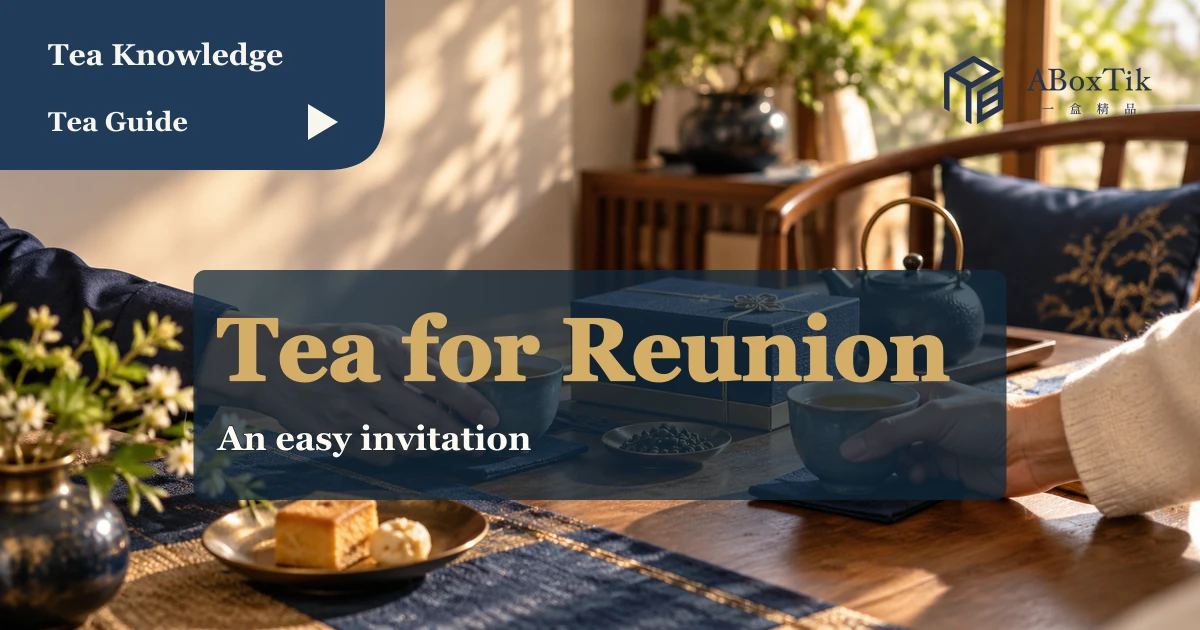
A thoughtful cup begins with a few clear, practical details.
A tea gift for a long-awaited reunion works best when it fits the meeting and the recipient’s everyday habits. Consider where you will meet, what they use to make tea and how much they can comfortably carry. Sharing a cup can be an invitation rather than an obligation: if the visit is brief, the tea can wait for a quieter day.
After a long time apart, familiarity and new discoveries may sit at the same table. You may remember a friend liking floral tea without knowing whether they still own a teapot. A small, easy question makes room for the person they are now, without asking either of you to summarise every year since you last met.
Let the meeting place guide the gift
| Reunion | Check before choosing | A comfortable way to share |
|---|---|---|
| A brief meeting | Size and ease of carrying | Include brewing information and leave sharing for another day |
| At a friend’s home | Whether tea is welcome and what equipment they use | Ask whether they would like to brew now |
| A group gathering | Portions, distribution and storage | Offer choices, including another drink |
| Sending from afar | An agreed address and suitable delivery time | Do not expect the parcel to be opened immediately |
A compact, intact package is easier to carry after meeting at a station. At a restaurant, check whether bringing and serving your own tea is suitable before planning a tasting. In someone’s home, ask “Shall we make tea now, or catch up first?” The gift does not have to run the entire afternoon.
Ask about the cup they use today
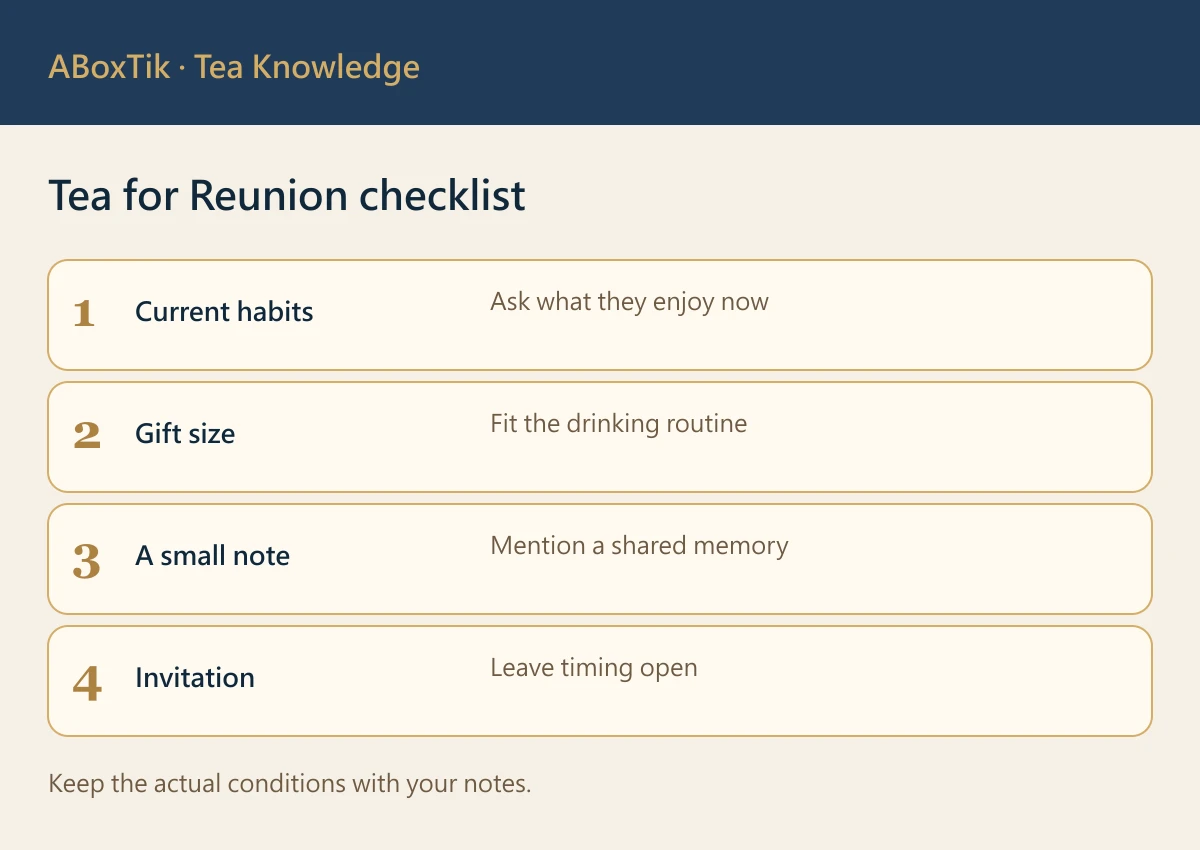
“Have you enjoyed any tea lately?” is easier to answer than a request for a precise cultivar. If a mug is their usual tool, check whether the current product has a convenient tea-bag option and clear instructions. Someone who enjoys a teapot may prefer loose leaf. These are formats, not a ranking of quality. If your friend does not drink tea, accept that answer; a present does not need a second career as a habit-changing coach.
If you know a preference, keep a familiar direction and ask whether they would enjoy trying another. Memories are a thoughtful starting point, not a substitute for checking today’s taste. Read the current name, ingredients, quantity and instructions before choosing, and do not infer an ingredient from an aroma description.
Write an invitation with room for an answer
A card could say: “It is lovely to see you again. I remember our afternoon over tea, so I brought a box for a time that suits you. If you feel like it, perhaps we can make a cup together another day.” Replace the example with a real memory, keep the words natural, and allow the answer to be “another time.” For a parcel, agree on an address and a convenient delivery window first. No immediate photograph, reply or unboxing is needed.
For a shared gift, decide who brings the package and who writes the card. Check the name and the spelling together. The tea can accompany the conversation; the card need not become a small puzzle.
Plan just the first round
Ask how many people would like tea and offer another drink if needed. Start with the instructions for the tea in hand, allow room to carry the cups, and pour small servings first when preferences are unknown. Ask before refilling. A familiar mug or pot is enough; a reunion does not require a new set of equipment.
Our tea hospitality guide offers ideas for people and serving space, while the partner gift guide focuses on shared memories in a romantic relationship. Here the practical question is how to reconnect with a friend: make the gift easy to receive, carry and enjoy later.
Leave the next conversation open
Keep the original package and its instructions, and follow the product’s storage guidance away from moisture and strong odours. If portions will be shared, make sure each retains the information needed to identify and prepare the tea. If the recipient already has plenty, a smaller gift or a cup of tea they already own may be more welcome.
At your next meeting, you might ask whether there was a tea they would like to try again. You can also talk about something else entirely. The gift has no progress report attached; it simply leaves an easy possibility for another conversation.
How much is appropriate after a long time apart?
A long absence does not require a large present to make up for every missed year. For a short meeting, a compact amount that is easy to carry may suit the occasion. If your friend has said they would enjoy sharing tea at home, consider the people involved and how often they actually drink it. The size of a box is not a measure of the friendship, and it should not leave the recipient feeling obliged to find an equivalent gift.
For someone familiar with tea, write down what you know and ask whether they would welcome a different style. For someone who rarely makes tea, clear labelling and an approachable preparation method can matter more than a large selection. If access to hot water or equipment is uncertain, ask about their usual routine. A gift can be thoughtful without creating a new shopping list for its recipient.
Three small changes of plan
If the meeting moves outdoors, keep the original package closed. There is no need to open it for a photograph, and if suitable water or equipment is unavailable, the tea can be prepared later. If your friend brings someone along, ask what everyone would like to drink instead of assuming that the whole group wants a tasting. A single present does not have to be divided immediately into visually equal portions.
If the meeting is postponed, check the product’s storage directions and choose another time that works for both people. A change of plans need not carry a hidden message about the relationship. If a friend declines a physical gift, accept the answer: a card or the pleasure of meeting can stand on its own. Travel, limited space and personal habits are all possible reasons, and you do not need to ask for an explanation.
Before you leave
Check the name on the card, the intact package, how it will be carried and the agreed meeting place. When using a delivery service, confirm the address with the recipient and provide it to the people who need it for the shipment. If timing changes, communicate first; a surprise should not require someone to race home for a parcel. The tea gift box guide can help you compare quantity, format and practical use before choosing.
One question may be all the preparation a conversation needs: “What is one small thing you have wanted to tell me?” Tea can be nearby while the answer takes its time. Old friends can begin getting to know each other again with the cup in front of them.
When the meeting lasts only a few minutes, handing over the gift and exchanging a little news is enough. “Let us catch up when we both have time” can be a complete invitation. The other person can choose another drink, another date, or simply a quiet afternoon. The tea remains a gesture of welcome rather than a deadline.

Related reading and tea choices
Sources
Sources checked: 30 October 2026.