
Tea Knowledge
Tea Liquor Texture: Thickness, Smoothness and Liveliness

Tea texture does not need to sound technical. Start by naming what the cup is doing.
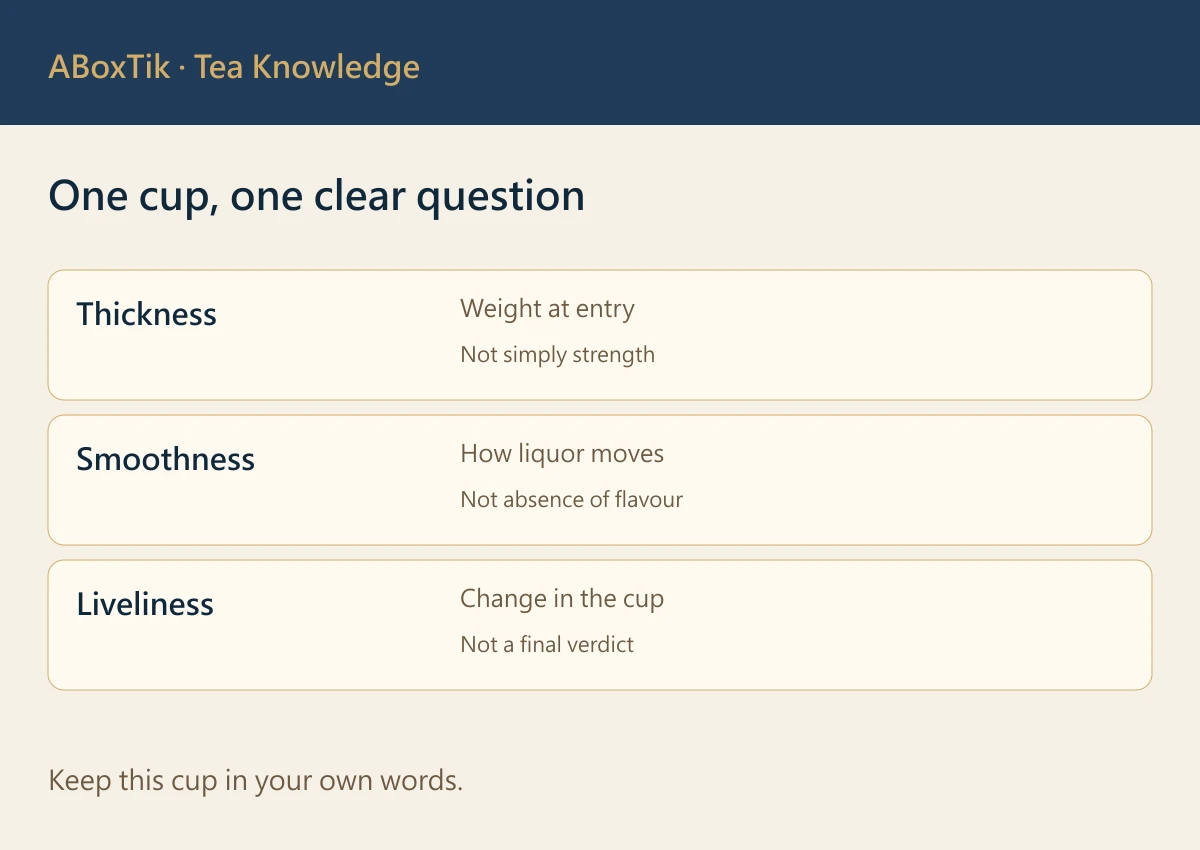
Thickness, smoothness and liveliness in tea liquor are not the same observation. Thickness concerns the sense of weight on entry; smoothness concerns how the liquor moves through the mouth; liveliness is a plain-language way to notice whether aroma, flavour and texture seem to change and invite another sip. None is a quality score.
If aftertaste, mouthwatering sensation and throat finish have all ended up inside “nice mouthfeel,” that is a very normal beginning. This guide separates the moments before, during and after the sip, so a tasting note can become clearer without becoming fussy.
Put the moments of observation in order
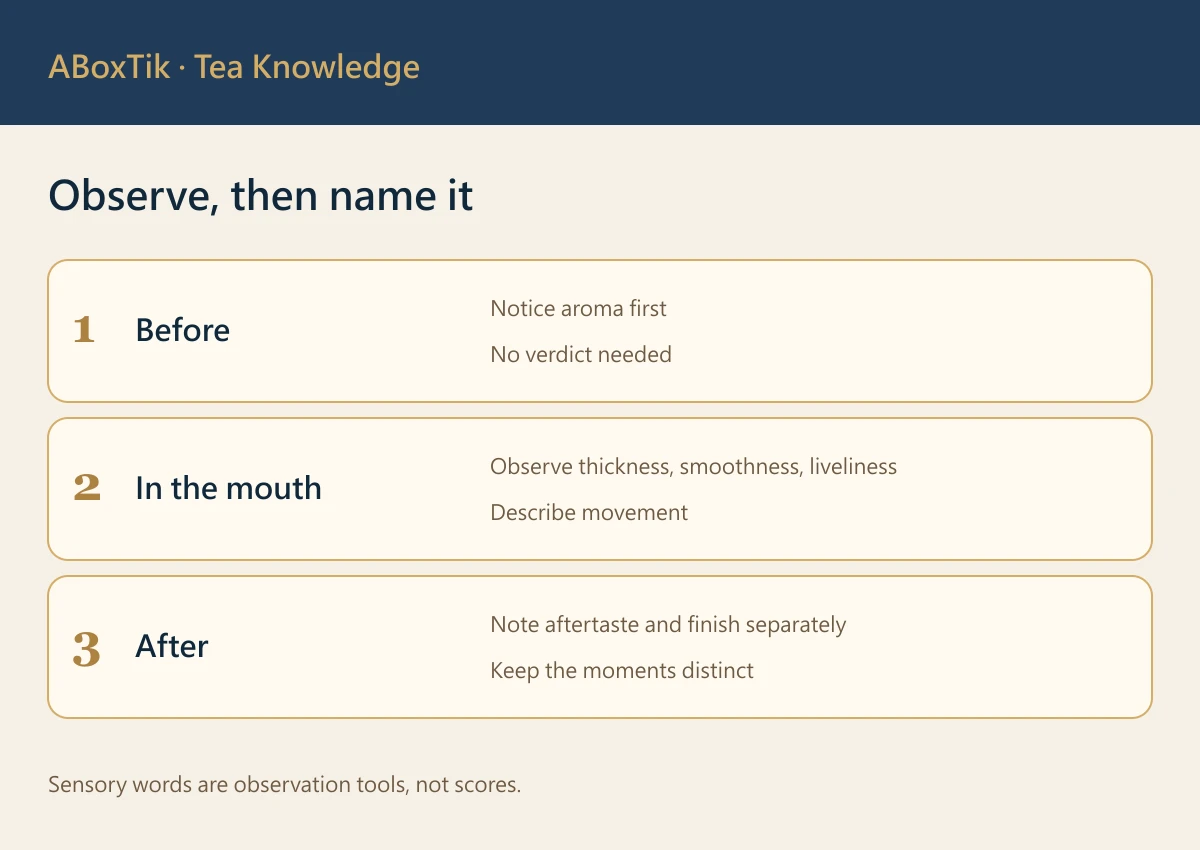
A cup can offer aroma before the sip, weight on entry and a lingering impression after it is swallowed. Put those observations on a simple timeline. Notice aroma first; use thickness, smoothness and liveliness while the tea is in the mouth; then consider sweetness, mouthwatering sensation or throat finish after swallowing.
Aroma observation belongs before the sip. Sweet aftertaste, mouthwatering observation and throat finish belong later. Separating them does not make tea difficult; it gives each experience somewhere to sit.
The Tea and Beverage Research Station flavour wheel distinguishes aroma, taste and mouthfeel as communication dimensions. Everyday notes need not imitate professional assessment. They only need to describe this cup honestly.
Thickness: the sense of weight on entry
When a tea feels thick, think of whether it spreads as a light layer or a more substantial presence across the tongue. Thick is not the same as strong, and it is not automatically better. Some drinkers prefer a clean, light frame; others enjoy a more complete sense of liquor in the afternoon.
If a cup feels heavy, do not immediately call it bitter or astringent. Observing bitterness, astringency and strength helps separate the amount of tea liquor from a taste that lingers later.
Use similar cups and comparable temperatures when comparing two teas. One modest question is enough: which has more weight at entry? It is easier to remember than a parade of adjectives.
Smoothness: how tea moves through the mouth
Smoothness can describe whether tea liquor feels connected as it passes across the tongue and mouth. You may write soft, fine or even. The useful part is naming the route you felt, not finding a single official word.
Smoothness does not mean an absence of flavour, and it does not erase bitterness or astringency. A tea with clear flavour may still move in a way that feels continuous; a lighter tea may feel dry or broken. Recording flavour and movement separately keeps the note close to experience.
For a later comparison, adjust one steeping condition at a time. When the conditions are clear, “smooth” does not have to rely on a vague memory.
Liveliness: not a mysterious verdict
In ordinary tasting language, liveliness can be a prompt: does this cup show a clear movement between aroma, flavour and texture that makes you want to take another sip? One person may call that bright, another may call it animated. These are personal sensory descriptions, not chemistry or a claim about the body.
Liveliness is also different from sweet aftertaste or a mouthwatering sensation. Leave those observations until after swallowing, then compare them with aftertaste and mouthwatering notes.
Used carefully, liveliness becomes useful because it returns attention to change in the cup instead of making it a catch-all compliment.
A before, during and after tasting card
| Moment | What to notice | A simple prompt |
|---|---|---|
| Before the sip | Dry leaf, warm and cup aroma | What direction arrives first? |
| In the mouth | Thickness, smoothness, liveliness | Does it have weight? Does it move evenly? |
| After swallowing | Aftertaste, mouthwatering, throat finish | What remains, without scoring it? |
Use one row only on a first try. Aroma and tasting observation can help preserve the observation, while a Taiwanese tea style starter offers useful differences to compare.
If all you write is “the first cup felt thicker; the second felt smoother,” the card has done its job. Tea does not require every adjective to come home with you.
Let vocabulary serve the next cup
These terms are helpful when they lead to a practical next choice: “I like weight without a long finish,” or “I want a clearer movement across the mouth.” That language is more useful than a generic good/bad verdict.
For a comparison of aromatic styles, read light versus roasted Taiwanese tea; for a broader foundation, start with the six tea categories. Each tea still deserves its own package guidance and brew.
Keep the notebook modest. Change one condition in a round and leave a few words on a page. A little space in the cup makes sensations easier to hear.
Make one comparison that you can return to
Use one tea and two similar cups for a first comparison. Record the package-based starting conditions: leaf amount, water volume, starting temperature and the point when leaves leave the water. On the next brew, alter just one condition. Wait until both cups are comfortable to sip, then take a small amount from each. There is no need to hold hot tea in the mouth to make a more impressive note.
Give weight and movement their own questions before deciding whether the overall cup feels lively. If one cup has a more noticeable aroma, put that in the aroma column instead of allowing it to answer every other question. A tea can be fragrant without feeling particularly weighty, or substantial without an especially loud aroma. Separating observations makes room for those combinations.
Cup shape, drinking temperature and tasting order belong beside the note. Try reversing the order in a later round and see whether the same impression remains. Treat this as an everyday observation exercise, with ordinary cups and honest limits. A different second impression is useful: check the conditions, then describe what changed rather than polishing the first answer until it looks certain.
When sharing notes, ask a friend where and when the sensation appeared. Their “soft” may overlap with your “smooth,” while their “thick” may refer to a strong taste rather than weight. A concrete description helps translate between the words. The adjectives can then stop arguing across the table and return to their job: making the next cup easier to choose.
Keep preference separate from description in the final line. “More weight” describes a comparison; “I prefer the lighter cup today” records a choice. That small distinction is especially helpful when buying tea for someone else. It gives a retailer a clear direction without turning one person’s favourite texture into a universal definition of quality.
Tea, one box at a time
Remember this cup in your own words
At ABoxTik, we see sensory vocabulary as a way to welcome detail, not create distance. Name the weight, movement and change you notice, and the next cup becomes easier to choose.
Continue with Aroma and tasting observation, or compare small servings with Classic Taiwanese Tea Four-Box Set.
Related reading
- Observe sweet aftertaste after swallowing
- Learn a note-taking method for mouthwatering sensation
- Separate bitterness, astringency and strength
Sources
- Tea and Beverage Research Station: Taiwan tea flavour wheel
- Tea and Beverage Research Station: Introduction to tea sensory evaluation
Sources checked 19 October 2026.