
ABoxTik Tea, Tea, Tea Bag, Tea Knowledge
TTES No. 20 Yingxiang: Parentage, Names and Cultivar Numbers
TTES No. 20 Yingxiang is a Taiwanese tea cultivar bred from female parent line 2022 and male parent Qingxin Oolong. It was named in 2004; 2022 is a breeding-line identifier. A pedigree can look like a password at first. Once the numbers have their proper places, there is no need to memorise them before enjoying a cup.
Taiwanese tea breeding gives growers and makers a wider choice of raw material. Yingxiang is one such story. The National Taiwan Science Education Center describes a gentle floral aroma and suitability for partially oxidised tea. That is a useful introduction to the cultivar, while each finished tea still deserves to be read through its own origin, season and processing details.
What is Yingxiang Oolong?
Why is it called Yingxiang Oolong and where does the name originate?
Yingxiang was crossed in 1962 and passed naming in January 2004, according to the National Taiwan Science Education Center. The cultivar is known as TTES No. 20. When its leaves are processed as oolong tea, the finished product is called Yingxiang oolong. Breeding and selection take time, but a fixed twenty-year timetable should not be assumed for every cultivar. If Jinxuan is not your favourite flavour direction, Yingxiang offers another route to explore at a comfortable pace.
The aroma of YingXiang Oolong Tea fills the air, enchanting my senses with its sweet fragrance, as I take a sip and let its flavors dance upon my tongue, I am transported to a world of pure delight and bliss.
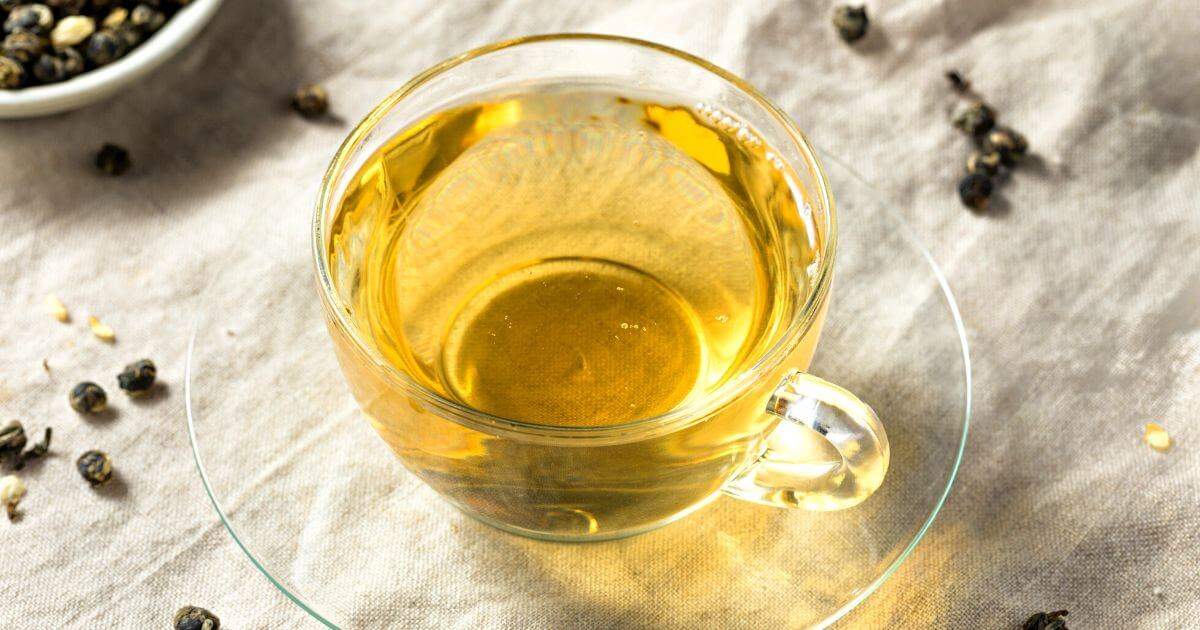
Tea Classroom – Yingxiang Oolong
Where is the Origin of Yingxiang Oolong?
Yingxiang is a cultivar name, not an origin label. For a particular packet, check the place of production and the producer’s batch information. ABoxTik’s current Yingxiang product page lists Nantou, Taiwan. The Tea and Beverage Research Station describes weak resistance to pests and diseases and moderate drought resistance; a variety bred with improvement in mind does not automatically excel in every trait. Garden conditions and management remain important.
Origin of Yingxiang Oolong
- Parent tea source
The parentage is documented: female parent line 2022, also identified as Tainung line 2022 by the National Taiwan Science Education Center, crossed with male parent Qingxin Oolong. These are breeding parents, not two finished teas blended in a tin. Nor does the pedigree divide the cup into percentages of each parent’s aroma. Growing conditions and the maker’s choices help shape the final tea.
- Brothers and Sisters of the Yingxiang Series
Yingxiang names the cultivar; tea type describes how its leaves are processed. The science education center lists clear-style strip-shaped Baozhong and ball-shaped oolong among its common tea styles, while other processing styles may also occur, including black tea. Different finished teas are not separate sibling cultivars, and roasting alone does not define every tea category.
- Taiwanese tea N.20
The two dates worth placing on Yingxiang’s family card are 1962 for the cross and 2004 for naming. Both the science education center and the research station support the naming year. “No. 20” identifies the named cultivar; “2022” identifies the maternal breeding line. Neither number tells us a packet’s harvest year, a flavour score or how many infusions it will give.
Read More:
Chinese Tea Culture [6 Tea Types] – The Origin of Tea
Reading Yingxiang’s family card: line 2022 is an identifier
It is easy to read “line 2022” as a date. Keep the word “line” beside the number, and its role becomes clearer: this is an identifier in the breeding record. Yingxiang was crossed in 1962 and named in 2004, well before the calendar reached 2022. The number has an identity job; it has not taken a second job as a harvest date.
TTES No. 20, Yingxiang and line 2022 are not interchangeable labels. The first two identify the named cultivar. The third identifies its maternal breeding line. Qingxin Oolong is the paternal parent. On a packet, keep those cultivar details separate from the place of production and harvest season. Doing so helps a little family history become useful reading rather than a list to memorise.
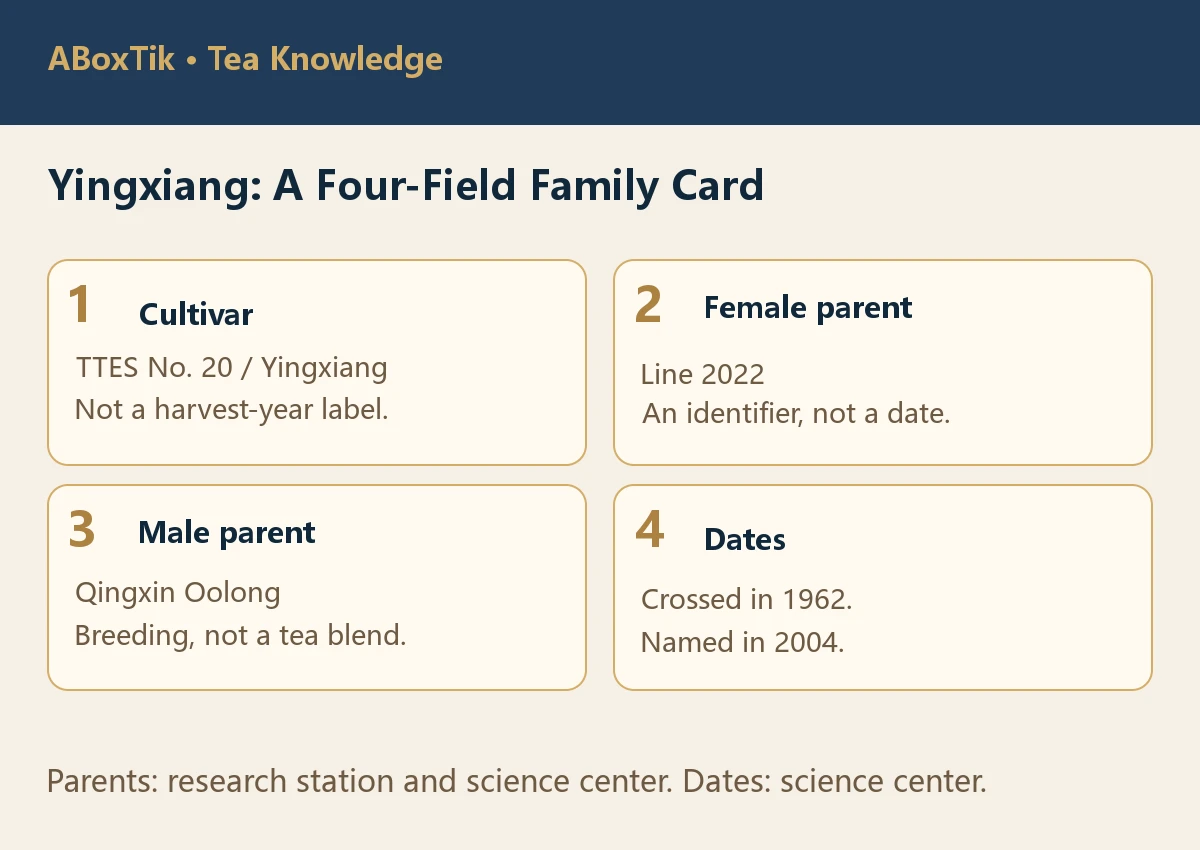
A four-field family card
- Cultivar: TTES No. 20, also called Yingxiang.
- Female parent: line 2022; the science education center calls it Tainung line 2022.
- Male parent: Qingxin Oolong.
- Dates: crossed in 1962; named in 2004.
This card records parentage, not a prize for the most fragrant parent. A selected cultivar has its own characteristics, and the finished cup also passes through a garden, harvest and processing choices. Knowing that Qingxin Oolong is the father does not let us assign a precise share of a batch’s aroma or promise a particular finish. The family card gives us a starting point; the batch information carries the story forward.
Cultivar, processing and flavour: ask three separate questions
Cultivar answers which tea plant supplied the leaves. Processing explains how those leaves became finished tea. Tasting records the cup in front of us. For Yingxiang oolong, floral descriptions offer a direction to notice, while harvest, oxidation, roasting and storage help explain a particular batch. Read the oolong oxidation guide alongside the cultivar record to see why two Yingxiang teas can have different personalities.
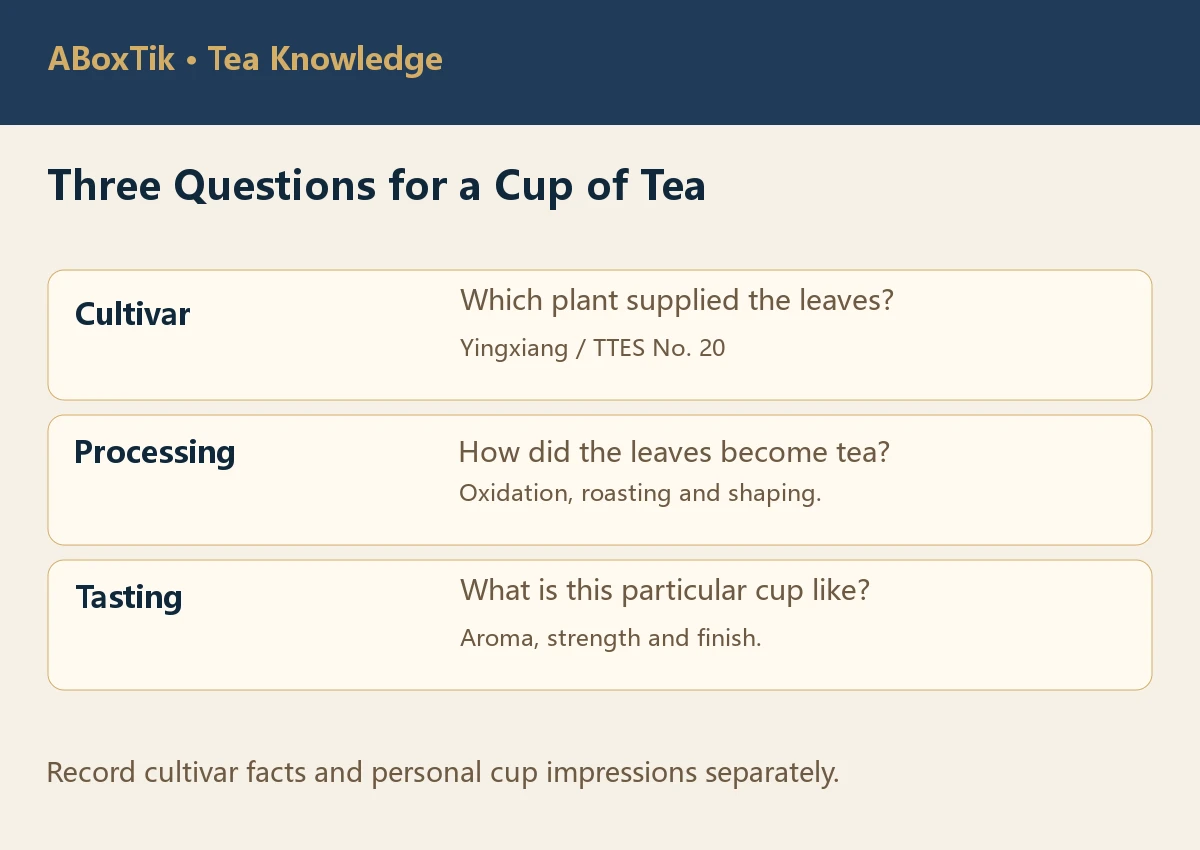
A first tasting note can be very short. Write whether the floral impression is subtle or clear, the tea feels light or fuller, and the finish seems brief or lingering. There is no need to name five flowers before breakfast. Record the brew conditions and the strength you enjoyed; those details make the next comparison more useful than a vocabulary test would.
Try the same two-column approach when reading a product page. Put cultivar, origin and batch details in one column; personal aroma and texture impressions go in the other. If a cup is unusually strong, look first at water quantity and infusion time. An overlong infusion need not become a verdict on the whole cultivar. Giving facts and preferences their own space makes choosing tea a more comfortable exercise.
A tiny tea-table quiz, with no papers to hand in
Does line 2022 mean a 2022 harvest? No. It identifies the maternal breeding line. Is Yingxiang a blend of Qingxin Oolong and Four Seasons tea? No. Official parentage is line 2022 and Qingxin Oolong; a breeding cross also differs from blending finished teas. Can orchid-like aroma confirm the cultivar? No. Aroma supports a tasting description, while cultivar identification needs source information.
No certificate is waiting at the end of the quiz. One fewer question when reading a packet is a useful result in itself. For another Taiwanese cultivar story, continue with the Cuiyu cultivar guide or the Jinxuan cultivar guide. This page concentrates on Yingxiang’s identity; comparing three teas for purchase belongs in a separate guide. For the broader relationship between breeding, place and craft, the Taiwanese tea guide provides a gentle next step.
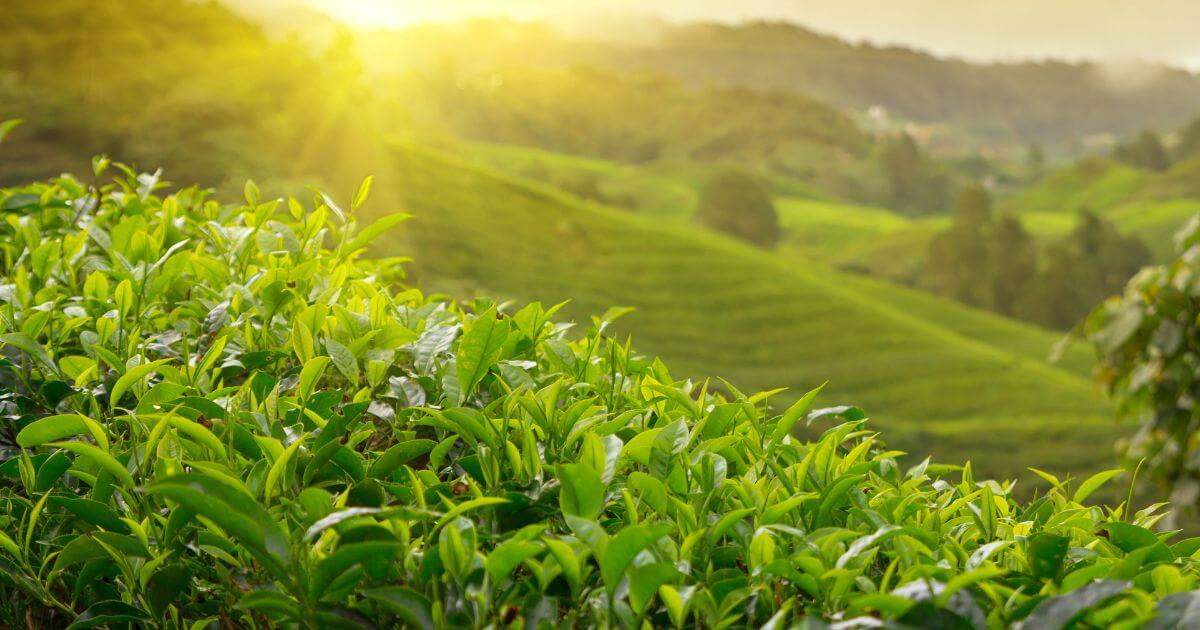
Features of Yingxiang Oolong Tea Tree
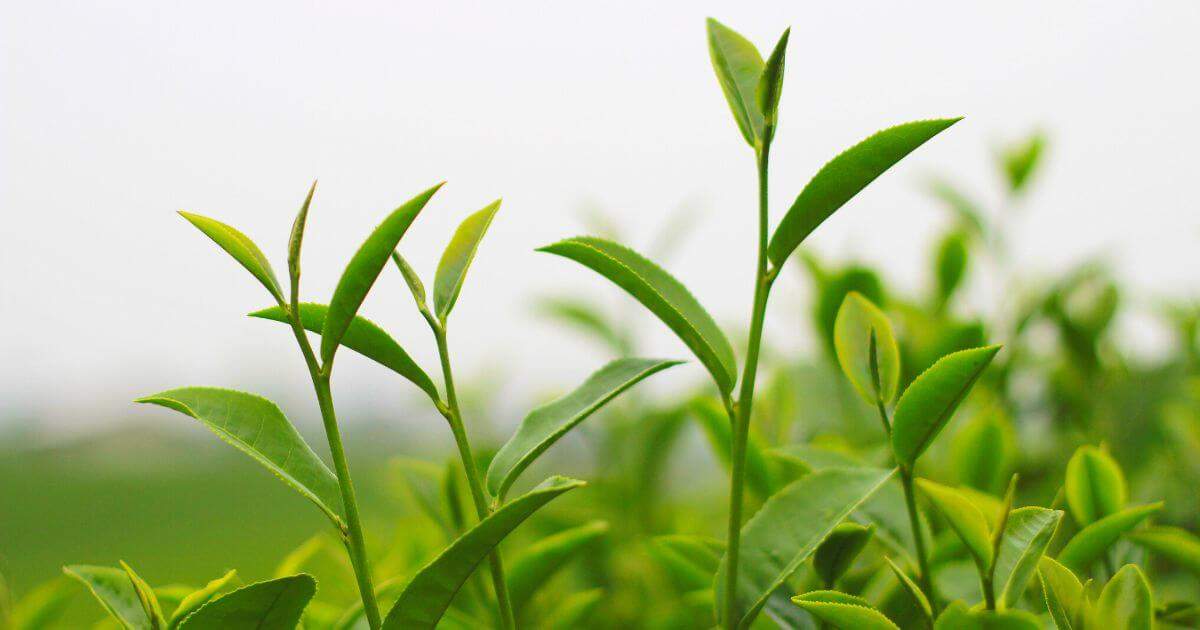
The research station describes Yingxiang as a small-leaf, medium-season cultivar with a spreading shrub habit. Young buds and leaves are fresh green with a slight purple tinge, turning fresh green later; mature leaves are long and narrow. Young-leaf hairs are denser than those of Qingxin Oolong. The leaves can become fibrous relatively readily. It is suitable for partially oxidised tea, but a fixed “30% oxidation” is not a cultivar specification.
Yingxiang Oolong tea brew taste and colour
Use these familiar flavour descriptions as prompts: notice the dry leaf, aroma and tea colour, then write down what this particular batch brings to your cup. Processing and brewing can change the result.
- The tea leaves are dry and green prior to brewing.
- The front stage has a fresh orchid fragrance, while the end stage has a floral aroma with a sweet aftertaste.
- The tea brew is transparent bright honey-yellow in colour, and has a sweet aftertaste.
Read More:
How to Brew Tea? ABoxTik of Tea Series
The aroma of YingXiang Oolong Tea fills the room, a fragrance that lingers in the air like a sweet melody, captivating your senses with every sip.
Price of Taiwanese No. 20 Yingxiang
When comparing Yingxiang tea prices, put pack size, origin, harvest information and processing description beside the price. These details are more useful than assuming the cultivar alone guarantees value. The craft of making the tea matters too: experienced makers guide withering, oxidation and roasting to suit the leaves and the intended style. For a manageable first encounter, ABoxTik Yingxiang oolong tea bags let the product information and brewing instructions be read together.
The producer’s batch details and processing description can help explain the price. A smaller trial and a short note about flavour are practical ways to decide whether a particular tea suits a daily cup or a gift.
The secrets of brewing Yingxiang Oolong Taiwanese Tea No. 20
Start with the water quantity, temperature and time printed on the product. The older guide’s 90°C, 3–5 g and 45 seconds are only a historical reference without a stated vessel volume; they are not a complete recipe for every Yingxiang tea or tea bag. Change one variable at a time: shorten the infusion if the cup is too strong, or lengthen it gently if it is light. Use the product’s own chilled-brewing instructions for cold tea. A familiar, easy-to-clean vessel is a helpful place to begin.
Read More:
[2023] 6 Best Herbal Tea of 2023 – Premium Herbal Series
Follow ABoxTik
Where to buy Yingxiang Oolong? A Taiwanese cup to enjoy and share with ABoxTik
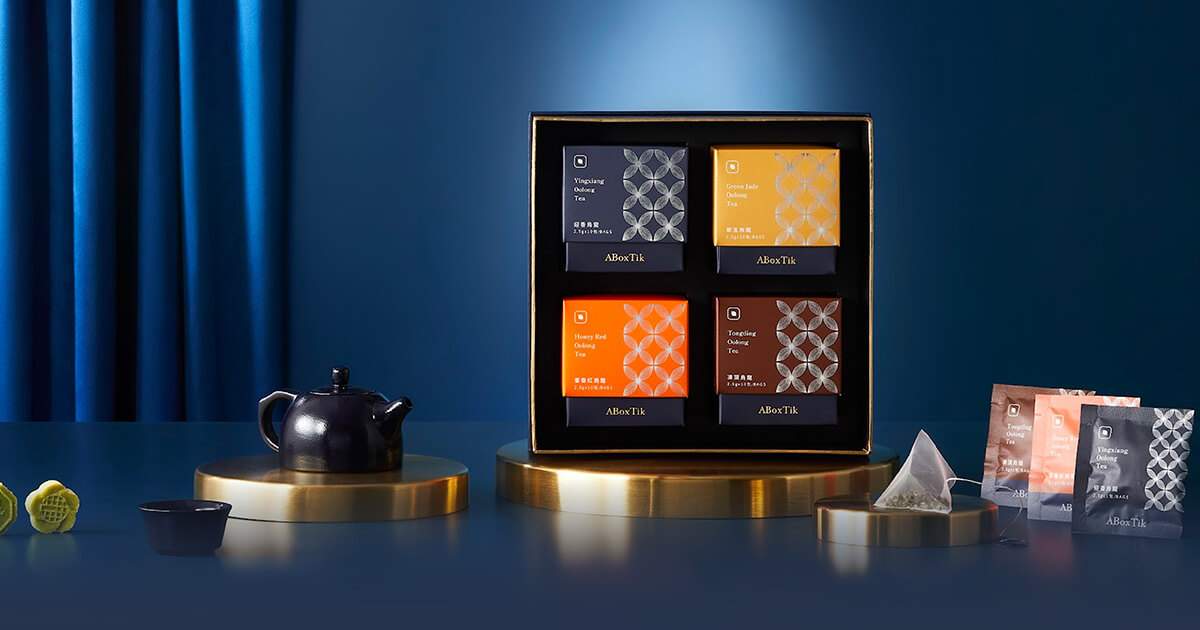
There are many places that retail Yingxiang Oolong, but it is important to confirm the origin of the tea, which is the greatest recognition of the tea farmers to the tea makers. The convenience of the Internet allows us to buy first-hand fresh from our origin. ABoxTik’s excellent and exquisite tea gift series, 100% use Taiwan tea, from the origin to the baking technique, are all carefully inspected, in hopes to deliver the meticulous uniqueness of Taiwanese tea to everyone. If you want to give delicious tea to your relatives and friends, an ABoxTik gift box offers a place to explore flavours and combinations.
For another cultivar story, continue with Cuiyu or Jinxuan.
Sources
Sources checked: 11 October 2026. Tea card and quiz: editorial learning activities.