
ABoxTik Tea, Tea Knowledge
Gaiwan vs Teapot: Which Brewing Vessel Should Beginners Choose?
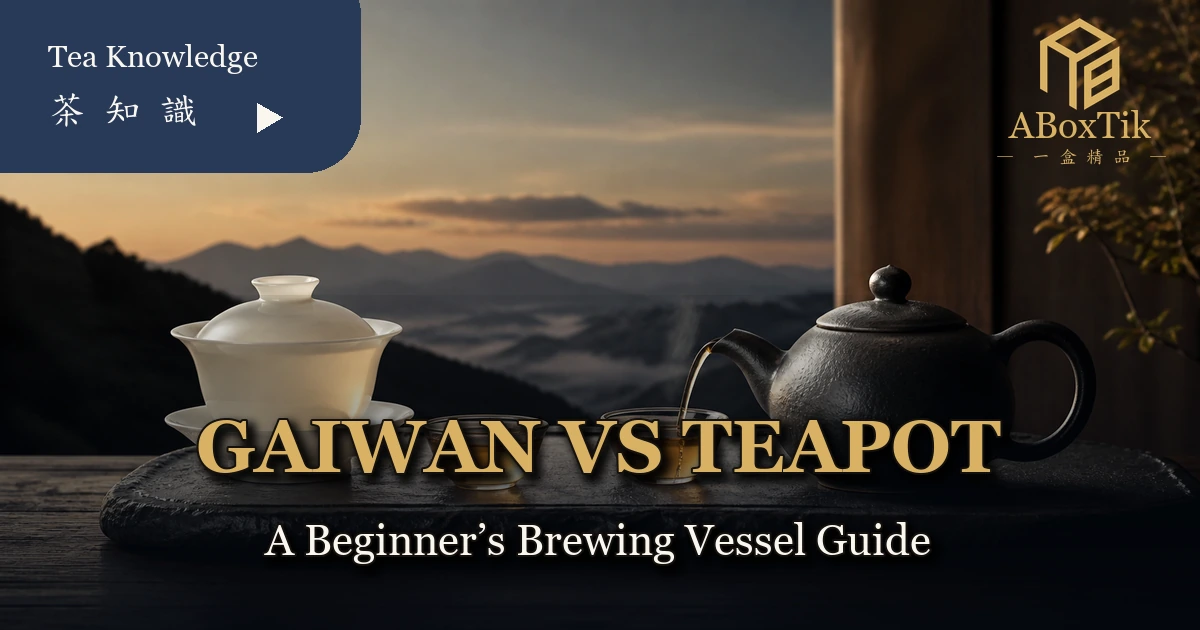
The same leaves reveal their outline in an open gaiwan and hold their warmth inside a rounded pot. Choosing a vessel is not choosing a winner; it is choosing which side of the tea you want to notice.
Gaiwan vs teapot comes down first to four things: control, heat, visibility and cleaning. A glazed porcelain gaiwan responds quickly and lets you inspect the leaves, which makes it useful for building a brewing baseline. A teapot provides a fixed handle and a wider range of shapes, wall thicknesses and capacities, which can suit repeated service or sharing. The name of the vessel is only one variable; volume, material, pour speed, leaf-to-water ratio and steep time also shape the cup.
If you are assembling your first tea set, do not begin with “Which one is more advanced?” Ask how you actually drink. Are you brewing alone or serving a family? Will you rotate through many styles of Taiwanese tea, or stay with one favourite? Do you want to watch rolled leaves unfurl, or is a handle and predictable pouring motion more important? Once the use case is clear, the vessel becomes much easier to choose.
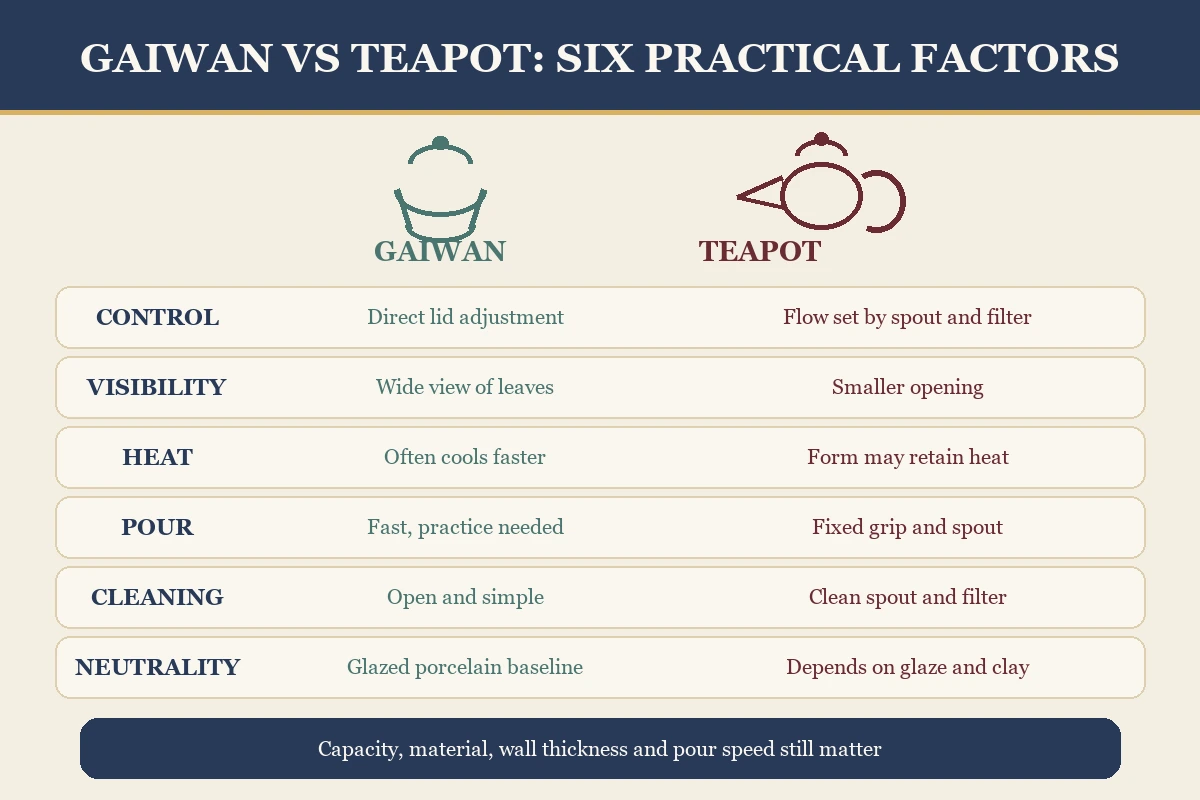
Gaiwan vs teapot: compare these six practical factors
| Factor | Gaiwan | Teapot | Beginner’s cue |
|---|---|---|---|
| Control | Lifting the lid stops covered steeping; changing the gap alters the pour | Flow depends on the spout, filter holes and lid fit | Choose a gaiwan if you want a direct lesson in timing |
| Visibility | The wide opening reveals dry leaf, infusion and spent leaf | A smaller opening usually shows less of the leaves | A gaiwan is intuitive while learning leaf shape |
| Heat | Cooling depends on material, wall thickness and the open form | The enclosed form may hold heat differently, but material and size still matter | Do not assume every pot is automatically hotter |
| Pouring | Can decant quickly, but finger placement takes practice | A handle and spout create a more fixed motion | If heat-sensitive or serving several people, test the grip first |
| Cleaning | Wide opening and few hidden areas make leaf removal easy | Spout, filter and underside of the lid require attention | A gaiwan is often simpler when rotating teas daily |
| Aroma carry-over | Glazed porcelain is generally easy to keep neutral | Glazed pots can also be neutral; unglazed clay needs a separate decision | For one all-purpose vessel, start with an easy-to-clean glaze |
There is no universal winner in this table. A thin gaiwan behaves differently from a heavy one, just as a porcelain pot differs from an unglazed pot. Even two vessels marked 120 ml may pour ten seconds apart, enough to change the extraction. Review the common mistakes that make tea bitter or flat and the basic tea-brewing sequence before blaming the vessel for a difference caused by water temperature or a slow decant.
A vessel does not speak on behalf of the tea. It changes the pace at which water meets leaf, helping the brewer hear more clearly.
Why did both the gaiwan and teapot become central brewing vessels?
Teaware history is not a single line of one object replacing another. Material from the National Palace Museum’s Southern Branch describes how steeping loose-leaf tea in pots became important during the Ming period, while Yixing and red-clay pots gained attention. Widespread use of the gaiwan is characteristic of the Qing period, when it could serve for both steeping and drinking. Placing both vessels on a modern table is therefore less about declaring a successor than understanding how different forms answered different habits.
A gaiwan combines bowl, lid and saucer, with an open form that makes observation and adjustment easy. A teapot joins body, spout, handle and lid into a more directed pouring system. Beyond shape, tea culture and hospitality affect the choice: a solo learner may value rapid comparison, while a family table may value capacity and a stable serving motion.
Should a beginner choose a gaiwan or a teapot?
- One vessel for many teas: choose a glazed porcelain gaiwan or glazed porcelain pot that can be cleaned thoroughly and used as a neutral baseline.
- You want to watch rolled oolong open: choose a gaiwan with enough internal room and resist filling it with too much leaf.
- Your fingers are heat-sensitive or you serve several people: hold the pot, test the lid and check the pour before choosing an appropriate capacity.
- You collect Taiwanese studio ceramics: confirm that the work is intended for food contact, then consider volume, cleaning, glaze, clay and the maker’s language.
- You want to compare one tea across vessels: begin with similarly sized glazed pieces so you do not change water, temperature, dose and vessel all at once.
For one to three drinkers, 100–150 ml is a common and manageable starting range, but cup size, number of infusions and hand size can change the answer. Instead of treating one number as a rule, fill your regular cups with water and pour them into the vessel. Check whether one infusion can be divided evenly while leaving room for the leaves to open.
Which vessel suits different Taiwanese teas?
| Tea direction | Try first | What to observe |
|---|---|---|
| Wenshan pouchong, Yingxiang, Cuiyu and lightly styled high-mountain oolong | Glazed porcelain gaiwan or porcelain pot | Clarity of floral aroma, decant speed and space for the leaf |
| Tongding and roasted oolong | One round in a gaiwan and one in a small pot | With conditions fixed, compare aroma focus, body and finish rather than assuming the pot must win |
| Honeyed red oolong and Taiwanese black tea | Either vessel | Decant fully and prevent small leaf particles or hotter water from extending the steep |
| Tea bags and broken-leaf tea | A mug or handled pot is often more practical | Follow the stated water and time; a gaiwan is not required for formality |
Use Lishan tea or another high-mountain oolong to notice how rolled leaves open, and compare that with the fuller roasted outline discussed in our rare Taiwanese tea guide. These are starting points, not fixed pairings. Understanding oolong oxidation and leaf-working helps you identify what belongs to the tea itself instead of assigning every difference to the vessel.
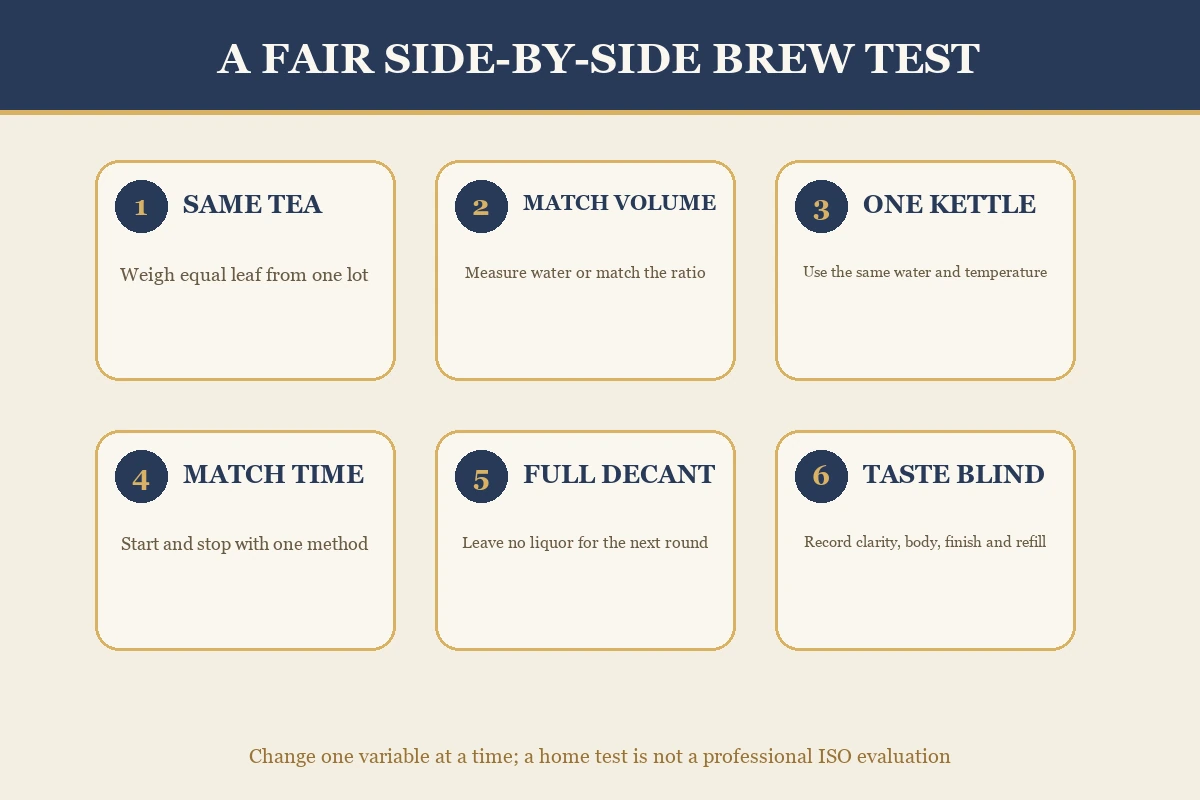
Run a fair gaiwan vs teapot test by fixing six variables
Taiwan’s Tea and Beverage Research Station explains professional sensory evaluation with white porcelain, fixed vessel capacity and consistent infusion conditions to improve comparability. A home experiment is not an ISO or professional evaluation, but it can borrow the essential idea: change only one thing at a time.
- Use the same tea lot: mix the leaves gently, then weigh equal portions.
- Match effective volume: measure the water rather than trusting a label; if capacities differ, calculate the same leaf-to-water ratio.
- Use one kettle and one temperature: avoid changing water source, reboiling pattern or cooling time.
- Match steep time: time both from the same point in the pouring sequence.
- Decant completely: retained liquor will make the next infusion an unfair comparison.
- Taste blind before revealing the vessel: ask someone to randomise the cups and record aroma clarity, strength, texture and which cup you would refill.
You do not need a catalogue of professional aroma terms. Use four columns for each infusion: “aroma clarity, strength on entry, length in the mouth, would drink again.” The sequence in our tea aroma guide can help you smell dry leaf, warm cup and spent leaf in a repeatable order. If the cups differ, change only one factor in the next round—perhaps bringing pour times closer—instead of declaring that clay simply “makes tea sweeter.”
Material, capacity and safety often matter more than the vessel’s name
Glazed white porcelain makes liquor colour easy to see and is practical when rotating teas. Unglazed pottery may behave differently according to porosity, firing and its history of use; “absorbs aroma” does not logically mean “always improves tea.” Ask whether a piece is intended for food contact, what temperature changes it can withstand and how it should be cleaned. To see how tea and Taiwanese craft meet on the same platform, browse the ABoxTik collection and rely on the current product page for material and use instructions.
Taiwan’s Ministry of Health and Welfare regulates lead and cadmium migration from ceramic food-contact ware and advises care with decorated contact surfaces. In everyday use, be cautious with pieces of unknown origin that have extensive bright decoration around the rim or interior. Stop using a vessel for drinks if it develops cracks, flaking glaze or an odour that cannot be removed. Clear the leaves, rinse and dry the vessel fully after brewing, and keep the tea itself away from moisture, light and odours by following our tea storage guide.
A vessel that fits your hand does not have to prove your expertise. It only needs to make brewing, pouring and cleaning a daily ritual worth repeating.
Gaiwan vs teapot FAQ
Is a gaiwan too hot for a beginner?
It can feel hot if overfilled, if fingers touch the bowl, or if the lid gap is opened too wide. Keep the water below the lid line, hold the rim with thumb and middle finger, rest the index finger lightly on the lid knob, and practise first with warm water. If hand mobility is limited or you still feel unsafe, a handled teapot is the better choice.
Can one teapot brew every kind of tea?
A glazed porcelain pot or another vessel that can be cleaned thoroughly can rotate among teas. Whether to dedicate an unglazed pot depends on its material, condition and your flavour goal; it is not a ritual every beginner must follow. If you own only one vessel, prioritise cleanability, appropriate capacity and a smooth pour.
Does a gaiwan always show aroma better than a teapot?
No. Its open form and glazed white surface can make observation direct, but aroma is also affected by water, temperature, dose, wall thickness, pour speed and the drinking cup. Compare similar conditions rather than treating the vessel name as the result.
Can I brew a tea bag in a gaiwan?
Yes, although it is rarely necessary. A tea bag already simplifies dose and removal, so a mug or handled pot is usually more convenient. If you want to test the same bag in different vessels, keep water volume, temperature and time the same.

Follow ABoxTik into the world of tea
Begin with one vessel and discover where Taiwanese tea meets craft
A gaiwan makes leaf and timing visible. A teapot brings grip, flow and object-making into the tea table. The right vessel is not the one somebody says will “season” tea best; it is the one with a clear origin, useful capacity and comfortable routine that makes you want to brew again tomorrow.
ABoxTik was created to bring Taiwan’s fine tea, local craft and cultural value to a wider world. Read our story, explore the latest collection, and carry these selection principles into the work of real makers. Product details, materials and availability can change; use the information shown on the current product page.
Sources
- Tea and Beverage Research Station, Taiwan: Introduction to tea sensory evaluation (checked 2026-08-26)
- National Palace Museum Southern Branch: tea culture exhibition material (checked 2026-08-26)
- Ministry of Health and Welfare, Taiwan: ceramic food-contact ware safety (checked 2026-08-26)