
Tea, Tea Knowledge
How to Tell Floral Tea Aromas Apart: Orchid, Gardenia, Jasmine and Osmanthus
No flower has fallen into the cup, yet the rising steam gives us flower names. Aroma is not a guessing game; it is a language for sharing attention.
Floral tea aroma can be easier to describe when you compare four directions. Orchid suggests an airy, refined and delicate floral line. Gardenia is fuller, rounder and more enveloping. Jasmine feels bright, clear and lifted. Osmanthus tends to be warmer and riper, often touching apricot or honey associations. These names are sensory analogies. They are not laboratory identification, and they do not prove that flowers were added to the tea.
If you need to know when to smell dry leaf, a hot lid or a cooling cup, begin with our step-by-step guide to smelling tea. This article answers a different question: once a floral note appears, which word fits it best? For the broader relationship between aroma and taste, continue with how tea flavor develops.
What does a flower name mean in a tea tasting note?
Taiwan’s Tea and Beverage Research Station describes its Taiwan Specialty Tea Flavor Wheels as indexing tools that help tasters associate and communicate flavor. The vocabulary was developed through descriptive analysis of representative teas and expert consensus. In the wheel for fragrant ball-type oolong, the floral section includes jasmine, orchid, osmanthus and gardenia among other terms.
That context matters. “Osmanthus-like” means that a taster found a warm, sweet floral resemblance in the cup. It does not mean osmanthus appears on the ingredient list. Nor can one note establish cultivar, mountain, season, price or grade. When exploring what makes Taiwanese tea distinctive, treat aroma as one clue within a larger story of leaf, place, craft and storage.
Orchid, gardenia, jasmine or osmanthus? Start with four axes
| Flower term | First impression | Weight and sweetness | Often confused with | Useful wording |
|---|---|---|---|---|
| Orchid | Refined, airy, gently expansive | Light to medium; not necessarily sweet | Delicate jasmine, magnolia | Fine white blossom, airy, graceful |
| Gardenia | Full white blossom, rounded | Medium to rich; enveloping sweetness | Rich jasmine, creamy sweetness | Full white floral, soft and lush |
| Jasmine | Bright, clear, upward lift | Light to medium; fresh sweetness | Bright orchid, scented jasmine tea | Clear white floral, sweet and high-toned |
| Osmanthus | Warm, golden and ripe | Medium; often close to fruit or honey | Apricot, honey, cooked sugar | Warm blossom, ripe fruit, honeyed |
These axes are an ABoxTik editorial framework for everyday tasting, not an official scoring sheet. Instead of asking, “Which exact flower is it?” begin with smaller choices. Is the aroma airy or full? Bright or ripe? More like a white blossom or a golden flower? Does it appear sharply above the cup, or expand slowly through the liquor and finish? One clear contrast narrows the vocabulary without pretending to certainty.
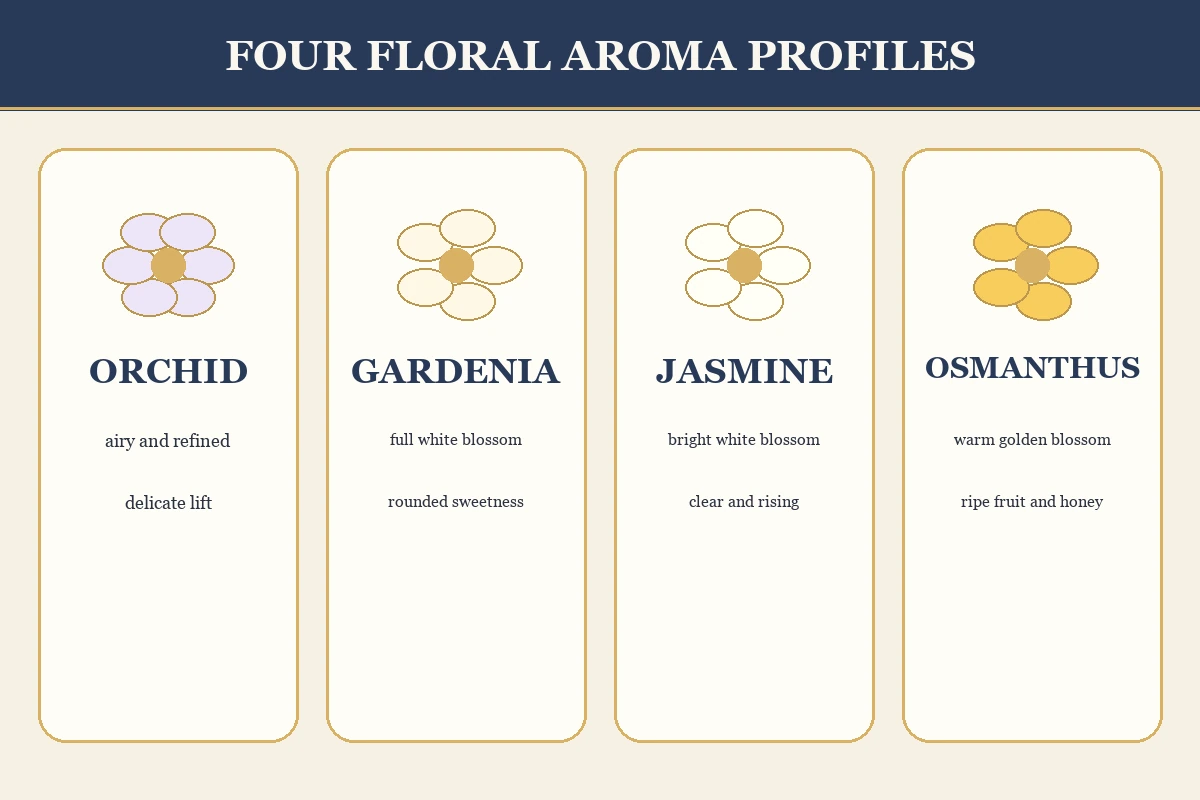
Flower names are reference points for aroma shape. Compare airy with full and bright with ripe before choosing a more specific word.
How each floral tea aroma behaves in a careful note
Orchid: airy, refined and delicately expansive
Use orchid when the floral line feels fine rather than heavy, with space around it and a gentle expansion above the liquor. It can describe a quiet white-flower impression that remains elegant rather than sugary. If the note is more direct and luminous, write “between orchid and jasmine.” If green leaf or fresh stem appears beside it, record that too. The floral direction mentioned in our guide to Yingxiang oolong is a way to approach a tea, not a promise that every lot will smell identical.
Gardenia: full white blossom with rounded sweetness
Gardenia is useful when a white-flower note feels more saturated and enveloping than orchid. Tasters may associate that fullness with creamy texture or soft sweetness, but “gardenia-like white floral with a rounded sweet impression” is more accurate than claiming that the tea contains a milk aroma compound. A strong fragrance also does not cancel roughness, muddiness or stale notes in the liquor.
Jasmine: bright, clear and lifted
Jasmine fits a white-flower impression that is easy to notice near the cup, with a bright line and fresh sweetness. In an unflavored pure tea, a jasmine association does not mean the leaves were scented with jasmine blossoms. Actual scented or blended tea should be identified from the product name, ingredients and producer information. Our overview of major tea types provides a useful starting point when labels and processing categories feel confusing.
Osmanthus: warm, ripe and close to fruit or honey
Osmanthus moves away from an exclusively white-flower register. It can suggest a warmer golden blossom with apricot, ripe yellow fruit or honey nearby. If you cannot separate osmanthus from fruit, write “a warm floral-to-apricot note” rather than forcing one answer. Perceived aromatic sweetness should also be kept separate from taste. Use our guide to sweetness, bitterness, umami and astringency in tea to record what happens on the palate.
“Between two flowers” is not a failed tasting note. It preserves uncertainty and gives the next comparison somewhere to begin.
A three-step method for a floral tasting note
- Name the broad family: fresh floral or sweet floral; white blossom or golden-flower association. Do not choose a flower yet.
- Make one useful contrast: airy or full, bright or ripe, concentrated or expansive. Choose only the axis you can perceive clearly.
- Add intensity, length and uncertainty: light, medium or strong; short, medium or long; distinct, blurred or between two references. A complete note might read, “Medium bright white floral, between jasmine and orchid, fading as the cup cools.”
When comparing two teas, keep leaf quantity, water, temperature, infusion time and vessels as consistent as practical. The Station’s introduction to tea sensory evaluation explains why professional evaluation controls the room and brewing method and considers appearance, liquor color, aroma, taste and infused leaf together. Home tasting need not imitate a competition, but changing every variable at once makes flower words much less meaningful.
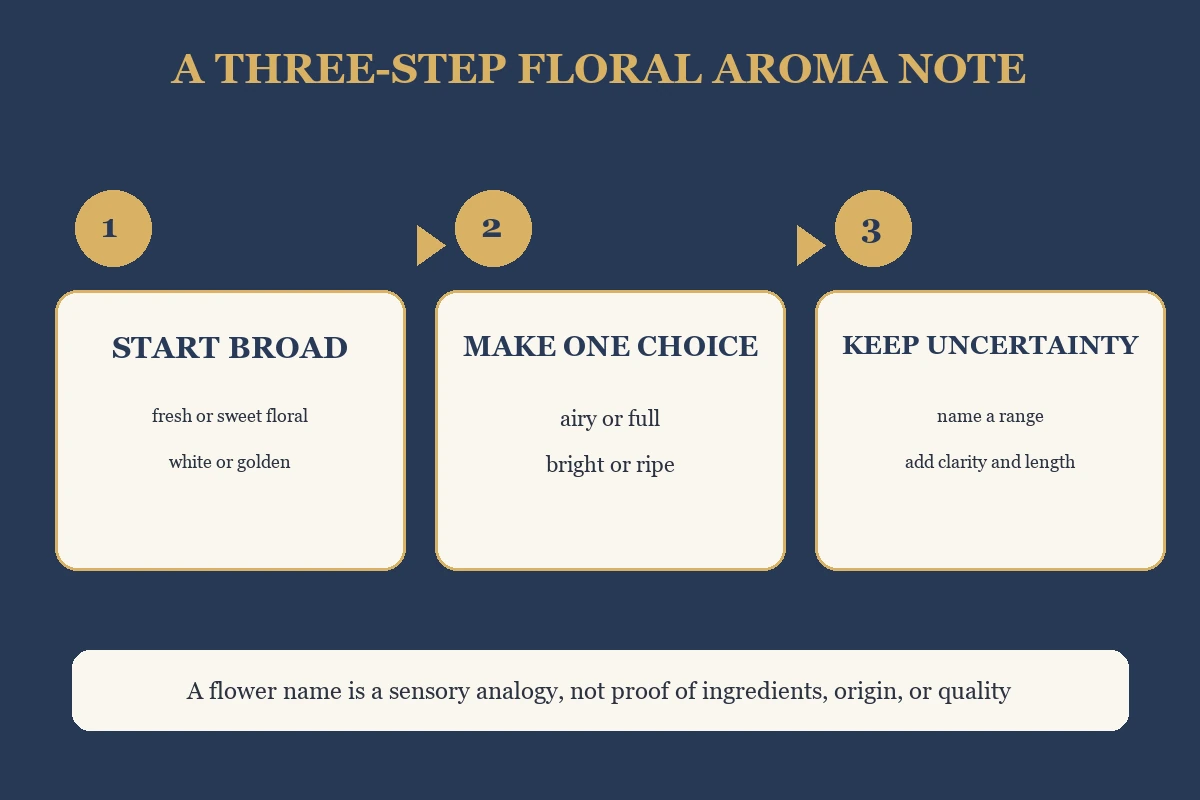
Start broad, make one contrast, then preserve uncertainty. A repeatable description is more useful than a dramatic guess.
Why can the same tea resemble orchid today and osmanthus tomorrow?
A tea’s expression is shaped by cultivar, origin, season, leaf maturity, processing, roast, storage and brewing. With oolong, withering and leaf agitation change moisture movement and oxidation; roasting can move a fresh floral note into the background while toasted, cooked-fruit or sugar-like tones become more visible. Read about oolong oxidation and leaf agitation and why tea leaves are withered for process context, but do not translate one oxidation percentage into a guaranteed flower.
Storage can blur the profile as well. Tea readily picks up surrounding odors, while heat, moisture and air can reduce freshness. Check the package and environment with our tea storage guide. Then use one stable starting recipe from the fundamentals of brewing tea and adjust one variable at a time.
Does a stronger floral aroma mean better tea?
No. Intensity is only one feature. A useful quality judgment also asks whether the aroma is clean, natural in context, coordinated with the liquor, persistent across infusions and free from stale, musty, sour or oily distractions. Aroma alone cannot establish origin or price. Pair sensory notes with traceable information and the broader context in our guide to Taiwan’s tea regions.
For practice, you do not need to collect all four flower names. Compare two to four pure teas with clear product information under the same brewing conditions. The Classic Taiwanese Tea four-box gift set is one possible way to build a broader flavor map, but the aroma of any lot must be judged in the cup in front of you. “Which profile do I enjoy?” is a better buying question than “Did I guess the official flower?”
Frequently asked questions about floral tea aroma
If pure tea smells like jasmine, were jasmine flowers added?
Not necessarily. Jasmine can be a sensory analogy. Whether flowers or flavoring were added should be determined from the product name, ingredient list and producer information, not from aroma alone.
What if I cannot identify any of the four flowers?
The tea may emphasize fruit, roast, vegetation or sweetness, or its floral note may simply be subtle. “Light fresh floral” with a clarity and length is already a valid, useful note.
Can a floral note identify cultivar or origin?
No. Cultivar and place influence flavor, but season, processing, roast, storage and brewing can change the result. Use traceable labeling for origin and keep aroma as supporting evidence.

Follow ABoxTik into the world of tea
Use precise language to remember a Taiwanese tea
You do not have to begin by memorizing flower names. First compare airy with full and bright with ripe; then use orchid, gardenia, jasmine or osmanthus to narrow the range. If the answer remains uncertain, write the range honestly. Add clarity, persistence, cleanliness and balance with the liquor, and the note becomes something you can carry into the next cup.
ABoxTik wants the details of Taiwanese tea to sound beautiful while retaining clear limits. A shared floral word can open the conversation, but the cup still leads back to cultivar, craft, land and the particular lot. That patient attention is part of how we understand premium tea.
Related recommendations
- How to smell tea from dry leaf to cooling cup
- Yingxiang oolong and its floral direction
- Classic Taiwanese Tea four-box gift set
Sources
- Tea and Beverage Research Station: Introduction to Taiwan Specialty Tea Flavor Wheels (checked 2026-09-07)
- Taiwan Specialty Tea Flavor Wheel promotional presentation (checked 2026-09-07)
- Tea and Beverage Research Station: Introduction to Tea Sensory Evaluation (checked 2026-09-07)