
Tea Knowledge
Brewing Tea in Porcelain: A Gentle Guide to Aroma and Everyday Teaware
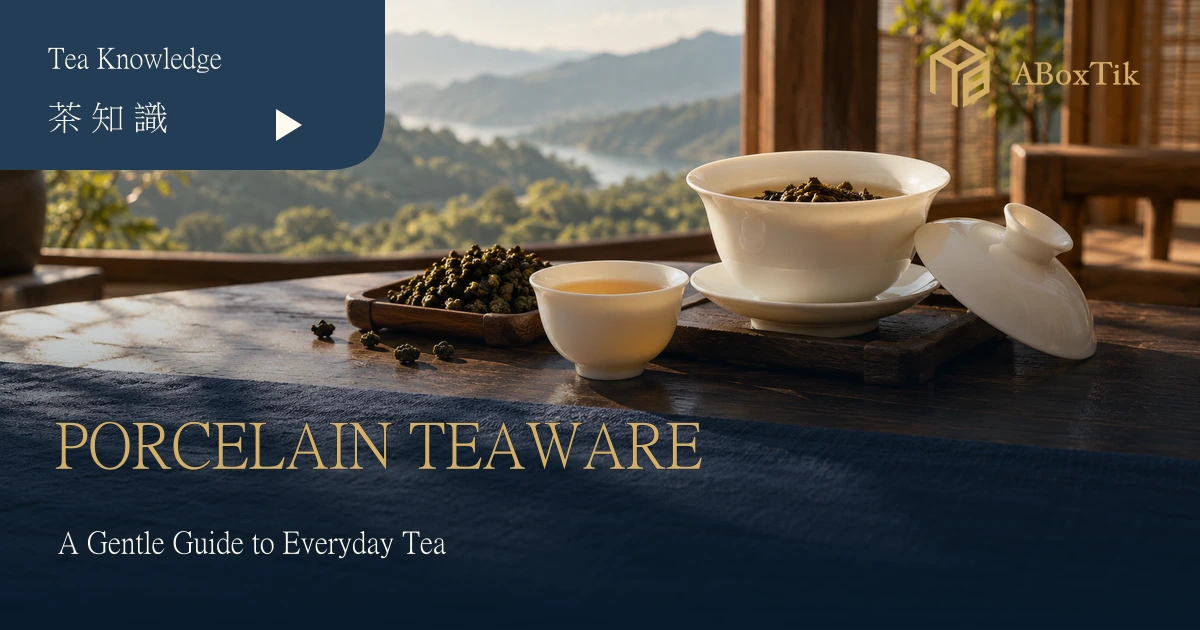
A clean white cup leaves a little quiet space around a tea’s aroma. Rinsing, pouring and sharing can be small ways of caring for an ordinary day. You do not need a whole new collection to begin.
Brewing tea in porcelain offers practical benefits: an intact glazed contact surface is generally convenient to clean when you rotate between teas, and a pale interior makes the liquor and tea stains easier to see. It can give your observations a useful starting point, but it does not guarantee a perfectly unchanged aroma. Rim shape, capacity, wall thickness, pouring, water temperature and time also affect the experience.
If white porcelain, celadon and clay pots leave you unsure where to start, that is understandable. Bring the decision back to your day: which tea do you usually brew, how many cups do you share, and can the vessel dry properly after washing? This article focuses on everyday glazed porcelain. For a broader comparison, see our teapot materials guide; for handling different vessel shapes, try gaiwan versus teapot.
Why porcelain makes a useful starting point: three layers to consider
The ceramics museum’s material introduction describes porcelain as generally having a dense body and low water absorption. Those are material characteristics, not a promise that every vessel will retain no smell. The glaze is what touches the tea, while spouts, filters, cracks and existing deposits also deserve attention. Porcelain comes in more than white; colour, a ringing sound or translucency alone cannot identify a particular piece reliably.
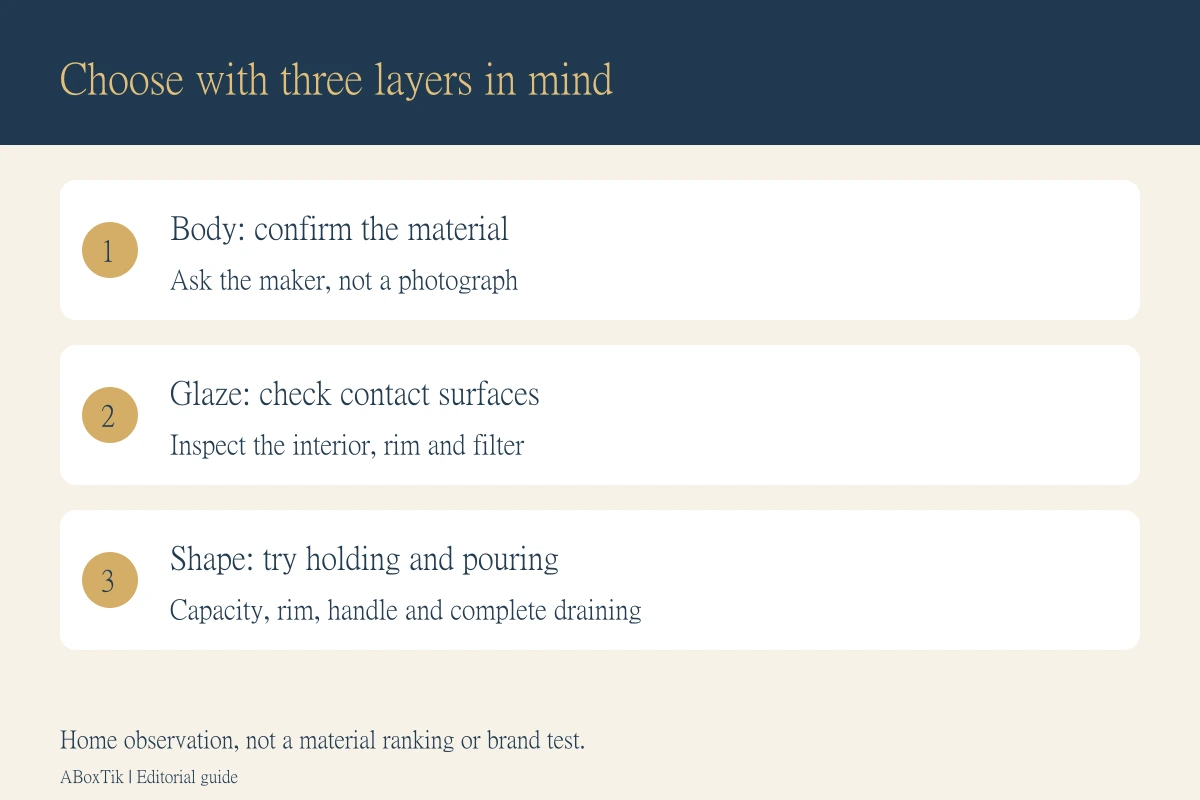
| Layer | What it helps you understand | What to check |
|---|---|---|
| Body | The material and how it was fired | Ask the maker; do not identify it from a photograph |
| Food-contact glaze | An intact smooth surface is convenient to inspect and wash | Interior, rim, filters and glaze condition |
| Shape and handling | How you hold, pour and share the tea | Usable capacity, rim, handle and complete draining |
Remove the leaves, clean the vessel and let it dry before changing teas. If you can still smell the previous tea or detergent, address that first instead of covering it with another brew. Our Taiwanese ceramics article offers more background on materials and making. A maker’s description is a better starting point than a story about what a material must do to every tea.
Does white porcelain in professional tasting mean aroma is unaffected?
The Taiwan Tea and Beverage Research Station’s sensory evaluation introduction uses white porcelain tasting sets alongside fixed tea quantities, water volumes and brewing times. The vessel is one part of a comparable procedure. Consistent conditions matter more than the words “white porcelain” alone. Your cups may have different dimensions, and everyday tea does not need to follow the longer infusion used for professional evaluation.
A helpful interpretation of “faithful aroma” is reducing interference from a previous tea, deposits or vessel odours so that you have a clearer starting point. It does not mean porcelain has no effect on temperature, or that the stronger-smelling cup is automatically better. A white interior helps you see the liquor, but use similar lighting when comparing it. Darker colour alone does not establish higher quality.
Take your time with dry-leaf, hot and cooling aromas. A narrow or open rim and the wait after pouring can change your impression. You do not need to attribute every difference to the porcelain body.
Thin, thick, white or celadon: choose what fits your hands
Wall thickness affects how a vessel feels and transfers heat, but capacity, opening, lid, preheating and surroundings also influence its temperature. “Thick keeps heat, thin releases it” is not enough to choose a whole teapot. It is often more useful to check whether you can lift it steadily when filled and where your fingers rest while pouring.
White and pale interiors are convenient for seeing colour. Celadon and other glazes can also be part of everyday tea when the intended use is clear, the surface is intact and cleaning is manageable. To explore Taiwanese glazes and handmade pieces, start with Yingge’s ceramic traditions and creative work, then ask the maker about capacity, hot-water use and care. You can appreciate a piece’s appearance while separately checking whether it suits your routine.
| Your routine | Design to consider | One extra question |
|---|---|---|
| Rotating between teas | A pale interior and accessible opening | Can the filter and spout be cleaned and dried? |
| Quiet tea for one | A comfortable cup or gaiwan of suitable capacity | Where will the water and your fingers sit? Consider a handle if heat is difficult to manage |
| Sharing with family | A porcelain pot that pours smoothly and feels steady | Can you serve the whole infusion without leaving tea steeping inside? |
If a gaiwan is new to you, practise with room-temperature water first. Our beginner’s gaiwan guide explains grip and water level. And if you already enjoy your cup, there is no need to replace everything simply to make a matching set.
Which Taiwanese teas can you try in porcelain?
Glazed porcelain is useful beyond lightly aromatic teas. When moving between Wenshan pouchong, Jinxuan oolong and Taiwanese black tea, a readily cleaned vessel can help you keep your observations organised. That is a practical benefit, not a guarantee that each batch will express the same aroma. You can also brew roasted Dong Ding oolong in porcelain without first buying a dedicated clay pot.
Begin with the product’s recommended leaf-to-water ratio, temperature and time, then adjust to your taste. If a different pot pours slowly, note the draining time too. A large mug changes the water volume and the space available for leaves to unfold. For practical adjustments, see our brewing guide; for the tea’s background, explore Taiwanese terroir and tea craft.
Compare two cups using the same infusion
If you wonder whether a rim changes your experience, avoid changing the tea, water and brewing vessel at the same time. This is a home observation exercise, not an ABoxTik test result or a way to isolate a material’s chemical effects.
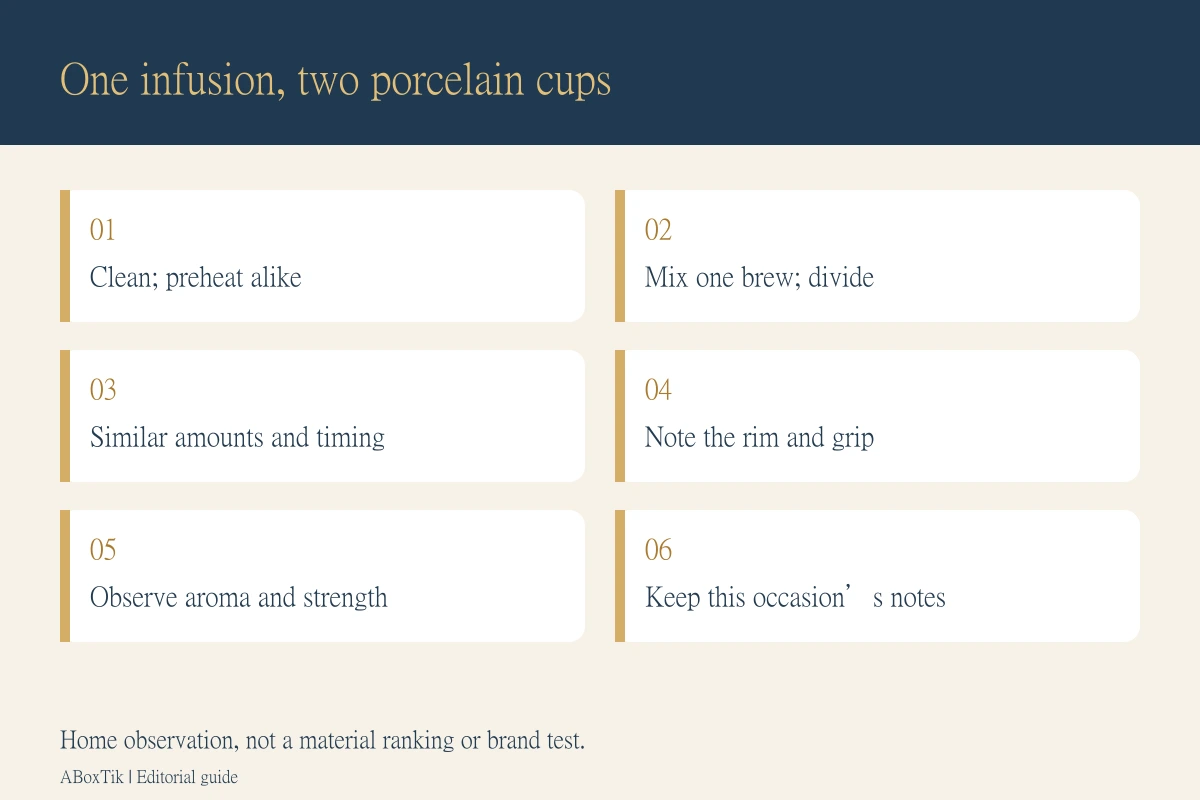
- Choose two clean, odour-free cups of similar capacity with a clear intended use. Preheat them consistently.
- Brew a familiar tea in one vessel. Mix the infusion in a sharing pitcher, then pour similar amounts into the cups.
- Smell and sip at similar times. Note the rim, grip, clarity of aroma and perceived strength.
- If someone can help, exchange the cup positions and try again. Record this occasion’s impressions rather than a material ranking.
- To compare brewing vessels later, keep the leaf-to-water ratio, water temperature, timing and complete pouring consistent. Treat that as a separate exercise.
“Easier to hold” or “a more comfortable rim” is already a useful note. Finding no obvious difference is useful too. Choosing teaware is not an exam. A cup that makes you look forward to tomorrow’s tea has given you something worth keeping.
Cleaning and putting porcelain away
Remove spent leaves and follow the maker’s cleaning instructions. Do not keep oil or lingering odours in the name of seasoning a vessel. Rinse cleaning products thoroughly, then let the body, spout and lid dry before storing them. Difficult-to-reach interiors and filters are worth considering before you buy.
Do not assume every porcelain piece can be boiled, put in a dishwasher or exposed to a sudden temperature change. If you find a chip, crack, flaking glaze or persistent odour, stop using it and consult the maker. Do not decide that something merely resembling decorative crazing is suitable for hot tea. Keep the tea itself away from moisture and odours using our storage guidance, so that both tea and vessel receive a little care.
A little tea, a little everyday care
Let one comfortable piece become part of your day
Porcelain’s value can be wonderfully practical: you can see the liquor, wash the vessel and pour smoothly while different teas take turns on the table. The National Taiwan Craft Research and Development Institute’s ceramics introduction places Taiwanese ceramics within everyday objects and varied creative traditions. When a piece catches your eye, learn about its making and purpose, then give it time to become useful in your life.
For this topic: explore Taiwanese teaware and craft pieces, checking each item’s material and care instructions; the category should not be assumed to contain only porcelain. To practise with familiar teas, you might also browse the classic Taiwanese tea gift set. You do not need to complete a collection today. A cup you want to brew again is a gentle and practical place to begin.
Sources
- Tea and Beverage Research Station: Introduction to Tea Sensory Evaluation
- New Taipei City ceramics museum: ceramic materials in its 2015 publication (printed page 29)
- National Taiwan Craft Research and Development Institute: Ceramics
Sources consulted: 2026-10-02. Selection tables and observation steps are editorial suggestions, not brand testing or authentication. Follow the maker’s and product’s descriptions for each piece’s material, intended use and care.