
Tea Knowledge
Is Machine-Harvested Tea Lower Quality? Lessons from Taiwan’s 2026 Tea Competition
How a leaf leaves the garden matters. Yet hand and machine are not, by themselves, a final judgment on the tea in your cup.
Machine-harvested tea is not automatically lower quality. Harvest method is one part of a longer chain: a suitable cultivar and well-kept garden, the timing and evenness of picking, careful fresh-leaf handling, and processing decisions that answer to the leaf all shape aroma, texture and balance. Taiwan’s 2026 National Partially Oxidized Tea-Making Skills Competition offers a useful, carefully bounded example.
That does not mean every machine-harvested tea is excellent, nor does it lessen the value of hand picking. A simple either-or frame misses the more helpful questions. Here, we use the competition as a doorway into what a tea drinker can look for. For the wider meaning of awards and judging, see our guide to reading Taiwan tea competitions.
What did the 2026 competition actually demonstrate?
The Tea and Beverage Research Station reported that the competition took place at its Yangmei headquarters on 2–3 September 2026. Thirty-nine qualified tea technicians from 11 cities and counties competed in strip-style and ball-style groups. Every participant received the same organic, machine-harvested TTES No. 12 (Jinxuan) fresh leaf and completed tea making within 48 hours. This was a controlled competition setting—not a survey of every tea sold in the market.
The official conclusion is appropriately conditional: with sound field management and precise harvest timing, machine-harvested fresh leaf can make fragrant, flavourful tea. It should not be stretched into “machine harvested means premium.” For cultivar context, visit our Jinxuan oolong guide: TTES No. 12 is Jinxuan, whose maternal parent is Tainung No. 8.
Hand and machine harvesting solve different practical problems
Hand picking can make fine selections according to bud-and-leaf condition, which is valuable for teas needing a particular pluck standard or visual specification. Mechanical harvesting can reduce labour pressure and, in a suitable garden, help concentrate work in a favourable weather and time window. Both results still depend on tree vigour, pruning, harvest standards, weather and subsequent sorting.
So “hand picked” is not a complete quality guarantee, and “machine harvested” need not be a deduction. An earlier TBRS demonstration event also connected good results with garden management, consistent standards and responsive processing. It echoes the reminder in Rare Tea Is Not Automatically Better Tea: rarity, labour intensity and an impressive name cannot replace a complete reading of the cup.
Four conditions matter more than the harvest label
| Condition | Why it matters | A practical reading |
|---|---|---|
| Cultivar and garden care | Variety, vigour, pruning and garden care affect the condition and consistency of available leaf. | Look for a clear cultivar and origin; do not invent a story where the information is absent. |
| Timing and uniformity | Maturity, surface moisture and mixed leaf condition affect withering and later reactions. | Ask when appropriate: was the leaf picked in a suitable, dry window and to a consistent standard? |
| Fresh-leaf handling | Holding, ventilation and the journey to the factory can leave leaf lively—or overheated and stressed. | Specific notes on batch or same-day handling say more than a vague superlative. |
| Processing and sensory review | Withering, agitation, fixation, rolling and drying must respond to the raw leaf; the cup remains the final check. | Read fragrance, palate and finish together rather than deciding from one strong aroma. |
For partially oxidized tea, withering is not passive waiting. Our tea withering guide explains water movement and aromatic change, while oolong tossing and agitation shows why a maker adjusts rhythm to leaf condition. Equipment may support a steadier operation; attentive judgment still matters.
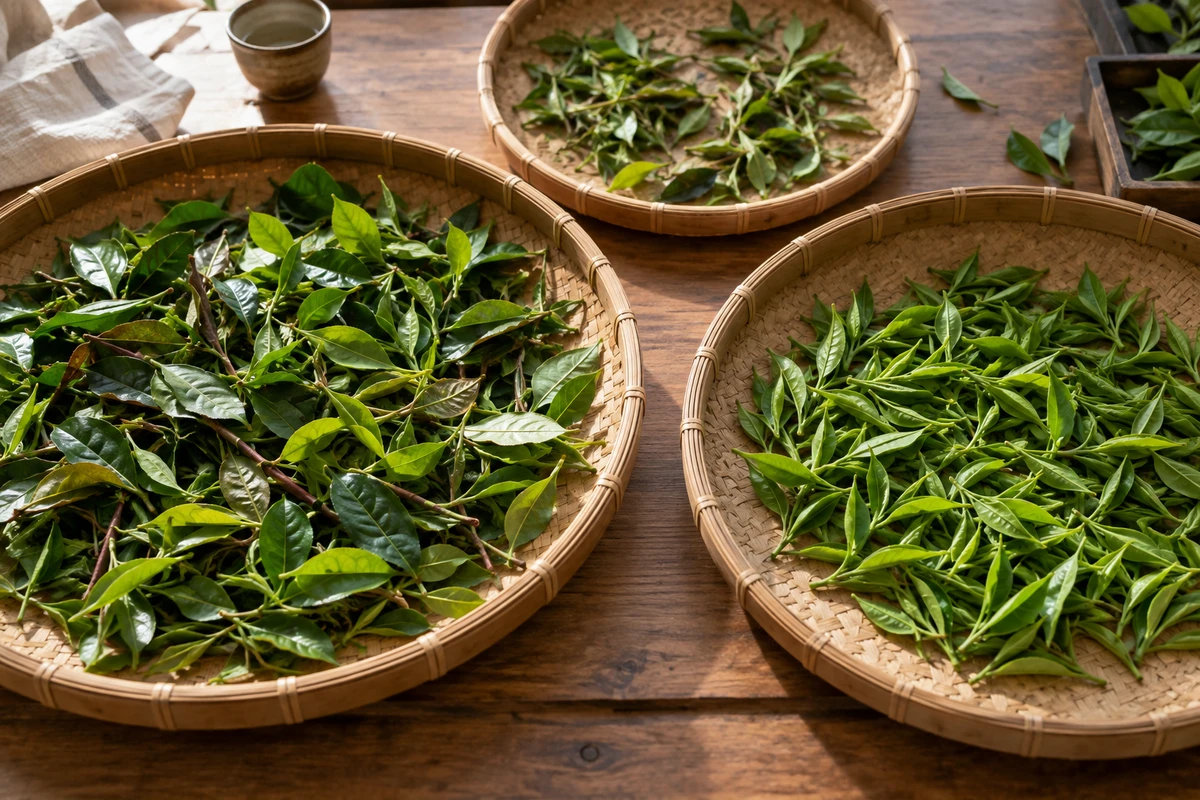
Hand-picked vs machine-harvested tea: garden, cost and intended style
Hand-picked vs machine-harvested tea begins with leaf selection and harvest planning. TBRS puts sound field management and suitable timing first: read the method alongside the garden and processing.
| What to compare | Hand picking may support | Machine harvesting may support | A useful question |
|---|---|---|---|
| Leaf selection | Step-by-step choices by bud, leaf and appearance for batches with a defined pluck standard. | Consistent picking where garden condition, pruning and standards are aligned. | Are cultivar, origin and batch information clear? |
| Cost structure | Labour planning and batch-by-batch selection form one part of cost; the result still changes with place, season and process. | Equipment, garden preparation and work planning also need investment; it does not automatically mean inexpensive tea. | Does the price sit beside useful processing, format and storage information? |
| Intended style | A sensible choice when visual appearance, tenderness or a precise pluck specification matters to the batch. | In a suitable harvest window with aligned leaf standards and processing, for example strip-style pouchong or ball-style oolong, it can support steady work and responsive making. | Does the tea describe the aroma, oxidation or roast style it hopes to express? |
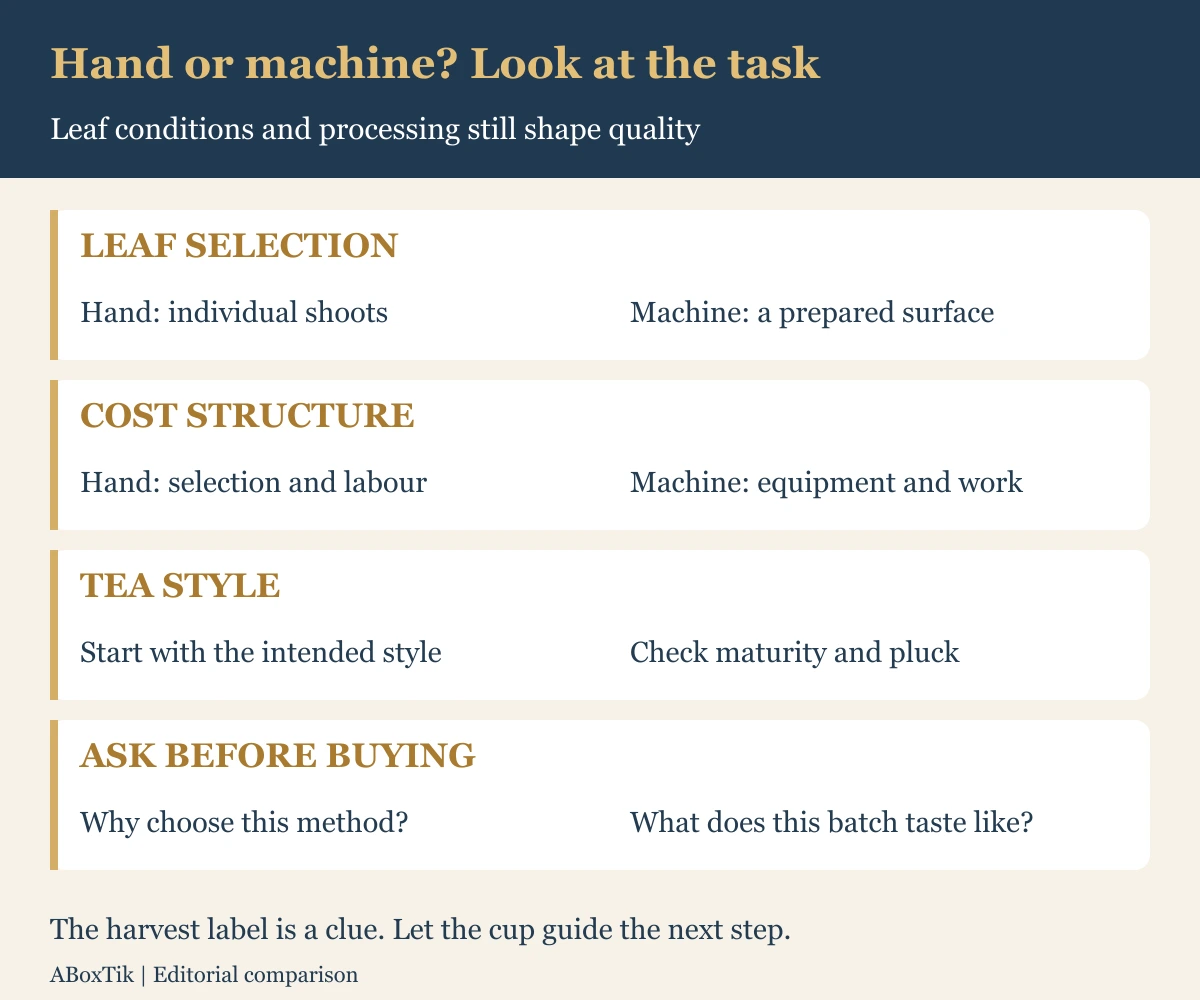
Imagine two packets on a table: one says hand picked and one says machine harvested. Those two words alone cannot rank them. “Is hand picked always better?” Let the tea do a little talking; the label can take a short break. Move next to cultivar, harvest season, processing style, then aroma, body and finish in the cup; that is more likely to show whether a tea suits today. Price benefits from the same reading. It can reflect a combination of labour, equipment, garden care, sorting, processing, packaging and route to market, rather than a timeless number attached to either method.
You do not need to understand the machine to read a tea well
When product information feels crowded, there is no need to decide which harvest method is “more luxurious.” Start with four calm questions:
- Is cultivar and origin clear? They give the raw material a useful coordinate; our introduction to Taiwanese tea places cultivar, place and craft together.
- Is the processing style specific? Oxidation, roast and aroma language are more useful than “top grade.” Build your vocabulary with a guide to smelling tea aroma.
- Are batch, storage and brewing notes available? Storage changes the tea that arrives at your table; keep tea storage guidance nearby.
- What do you enjoy? Brew two or three infusions with the same vessel and similar water, noting aroma, body and finish. It is a more personal answer than a single label can give.
The same questions serve hand-picked tea as well. Clear information and a cup that stays harmonious enough to invite another sip are more useful than a harvest claim alone. If you would like a repeatable home routine, our tea brewing guide can help without turning a quiet cup into an exam.
It also helps to separate a useful absence from a warning sign. A small producer may not print every field or processing detail on a compact label, and that alone does not make the tea less worthy. What matters is whether the seller can answer a reasonable question with care: what style the tea is meant to express, how it is best brewed, and how freshness is protected. Conversely, a long story about hand picking is not a substitute for clean aroma, comfortable texture and a finish that remains pleasant after the cup cools. If you are choosing online, begin with the information that is actually present, ask only what would change your decision, and allow your first tasting to remain exploratory. This gentle discipline protects both your budget and the pleasure of discovery.
Smart production keeps judgment in the process
The 2026 event also brought a younger generation and a wider range of makers into the same raw-material challenge: 30 participants were age 45 or under, and four were women. Its TAGs digital scoring allocated 20% each to appearance and liquor colour, and 30% each to aroma and taste. A digital record makes sensory results easier to revisit; it does not replace an understanding of fresh leaf or a thoughtful palate.
As tea production responds to labour and climate pressure, the promising direction is not equipment replacing people. It is a suitable garden, a suitable harvest window and a tea maker’s judgment working together. That is how Taiwanese tea can evolve without losing its care for detail.
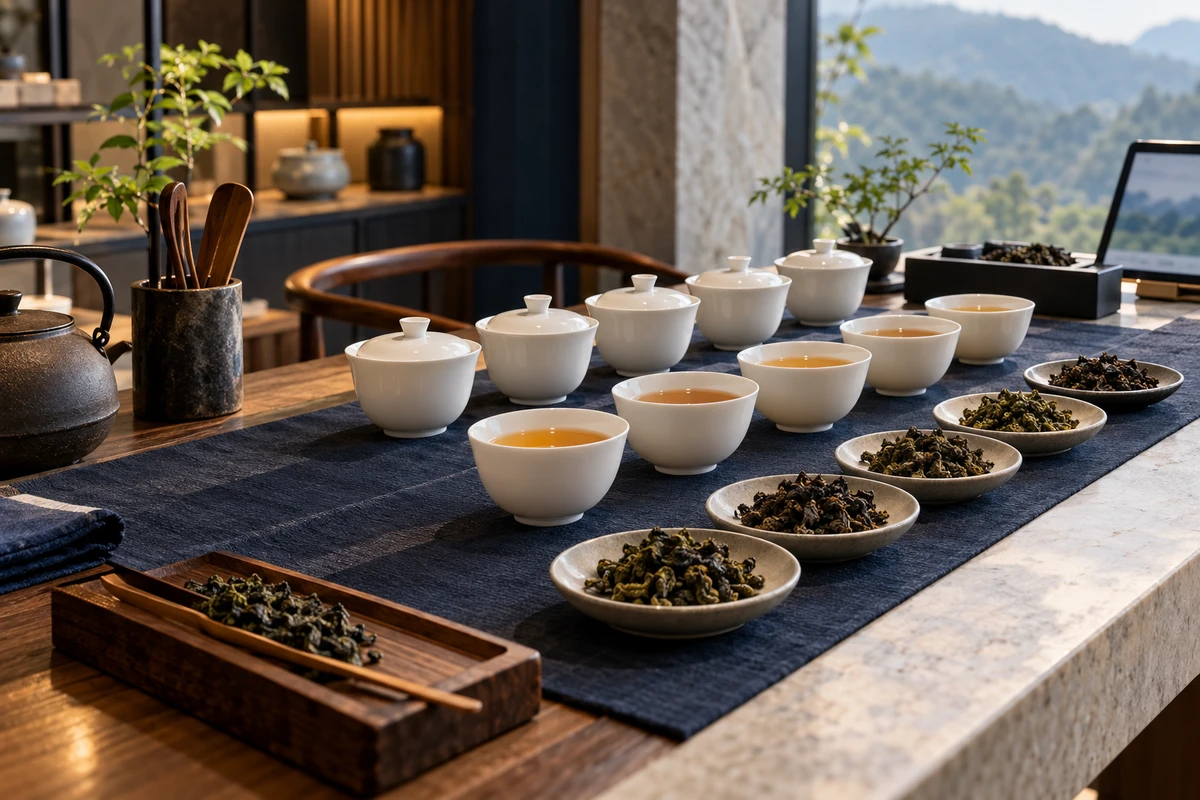
See the conditions clearly, then give the cup enough time. Quality often reveals itself between those two gestures.

Follow ABoxTik
Begin with Jinxuan and notice the making behind the leaf
At ABoxTik, we believe a clear choice need not depend on a loud label. To begin comparing cultivar and aroma, explore our Jinxuan Oolong description, or brew two styles side by side from our Taiwan tea collection.
Our gentle recommendations: begin with Jinxuan Oolong for its medium oxidation, progressive roast and baked sugar-cane sweetness, or choose the Classic Taiwan Tea Gift Set for an unhurried side-by-side tasting.
Sources
- Ministry of Agriculture / TBRS: Machine-harvested tea leaves, younger makers and sustainable transition (published 2026-09-24; checked 2026-10-06)
- Tea and Beverage Research Station: TTES No. 12 (checked 2026-10-06)
- Tea and Beverage Research Station: machine-harvested fresh leaf, field management and precise harvest timing (checked 2026-10-06)