
Tea Knowledge
Tea Pesticide Residue Testing: Read the Report with Confidence
Clear information gives a cup of tea something quietly valuable: details that can be checked again when it is time to open, brew, or share.
Tea pesticide residue testing measures listed pesticide residues in a particular sample using a specified method. Start by matching the product and batch, then read the method, analytes, results, and quantification limits. “Not detected” does not mean absolute zero, and one report does not cover every product from a brand. Taiwan offers public traceability and inspection records, but no single complete register for every retail pack.
Pages of abbreviations can feel unfamiliar. There is no need to learn every instrument name before making a useful first check: does this report relate to the tea in your hands? For package codes and certification systems, use our tea traceability guide. Here, we focus on reading the report itself.
How does tea pesticide residue testing work?
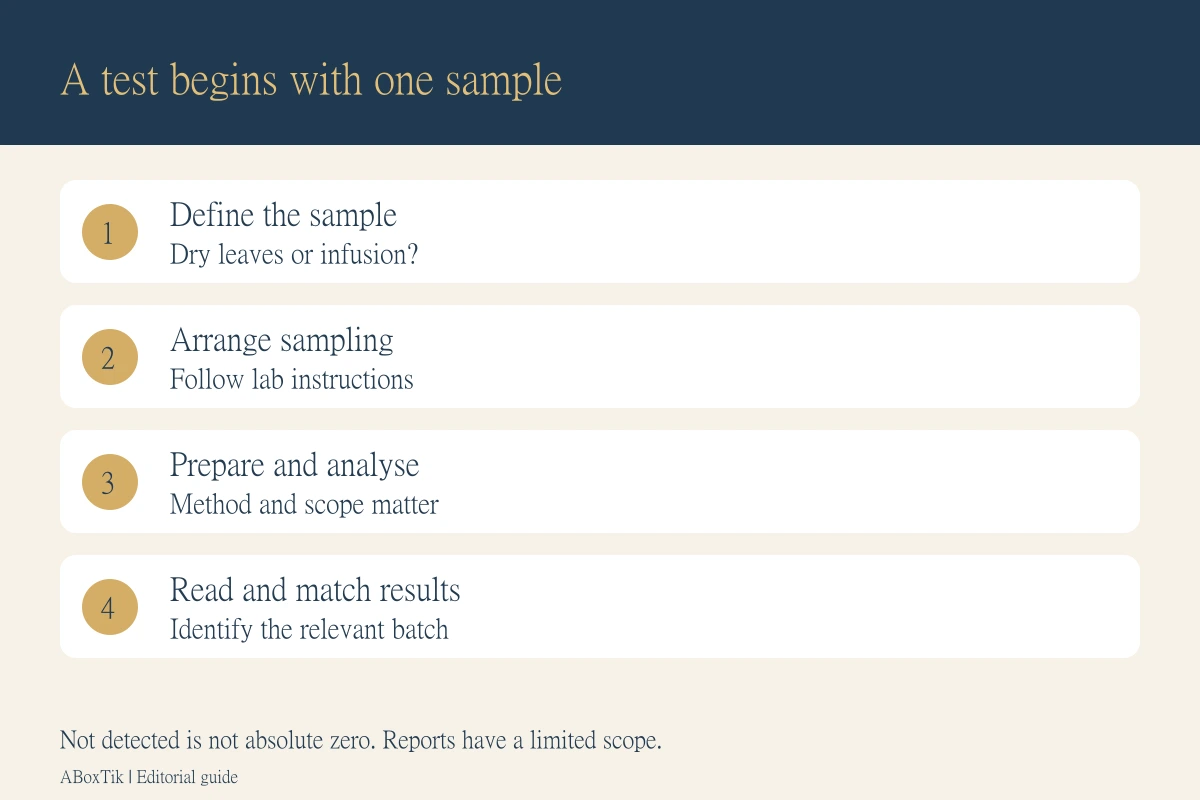
First define the sample: dry tea leaves, brewed tea, or another product. Record who collected it, when, and its connection to a batch. A sample submitted by a seller should not be described as independently collected by the laboratory at a farm or shop. Before commissioning testing, ask the receiving laboratory about sample quantity, packaging, collection instructions, and the service’s scope.
Taiwan’s Food and Drug Administration, or TFDA, publishes Multi-residue Analysis Method V, with a stated scope of 410 pesticides including application to tea. Dry leaves are ground, extracted, and cleaned up before liquid and gas chromatography with tandem mass spectrometry, LC-MS/MS and GC-MS/MS. That published scope does not mean every commercial report tests the same panel.
A familiar tea name can still cover different harvests and packing batches. Tea regions, cultivars, and processing explain origin and flavor. A test report addresses a separate question with a defined scope.
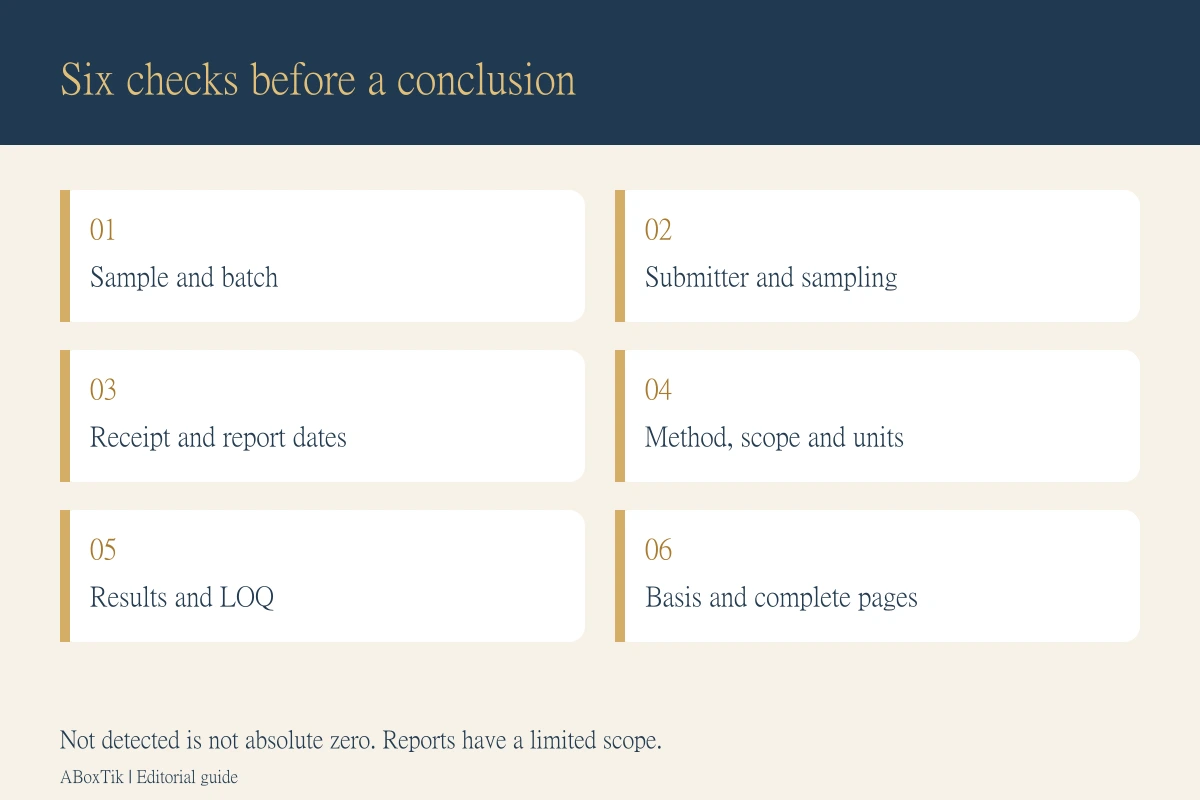
Match six fields before reading the conclusion
| Field | What to check | If information is missing |
|---|---|---|
| Sample and batch | Product name, batch identifier, and production or packing details | Ask how the sample relates to the purchased product |
| Submitter and sampling | Who submitted and collected the sample | Do not assume independent sampling |
| Receipt and report dates | A plausible connection to that batch | An older report does not automatically cover a new batch |
| Method, panel, and units | The complete list and method, beyond the headline count | Request attachments and notes |
| Results and LOQ | ND definitions, quantification limits, and individual values | Request clarification |
| Assessment basis and pages | Referenced standard, report number, and complete pages | Keep the conclusion open until details are available |
A recent date is helpful only when the sample matches. A gift box may contain several teas, while a report naming only “tea” may not identify each item. Keep the package and its product details together. Our tea gift selection guide covers the separate questions of format and use.
What do ND, LOQ, and a detected value mean?
ND, or not detected, must be read using the report’s definition. It is not proof that no pesticide molecule exists. LOQ, the limit of quantification, describes a method’s quantification boundary; it is not a legal maximum. In a reporting FAQ concerning lead in food additives, TFDA explains that a result below LOQ may be reported as not detected with LOQ stated. We use that reporting principle, not the example’s numerical limit.
A detected value is also not automatically an exceedance. Match the pesticide, food category, units, and applicable standard. Any prohibition or special note requires its own interpretation. There is no single ppm threshold for every pesticide in tea, and this article does not determine the legality of an individual sample.
A large panel still has boundaries: unlisted substances cannot be called undetected. If a report says a result complies, check which market and standard it references. Different countries’ requirements are not interchangeable. For the role of evidence in product value, see our premium tea price guide.
Use seven steps to keep the conclusion precise
- Match the product, package, and batch to the sample.
- Identify collection and submission arrangements.
- Read the complete method, panel, and notes.
- Check each result and its unit.
- For ND, read its definition alongside LOQ.
- Consult the applicable Taiwan pesticide residue standard and amendment attachments, matching the pesticide and tea category.
- Record the boundary: which report, sample, and analytes support the conclusion? Leave unmatched details unresolved.
A practical message to a seller could be: “Which batch in my order does this complete report cover? Where are the method, full panel, and ND definition? If you submitted the sample, how is it linked to the goods?” Asking for those connections is more useful than requesting an absolute assurance. Keep the response with the package and report; missing information can remain a question rather than become a guess.
Which records can consumers look up in Taiwan?
| Official service | Useful information | Boundary |
|---|---|---|
| Agricultural product inspection lookup | Published records searchable by traceability code, unit, product, and category | Verify source, date, scope, and batch |
| AFA TAP inspection section | Published quality sampling and labeling inspection lists | Summaries do not cover every retail batch |
| Taiwan Agricultural Traceability portal | Product and certification details linked to a traceability code | Not every page includes a complete residue report |
| TFDA border non-compliance records | Non-compliant imported-food cases | Not a register of domestic tea or all compliant products |
The absence of a matching record proves neither compliance nor non-compliance. Government sampling, rapid mass-spectrometry screening, and producer-uploaded information also require attention to their different sources and scopes. Return to the traceability lookup guide if the package code itself needs clarification.
What cannot a laboratory name or certification tell you?
SGS or another laboratory’s name identifies who performed the listed testing. It does not, by itself, establish government product certification, organic status, or “zero residue certification.” Accreditation also needs to be checked against the particular method and analytes. Organic certification and TAP address different systems; our organic versus TAP comparison explains that distinction.
Aroma, bitterness, leaf shape, and price are not home residue tests. Aroma observation and whole-leaf tea bag selection help with flavor and practical use. Following storage guidance is worthwhile too, but it does not extend a report’s scope.

Follow ABoxTik
Clear details make room for an unhurried choice
A report need not turn tea shopping into an exam. Match the batch, establish the scope, and then read the result. Give unanswered questions time to be resolved. ABoxTik values both Taiwan’s tea craft and the care of stating what evidence actually supports.
Related options: For everyday brewing and flavor exploration, browse the Classic Taiwanese Tea gift set. For product and batch questions, contact us with the details. These recommendations do not establish any testing or certification mentioned here; such claims require current product-specific evidence.
Sources
- TFDA: Multi-residue Analysis Method V and attachments
- TFDA: Reporting results below LOQ
- TFDA: Pesticide residue standard amendment
- TFDA: Example food testing report
- AFA: Agricultural product inspection lookup; TAP inspection section
- TFDA: Border non-compliance records
Sources reviewed 1–2 October 2026. This editorial guide does not assess an individual sample’s legal status or health implications. Consult current official methods, standards, and services.