
Tea Knowledge
Can You Add a Company Logo to a Tea Gift? Thoughtful Branding for Business Gifts
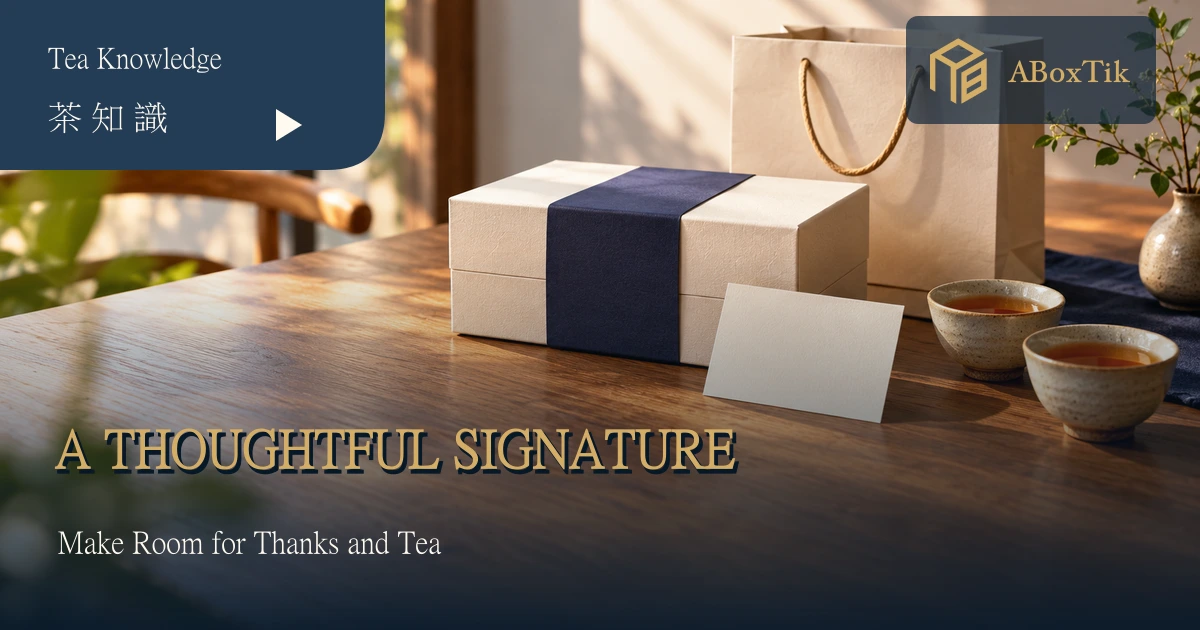
“Should we make the logo bigger so they remember us?”
“Let’s make the thank-you easy to read first. The tea can help with the next conversation.”
Company logo tea gifts start with choosing a suitable place for the company signature: a card, sleeve, sticker or box surface. Discuss dimensions, production method, quantity and proofs with the supplier. Keep the sender recognisable while leaving space for the message, tea names and brewing instructions. A clear hierarchy is more useful than filling every available surface.
A corporate tea gift often has two jobs: to be remembered and to be enjoyed. Finding the balance is perfectly reasonable; nobody particularly needs a presentation deck disguised as a parcel. Our corporate gift selection guide covers the broader decision. Here, we focus on the logo and wording, turning “a little more prominent” into something a team can actually review.
Company logo tea gifts: decide what the gift should say
Write down the purpose in one sentence. Is this a thank-you for a year of collaboration, a welcome for visiting partners, or a reminder of a shared project? For a thank-you, lead with appreciation and follow with the company signature. For an event, give the event name and date a clear place without trying to fit the whole programme onto the lid.
The tea brand identifies the contents; the gifting company identifies the sender. Keep those roles easy to understand, so nobody has to work out which business produced the tea. The tea gift box guide helps establish the contents. If a department will share the gift, settle the amount and brewing format before arranging the artwork.
Imagine the design discussion: “Would putting our logo on every side make it more complete?” “Let’s compare the front and the card first. Even a logo deserves an afternoon off.” Two concrete layouts help more than abstract requests for elegance. There is no universal branding percentage; the box, company guidelines and legibility determine the useful size.
Cards, sleeves, stickers and box surfaces have different jobs
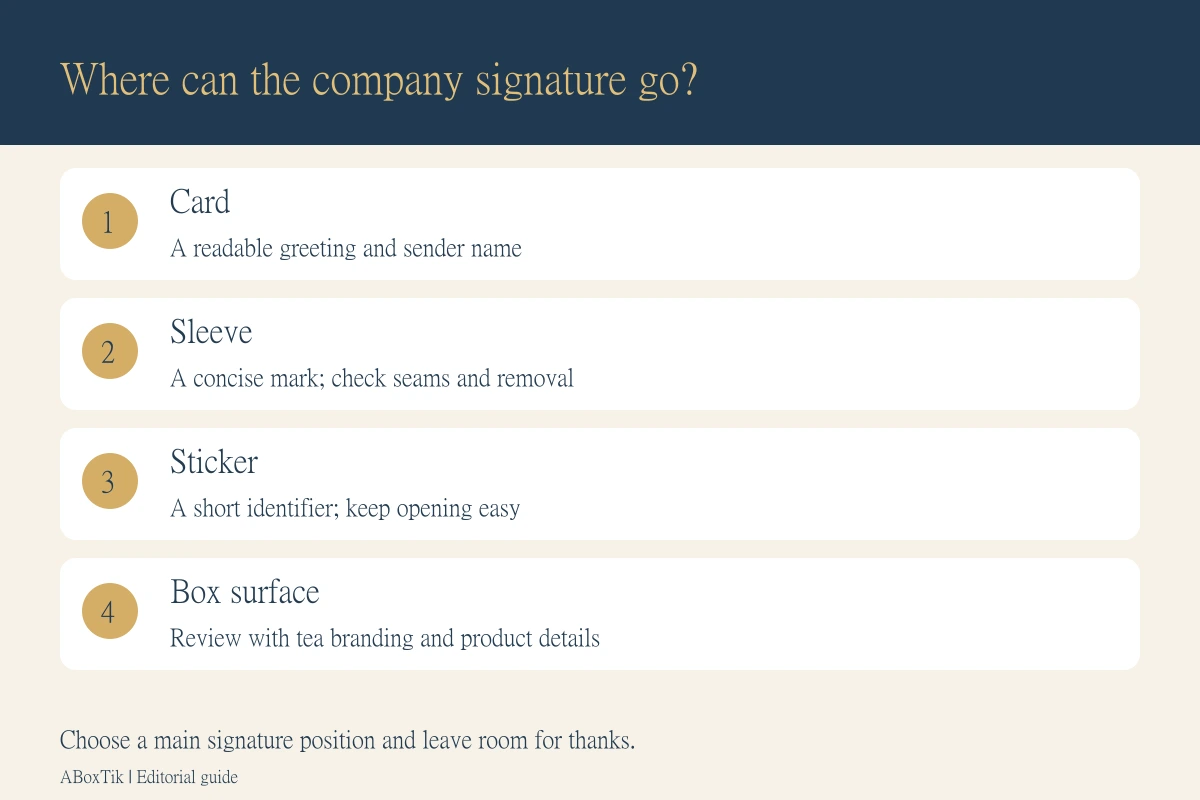
Choose one main place for the signature, then decide whether a second adds anything. A card accommodates a personal greeting. A sleeve connects the outer presentation to the message. A sticker suits a short identifier. A printed box needs consideration of the whole existing package. Use these options as a discussion brief for the supplier.
| Placement to discuss | Useful content | Check on the proof |
|---|---|---|
| Card | Thanks, sender and a relevant contact link | Names, greeting and readable type. |
| Sleeve | A concise logo, event name or message | Seams, folds and easy removal. |
| Sticker | A short signature or closure identifier | Position, material and opening path. |
| Box surface | A coordinated brand or commemorative design | Relationship to the tea brand and product information. |
Think through opening, taking out the tea and storing it. Keep existing names, contents, dates and instructions visible; leave sealed inner packs intact. The gift box design overview offers broader packaging considerations, while the tea storage guide brings the contents back into the conversation.
Judge logo size on a life-size layout
Ask for actual dimensions and placement, with the box, card and bag shown in one review set. Follow the company’s rules for proportions, clear space and permitted colours. Stretching a mark to fill a gap rarely helps. Compare two sizes at their intended printed dimensions rather than admiring a greatly enlarged screen view.
Consider the reading order: does the recipient first need to understand the greeting, the tea name or the sender? Give that element a clear position. When two brands appear together, a short “With thanks from” line and the full company name can explain the relationship. Keep the marks distinct instead of merging them into an unfamiliar symbol.
Look from a little distance for the overall composition, then close up for the small text. Check where the useful information sits after opening. A signature should be identifiable and comfortable to read. The warmth of the relationship can live in the message; the logo need not carry every ounce of it.
Prepare artwork and agree how colour will be checked
Supply approved original logo artwork, the brand guidelines, permitted versions and the exact company name. Adobe’s logo design tutorial explains that vector artwork can be resized without losing quality. Ask the designer and printer which vector formats they accept. A small image copied from a chat is better treated as a reference than as final production artwork.
A lit screen and a printed paper surface show colour differently. Discuss the output conditions alongside the brand colour information. Adobe’s commercial printing guidance describes soft proofing with a press profile. Ask the producer about the appropriate settings and whether a physical colour sample or mock-up is needed. A photo labelled “this gold” leaves rather a lot to interpretation.
Keep the files in one folder with a version date and a named final approver. Identify which variant is single-colour, reversed or full-colour. A file called “final-really-final-this-one” may deserve its own tea break. Clear filenames give everyone more time to check the details. For the handover stages, see the custom gift box timeline.
Make the thank-you card and bilingual wording easy to use
Begin with appreciation, add a short introduction to the tea and finish with the sender. For example: “Thank you for everything we have worked on together this year. We chose two Taiwanese tea styles for your next shared break.” Match the tea names and flavour descriptions to the selected products instead of giving every tea the same mountain story.
For international partners, check the company’s English name, personal names, forms of address and dates. Ask a fluent reader to review the complete message. Keep the greeting natural and explain unfamiliar tea names simply. Brewing quantities, temperatures and times should follow the selected product’s instructions, with consistent units. The brewing introduction and steeping time guide can offer further reading; the card should still explain how to begin.
A QR code can lead to tea information or a relevant story. Label its purpose and scan the printed version with a phone to check the destination. A thank-you gift is easier to enjoy when brewing information does not require an account, a survey or an entire sales presentation. Think of the card as a welcoming guide, not a surprise entrance exam.
Use five checks before approving the proof
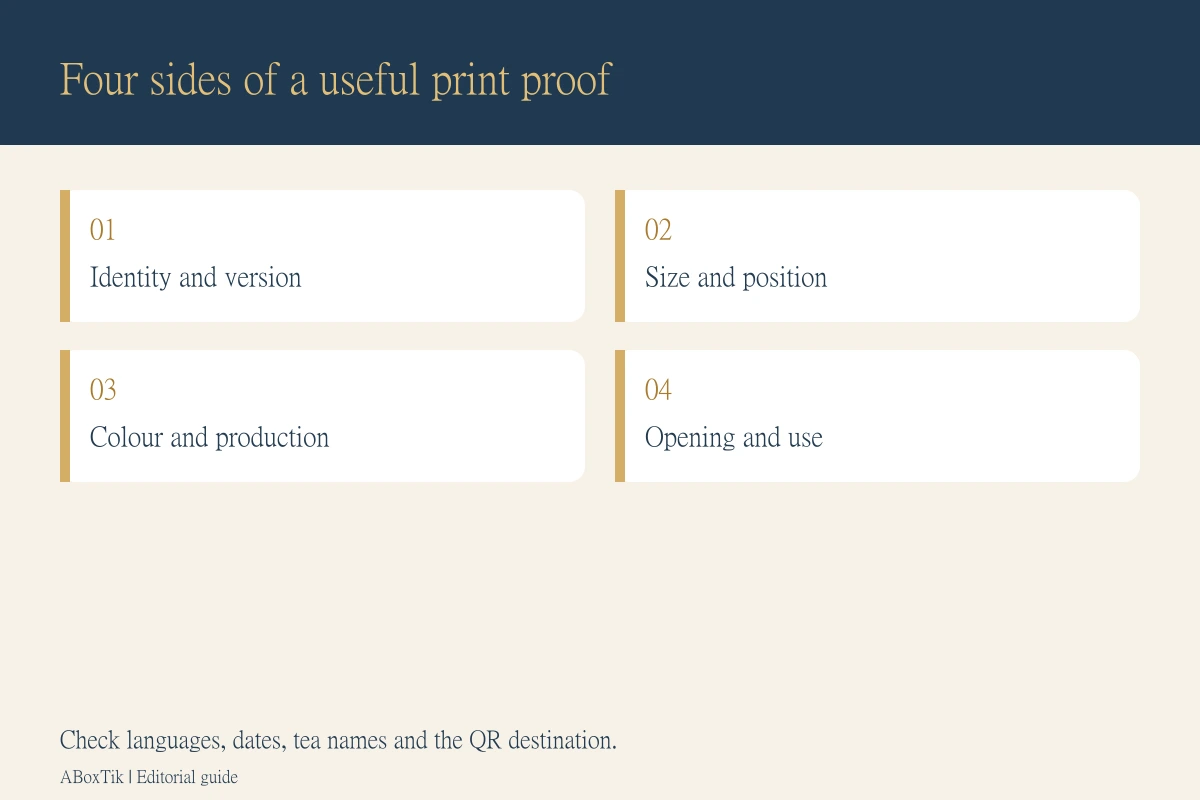
- Identity and version: check company names, logo variants, greetings and the final approver.
- Size and position: read the type at actual size and inspect folds, seams and existing labels.
- Colour and production: confirm material, colour approach, method and any required sample.
- Opening and use: ensure tea is accessible, inner packs stay sealed and instructions are easy to find.
- Wording and links: review both languages, dates, tea names and the QR destination; retain the approved file.
Recheck a new proof if the logo, wording or dimensions change. A verbal “use the earlier one” is less useful than a named file. In the corporate tea gift budget, list design, printing and samples separately. Use the quantity planning guide to settle the count so the quotation and review refer to the same scope.
A first enquiry can be straightforward: “We are thanking our partners, expect approximately this many boxes and would like them by this date. We would like to compare a card and sleeve; our logo, colours and bilingual message are attached.” Share the brief through ABoxTik’s contact page, then discuss feasible production, costs, quantities and delivery. If the tea is undecided, describe the recipients’ routine first.
Follow ABoxTik into a tea break: a signature with room for thanks
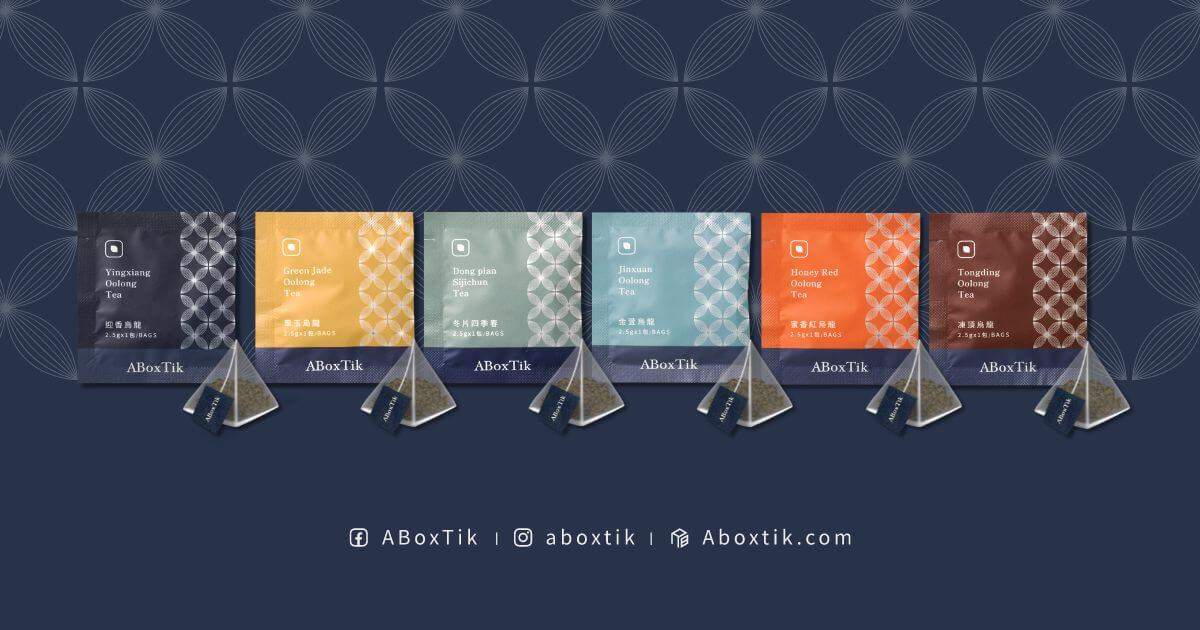
Company logo tea gifts begin well with tea people want to open and a message they can read. For several Taiwanese styles, compare the Classic Taiwanese Tea four-box set: its published specification lists ten bags per box, forty in total. Consider that amount against the sharing situation. For a known preference, explore the floral direction of Yingxiang Oolong before developing the artwork.
The story of Taiwanese tea and craft can support the card when it matches what is inside. Visit About ABoxTik for the brand’s design perspective. Let the signature be clear, the thanks be easy to find and the next conversation arrive over a cup of tea.
Related recommendations
- Classic Taiwanese Tea four-box set: compare flavours before planning the sharing.
- Custom gift box confirmation stages: give artwork, approval and handover clear places.
- Corporate tea gift enquiries: discuss quantity, dates and brand materials together.
Sources
- Adobe Illustrator: vector logo design and resizing
- Adobe Photoshop: commercial printing and soft proofing
Sources and products checked: 2026-10-05.