
Tea Knowledge
How Many Times Can You Steep Tea? A Guide to Re-Steeping by Taste
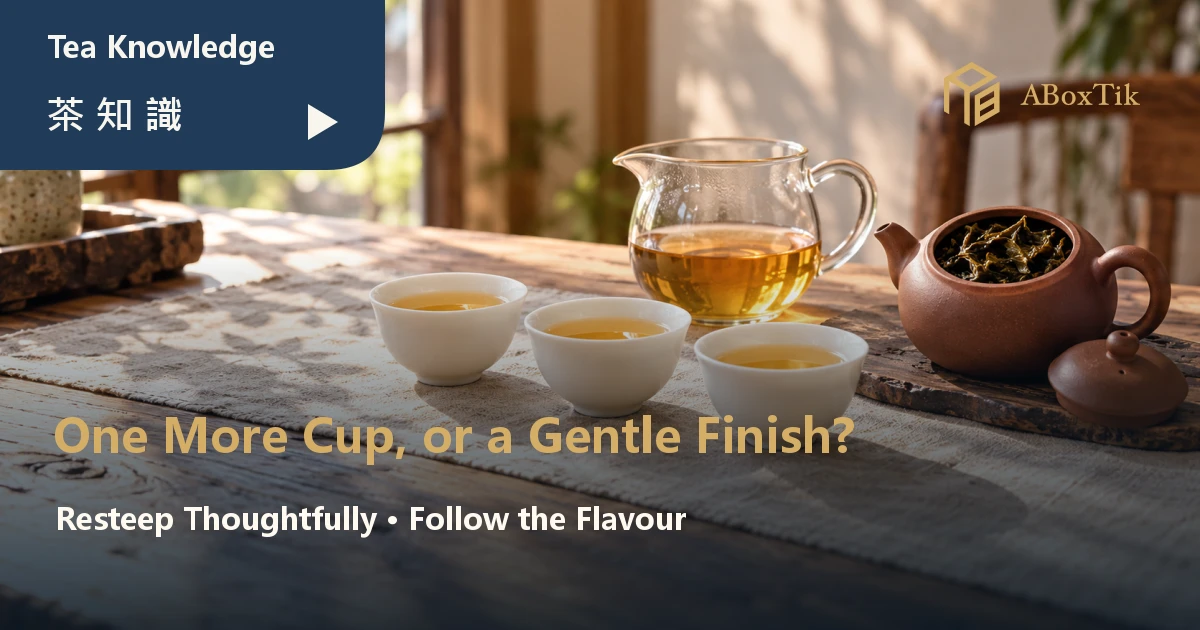
One more cup, or a gentle finish? Let aroma and comfort guide the choice.
How many times can you steep tea? There is no single number that fits every tea and every brewing method. Look at the aroma, body and comfort of the cup, then ask whether another infusion sounds enjoyable. Leaf quantity, water volume, temperature, time and the tea itself all influence the result. The infusion number is a useful note, but it need not become a report card.
Perhaps you have reached the third cup. The leaves have opened, the kettle is nearby, and a small question arrives: would another infusion be worthwhile? Take a sip before deciding. The leaves have no attendance sheet, and a pleasant tea session does not need to reach a particular total to count.
Begin with the cup, then count the infusions
A larger amount of tea in a small vessel with short infusions may give a different number of cups from a small amount of tea left longer in more water. When someone says a tea lasted for many infusions, ask about their leaf amount, vessel size and timing. Those details make the experience easier to understand and perhaps repeat at home.
Taiwan’s Ministry of Agriculture tea information resource describes differences in extraction between teas and encourages attention to aroma and taste when choosing tea. For a home session, that suggests a useful habit: record the number, but let the actual cup guide the decision. Someone who enjoys a light finish may continue longer than someone who prefers a fuller cup. Their preferences can both make sense.
If you still need a starting point for the first infusion, visit the Taiwan tea steeping-time guide. Here, we move on to the question that comes after drinking it: what should happen next?
Notice leaf shape, then check the flavour
Tightly rolled tea and more open, strip-shaped tea look different in the vessel. Watching the leaves unfold can be part of the pleasure. Note when they open further, then compare that observation with the aroma and flavour. Leaves that still look intact do not, by appearance alone, promise a full-bodied next cup.
Whole leaves, broken leaves and different processing shapes are best treated as clues rather than a ranking of how many infusions a tea must deliver. The whole-leaf and broken-tea guide explores shape and extraction speed. For a re-steeping decision, return to the tea you have actually tasted.
A simple note is enough: “The leaves opened more in the second infusion; the aroma remained clear.” There is no need to measure each leaf. Your teapot is enjoying a quiet afternoon, rather than organising an inspection.
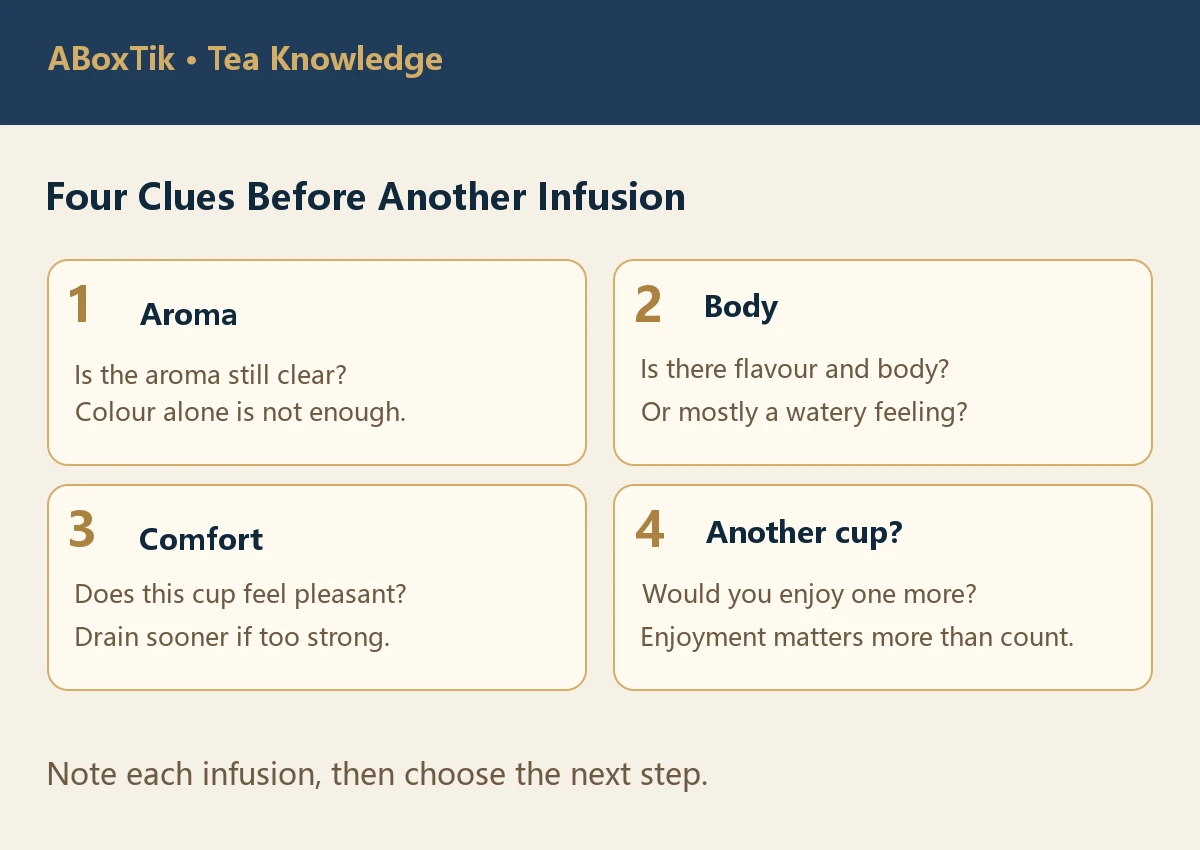
Four clues: aroma, body, comfort and another cup
Aroma: is there still a clear fragrance you can recognise? It does not have to be stronger than the first infusion. A quieter aroma can still be enjoyable. Observe the colour if you like, but give smelling and tasting their own place in the decision.
Body: does the liquid still have a satisfying presence, or does it feel mostly like water? This is an observation about the cup, rather than a judgement based on darkness. A delicate tea need not become heavy to be worth drinking.
Comfort: how do bitterness, astringency and overall strength feel together? If the last cup was too strong, try a shorter infusion next time and note the change. For language to describe the texture, see the tea astringency and balance guide.
Another cup: are you curious about the next infusion, or already content? This question deserves a place beside the other three. Finishing with a cup you enjoyed can be more satisfying than continuing simply to increase the count.
Change one small detail at a time
If the last cup was pleasant, begin by keeping the current settings and observing the next infusion. If it has become lighter but still carries an enjoyable aroma and flavour, consider a small increase in steeping time. Taste the result before increasing it again. There is no need to add time automatically at every round.
Some tea-art brewing methods lengthen successive infusions, with leaf quantity and water temperature already established. That is a useful way to understand adjustment within a method. It is not a universal timer for every tea and every vessel. When the previous cup already felt too bitter or astringent, adding more time may move away from the cup you wanted.
Keep a note of leaf amount, water volume and temperature, and change time on its own first. Changing the water, vessel and temperature together gives the notebook plenty to discuss, but makes the cause harder to recognise. For another part of the preparation, use the oolong water-temperature guide or the Taiwan tea gongfu brewing guide.
Three next steps: continue, adjust or finish
Think of three gentle branches. If the cup is still enjoyable, keep the settings. If it is lighter but still flavourful, try a little more time for the next infusion and taste again. If it is mostly watery, finish the session. When the problem is excessive strength, take the shorter-time branch instead of chasing a higher infusion number.
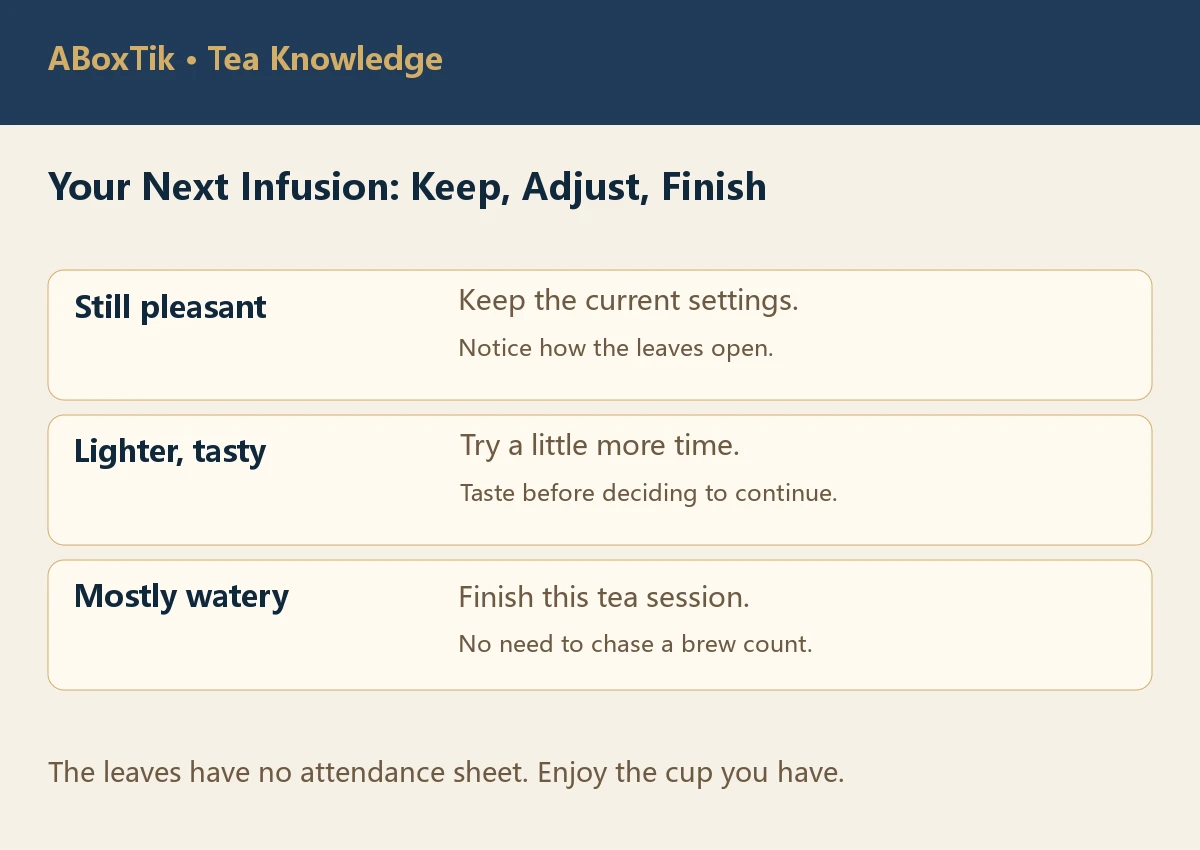
For example, a third infusion might be lighter than the second while retaining a clear aroma and comfortable flavour. A small timing adjustment could be worth trying. If a later cup feels mostly watery and no longer inviting, stop there. This is a decision-making example, rather than a required number of infusions for a particular tea.
With friends at the table, ask, “Would another cup be nice?” Some may enjoy the lighter finish, while others have had enough. A shared pot can hold several preferences without needing one winning answer.
Keep a note that helps next time
Start with five details: tea and leaf shape; leaf amount and water volume; temperature; each infusion’s time; and how each cup felt. Ordinary words work well: “clear aroma, comfortable strength”, “lighter, still enjoyable”, or “mostly watery, finished here”. Recording the last cup you liked is more useful than keeping only a total.
For a later comparison, use the same tea and vessel with similar starting conditions, then change one detail. If handling the vessel is still unfamiliar, the beginner’s gaiwan guide can help. Recording just two or three cups is a good beginning. The notebook supports a relaxing tea session; it does not need to take charge of it.
Try a small prediction before the next infusion: “I think the aroma will remain” or “I think this one will be lighter.” Add what actually happened after tasting. A wrong guess earns no penalty. It simply gives you another detail about the tea. Curiosity makes a more agreeable companion than a target number.
Find Your Next Comfortable Cup with ABoxTik
Let favourite flavours guide the next tea
Choose by the aromas and tastes you enjoy, along with the vessel and pace that suit your day. The Classic Taiwanese Pure Tea Gift, with four selections offers a starting point for exploring different flavours. Use the same observation card for each tea, allowing it its own character. For the wider story of place and craft, continue with why Taiwanese tea is special.

At the next session, try replacing “How many more times?” with “What do I still enjoy in this cup?” Continue while the answer feels inviting, and finish when you are content. A comfortable final cup is a lovely way for the pot to complete its work.
Related recommendations
Sources
Source checked 11 October 2026. The observation card and notebook exercise are editorial activities.