
Tea Knowledge
Taiwan Teahouse Culture: From Tea Shops to Tasting Spaces
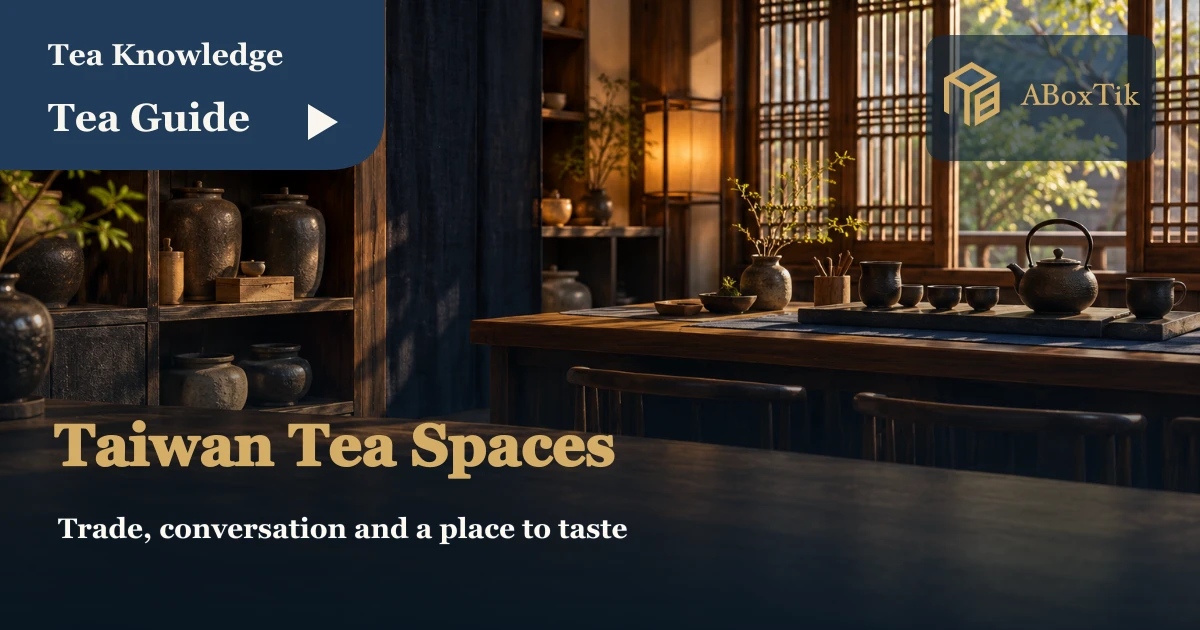
Before entering a tea room, ask how the people inside bring one cup into everyday life.
Taiwan teahouse culture can be read through three connected activities: trading tea, gathering around it and creating a tasting experience. Tea merchants, tea-art houses and contemporary spaces have different histories, yet they can coexist on the same street or within one building. The story is richer than a relay in which each new format replaces the last.
This guide follows a few documented points from a Dadaocheng tea business through the growth of tea-art spaces to present-day interpretation. A three-column visiting sheet then turns the history into useful questions: where does the tea come from, who explains it, and how does a visitor participate? There is room to enjoy the cup before producing an answer.
Taiwan teahouse culture begins with the work of a tea shop
A tea shop suggests buying leaves, but a preserved building can reveal processing, storage, sorting, packing and family life around the trade. Taipei’s Department of Cultural Affairs describes Sin Hong Choon, completed in 1934, as combining a tea business, roasting workshop, warehouse and residence. The example places tea back within working and domestic routes, rather than leaving it as an attractive object on a shelf.
When looking at an old business, follow how tea and people moved through it. A corridor, workroom or connection to living quarters can explain more than an antique-looking sign. In a restored site, record the earlier use separately from the present display. A building can preserve traces of work while using new methods to help visitors understand them.
The Taiwan tea-regions guide provides geographical context, while places and craft in Taiwanese tea follows the leaves. The city shop adds another map: how tea was prepared for sale, presented and carried to a different table. Reading these maps together gives a fuller sense of its journey.
From buying leaves to taking a seat
The National Cultural Memory Bank’s account of Taiwanese tea culture describes tea-art houses growing after 1975 alongside rising living standards, tea promotion and quality competitions. This supplies a useful historical connection: tea became something people could make time to sit with in a city, observing preparation and conversation as part of the occasion.
At such a table, the placement of tools, the brewer’s movements and the rhythm of sharing cups can become part of the experience. A guest may watch the leaves and successive infusions, or simply enjoy the drink quietly. Different places have different arrangements. Understanding the table in front of you is more useful than worrying that your way of holding a cup will fail an invisible entrance examination.
If the tools are unfamiliar, begin with gaiwan and teapot functions and everyday brewing methods. Knowing what a vessel does frees attention for the tea and the people. Detail can support a smooth exchange without becoming a checklist that everyone must perform identically.
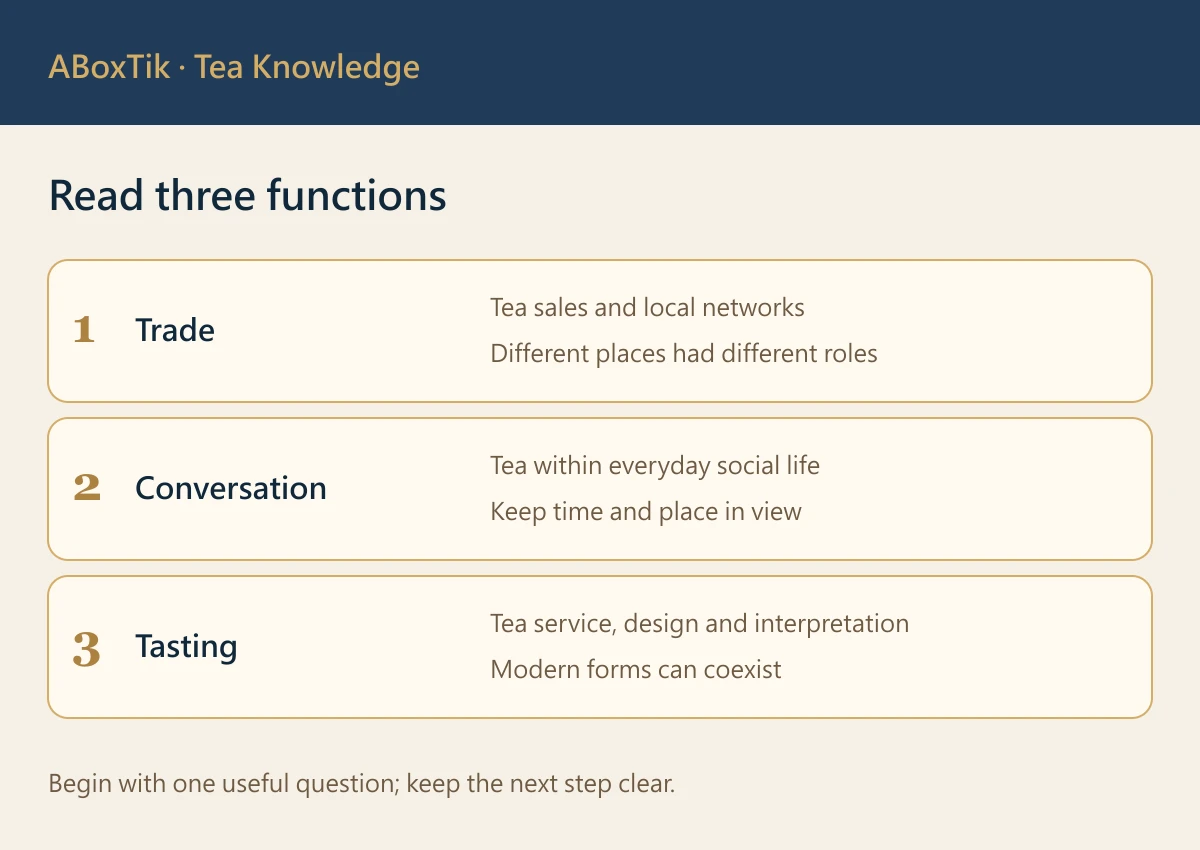
Contemporary spaces can combine several kinds of service
Look first at what a place offers: retail selection, tasting flights, host-led brewing, classes, exhibitions or some combination. The Tea and Beverage Research Station’s industry-service description includes tea sales, tea culture and visitor experiences as distinct service areas. These can connect, while the actual experience still depends on the individual place.
A concise display or a flight of small cups changes how a visitor joins the conversation. One host may begin with origin information; another may invite a taste before discussion; another may connect tea with food or objects. Ask what difference the selection is intended to reveal. That opens the logic of the table more readily than giving the whole room a traditional-or-modern score.
The aroma-observation guide and honey and fruit vocabulary can help express a clear impression. They do not prescribe which aromas a tea room should produce. Keeping one observation is usually more useful than memorising every adjective on a menu before the first cup has cooled.
A historic building can take on a new interpretive role
Sin Hong Choon also shows how a working building can become a place for understanding an industry. A 2023 Cultural Affairs report records the use of extended reality to present historical scenes and objects there. Interpretation changes too: a preserved building need not speak only through still objects in a cabinet.
When viewing an exhibition, distinguish an original object, a repaired element, a reproduction and a digital reconstruction. Follow the label’s dates, uses and sources, then ask about anything unclear. This adds a useful layer to looking, rather than a burden to the visit. Today’s presentation and yesterday’s working routine can both be interesting without being mistaken for the same thing.
Tea culture is not contained in one celebrated building. Outside an exhibition, notice how a working shop introduces its products, packets and service. The broader tea-culture guide offers background. During a visit, bring the scale back to one object, one explanation and one cup, so a large idea has a detail that can actually be remembered.
Take a three-column visiting sheet
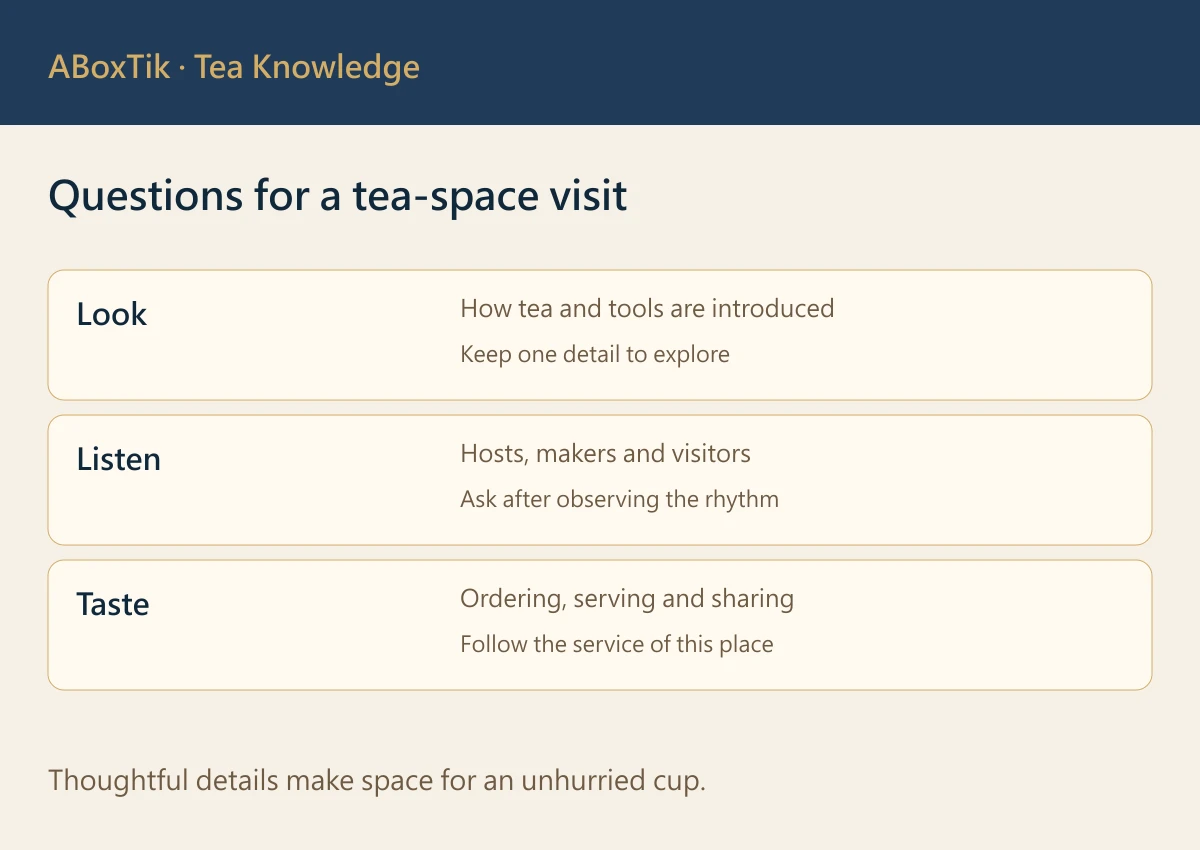
Before visiting an unfamiliar space, check its own service information, including whether reservations or a particular tasting format are used. After sitting down, listen to the introduction before presenting a long list of questions. Choose the one thing you most want to understand. A little attention to the host’s rhythm leaves room for both explanation and enjoyment.
| Area of attention | What is present | One question |
|---|---|---|
| Tea and objects | Origin, cultivar, tools or display: ____ | ____ |
| People and exchange | Introduction, serving and conversation: ____ | ____ |
| Space and time | Earlier use, present function and rhythm: ____ | ____ |
Separate an observed action from a personal response. “The host explained the origin before brewing” records a sequence; “that helped me relax” records an impression. Both matter, without making one visitor’s comfort a rule for every tea house. The aftertaste-note guide can add a cup-level observation alongside the details of the room.
Bring one useful detail home
After a visit, choose something small to reuse: legible tea names, tools placed within reach, or a way of inviting comments without requiring everyone to speak. Home need not reproduce the furniture of a tea house. A clear serving order or a readable tea card can make the next gathering easier. Continuity can live in these ordinary actions as well as in preserved buildings.
For a home comparison, check the current Green Jade Oolong and Dong Ding Oolong information, or consider a two-box tea-bag format to reduce preparation. Follow the actual product directions and record the vessels and method. A rewarding visit does not need to turn immediately into an assignment to purchase a complete tea setting.
On the next visit, try a question with a specific object: “How is this tea introduced here?” The answer may concern origin, brewing or a family’s work. The interest of Taiwan’s tea spaces lies partly in how they look, and partly in how they help people stay, understand and carry a cup back into their own lives. That is a conversation with room to continue.

ABoxTik brings the stories of places and people back to a cup that can be shared.
Leave one good question for the next tea-space visit
Begin with an old tea business, a tea table or a contemporary counter. Notice how tea is introduced, who participates, and how earlier and present uses relate. Then keep the question you would most like to return to.
There is no need to understand a whole city in one afternoon. One object, one exchange and one cup are enough to give the next visit another layer.
Related reading
Sources
- Taipei Department of Cultural Affairs: Sin Hong Choon Tea House
- National Cultural Memory Bank: Taiwanese tea culture and science
- Taipei Cultural Affairs: technology and interpretation at Sin Hong Choon
- Tea and Beverage Research Station: industry services
Sources checked 17 October 2026.