
Tea Knowledge
Giving Tea Across Cultures: Questions Before You Choose
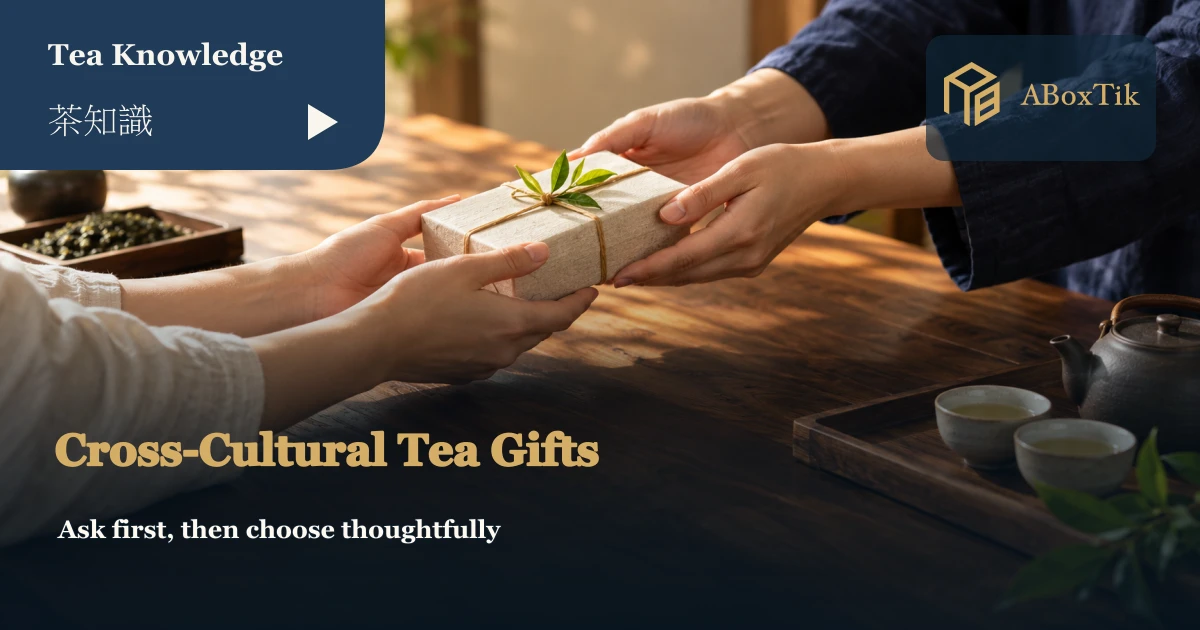
One well-placed question before a gift often carries more care than a whole page of memorised taboos.
International tea-gift etiquette starts with the setting, relationship, personal preference and any recipient rules before choosing the tea or delivery method. Treating every person from one country as liking or avoiding the same tea can hide the person actually in front of you. When uncertain, a polite question is kinder than a guess.
This guide covers private visits, business meetings and group settings, with short wording, a handover checklist and a response to refusal. The aim is to leave choices open, not turn one tea box into an immediate opening, tasting and photo assignment.
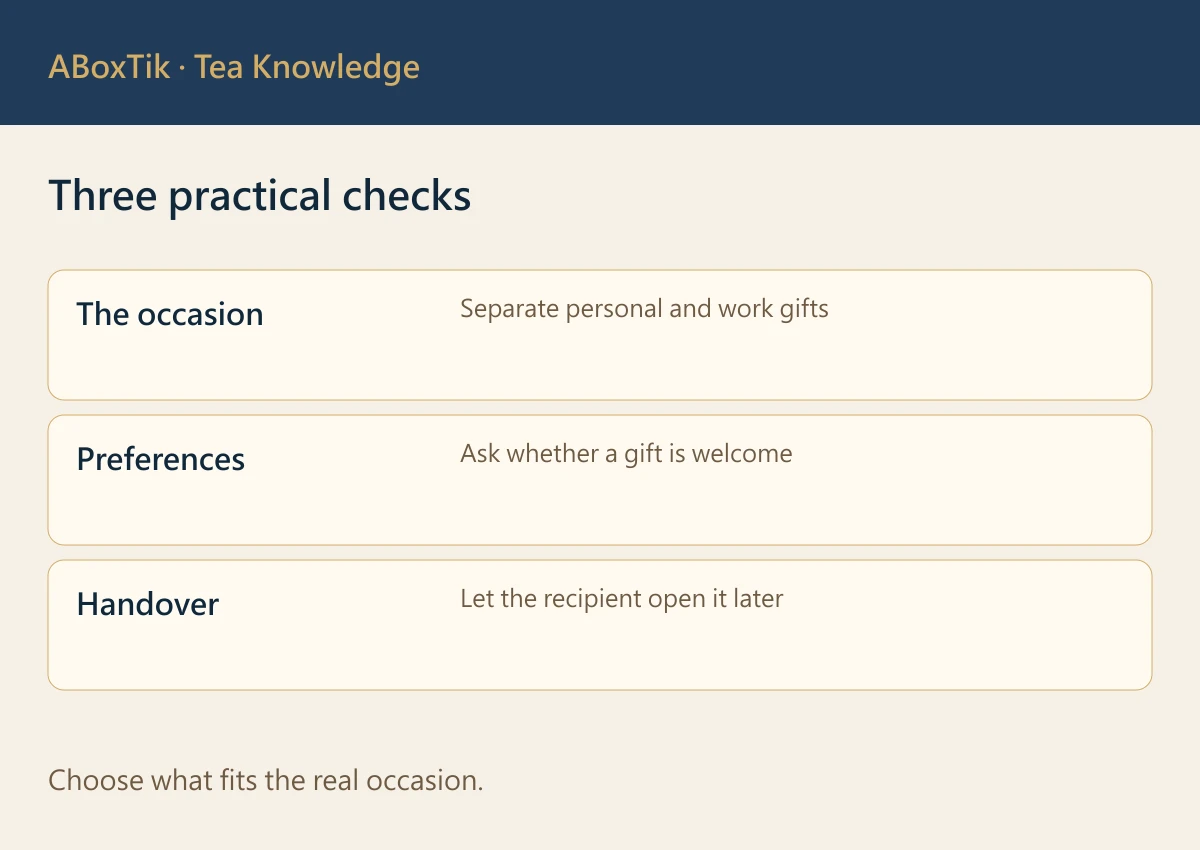
Begin by separating private and work settings
For a visit to a friend’s home, ask about everyday habits and how many people will be present. For a work meeting, first confirm whether the organisation can accept a gift and what form suits the occasion. Both settings call for respect, but private warmth cannot replace workplace rules, and a company procurement sheet is not the right way to manage a friend’s tea cupboard.
When a recipient belongs to a government body, school, company or other organisation, ask the contact person about the current gift process. Do not guess a limit or bypass the question because the item is only a small tea bag. Tea gifts for client visits and private host gifts make the distinction easier to discuss.
When uncertain, begin with a greeting, a tea introduction or a question about whether later delivery would be convenient. A gift does not need to be placed in someone’s hand immediately to show care; it can leave room for a relationship to continue comfortably.
Ask about preference instead of using nationality as an answer
Ask whether the person drinks tea, prefers floral or roasted notes, has hot water and a cup, or needs to avoid particular ingredients. Let them offer only the information they choose to share. If a blend is involved, provide a full ingredient list instead of claiming that everyone can drink it.
Language is part of accessibility too. Someone may read an English tea name without knowing how oolong differs from black tea in processing. A short card giving the tea name, origin, flavour direction and actual brewing start is often more useful than a wall of specialist vocabulary. Introducing Taiwanese tea in English and starting with Taiwanese tea can help.
A simple question works: “Would you like to try some Taiwanese tea? If you do not have brewing equipment, I can choose an easy format.” A present is allowed to receive a no. Cultural exchange does not require everyone to submit the same preference form.
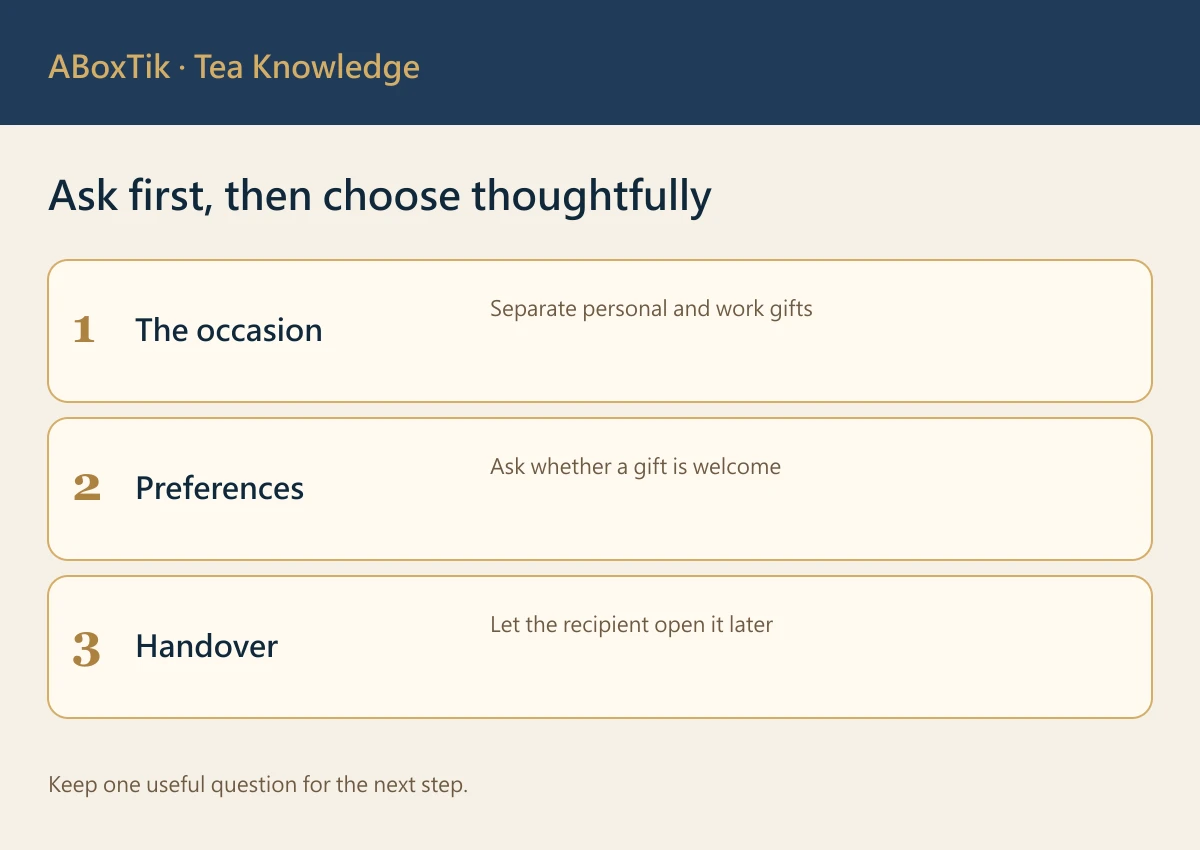
Three short questions keep the conversation clear
Ask early, before purchasing or arriving with a large box. “Would a small tea gift be welcome?” opens the personal question. “Is there a gift policy I should check?” gives a workplace contact a safe way to explain the process. Once appropriateness is clear, flavour can come later.
| Setting | Useful wording | After the answer |
|---|---|---|
| Private visit | Would you enjoy a little Taiwanese tea? | Match preference and equipment |
| Work meeting | Is a small gift permitted here? | Follow the contact’s guidance |
| Group event | Which language is most useful for tea information? | Prepare a readable short card |
| Polite refusal | No problem; I am glad I asked. | Do not persuade or reroute it |
For an international conference tea gift, a shared information card and confirmation with the organiser usually save trouble. For a private present, leave room for ordinary conversation. Good etiquette makes an answer easier, not more elaborate.
Let the recipient choose when to open the gift
At a suitable moment, say briefly what the tea is, how it can be used and that it may be enjoyed later. Do not ask a host to find a pot, boil water or review the tea immediately, particularly while they are welcoming other people. Whole-leaf tea bags or a small portion may be convenient without assuming that every guest lacks a teapot.
Choose packaging for carrying, complete information and the occasion. Keep contents and origin labels available, and use a language the recipient can read. If colours, numbers or imagery raise a specific concern, ask a contact who knows the setting rather than turning an online list of national taboos into a permanent rule.
A simple thank-you without opening the box or taking a photograph is still a complete handover. Tea can wait, and so can the response. A gift box is not meeting software; it does not need an immediate read receipt.
Receive a refusal, sharing or delay with ease
If someone says that accepting is inconvenient, accept the answer and stop persuading. Do not offer the item to another colleague as a route around the decision, and do not describe group sharing as a workaround. A verbal greeting or non-commercial note may be appropriate only when it fits the person’s wishes and the organisation’s arrangement.
A private friend may share the tea or open it later without signalling a lack of appreciation. Tea storage supplies practical card information, and sharing several teas helps with quantity. Neither should schedule the recipient’s week for them.
For a group activity, ask in advance whether collection is optional, whether alternatives are available for people who do not drink tea, and how leftover gifts are handled. Visible choice is kinder than asking people in public why they are declining.
Tell one true story and keep expectations light
A card can state one confirmed detail about this tea’s origin or processing and add an accessible flavour direction. Taiwanese tea terroir and craft supplies context, while light and roasted styles helps choose words. Do not add an award, certification or local story the product does not actually state.
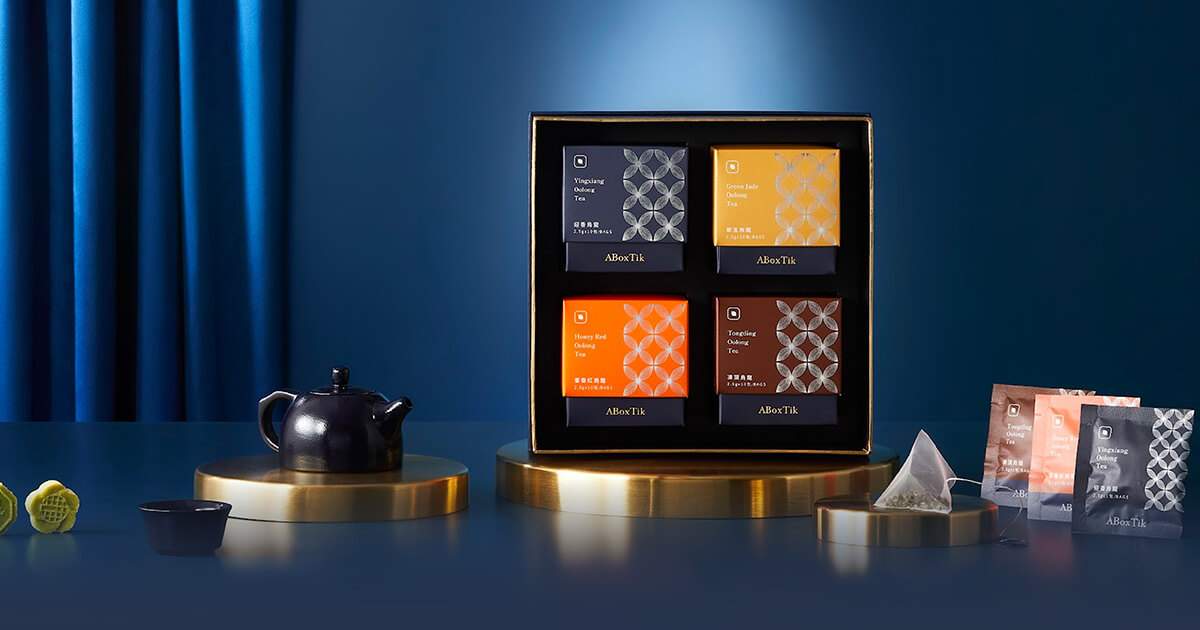
Compare the actual contents of a two-box tea bag set and a multi-tea gift box, then decide according to setting, quantity and budget. Entry or shipping questions need separate checks through traveller tea-gift preparation or overseas corporate handover. Etiquette and border procedures are different questions.
Before sending, check four things: whether the gift is convenient to receive, whether ingredients are clear, whether the language is understandable and whether handover adds work. Those answers are more useful than memorising dozens of national impressions. The next conversation can simply begin with “Was that format convenient?”
Follow ABoxTik
Let a tea gift become a comfortable greeting
At ABoxTik, care often begins with a well-judged question. Confirm the setting, make information and portions clear, and a gift will not need ceremony to show respect.
Choose one story from Taiwanese tea and pair it with an easy-to-use format. Leave an invitation and leave room for an easy answer.
Related reading
- Private host gifts
- Natural English tea introductions
- Compare actual tea-gift contents
Sources
Sources checked 21 October 2026.