
Tea Knowledge
Corporate Tea Gift RFQ: A Practical Request Template
Put thoughtful intentions into clear fields, and the next reply can move closer to an answer.
A corporate tea gift RFQ should state purpose, quantity range, budget basis, arrival date, delivery locations and customization needs. Ask the supplier to answer the same fields and itemize costs. Separate essentials, acceptable alternatives and decisions still pending internally. The template below turns a broad gift idea into questions a supplier can actually answer.
“Elegant, reasonably priced and quite soon” is an understandable wish. It also asks the supplier to practice a little tea-leaf fortune-telling. Give each adjective a concrete condition and both sides can spend less time composing follow-up emails.
Begin the tea gift RFQ with its purpose
Explain whether the tea is for event guests, annual partner appreciation, staff sharing or introducing Taiwan to overseas contacts. Purpose affects format, package size and the recipient’s first use. Add known habits, such as mug brewing in an office or a need for bilingual instructions. Unknown preferences can stay open instead of becoming assumptions about a whole country or profession.
Use quantity planning to separate confirmed and tentative recipients, and budget planning to establish the spending basis. This page does not recalculate the list. It turns the result into a clear request.
A copyable request template
| Field | Fill in | Ask the supplier to confirm |
|---|---|---|
| Project and purpose | Project ___; recipients ___; use ___ | Suitable current formats and teas |
| Quantity | Confirmed ___; tentative ___; quote tiers ___ | Feasibility and price at each tier |
| Budget basis | Per gift ___; total ___; included costs ___ | Itemized charges and exclusions |
| Tea contents | Loose tea or bags ___; style ___; restrictions ___ | Names, net weight, count and inner packs |
| Packaging and text | Existing box, card or other work ___; languages ___ | Available scope, size and approval method |
| Dates | Preferred arrival ___; latest acceptable ___; decision ___ | Starting conditions and estimated milestones |
| Delivery | One location or multiple ___; regions ___ | Feasibility, charges and data deadline |
| Samples and proofing | Tea, physical box or artwork ___; approver ___ | Process, charges and proof stages |
| Alternatives | Flexible ___; non-negotiable ___ | Options if the first idea is unsuitable |
| Reply management | Contact ___; reply by ___; request version ___ | Quote validity and outstanding questions |
Not every field must be settled on day one. Give the uncertainty a name: “quantity awaits approval; please quote two tiers.” That is more useful than concealing it inside “the usual arrangement.” Send the same request version when comparing suppliers.
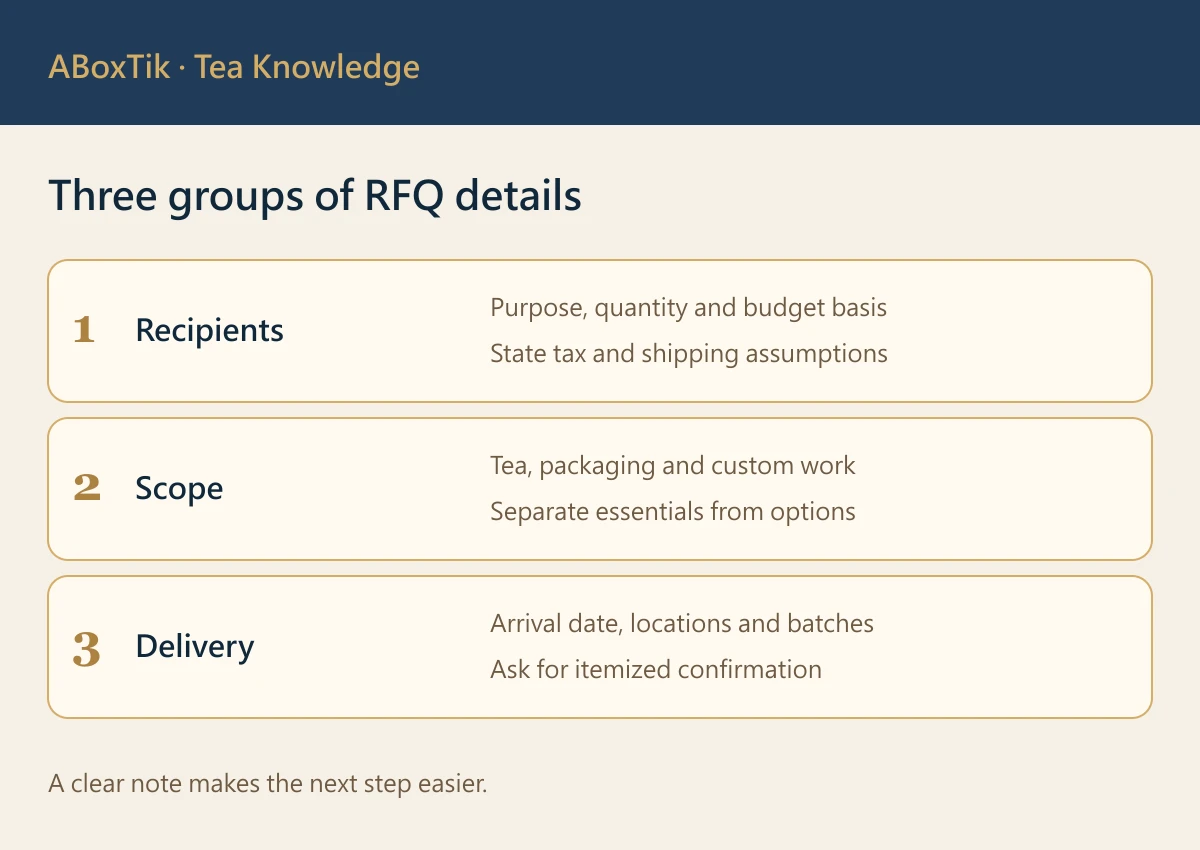
Align the price basis before comparing totals
A lower unit price may describe a smaller net weight, fewer tea bags or packaging without printing. Ask for tea contents, display packaging, added cards or branding, shipping and other necessary charges separately. State whether tax is included. A retail tea gift selection can help establish format, but it is not automatically a bulk customization quote.
“Our per-gift ceiling includes consolidated delivery to our office” differs from a product-only budget. Write the boundary down. This often helps more than another request for a special discount, and prevents an attractive unit price growing unexpectedly when the whole project is added up.
Specify arrival, not only dispatch
The day gifts are needed and the day a supplier hands them to a carrier are different milestones. Include preferred arrival, latest acceptable arrival, sample approval and the internal decision date. Ask what must be confirmed before work begins. If quantities, artwork or addresses remain open, say so.
The customization timeline explains the sequence. A tentative duration in a conversation should not be treated as a confirmed commitment. Multiple-address and cross-border delivery also belong in the feasibility questions, rather than being assumed services.
Separate essentials from flexible choices
Essentials might include plain tea, individually packed portions and bilingual brewing instructions. Flexible items might include a box color, card format or tea combination. Agree on those boundaries internally so a supplier can propose an alternative without restarting the entire discussion each time.
If no added flavoring matters, ask about the actual ingredient list. If Taiwanese origin matters, request information linked to the offered product rather than relying on a landscape photograph. Origin and label information and Taiwanese tea and craftsmanship provide background. Specific conditions support an accurate story later.
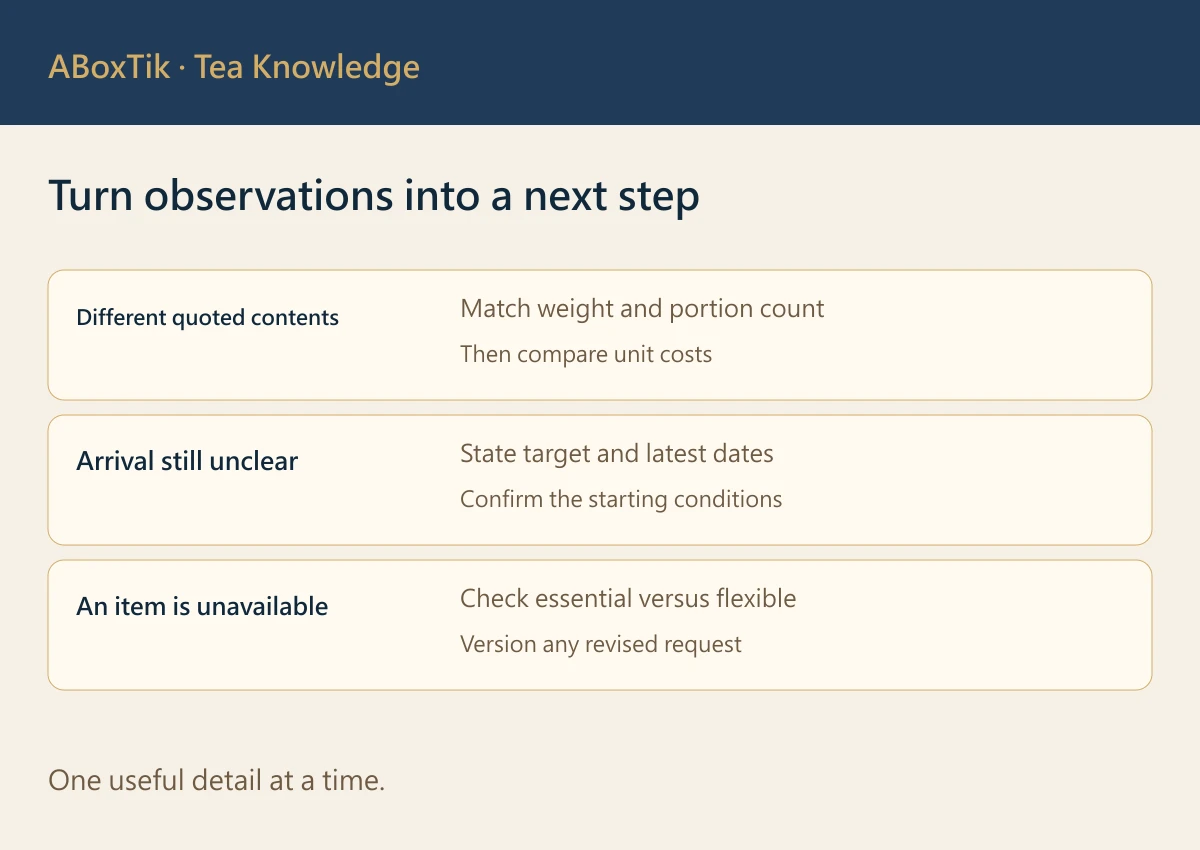
A first inquiry email you can adapt
Hello, we are planning tea gifts for ___, primarily for ___. We have ___ confirmed gifts and ___ still pending. Please compare quantities of ___ and ___. Our per-gift budget is ___; please separate tea contents, packaging, customization, tax and shipping. Preferred arrival is ___, with ___ as the latest acceptable date. Essentials are ___ and flexible items are ___. Delivery would be ___. The attached request is version ___. Please reply by ___ with feasible current options, itemized costs, quote validity and the information still required. Suggestions that fit the recipient’s use are welcome. Thank you.
Adapt the template to the project and leave proposed services and costs for confirmation in the reply. Initial feasibility discussions can usually begin with address counts and regions. Supply actual recipient details through the company’s established process when delivery requires them, instead of attaching a complete contact list to the first inquiry.
Review three kinds of differences in the reply
- Contents: do tea names, format, net weight, portion count and packaging describe comparable gifts?
- Conditions: are quantity tiers, included charges, validity, starting requirements and alternatives clear?
- Unanswered items: collect them into one follow-up, retain the request version and ask the supplier to confirm the impact of changed quantities or packaging.
Do not transfer only the lowest number into the comparison sheet. Matching scope creates a shared basis for discussing price. If proposals genuinely differ, preserve those differences and decide which recipient needs matter most. The quantity list, budget sheet and RFQ can connect while each remains responsible for a distinct question.
Follow ABoxTik: let good questions carry some of the work
A clear corporate tea gift RFQ leaves room for the buyer, supplier and recipient. Explain the purpose, then give contents, costs and delivery a place to be checked. For current ABoxTik options, bring the request to the contact page. The Classic Taiwan tea selection and two-box tea gift can help establish a format, with feasibility confirmed in the specific reply. No fortune-telling is required, and the project contact deserves time to finish a cup too.

Related reading and tea choices
Sources
- Tea and Beverage Research Station: tea packaging and storage
- ABoxTik: contact for current products and project questions
Sources checked: 24 October 2026.