
Tea Knowledge
What Is Low-Carbon Tea? How to Read the Evidence
A green phrase can be an invitation to ask a better question. Give the product, period and evidence their own places on the table, and choosing tea becomes a little less hurried.
To assess low-carbon tea claims, identify the exact product, assessment boundary, comparison baseline and supporting evidence. A carbon footprint, a reduction and carbon neutrality answer different questions. A tea garden photograph or paper box can start a conversation, but cannot supply the missing comparison. Begin with the claim’s scope before judging its size.
This guide offers a practical reading and enquiry method for shoppers and gift buyers. For the sources of emissions, see tea’s life-cycle carbon footprint. No qualification in environmental accounting is required to ask what a number describes. The cup can remain a cup rather than becoming a pocket calculator.
Low-carbon tea claims: identify the product, scope and evidence
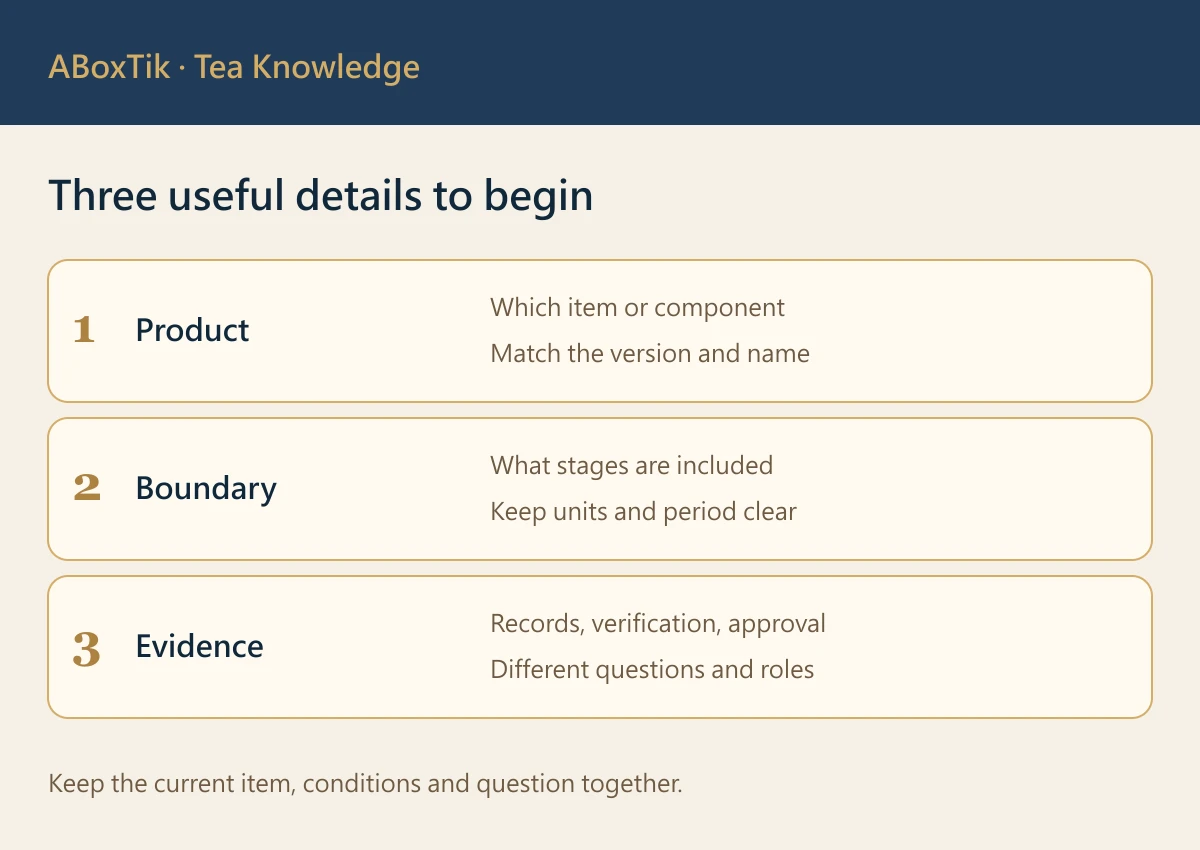
Start by copying the actual statement, rather than the impression left by an advertisement. Does it describe a tea, a packaging component, a factory or an entire business? A change to factory equipment is useful information about that operation. A claim about a finished product’s life cycle needs evidence for that wider object. Their appearance in the same picture does not make their boundaries identical.
Next, ask where the assessment begins and ends. Finally, distinguish an activity record, an emissions calculation, independent verification and official approval. They offer different kinds of information. A simple note headed “object, boundary, evidence” is enough to begin. The same approach supports ESG corporate tea purchasing, where several people may later need to understand what was agreed.
Taiwan’s Ministry of Environment regulates voluntary product carbon-footprint approval through life-cycle accounting, product category rules and verification requirements. Use that framework to locate the relevant conditions, rather than reading CO₂ as a quality badge. Tea-origin information answers a separate provenance question. Keep both records, with each doing its own job.
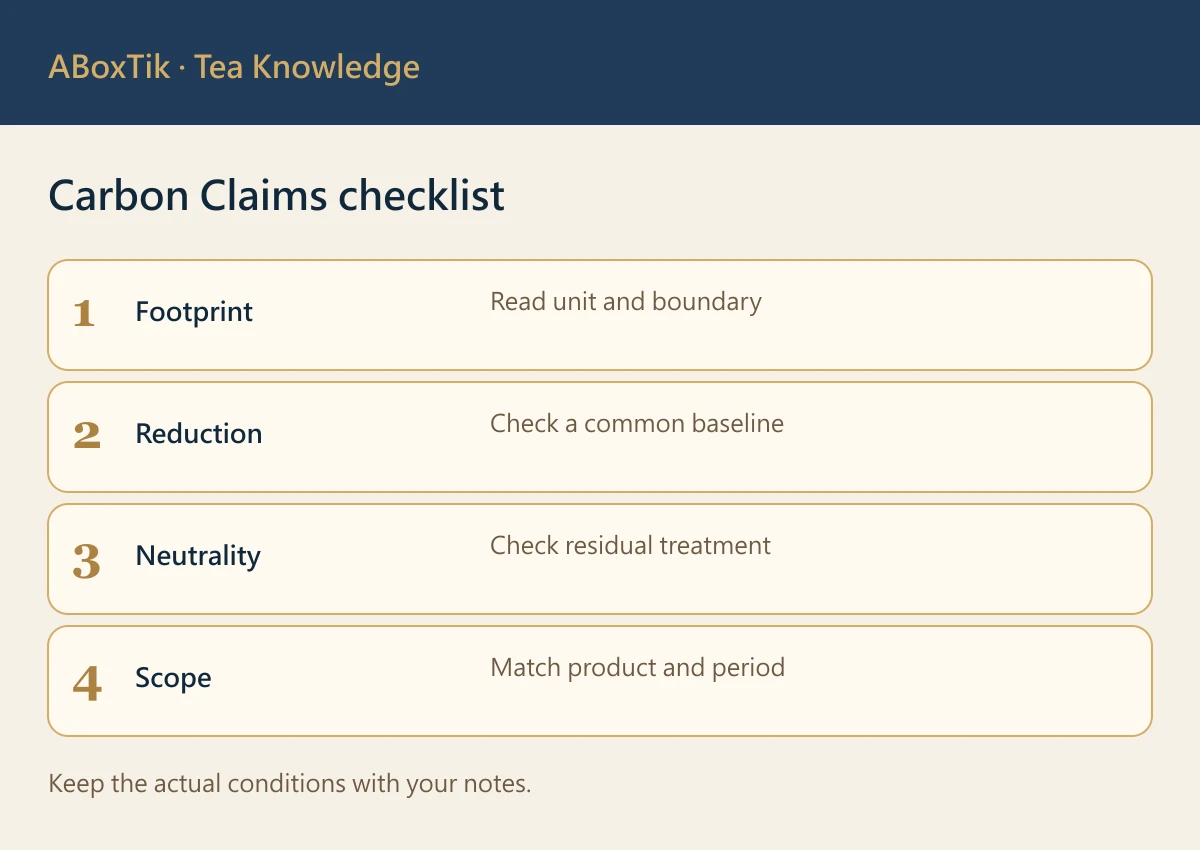
A footprint, a reduction and neutrality need different questions
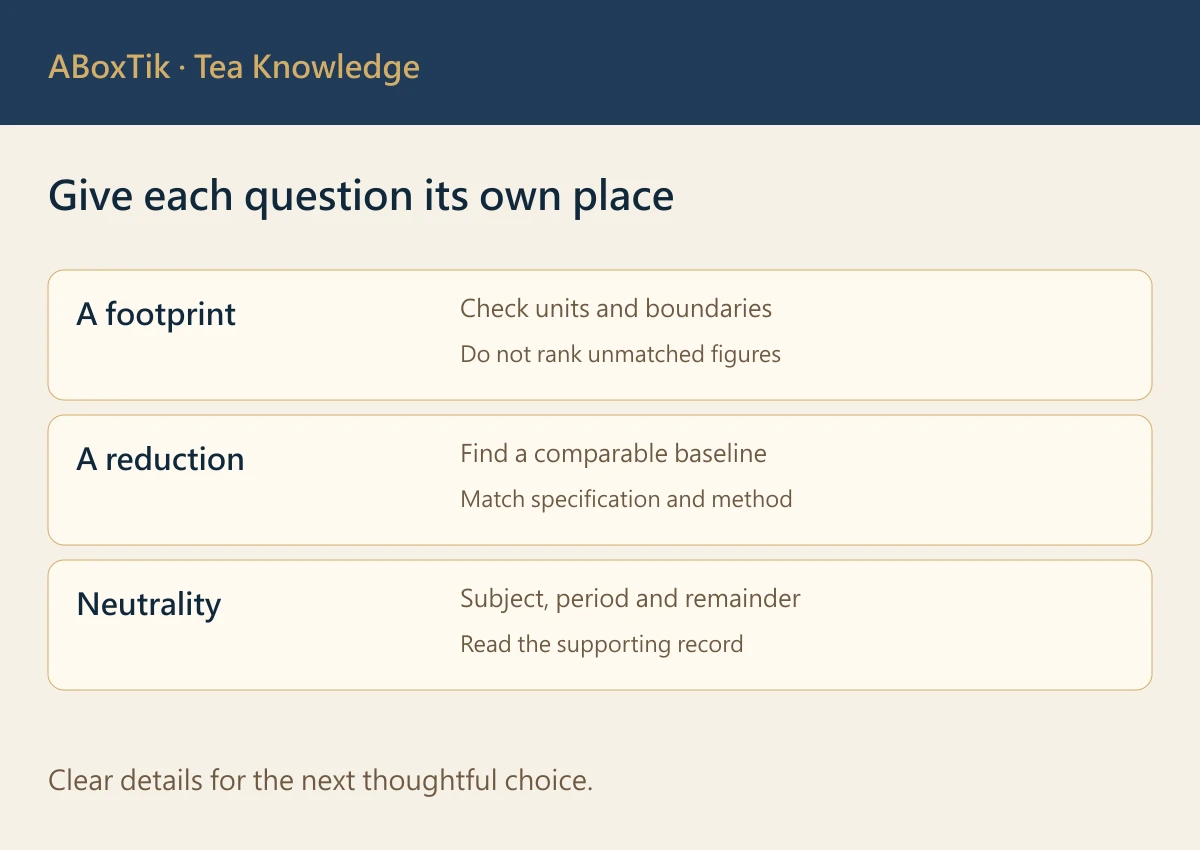
A footprint quantifies emissions within a defined assessment. A reduction needs a comparable baseline. A neutrality statement also raises questions about its subject, period, reductions and treatment of remaining emissions. Separating these ideas prevents a disclosed number from being mistaken for an improvement, or a change in one stage from being extended to the whole product.
Suppose a supplier describes lower electricity consumption in tea manufacture. Ask which site and period it covers, and whether the measure is total electricity or electricity per unit of output. Consider whether production volume or the product mix changed. These enquiries help interpret the action; a product-level conclusion still needs the corresponding wider assessment. Drying and roasting explain manufacturing context, while roast colour cannot stand in for an electricity meter.
The Ministry’s guidance on corporate carbon-neutrality declarations addresses quantification, reduction and offsetting. Where offsets are invoked, ask how they relate to the stated subject and period, alongside their supporting records. For a purchasing team, this becomes a documentation question rather than a contest to find the most reassuring green graphic. Leave room for a precise answer, including a narrower claim where appropriate.
Compare tea footprints only after aligning the basis
A packet, a kilogram of dry tea and a serving are different units. Even two figures described as “per cup” need the tea dose, water volume and resteeping assumptions. An assessment ending at the factory gate also differs from one including water heating at home. Align units, boundaries, data period and methods before putting two results in a ranking.
For a before-and-after comparison, check whether the product specification or allocation method changed as well. Moving from a large pack to individually wrapped bags changes the question. So does excluding distribution from one assessment. Whole-leaf and broken tea concerns use and extraction; tea price and value concerns another set of considerations. Neither supplies a missing carbon baseline.
Try a comparison without invented numbers. File document A, which describes dry tea at the factory gate, under production. File document B, which describes a prepared serving including heated water, under drinking service. Ask whether a matching scope is available. “Not yet comparable” is a useful result: it tells the next person exactly what is needed. The figures have not disagreed; they are answering different questions.
Check an official label against the actual product
For a Taiwanese product carbon-footprint label, use the Ministry’s information service and match the business, product or model, figure, declared unit, approval reference and relevant period. Another product from the same brand should not silently inherit the result. The Ministry’s open-data description also identifies fields for products whose carbon-label certificates are within their validity period.
Photograph the complete packaging and retain a dated search note. If a name is similar, compare the specification and declared unit too. If a result does not match, ask the supplier for the relevant record rather than filling the gap from a neighbouring listing. An unsuccessful search is a sensible reason for an enquiry, rather than enough information for a public accusation.
Other labels address other questions. Organic and production-traceability verification should be read within their own schemes. Compostable tea bags require attention to materials, conditions and local collection. Keep separate headings for provenance, packaging disposal and carbon information. The small print becomes friendlier once every line has a clear purpose.
Translate paper, local sourcing and energy actions into details
Break “less packaging” into components and versions: what was removed, what weight was recorded, whether protection was maintained and whether transport packaging was included. Break “local” into tea origin, box manufacture, assembly and delivery. Distance is one condition, not a complete result. For gifts, quantity and reserve planning can also help prevent unnecessary purchases.
Describe a practical action at the level its evidence supports. Removing a sleeve can first be explained as removing that sleeve from a specified version. A claim about the resulting emissions needs a corresponding calculation. When considering corporate gift branding, give cards and sleeves clear functions before adding them. Good communication does not need every surface to work a double shift.
At home, choose quantities that suit the pace of drinking, heat water for the intended use and follow tea-storage guidance after opening. These are useful ways to organise use and avoid waste. A quantified environmental result would need the actual conditions and accounting. Finishing a tea that fits the household is a practical place to begin; the cupboard need not become a long-term waiting room.
Use an enquiry sheet that someone else can understand
Send a product link or photograph, the purchasing purpose and the exact statement being checked. Keep six fields: product, unit, boundary, data period, baseline and verification or approval record. Sort replies into matched, further information needed and not applicable. Add a version date. This small discipline makes a later handover easier than reconstructing a decision from screenshots of an old conversation.
If a team is preparing a public gift card, ask the purchasing and copy owners to review the actual supplied contents together. A confirmed origin supports an origin statement. A confirmed packaging change supports a description of that change. Write the checkable fact first, then decide whether a broader environmental statement is needed and supportable. This often makes the editing process shorter as well as clearer.
Choose one familiar term today: low-carbon, recyclable or local. Turn it into a question that can receive a specific answer. For tea formats, compare the actual contents of the four-box classic tea selection and two-box tea gift. Taste, portions and environmental documentation each deserve attention. None needs to erase the others for a considerate choice to be possible.
Five useful questions when tea packaging says “environmentally friendly”
Start with the component, then ask for its evidence and a practical destination after use. Recycled content concerns material inputs. Recyclability concerns what can enter an appropriate collection and processing system. Compostability needs specified conditions. These are different questions, even when the words share one small panel. Photograph the complete label and choose the statement that matters most for this purchase. One clear enquiry is a comfortable place to begin.
| Wording on the pack | A specific question to ask | What to do with the answer |
|---|---|---|
| Made with recycled material | Does this cover the box, insert or whole package? What is the basis for the percentage? | Keep the matching specification and proportion. Record other components separately. |
| Recyclable | Which parts need separating? Does the recipient’s service accept this material and construction? | Follow local collection instructions and check coatings and attached fittings. |
| Compostable / plant-based | Which item is covered? Home or industrial conditions? Which service accepts it? | Match product evidence to the conditions and route. Check disposal separately from feedstock origin. |
| Reduced packaging | Compared with which version? What was removed, and how were weight and dimensions recorded? | Compare the same contents, component boundary and measurement method. |
| A certification or seal | Which model, component, issuer and validity period does the record identify? | Match the full designation and record, then read the environmental attributes it covers. |
Consider a simple example: a supplier confirms that a particular gift-box version no longer includes a decorative sleeve. Retain the version and component in the description. If the team also wants to compare whole-product emissions, the next request is for a common assessment boundary and baseline. Keep a recycled-content percentage separate from a reduction in packaging weight, too: their denominators may describe different things. Precise, modest wording makes a handover much easier.
For a seal, put the record beside the actual item rather than reading a logo on its own. Product names, covered parts and validity dates need to match, and important conditions deserve a readable position alongside the statement. Evidence for a filter material calls for a further check of seams, strings and tags before describing the finished bag. The compostable tea bag guide explores those details, including home and commercial conditions. A destination also needs someone willing and equipped to receive that product; a material name cannot arrange collection.
For the next tea purchase or gift project, try a small three-line card: “The statement covers ___; the matching record is ___; after use it goes to ___.” Send it with the product name and a photograph of the complete label. If one line remains open, ask about that line. There is room to enjoy the tea while making the information more useful, one answer at a time.
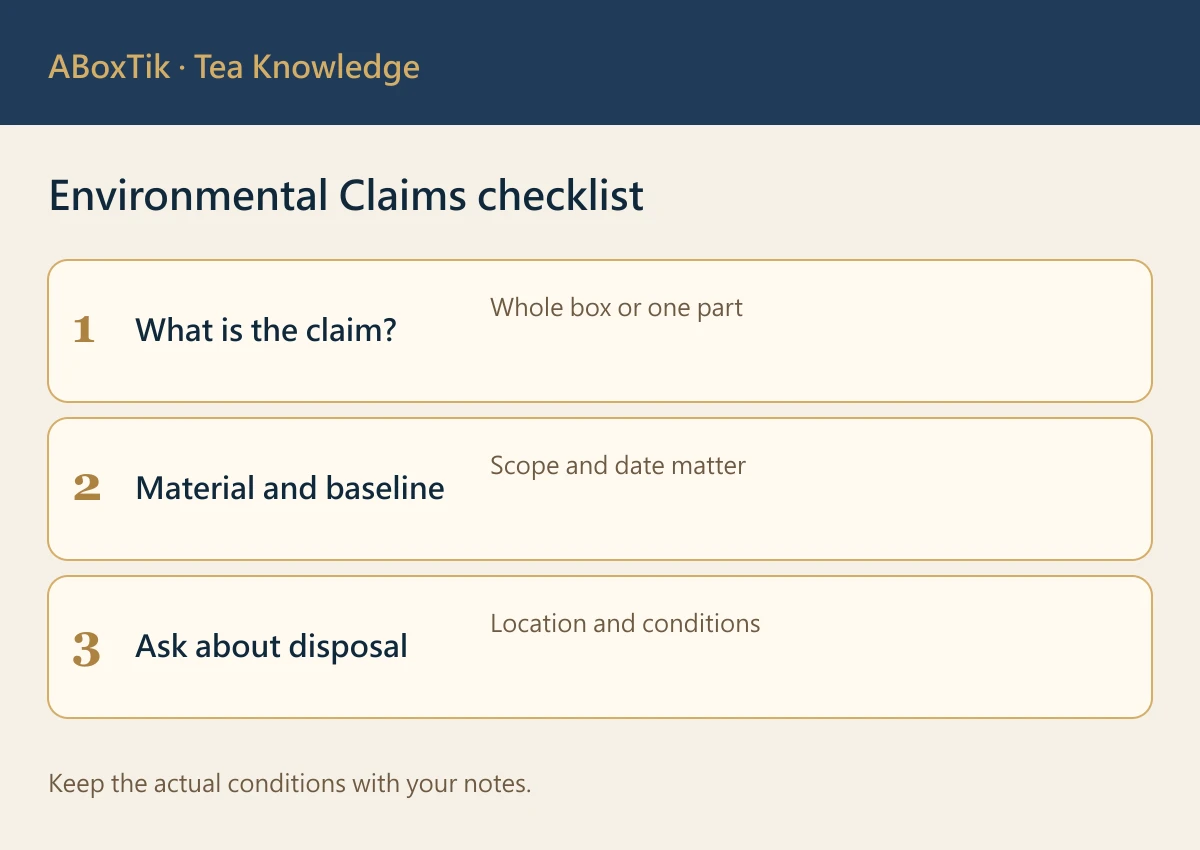
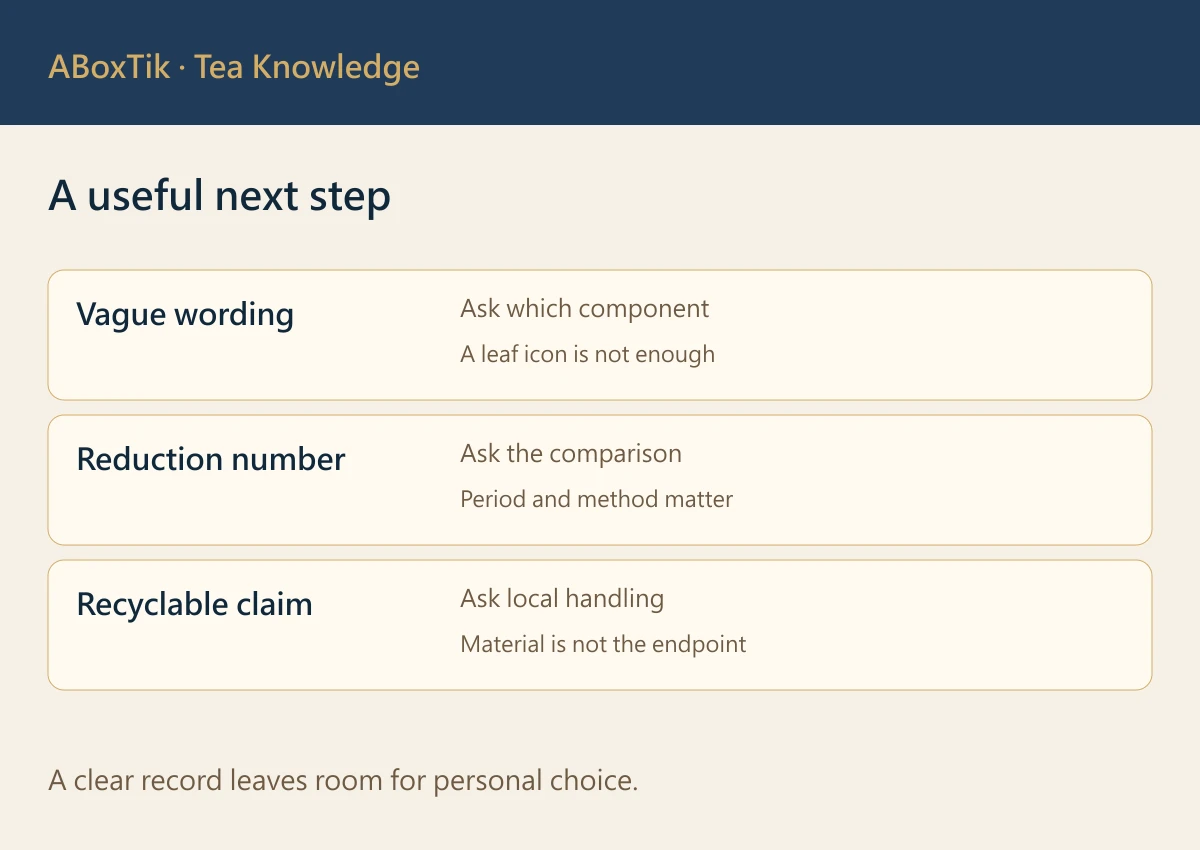

Follow a box of tea: turn a broad promise into a question with a useful answer.
Give clear information a place beside the next cup
Reading low-carbon tea information can start with one courteous, specific enquiry. A suitable quantity and a tea someone wants to drink also matter. The Taiwan tea starter selection guide offers a separate route into choosing flavours.
ABoxTik values tea that can be understood as well as enjoyed. Read about ABoxTik, then identify the actual item and information needed for the occasion. A good conversation leaves the next person with a clearer choice, and enough time to enjoy the tea.
Turn an environmental adjective into a reviewable claim sheet
Before publishing “greener,” record the proposed wording, applicable product or component, version and period, evidence source and validity, comparison baseline, bounded public sentence, and responsible owner. Evidence about an outer box supports a statement about that box. Removing one component from one version can be described as that change; it does not automatically establish plastic-free, recyclable or lower-carbon performance for the whole life cycle.
| Review field | Question to answer |
|---|---|
| Claim and scope | Which product version, component and period? |
| Evidence | What source, date, validity and disclosure scope? |
| Comparison | Are unit, boundary and baseline consistent? |
| Bounded wording | What sentence is supported, and what is not? |
| Owner | Who confirms, updates and rechecks it? |
For Taiwan, Article 21 of the Fair Trade Act addresses false or misleading representations capable of affecting a transaction decision. A Taiwan product carbon-footprint label also requires checking the approved product details and validity period. This sheet is a review aid, not a compliance certification or safe harbour. Recycling, composting and carbon-reduction wording should identify the component, conditions and local acceptance. Sources: Taiwan Fair Trade Act, Article 21 and Taiwan product carbon-footprint labelling regulations.
Related reading
- Tea life-cycle carbon footprints: understand the accounting stages.
- ESG corporate tea gifts: connect evidence with purchasing.
- Compostable tea bags: distinguish material and disposal conditions.
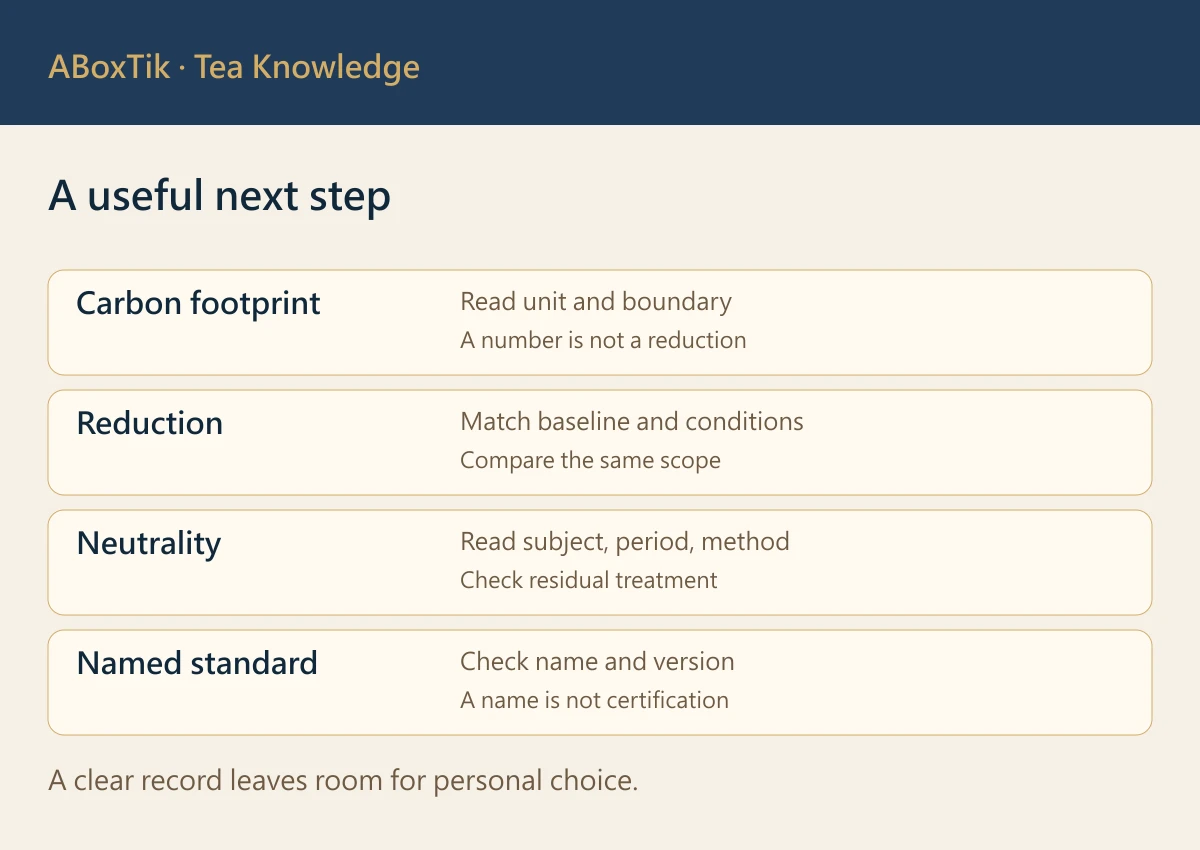
Carbon reduction and carbon neutrality: separate three evidence cards
Carbon reduction asks how emissions have fallen relative to a defined baseline. Carbon neutrality asks about a defined subject and period, quantification, priority reductions and the treatment of the remaining footprint under the chosen approach. Buying credits is not a shortcut that makes these terms interchangeable. A cup can be full without requiring every climate term to share one small field.
| Claim | Request first | Do not rewrite it as |
|---|---|---|
| A carbon footprint has been quantified | Subject, unit, boundary, method, period and result | Emissions have already been reduced or neutralised |
| Emissions were reduced against a baseline | Comparable baseline and current data, with the reduction calculation | No residual emissions remain |
| Carbon neutrality is declared | Applicable product or organisation, period, reductions, residual treatment and declaration basis | The life cycle produces no emissions |
ISO’s introduction to its carbon-neutrality standard gives priority to value-chain emission reductions and enhanced removals over offsetting. Ask which standard and version the declaration uses and what it covers, then examine the actual supporting documents. Mentioning a standard number does not establish that a particular tea has been verified or is entitled to display a mark.
If offset information is supplied, ask how it corresponds to the subject, year and quantity of the claim. Project or credit information and applicable cancellation or retirement records may be relevant. These are checking questions rather than a universal document list: the actual requirements depend on the approach and rules being used.
Compare two statements: “The factory used less electricity than last year” and “This tea box is carbon neutral.” The first requires electricity, production and period information. The second requires the product boundary, footprint, reductions and treatment of residual emissions. An improvement at one factory is not automatically a conclusion about the whole box, and records for a different product cannot fill the gap.
After reading a reply, write one factual sentence: “The subject is ____, the period is ____, the action is ____, and the supporting information is ____.” Leave unmatched fields open. A purchasing card should not expand the claim while those details are still being checked. Questions can be precise and considerate at the same time.
For a team preparing public copy, have the person handling documents and the person writing the card read the same claim together. Keep its scope visible, including whether it concerns an organisation, a product or a particular operation. If only an operational change is supported, describe that change at the supported level. A concise factual line is easier to maintain when the package or reporting period changes.
Finally, keep climate information separate from taste, origin and package convenience. Each can matter to a purchase, but they answer different questions. Choose a useful amount of tea for the occasion, then keep the environmental record close enough to revisit when a claim needs checking.
Sources for this addition
Sources
- Ministry of Environment: voluntary product carbon-footprint approval regulations
- Ministry of Environment: Taiwan product carbon-footprint dataset
- Ministry of Environment: corporate carbon-neutrality declaration guidance
Sources checked 16 October 2026.