
Tea Mixology
Make-Ahead Tea Base for a Party: Preparation and Serving
A little preparation leaves more room for the people at the table.
You can prepare a tea base before a party. Start by estimating how guests may use it, brew according to the tea’s directions, remove the leaves, and arrange clean containers, labels and refrigeration. Keep fruit, dairy, sweeteners and sparkling water separate according to their own handling instructions, then let each guest choose what goes into the glass. The useful question is not how early the tea can possibly be made, but whether the batch can be cooled, stored and served with care.
A large unlabelled pitcher in a crowded refrigerator can turn the host into a beverage detective just as the doorbell rings. A short preparation card gives every container a name, a time and a person responsible for it. Plain tea remains available for anyone who wants it, while guests who enjoy a mixed drink can add their own finishing touches. A good plan leaves a little room for conversation as well as for ice.
Begin with the people, the drinks and the person in charge
Write down the expected number of guests, the length of the gathering and the other drinks available. There is no need to assume that everyone wants tea, that every guest will have the same amount, or that every person will return for a second glass. Plan an initial serving and a way to replenish it instead of placing the whole batch on the table at once. Water and another suitable option give guests a comfortable choice.
Next decide whether the base will be served plain, poured over ice or offered with optional additions. A plain shared base keeps the directions flexible. Put sweetener and dairy in separate, clearly identified containers, and keep ingredient information available. Assign a person to brewing, labelling and refrigeration, even if that person is the same host. If someone else will serve, write down what has already been done and what still needs attention.
A practical preparation and handoff table
| Stage | Action | Record |
|---|---|---|
| Planning | Confirm guests, drink choices, fridge space and equipment. | Estimated amount, containers and owner |
| Brewing | Follow the tea directions; remove the leaves at the chosen time. | Tea, batch, preparation time and actual method |
| Cooling and storage | Use clean food-contact containers; divide into manageable portions and arrange prompt cooling and refrigeration. | Container labels, storage location and responsible person |
| Before serving | Prepare clean cups and utensils; take out the amount needed for the round. | Ice and any added ingredients |
| During and after | Replenish in batches and handle remaining ingredients according to their requirements. | Time taken out, remaining condition and next step |
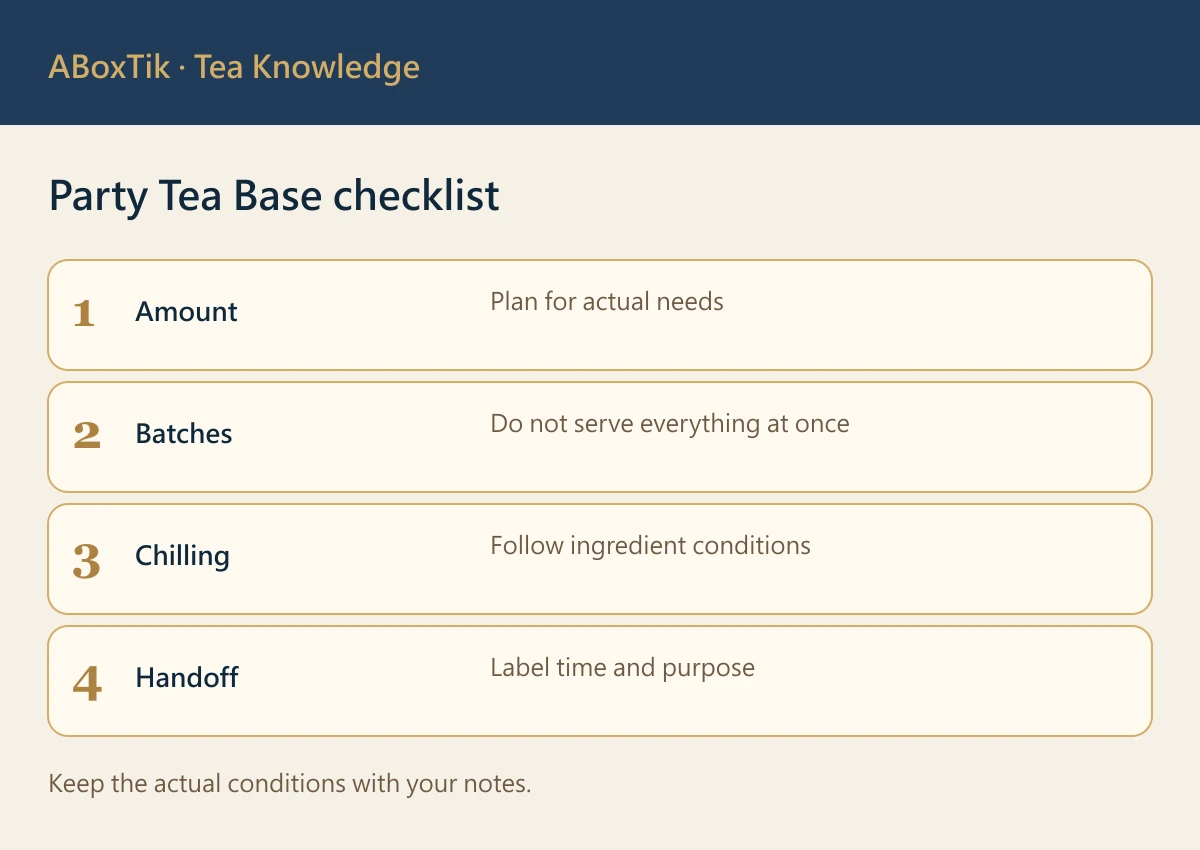
The first row is deliberately a planning stage rather than a promise that tea will keep for a set number of days. Container size, refrigerator capacity, tea and added ingredients vary. Check that there is room to cool and refrigerate the intended amount before deciding how much to make. If there is not, reduce the batch or prepare it closer to serving. A pitcher does not become easier to manage simply because it is larger.
Make a base that can still be adjusted
Choose a familiar tea with clear product information. Begin with the package guidance for tea, water and steeping time, then taste a small amount of the plain brew at a comfortable temperature. Note the aroma and strength that you would like to retain. If ice, water or another ingredient will be added later, consider the final drink as well as the first sip. A dark colour alone does not say whether the aroma will remain clear.
Change one brewing variable at a time if an adjustment is needed, and record what actually changed. Making the base stronger is not automatically an improvement: bitterness or astringency may become more noticeable too. The non-alcoholic tea mixology guide discusses the balance of tea, acidity, sweetness, ice and bubbles. This guide has a different job: getting a batch from preparation to the table with an understandable handoff.
Remove the leaves or tea bags when the intended steep is complete so they do not continue to infuse during the wait. If the equipment is too small for the planned amount, make manageable batches and identify each one. Two batches with the same tea name can still differ if their timing or vessels differ. Record the actual tea, start and finish time, water amount and any addition rather than expecting the next person to infer them from the colour.
Make room for cooling and refrigeration
Wash hands, work surfaces and utensils before preparation. Use clean containers intended for food contact, and check that each is suitable for the temperature of the tea and for the way it will be cooled. The FDA recommends dividing large quantities of food into shallow containers for quicker cooling. Apply that general principle with attention to the container manufacturer’s instructions and the available refrigerator space; do not force a vessel that cannot tolerate the temperature change into the fridge.
Arrange prompt cooling and refrigeration instead of leaving a large pitcher on the counter for the duration of the party preparations. Use an appliance thermometer to check the refrigerator and follow applicable guidance for the ingredients being handled. Cover and label portions appropriately, and place them where the server can find them without repeatedly rearranging every other dish. Leave room around the plan for real life: a second batch should not have to share a shelf with a precariously balanced cake.
When guests arrive, take out the amount needed for the current round and keep the reserve refrigerated. Use clean utensils and containers for each refill, and record when each portion was taken out. Keep tea already put out for service separate from the refrigerated reserve; do not pour it back into the reserve or treat re-chilling as a reset of its time outside refrigeration. The FDA’s clean, separate, cook and chill framework is general food-handling guidance. It does not establish a universal shelf life for every brewed tea or every mixture made with it. Follow the relevant current guidance and the instructions for the particular ingredients.
Let additions meet the tea in the glass
Fruit, dairy, sweeteners and sparkling water each have their own preparation and storage needs. Rinse fresh produce under running water and use clean cutting equipment. Keep dairy under the conditions stated on its packaging. Separate ready-to-drink ingredients and utensils from raw meat, seafood and eggs, and wash equipment thoroughly if it has been in contact with them. These ordinary steps make a busy kitchen easier to navigate, especially when several people are helping.
Keep the original package or a clear label showing what each addition contains. If a guest has an ingredient preference, ask rather than guessing. Once milk or fruit juice is mixed into a tea base, the mixture needs to be handled with all of its ingredients in mind; it is no longer the plain tea that went into the pitcher. Separate spoons and labels also help a guest understand what has actually been served. Sparkling water can be added at the glass when wanted, leaving a still version available.
Try one small comparison before scaling up
If time permits, make a small comparison under appropriate handling conditions. Taste the plain tea first; divide another small portion and add just one intended ingredient. Record the tea, amount of base, final volume, ice and serving condition, along with the impression of aroma and strength. If the question is whether the tea is still recognisable, do not simultaneously change the tea, juice and sweetener. An inconclusive result is still a useful reason to keep the first batch simple.
A small comparison helps organize preferences and the next adjustment. Food safety still depends on the ingredients and handling, and a tasting cannot prove a chemical explanation for an observed difference. On the day of the gathering, update the notes if the tea batch, vessel or ingredient changes. The milk-tea base guide offers a separate way to observe what happens to aroma after milk is added; it does not prescribe one ratio for every kind of dairy.
Hand over a clear next step
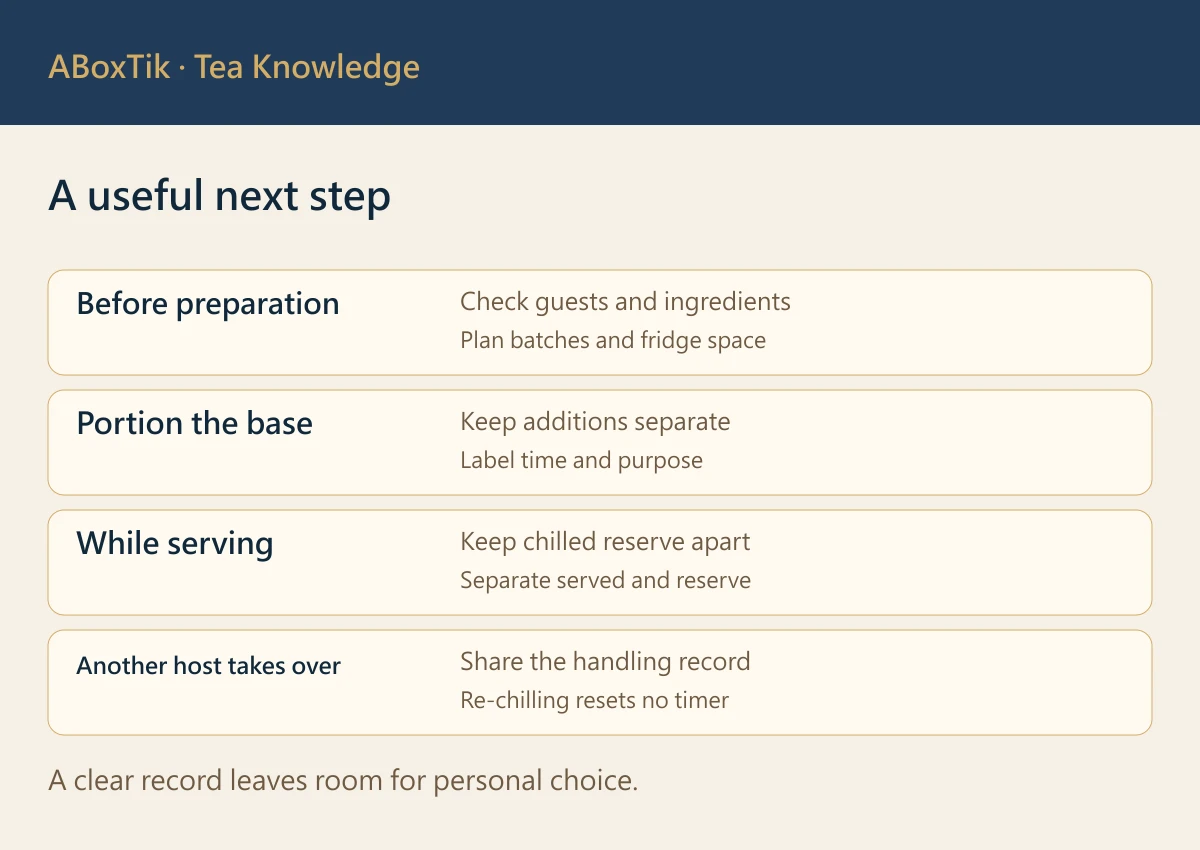
Before another person takes over serving, point out the tea name, preparation time, additions, refrigerated location, clean serving utensil and responsible contact. Identify the container already taken out for service so it is not confused with the reserve that stayed chilled. At the end, decide what to do with any remainder using the actual ingredients, storage and time exposed, together with applicable official advice and product instructions. Appearance or smell alone cannot guarantee safety, and one invented expiry time cannot cover every tea mixture.
A prepared base does not require everyone at the party to drink the same thing. Give the tea, ice and additions their own places, make water easy to find, and let a guest decline without explanation. To choose a starting tea, explore the introduction to Taiwanese tea; the current Taiwanese tea selection provides the product details and brewing instructions for the items actually available. Then put the preparation card somewhere visible and return to the people at the table.

Related reading and tea choices
Sources
Sources checked: 30 October 2026.