
Tea Knowledge
Taiwan Tea Gifts for Japanese Clients: A Practical Check Card
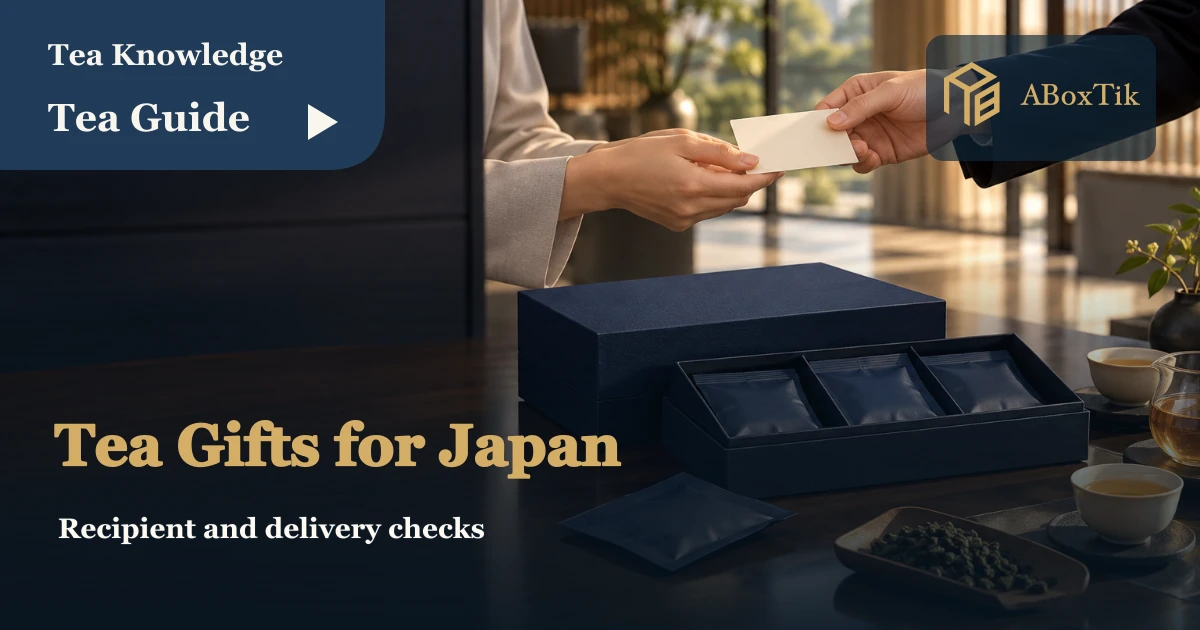
A thoughtful question makes the next cup easier to choose.
A thoughtful Taiwan tea gift begins with a question, not an assumption: may this person or organisation accept a gift, and what would make it useful? Confirm the recipient, their company policy, the purpose, the arrival details, and the actual product information before choosing a box. That may sound less romantic than beginning with a ribbon. It is also how a ribbon avoids becoming an office mystery with nowhere to sit.
There is no single “Japanese client preference.” Individuals differ, companies set their own gift rules, and a tea that works beautifully for one relationship may be awkward for another. Treat the recipient as a person and the organisation as an organisation: ask a named contact what is welcome, rather than asking a country to answer on their behalf.
This guide is a communication tool for a business gift from Taiwan. It does not promise availability, delivery timing, import clearance, or a particular tea experience. If a shipment will cross borders, the responsible sender or importer should confirm the current product, carrier, and official requirements for that specific shipment. The official Japanese references are linked at the end so the right party can check the live rules.
Start with the purpose, not a national script
Write one sentence that explains why you are sending the gift: thanks after a completed project, a seasonal greeting, an introduction to your company, or a small gesture for a visit. Then decide whether it is for one person, a small team, or an office. These decisions shape the package more reliably than a list of imagined national tastes.
| Situation | Useful question | What it changes |
|---|---|---|
| One named client | “May we send a small non-cash thank-you gift, and is tea welcome?” | Whether to send at all, and whether the gift should be personal or neutral. |
| A project team | “Is a shareable, individually portioned item practical for the team?” | Format, quantity, and whether a group gift fits the workplace. |
| A first meeting | “Does your organisation have a policy on receiving gifts?” | Whether a gift could create a compliance concern. |
| Delivery to an office | “Who may receive it, and what address and contact details should we use?” | Handoff clarity; a beautifully chosen package still needs a real recipient. |
Do not turn a gift into a quiz. One contact may be able to answer only the policy and delivery questions, which is already useful. If the recipient’s dietary, caffeine, or flavour preference is unknown, choose a modest, accurately described option or ask whether tea is appropriate before guessing. “Thoughtful” does not mean “surprising enough to require detective work.”
The Japanese-client gift conditions check card
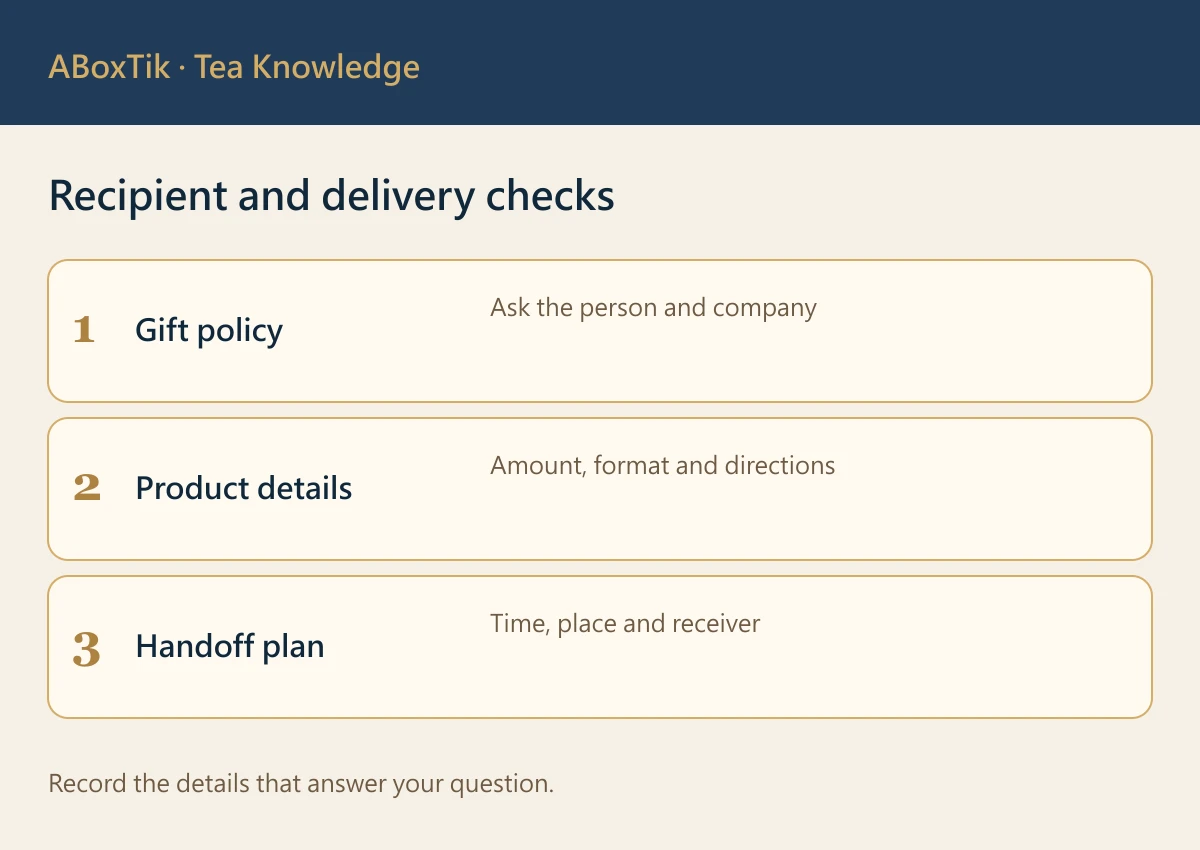
- Permission: Is the recipient allowed to accept this kind of gift? Is there a value, timing, or registration rule?
- Recipient: Is it for one person, a team, or a hosted meeting? Who can receive it?
- Purpose and message: What is the occasion? What short, factual note should accompany it?
- Tea fit: Is tea welcome? Are there stated preferences, ingredient concerns, or a preference for individually packed portions?
- Product facts: Which current item is available? Confirm its name, contents, ingredients where applicable, package size, origin information as stated, and preparation guidance.
- Language and presentation: Can the product information and accompanying note be understood by the recipient? Is the message accurate and easy to read?
- Delivery: Confirm address, contact, desired arrival window, carrier constraints, and who is responsible for import and receiving steps.
- Record: Keep the approved product page or quotation, recipient approval, final message, and dispatch details together.
The card is deliberately unglamorous. It prevents a common error: deciding that packaging is “considerate” before knowing whether the recipient can accept food, has someone to share it with, or even works at the address printed on last year’s business card.
Choose tea by a stated preference, not a personality type
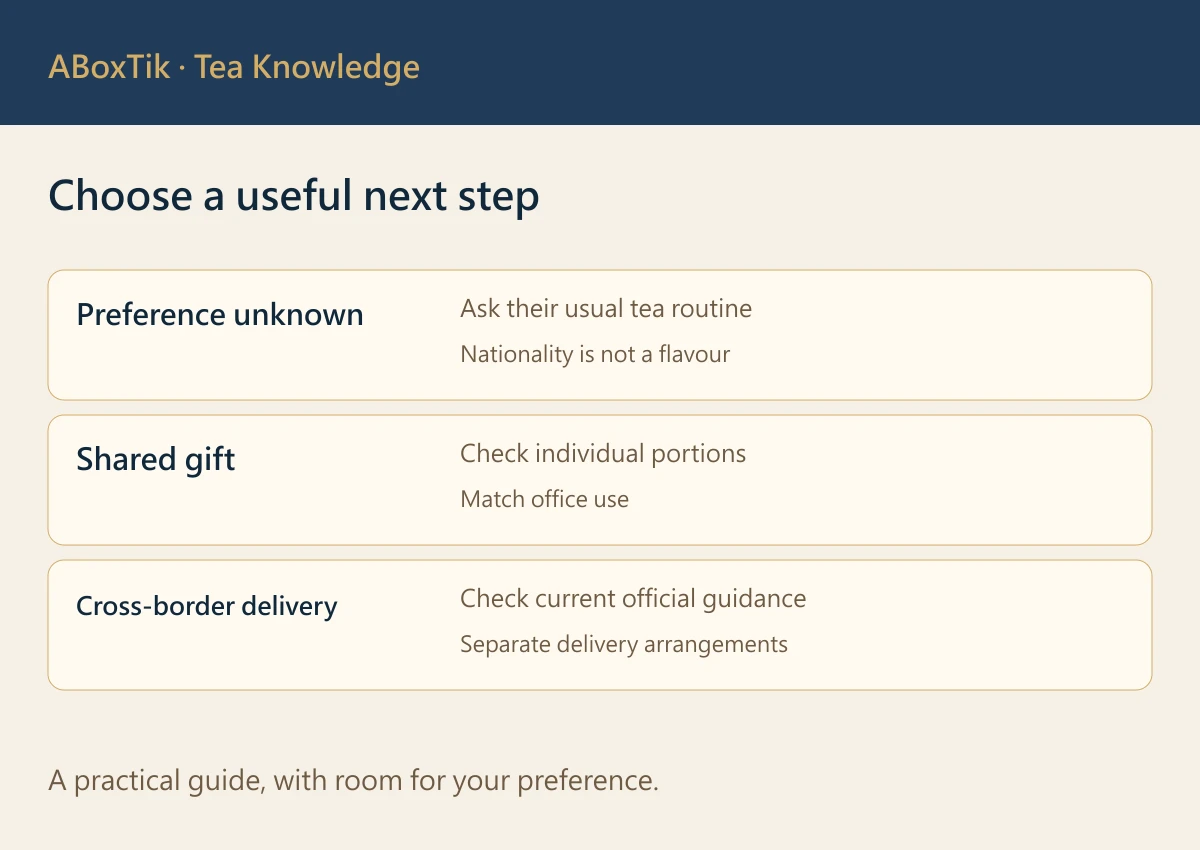
When a contact welcomes tea, ask one uncomplicated flavour question: “Would a fresher floral direction, a warmer roasted direction, or a more familiar black-tea style be most useful?” If they cannot answer, ask whether they would prefer a small assortment or a single plainly described tea. Do not promise that a description will taste identical to every recipient; aroma and flavour are sensory experiences shaped by preparation.
| What you know | A sensible next step | A claim to avoid |
|---|---|---|
| “They enjoy light, fresh teas.” | Ask the retailer for a currently available tea described in that direction, with preparation information. | “All people in this market prefer floral tea.” |
| “The team shares refreshments.” | Confirm a format and quantity that are practical for the actual group. | “A larger box is automatically more respectful.” |
| “No preference is known.” | Ask permission, use clear product information, or send a modest option only after policy confirmation. | “Premium price solves uncertainty.” |
| “They asked about Taiwan tea.” | Describe the verified product facts and invite them to follow the package guidance. | “This tea represents every Taiwan tea style.” |
A retailer can help with a current product description. A useful request says: “We are sending a permitted business thank-you gift for a small group. Could you show us tea options currently available, the exact contents and package size, the flavour direction used on the product page, and the preparation guidance?” It is specific, respectful, and does not ask the retailer to invent a cultural theory between lunch and the packing bench.
Make the message short, accurate, and easy to receive
The note carries the relationship; it does not need to carry a tourism brochure. State the occasion, thank the recipient, name the gift accurately, and give a simple invitation to enjoy it. Avoid unverified claims about rarity, wellness, awards, or how the recipient will feel. If the language is not being professionally checked, keep it especially plain.
For example: “Thank you for your collaboration on [project]. We would be pleased to send this Taiwan tea as a small token of appreciation, if permitted by your company policy. The package includes [verified product name and format]. We hope it offers a pleasant moment to share.” Replace the bracketed text only with verified current information. A warm sentence is more durable than an elaborate one that gets one product name wrong.
Packaging matters because it helps the recipient identify, store, and share the gift. It is not evidence of cultural insight by itself. Check that the outer label, contents, preparation guidance, and sender details are clear. If an individual item is being represented as a company gift, obtain the appropriate internal approval before it is sent.
Cross-border delivery: hand the legal check to the responsible party
Food and plant-related entry rules can depend on the item, its ingredients, its intended use, the route, and current official guidance. It would be careless to turn a general article into a clearance promise. Japan’s Ministry of Agriculture, Forestry and Fisheries Plant Protection Station publishes traveller information, and Japan’s Ministry of Health, Labour and Welfare explains food-import procedures, including notification for food intended for sale or business use. Read the official pages for the real shipment and contact the appropriate carrier, importer, or authority when details are unclear.
Before dispatch, make a practical handoff sheet: exact product name; ingredient and package information supplied by the maker; quantity; sender and recipient contact; purpose; carrier reference; and the person responsible for confirming cross-border steps. This is not legal advice. It is a way to ensure that the person who needs to make a decision has the actual product facts in front of them.
A final two-minute review
- Relationship: We have permission, a named recipient, and a fitting occasion.
- Policy: We checked the recipient organisation’s gift requirements instead of assuming.
- Product: We used current, verified item information; we did not invent availability or a sensory promise.
- Message: It is short, accurate, and understandable.
- Delivery: Address, contact, timing, responsibility, and current official checks are assigned.
A good business tea gift does not need to perform a country on a ribbon. It needs to be welcome, clear, appropriately modest, and easy for the recipient to enjoy. Once the conditions are right, tea can do its quieter work: making a sincere thank-you feel considered rather than automated.
Official references
- Japan MAFF Plant Protection Station: traveller information
- Japan MHLW: Import Procedure under Food Sanitation Act
Sources checked 25 October 2026.

Related reading and tea choices
Sources
See the linked primary sources in the article.