
Tea Knowledge
How Tea Makers Decide What Comes Next: Observation and Questions
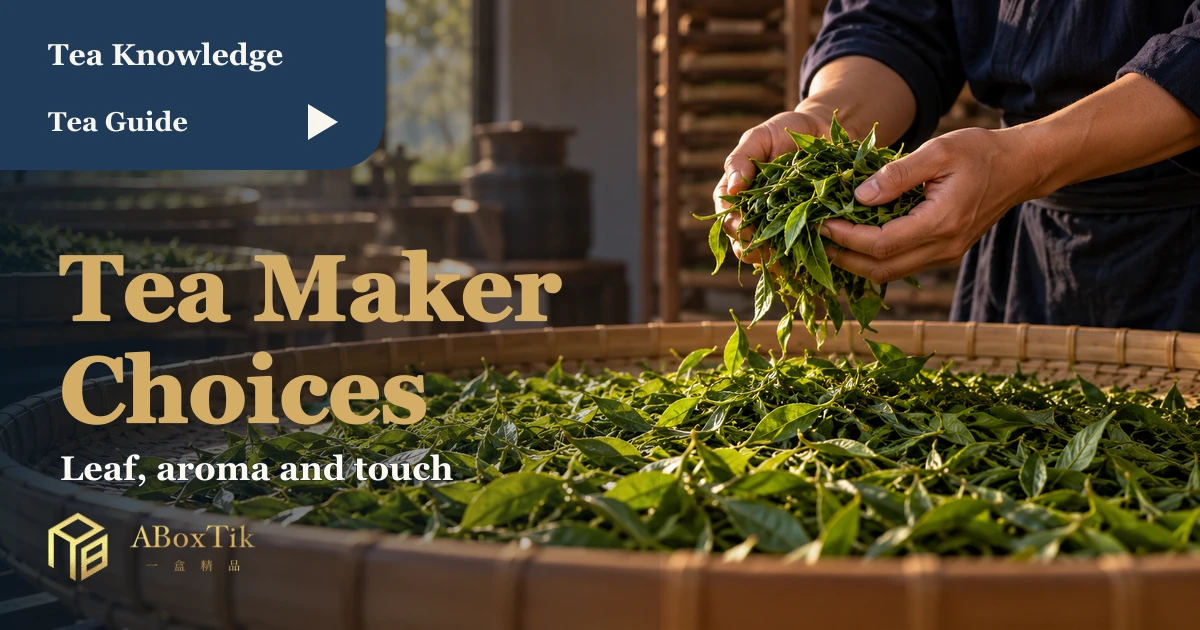
The next step begins with careful observation.
A tea maker's next decision usually involves more than a clock. The condition and aroma of the current batch, the environment, equipment and intended tea style all contribute to the choice. In a simplified partially oxidised tea process, leaves undergo withering and agitation, followed by heat treatment that controls earlier enzyme activity; rolling and drying come later. Batches and working conditions differ, so one aroma word or fixed number of minutes cannot make the decision for every tea.
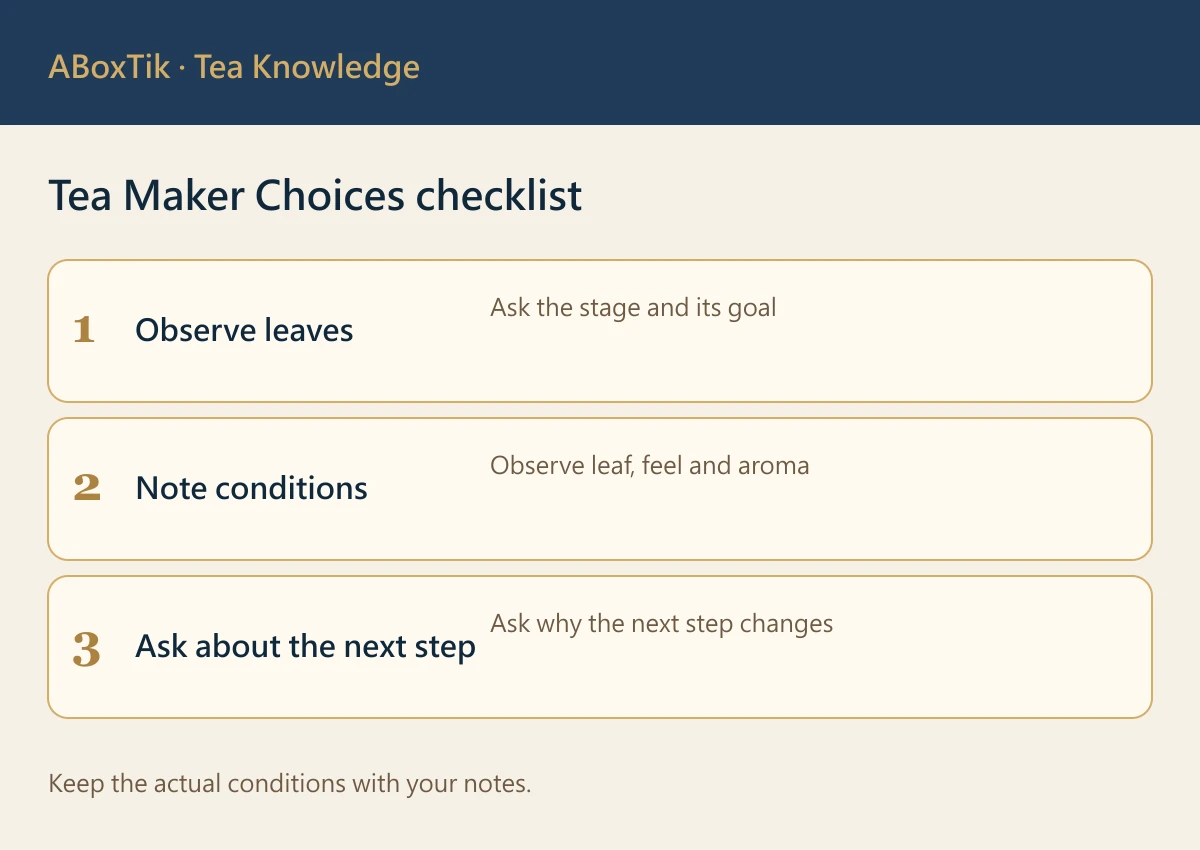
On entering a tea-making setting, you might first hear machinery or notice the scent of leaves. A useful starting point is to ask three things: what is being observed now, what the next step is intended to accomplish, and what other conditions matter? There is no need to read the maker's mind. A clear question gives their experience room to become visible.
Put the stages in context first
Taiwan's Tea and Beverage Research Station describes different processing routes for different tea categories. A simplified route for a common partially oxidised tea includes sun or warm-air withering, indoor withering and agitation, then heat treatment, rolling and drying. The actual sequence depends on tea style and equipment. Green and black teas have different arrangements; a particular oolong process is not a universal recipe for every tea.
Each stage addresses a different task. Withering involves moisture loss and changes in the leaves. Agitation and subsequent development are arranged around the intended style. Heat treatment inhibits earlier enzyme activity and softens leaves, while rolling and drying continue the work of shaping and preparing the finished tea. Ask which stage you are seeing before asking what the operator observes. That is more useful than memorising a list of machines without their jobs.
Looking: record changes in the same batch
An observer can note appearance, how leaves are spread and the time, from a position permitted by the staff. If the maker describes a change in softness, colour or edges, record their words and the processing stage. Do not turn one visual feature into a universal pass mark. Maturity, harvesting conditions and the intended style can vary; a photograph captures one moment and cannot tell the whole story of a batch.
Before comparing observations, check that they concern the same batch, a comparable sampling position and similar viewing conditions. If leaves were removed during the period, note that in the record. The station's withering-monitoring introduction considers environmental conditions alongside the process. This helps explain why a maker reads the leaf and its setting together rather than pressing a “next step” button when a particular colour appears.
Smelling: describe a change without guessing its cause
An aroma can be a starting point for a question. Instead of recording only “fragrant”, note when and where the observation occurred, what words were used and whether the impression differed from an earlier stage. If companions perceive different things, keep separate notes. People describe smells differently; there is no need to vote for one correct adjective.
Several raw-material, processing and environmental factors may contribute to an aroma change. A single smell cannot reveal an exact oxidation level, equipment setting or final quality. Ask instead, “What changes do you look for at this stage, and what leaf or environmental information do you consider alongside them?” That gives the maker space to explain instead of turning a single word into a remote control.
Touch: follow the staff's demonstration
Leaf texture and softness may also be observed, but visitors should not reach into tea being processed. Ask whether observation is permitted in a designated area, whether there is a demonstration sample, and which hygiene and safety instructions apply. If staff invite participation, follow their directions. Keep the required distance from running machinery and hot processing areas.
When someone describes a leaf as softer, ask what it is being compared with: freshly picked leaves or the preceding stage? You can also ask how the operator avoids relying on one sensation alone. Do not invent a touch threshold that anyone could apply to every tea. A note sheet makes questions clearer; the decision remains with the people who know the batch and equipment.
A practical observation and interview sheet
Keep five fields. First, note the date, tea style and any batch information the maker permits you to record. Second, identify the current stage and its intended task. Third, describe leaf appearance and the aroma terms supplied by the staff, together with the permitted observation method. Fourth, record available weather, ventilation, equipment and measurements, including where a reading was taken. Fifth, write the next action and the maker's explanation, if shared, and ask what might cause them to reassess it.
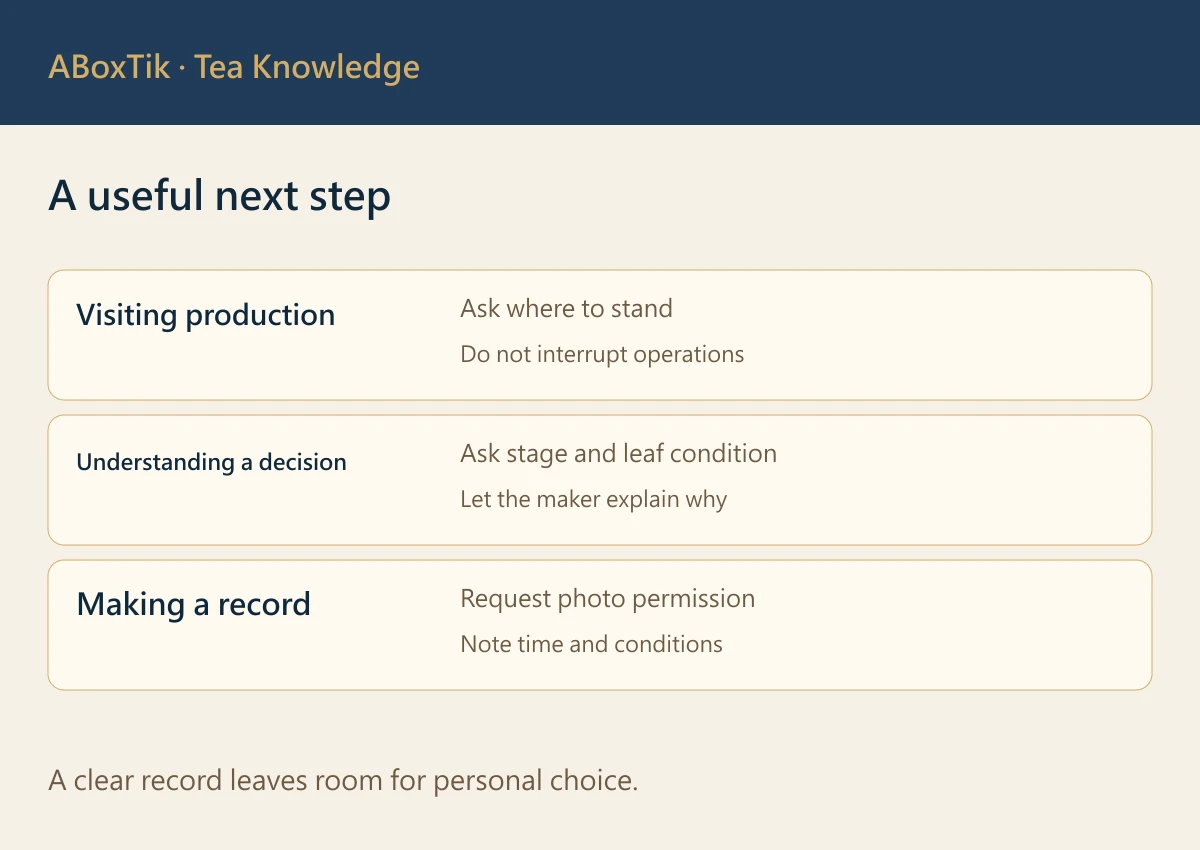
The sheet can have empty fields. A tour may not disclose batch or equipment information, and visitors may not be taken close to an active work area. Respect the arrangements rather than trying to fill every box. Ask permission before photographing, recording or quoting a conversation and agree on what may be made public.
Read the weather, leaves and equipment together
The research station explains that sun withering uses solar heat to accelerate moisture loss, while indoor withering continues the loss of water. Temperature, humidity and ventilation can affect the process; warm-air equipment may also be used. When someone gives a measurement, ask whether it concerns room air, a position in a machine or the leaves, and when it was measured. These readings are not automatically interchangeable.
“How long did it take today?” is easy to write down. The same duration under different weather, spreading and raw-material conditions does not necessarily describe the same leaf state. A more useful follow-up is, “What other information helps you decide whether to wait or proceed?” If the answer includes experience, record the batch and situation to which it applies rather than rewriting it as a universal instruction.
Heat treatment and later work: ask about purpose as well as numbers
Heat treatment inhibits enzyme activity from the earlier stage and is accompanied by some moisture loss and leaf softening. Its task differs from later drying and any roasting. Equipment settings, actual heating and the amount and state of leaves belong in the same discussion. When a video shows a temperature or time, ask where it was measured and what equipment was used; do not transfer the number directly to another factory.
Rolling relates to leaf shape and changes in tissue, and some styles have further shaping steps. To ask how a maker adjusts the process, identify the tea style and stage first, then ask about the goal and observations for that batch. The answer may combine experience and records. It need not be compressed into a promise that anyone can judge tea in three seconds.
Bring useful questions back to the tea table
When drinking the finished tea, begin with its package directions and record observations of dry leaves, liquor and infused leaves separately. When comparing two teas, note their names, available origin or cultivar information, vessels, water and time. Many conditions differ between teas; the aroma in one cup cannot by itself prove that a particular processing step was done well or badly.
If you plan a visit, ask ahead about reservations, open areas and the site's photography and hygiene rules. Bring two questions you actually want to understand, such as “What is this step trying to accomplish?” and “Which conditions could change the next decision?” Notes are more useful than a fixed answer: they make room for a conversation about details the maker considers important.
Leave one question for the next cup
Understanding a tea maker means putting observation, aroma, environment and process on the same working table. You do not need to assign a single cause to every aroma today. Write down what you saw and what you still want to ask. Explore the withering, heat-treatment and rolling guides, then choose a tea using its current product information. Each cup can begin a better question; it does not need to turn the drinker into a remote factory judge.
| Field | Observe or ask |
|---|---|
| Batch and tea style | Record available information and intended style |
| Stage | Ask what this stage aims to achieve |
| Leaves and aroma | Separate your observation from the operator’s explanation |
| Conditions | Ask where and when a value was measured |
| Next decision | Ask which other clues matter for this batch |

Related reading and tea choices
Sources
- Tea and Beverage Research Station: tea processing
- Tea and Beverage Research Station: withering monitoring
Sources checked: 29 October 2026.