
Tea, Tea Knowledge
How to Smell Tea: A Practical Guide to Dry Leaf, Hot Aroma and Cooling Notes
Aroma does not stay at the rim of the cup. It opens with temperature, giving a leaf’s mountain air, season and craft a language we can remember.
If you are learning how to smell tea, follow the aroma through several moments: the dry leaf, the leaf warmed in an empty vessel, the hot lid and infused leaf, the liquor as you sip, and the cup after it has cooled. The goal is not to guess a rare flower. It is to observe aroma family, clarity, persistence and cleanliness under repeatable brewing conditions.
A tea that seems quiet when the package is opened may release white-floral, ripe-fruit or toasted notes when heated. Minutes later, the empty cup may retain only a gentle sugar-like sweetness. This guide is about that sequence. For the chemistry behind aroma and taste, begin with what creates tea aroma and flavor; for sweetness, bitterness, umami and astringency, see where the tastes of tea come from.
How to smell tea: dry leaf, hot aroma and cooling notes
Professional sensory evaluation is controlled work, not a casual sniff. Taiwan’s Tea and Beverage Research Station describes a standardized setting, vessels, tea-to-water ratio and timing, followed by assessment of dry appearance, liquor color, aroma, taste and infused leaf in its introduction to tea sensory evaluation. Our dry, hot and cooling sequence is an ABoxTik editorial method for home tasting. It does not replace competition judging or professional certification.
| Stage | What to smell | What to note first |
|---|---|---|
| Dry aroma | Unbrewed leaf, first at room temperature and then in a warm vessel | Freshness, floral or fruit direction, toast, vegetation and off-odors |
| Hot aroma | The lid, wet leaves and space above the liquor immediately after decanting | Intensity, dominant family, clarity and balance |
| Warm or cooling aroma | The lid, liquor or empty cup as it moves from warm to cool | Whether aroma persists, turns sweeter, becomes deeper or disappears |
| Retronasal aroma | Aroma perceived after sipping as it travels from the mouth toward the nose | Agreement between the first smell, the sip and the finish |
Aroma and taste meet to form flavor. The US National Institute on Deafness and Other Communication Disorders explains in its overview of taste that flavor integrates taste, smell, temperature and oral sensations. It also notes that aromas released while eating or drinking can reach the nose through a channel behind the throat. Smelling above the cup therefore reveals only one part of the tea.
Do not rush to name the fragrance. Follow it through temperature first; the second approach to the cup often says more than the first.
Before tasting, remove interference and control five variables
Perfume, hand cream, incense, coffee, cooking fumes and strongly scented detergent can overwhelm fine tea aromas. Ventilate the room and use clean, odor-free porcelain or glass. If you have just eaten spicy food, sweets or mint, give your palate and nose a short rest. Readers setting up their first tea table can review the basic tea-making steps and tools or browse the ABoxTik shop for tea and suitable vessels.
- Use the same amount of leaf. A strong cup and a weak cup cannot offer a fair aroma comparison.
- Keep water volume and temperature consistent. Heat changes both extraction and the release of volatile aroma.
- Time each infusion. A thirty-second difference can matter, especially in side-by-side tasting.
- Match the vessels. Cup shape and material change how aroma gathers and how quickly the liquor cools.
- Use one water source. Do not change mineral profiles halfway through a tasting session.
A home exercise does not need to copy the official evaluation method of three grams in a 150-milliliter cup for five to six minutes. It does need a written ratio and time. Begin with the producer’s instructions; if you need a foundation, use our four-step tea brewing guide. A useful tasting note is not the most poetic one. It is the one you can recreate next week.
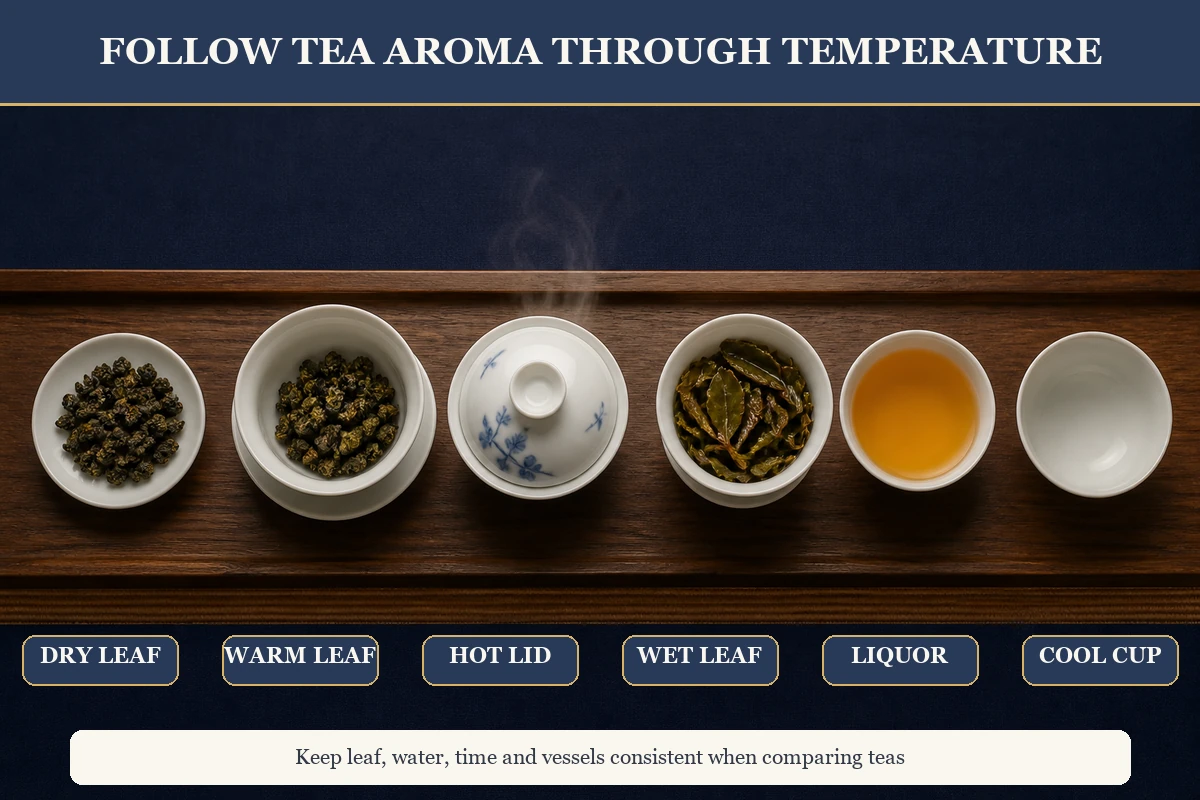
Follow aroma from dry leaf to the cooling cup, keeping every brewing variable consistent for comparison.
A complete seven-step tea aroma tasting sequence
- Smell the empty equipment. Check the pot, gaiwan, lid and cups for cupboard odors or traces of detergent before adding tea.
- Observe the dry leaf at room temperature. Take two or three short sniffs. Start with broad impressions—fresh, sweet, floral, roasted, green or musty—rather than forcing a specific flower name.
- Warm the vessel and smell again. Empty the warming water, keep the rim dry and add the leaf. Gentle heat often makes a quiet dry leaf easier to read.
- Smell the hot aroma immediately after decanting. Check the lid first and the infused leaf second. Keep a safe distance from steam. Short, separated sniffs are more useful than one long, forceful inhalation.
- Smell the liquor, then sip. Notice the space above the tea before drinking. Take a small sip and, after swallowing, exhale gently through the nose. Observe how aroma connects with sweetness, umami, bitterness and astringency.
- Return for warm and cooling notes. Revisit the lid, wet leaf and empty cup after several minutes. Record whether the aroma remains clear, becomes sugar-like, settles into toast or fades quickly.
- Compare the second infusion. Rolled oolong leaves may open more fully after the first steep. Write which aroma family increased, decreased or appeared later instead of simply noting “more fragrant.”
If the dry leaf smells of damp cardboard, stale oil, mildew or an overpowering added fragrance, and the odor remains after brewing, pause before drinking. Tea readily absorbs its surroundings, so consult our tea storage guide and examine the condition of the leaf. When mold or spoilage is suspected, do not taste it merely to complete the exercise.
Cannot name the flower? Use two layers of aroma notes
It is completely normal to recognize an aroma without finding the word. Taiwan’s specialty tea flavor wheels were developed by researchers through descriptive analysis of representative samples and shared vocabulary. Use the inner categories before moving outward to specific associations. A flavor wheel is a map for communication, not an answer sheet and not a quality score.
Layer one is the aroma family: floral, fruity, sweet, roasted, woody, green, spicy or an off-odor. Layer two describes performance: clear or vague, focused or scattered, brief or persistent, clean or muddled. “Light floral aroma, clear, present for about a minute” is more useful than five uncertain flower names.
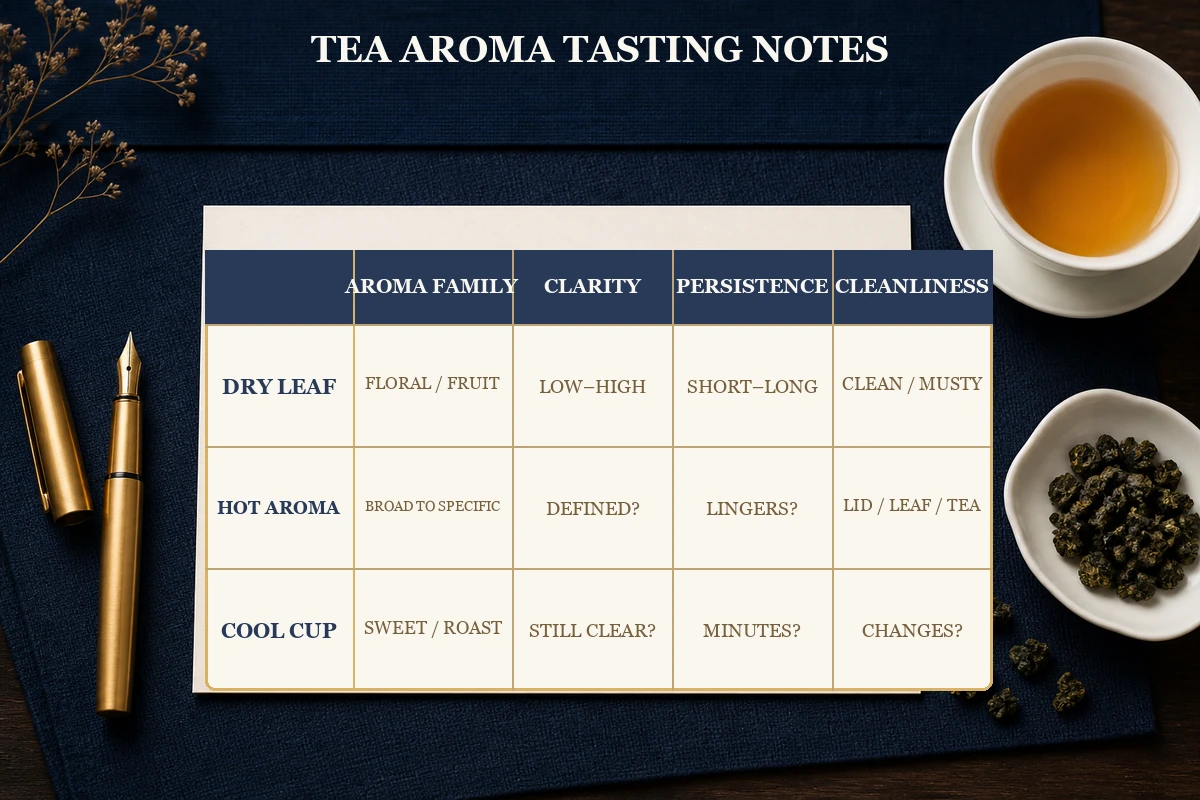
Record the aroma family first, then clarity, persistence and cleanliness instead of forcing a precise flower name.
| Round | Aroma family | Clarity | Persistence | Cleanliness and change |
|---|---|---|---|---|
| Dry leaf | Floral, fruit, sweet, roast or green | Low, medium or high | Short, medium or long | Clean or musty; change after warming |
| First infusion, hot | Broad family, then a specific association | Defined or indistinct | Does it remain after moving away? | Agreement among lid, leaf and liquor |
| Cooling empty cup | Sweet, fruit, roast or fading | Still recognizable? | Present after several minutes? | Sweeter, deeper, gone or developing an off-note |
Does a stronger aroma mean better tea?
Not by itself. A high, immediate fragrance is one style of expression. Also ask whether the aroma is clean and natural, whether it agrees with the liquor, whether it persists through infusions and whether the wet leaf develops any uncomfortable stale or muddled character. Cultivar, origin, season, oxidation, roasting, storage and brewing all affect the result. Our guide to oolong oxidation and leaf manipulation explains why floral, ripe-fruit and roasted directions cannot be reduced to one “fermentation percentage.”
Aroma alone cannot verify origin or price, either. Build the broader context through the qualities that distinguish Taiwanese tea and our guide to Taiwan’s tea regions. When comparing Alishan tea, consider labeling, season and producer alongside geography in our Alishan region comparison; no single fragrance can speak for an entire mountain.
Fine tea does not always speak loudly in the first second. Some aroma rests on the lid, some waits in the finish; what matters is whether the cup remains whole as it cools.
Practice with three Taiwanese teas—one question at a time
You do not need a cabinet full of tea. Choose two or three teas with different processing and clear product information, then brew them side by side with the same vessels and parameters:
- Selected Wenshan Pouchong: observe how a bright white-floral direction moves from hot aroma into the warm stage.
- Green Jade Oolong: record floral freshness and sweetness, as well as the difference before and after rolled leaves open.
- Jinxuan Oolong: compare toasted sugarcane sweetness with floral notes instead of assuming every Jinxuan must smell milky.
For a broader side-by-side map, assemble several profiles in the Classic Taiwanese Tea four-box gift set. Keep the questions simple: Which dry leaf is clearest? Which tea changes most between hot and warm? Which empty cup retains sweetness after cooling? These questions train the senses more effectively than “Which one is most premium?” and they reveal what you genuinely enjoy.
Frequently asked questions about smelling tea
Should I inhale very strongly to smell tea?
No. Keep a comfortable distance and use short, separated sniffs, resting between attempts. Move a little closer if a fragrance is faint, but do not press your nose over hot steam or inhale continuously.
If I cannot smell flowers, is the tea poor quality?
Not necessarily. A tea may emphasize roast, ripe fruit, wood or sweetness rather than flowers. Brewing parameters, vessels, surroundings and individual sensitivity also change what is perceived. Begin with broad families and intensity instead of forcing a flower name.
Is a cooling aroma the same as cold-brew tea?
No. “Cooling aroma” here means the fragrance left in hot-brewed tea, its lid or the empty cup as it drops from warm to cool. Cold brewing is a separate extraction method using lower temperature and a much longer infusion.
Can aroma alone determine tea quality?
No. Professional evaluation considers appearance, liquor color, aroma, taste and infused leaf. At home, also review origin information, storage condition, balance in the mouth and the finish. For small-production or unusual teas, continue with our guide to understanding rare tea.

Follow ABoxTik into the world of tea
Turn tea aroma into a memory you can revisit
Learning how to smell tea is not about memorizing a correct answer. It is about turning each approach to the cup into evidence you can compare next time. Remove interference; follow the dry leaf, warm vessel, hot lid, infused leaf, liquor and cooling cup; name the family first, then clarity, persistence and cleanliness. After a few sessions, “fragrant or not” gives way to a more precise memory of how one Taiwanese tea opens through time.
ABoxTik believes a true boutique deserves to be understood as well as seen. One cup at a time, we translate Taiwan’s mountains, cultivars and tea-making care into a language of flavor that can travel. Every quiet moment of attention at the cup helps Taiwanese tea become more clearly remembered around the world.
Sources
- Tea and Beverage Research Station: Introduction to Tea Sensory Evaluation (checked 2026-08-25)
- Tea and Beverage Research Station: Introduction to Taiwan Specialty Tea Flavor Wheels (checked 2026-08-25)
- US NIDCD: Taste Disorders (checked 2026-08-25)