
ABoxTik Tea, Boutiques, Tea Knowledge
Is Tea a Good Birthday Gift? Choose by Age and Tea Habits
A birthday marks one day. A box of tea can return to that moment through many ordinary afternoons, each time the leaves meet water and the room fills with fragrance.
A birthday tea gift is a thoughtful and practical choice when it fits the way the recipient actually drinks. Before choosing by age or price, find out whether they use a mug or teapot, prefer floral or roasted flavors, drink tea at work or at night, and need to limit caffeine. Those details tell you whether to give tea bags, loose leaf tea, or a mixed gift set far better than a birthday number does.
Tea lasts beyond the celebration and can be shared, yet taste and brewing habits are personal. Our guide to why tea makes a meaningful gift explains the broader symbolism, while the premium tea gift box checklist covers general selection. Here, the question is narrower: what will make a birthday tea gift easy to open, brew, and enjoy in the recipient’s real life?
Is tea an appropriate birthday gift?
Yes. Tea is shareable, useful, relatively easy to store, and not limited to one gender or a single kind of relationship. A clearly labeled Taiwanese tea also carries a story of place, cultivar, craft, and hospitality. It is especially suitable for someone who already drinks tea, hosts friends, enjoys food gifts, or keeps a hot drink beside them while working.
The risk is not giving tea; it is giving the wrong format. Someone who avoids caffeine should not receive a large set of traditional tea. A mug-only drinker may never use loose leaves that require a complete brewing setup. An experienced tea drinker may prefer one distinctive origin over a broad flavored assortment. If Taiwanese tea is new to them, begin with the qualities that make Taiwanese tea distinctive.
How to choose a birthday tea gift: ask these five questions first
| Ask about | Look for | Safer direction |
|---|---|---|
| Usual drink | Tea, coffee, cold drinks, or herbal infusions | Extend a familiar strength or aroma instead of choosing an extreme |
| Brewing setup | Mug, travel bottle, teapot, or gaiwan | Choose individual bags when there is no teaware; loose leaf when a routine already exists |
| Time of day | Morning, desk, after meals, or evening | Match convenience, strength, and caffeine awareness to the moment |
| Curiosity | Regularly explores or stays loyal to one tea | A sampler for the curious; one familiar direction for the habitual drinker |
| Sharing | Solo, couple, office, or family | Match the size and format to the people who will actually drink it |
These questions move the decision from “the prettiest box” to “the box most likely to be used.” For a mug drinker, our comparison of pyramid and regular tea bags explains why shape alone is not enough. For someone who prefers a cold bottle in summer, add the cold-brew tea method to the birthday card.
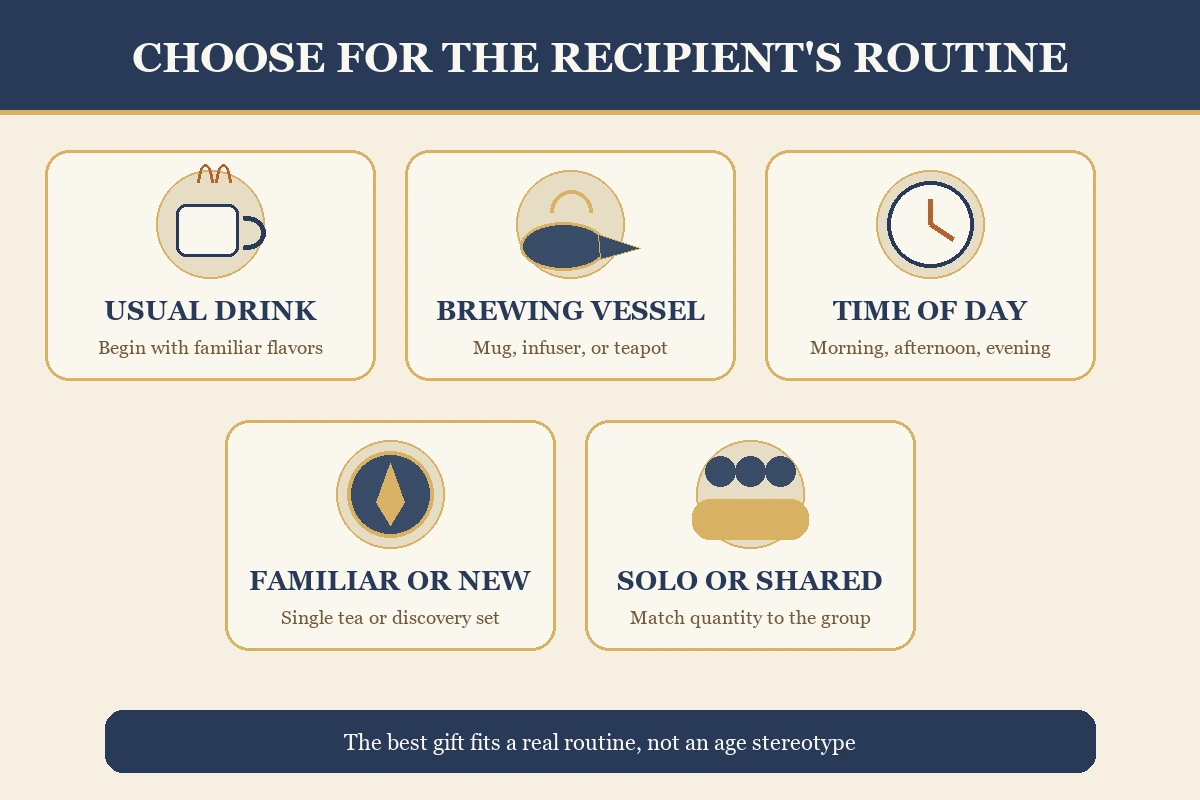
A considerate gift does not assign someone a new ritual. It notices the ritual already there and gives it a little more fragrance.
Choosing by age can help, but do not turn life stages into stereotypes
Age may suggest a living situation or schedule, but it does not determine flavor. Research published by Taiwan’s Tea and Beverage Research Station found that convenience, time, and brewing knowledge can be barriers for younger consumers. The useful lesson is to make the gift easy to begin—not to assume that younger people cannot appreciate tea. Treat these age bands as prompts, then let observed habits decide.
Ages 20–29: make the first cup effortless
People starting work, living in smaller spaces, or moving between home and office may not want several pieces of teaware. Individually wrapped tea bags, teas that work hot or cold, and two to four clearly different flavors offer exploration without equipment. When preferences are unknown, a two-box Taiwanese tea gift is easier to approach than a large amount of one unfamiliar tea.
Ages 30–45: fit busy work and shared home routines
A practical set should brew in a few steps, provide clear portions, and work for both a quiet desk and a family visit. Pairing one lighter tea with one roasted or honeyed tea gives useful contrast. For more variety, a customizable four-box Taiwanese tea assortment can cover several moments without asking the recipient to master a new brewing system.
Ages 46–60: upgrade a known preference
If the recipient already drinks oolong, black tea, or high-mountain tea, look for clearer origin, cultivar, processing, and flavor information within that familiar family. Do not use rarity or price as a substitute for fit. A teapot user may welcome loose leaf; an office drinker may still prefer whole-leaf tea bags. The six ABoxTik Taiwanese tea profiles provide a useful flavor map.
Ages 61 and above: clarity and ease matter more than strength
Do not assume an older recipient wants the darkest or strongest tea. Ask when they drink, what they brew with, and which flavors they already enjoy. Favor readable labels, simple brewing instructions, and transparent ingredients. If caffeine disrupts their sleep or comfort, do not make a health decision on their behalf; consider a clearly labeled herbal infusion and review the difference between caffeine-free and low-caffeine drinks.
Match the gift to the tea habit, not just the birthday
| Recipient | Gift direction | Why it works |
|---|---|---|
| Rarely drinks tea | Small two-flavor tea-bag set | Low commitment and easy brewing |
| Uses a mug every day | Whole-leaf pyramid tea bags | Keeps convenience while giving larger leaves usable room |
| Owns a teapot and brews carefully | Single-origin or craft loose leaf | Lets them explore aroma, texture, and repeat infusions |
| Likes coffee and fuller flavors | Roasted oolong or red oolong | Roast, ripe-fruit, and caramel notes provide a familiar bridge |
| Drinks at night or watches caffeine | Herbal infusion with verified ingredients | “Low caffeine” should never be confused with “caffeine-free” |
Taiwan’s FDA notes that excessive caffeine may contribute to palpitations or insomnia, so a giver should respect the recipient’s own response and usual drinking time. Traditional tea can contain caffeine, and the amount in a cup changes with leaf quantity, temperature, and steeping time. If caffeine matters, read the ingredients and product information rather than guessing from color or roast. Our guide to tea flavor and caffeine adds useful context.
Three flavor directions when you do not know their favorite tea
- Light and floral: Yingxiang, Cuiyu, or winter Sijichun suits someone who orders unsweetened tea and enjoys a clean aroma. Yingxiang Oolong offers an orchid-led starting point.
- Roasted and naturally sweet: Dong Ding, roasted Jinxuan, or honey red oolong suits someone drawn to toast, ripe fruit, caramel, or a fuller cup. Compare the classic roasted direction of Dong Ding Oolong.
- Still uncertain: choose two to four contrasting teas rather than letting price make the decision. Add a small card suggesting a tasting order from lighter to more roasted.
A customizable four-box ABoxTik Taiwanese tea set can bring several profiles into one gift. If adding herbal infusions, check each ingredient list and avoid treating words such as “wellness” or “relaxation” as a medical promise.
Tea bags, loose leaves, or teaware?
Tea bags fit offices, travel, small homes, and beginners. Loose leaves suit someone who already owns teaware and enjoys adjusting leaf quantity and time. Teaware is best when you know exactly which vessel is missing. Material, capacity, and hand feel are personal; if you only know that someone likes tea, consumable tea is usually the more dependable gift.
Size should reflect the relationship and sharing plan. A two-box set works for a friend, colleague, or first tea gift. Four boxes suit close family, a milestone birthday, or a group table. A higher-value origin tea makes sense only when the recipient cares about terroir and craft. For the collector, the design principles behind a limited-edition tea gift box offer another direction.
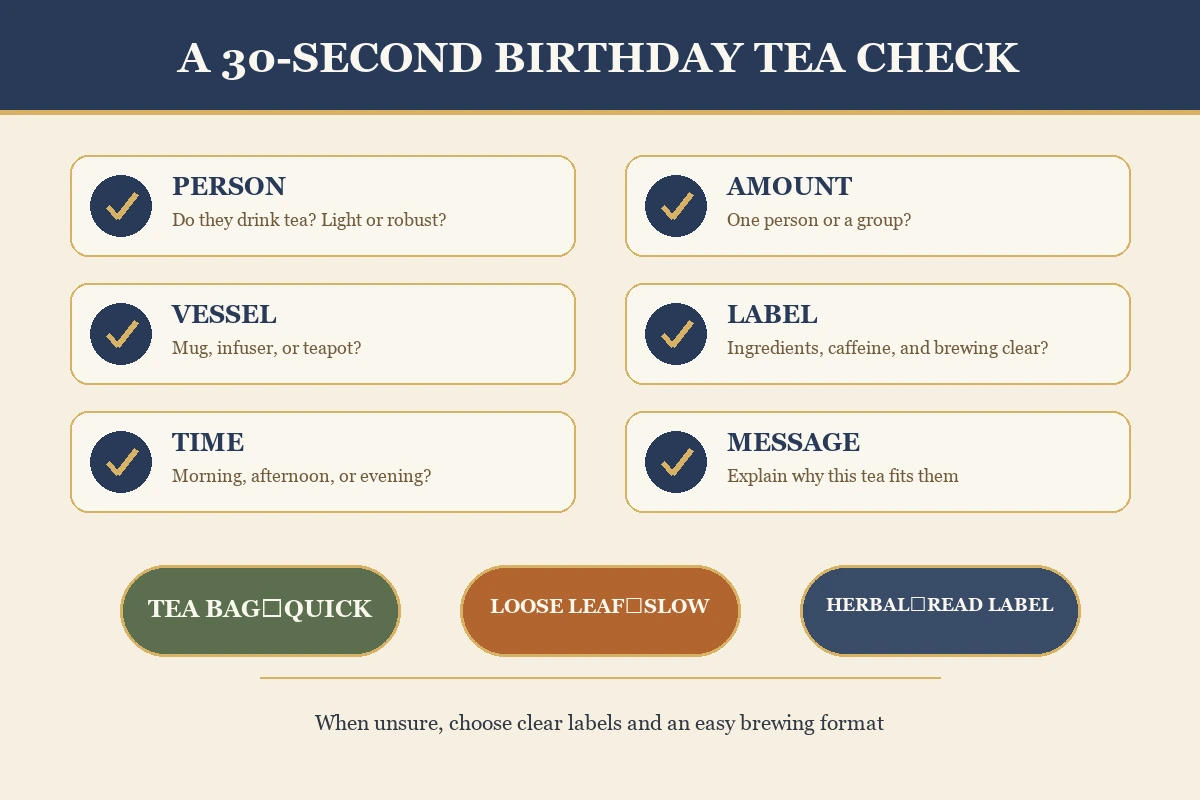
A 30-second birthday tea gift checklist
- Person: Do they drink tea? Floral, roasted, fruity, or herbal?
- Vessel: Only a mug, or a teapot, gaiwan, and fairness pitcher?
- Time: Morning, desk, after meals, or evening?
- Amount: Solo drinking, two people, or a family table?
- Label: Are origin, ingredients, storage, date, and brewing instructions clear?
- Message: Does the card explain why you chose this tea?
Tea should be kept sealed and away from heat, moisture, light, and strong odors. Add our tea storage guide to the card so the gift is cared for from the first opening to the last cup.
Birthday tea gift questions
Does tea feel too formal for a birthday?
Not necessarily. Two teas and a handwritten note can feel relaxed; a four-box set or distinctive loose leaf can mark a milestone. The relationship, presentation, and amount set the level of formality.
Can I give tea if I do not know their favorite?
Yes. Choose a small assortment with meaningful contrast rather than a large amount of one tea. Their usual coffee, unsweetened drink, cold drink, or evening beverage can suggest a direction, but treat it as a clue rather than certainty.
Should a gift for an older tea drinker be expensive high-mountain tea?
No. A costly floral tea may miss someone who prefers roasted flavors, and rare loose leaf may be inconvenient for a mug drinker. Familiarity, clear sourcing, and an easy brewing format often show more care than price.
How early should I order a birthday tea gift?
Allow at least five to eight business days to confirm products, a card, and local delivery. Custom quantities, offshore islands, or international delivery need more time. Always check current production and shipping information before ordering.

Follow ABoxTik|A birthday is one day; a thoughtful cup may return all year.
Choose a birthday tea gift they will genuinely open
The best birthday tea gift does not assign one tea to every age. It notices how the recipient lives: a rushed morning needs ease; a quiet weekend can welcome a slower pot. A curious drinker needs contrast, while someone with a settled preference deserves a tea that respects it. ABoxTik brings Taiwanese origin, cultivars, craft, and considered packaging into the same gift, so the box communicates both quality and attention.
Browse the ABoxTik Taiwanese tea gift collection, then use the five questions above to narrow the choice. To understand why the brand was created and how it presents Taiwanese craft to the world, visit About ABoxTik.
Sources
- Taiwan Tea and Beverage Research Station: Survey of Young People’s Tea-Drinking Habits and Promotion Applications (reviewed 2026-08-29)
- Taiwan Tea and Beverage Research Station: Next-Generation Rapid-Extraction Tea Processing (reviewed 2026-08-29)
- Taiwan Food and Drug Administration: Reading Labels and Understanding Caffeine in Packaged Drinks (reviewed 2026-08-29)