
Tea Bag, Tea Knowledge
Do Tea Bags Release Microplastics? How to Check Materials and Labels
A simple cup can still leave room for a clear question: what has this tea touched, and what can I actually check?
Do tea bags release microplastics? Some studies have measured micro- and nanoscale particles released from particular plastic or plastic-containing tea bags under particular hot-water brewing conditions. That finding does not yet tell us the human-health risk of one cup of tea. Rather than let one dramatic number decide for every tea bag, separate what a study measured from what it cannot establish, then use material, heat-use and care labels to make a practical choice.
This is not another guide to pyramid versus flat-bag extraction; our pyramid tea bag guide covers space and brewing. Nor does “whole leaf” identify a filter material—see our whole leaf tea bag guide. Here, the focus is evidence limits, label reading and the next calm step.
Keep release, exposure and health risk separate
A 2019 study steeped a specific plastic tea bag at 95°C and reported approximately 11.6 billion microplastic and 3.1 billion nanoplastic particles per cup. In 2025, however, Germany’s Federal Institute for Risk Assessment (BfR) explained that drying the extract before examination could cause dissolved substances to precipitate and be counted as particles. Later work that chemically identified individual particles found counts above 1 micrometre roughly two to three orders of magnitude lower. The “billions” figure is therefore best read as a lesson in how strongly method can shape a result—not as a universal count for every tea bag.
A Taiwan FDA survey immersed 12 bag samples—seven tea bags, three coffee filter bags and two herb or spice bags—in 200 mL of 95°C ultrapure water for 10 minutes. All 12 had detected microplastics; across this combined sample set, the average was 120.4 particles per 200 mL, with detected sizes from 12 micrometres to 5 mm. This is not a tea-bag-only average and should not be compared directly with the 2019 estimate because the sample mix, detectable size range, preparation, identification and counting methods differed. The survey did not establish a relationship between filter material and particle count or size; that does not prove materials make no difference.
If a brewed cup contains measured particles, drinking it is a possible oral-exposure route; a particle count is not a personal absorbed dose or a lifetime total. Health risk is a further question. WHO’s 2019 review concerned drinking water, not tea bags; using limited evidence, it assessed the indicated risk at the time as low while identifying major method and health-data gaps. EFSA has not yet completed its full food risk assessment, so no conclusion can be drawn on potential human-health effects. BfR considers a health risk unlikely based on current knowledge, while also saying the effects on the intestinal barrier and human body cannot yet be fully assessed. Together, these positions support uncertainty—not proof of either safety or harm.
Food-contact compliance is not a “zero particles” promise
In Taiwan, products within the announced scope whose food-contact surface contains plastic must carry information such as material name, heat resistance, intended use and precautions, generally on the smallest retail package or the item itself; multiple materials should be identified separately. Requirements differ by market. Compliance does not prove that research has found zero particles in every brewing condition, and a product page may not disclose every part of a filter. When the answer is not available, ask the seller. The reverse is also true: seeing the word “plastic” is not enough to declare a particular product dangerous.
Four checks that replace guessing
- Read the material name, not the look or feel. A silky, clear or pyramid-shaped bag does not reliably identify its material.
- Read heat-use and brewing directions before choosing water temperature. “For tea” is not a substitute for an actual temperature or use instruction.
- Ask about material and conditions, not for an absolute promise. A useful question is: what food-contact material is the filter, where is the label, and what water temperature and steeping time are advised?
- Choose a routine you can keep. If reducing this uncertainty matters to you, choose clearly labelled products or brew loose tea with a reusable stainless-steel, glass or ceramic infuser, following that item’s food-contact and cleaning instructions.
What a useful label lets you compare
A useful label gives more than a reassuring word. It identifies the material or directs you to the place where it is stated, gives a heat-use limit or preparation instruction, and makes clear whether the item is intended for one use or repeated use. If a product has more than one food-contact component, a single broad phrase may leave the actual filter unanswered. Keeping a short note of the material, brewing guidance and date you checked it is enough to compare products without turning a tea cupboard into a science project.
When a brand uses a sustainability term, it is reasonable to ask what the term covers: the tea leaf, the outer carton, the filter itself, or a disposal route. “Compostable” and “plastic-free” are not interchangeable statements, and neither one substitutes for a food-contact material or heat-use instruction. This is not a demand for perfection; it is a way to make a label answer the question it is being asked.
How to change course without wasting good tea
If an existing box has incomplete material information, there is no need to treat the remaining tea as an emergency. You can contact the maker, save the reply with the package, and decide what feels proportionate for your next purchase. If you prefer loose tea, use the same tea leaves with a clean reusable infuser and adjust dose, water temperature and time gradually. A small comparison—one cup prepared to the package directions, then one adjusted only for steeping time—also keeps flavour decisions separate from material questions.
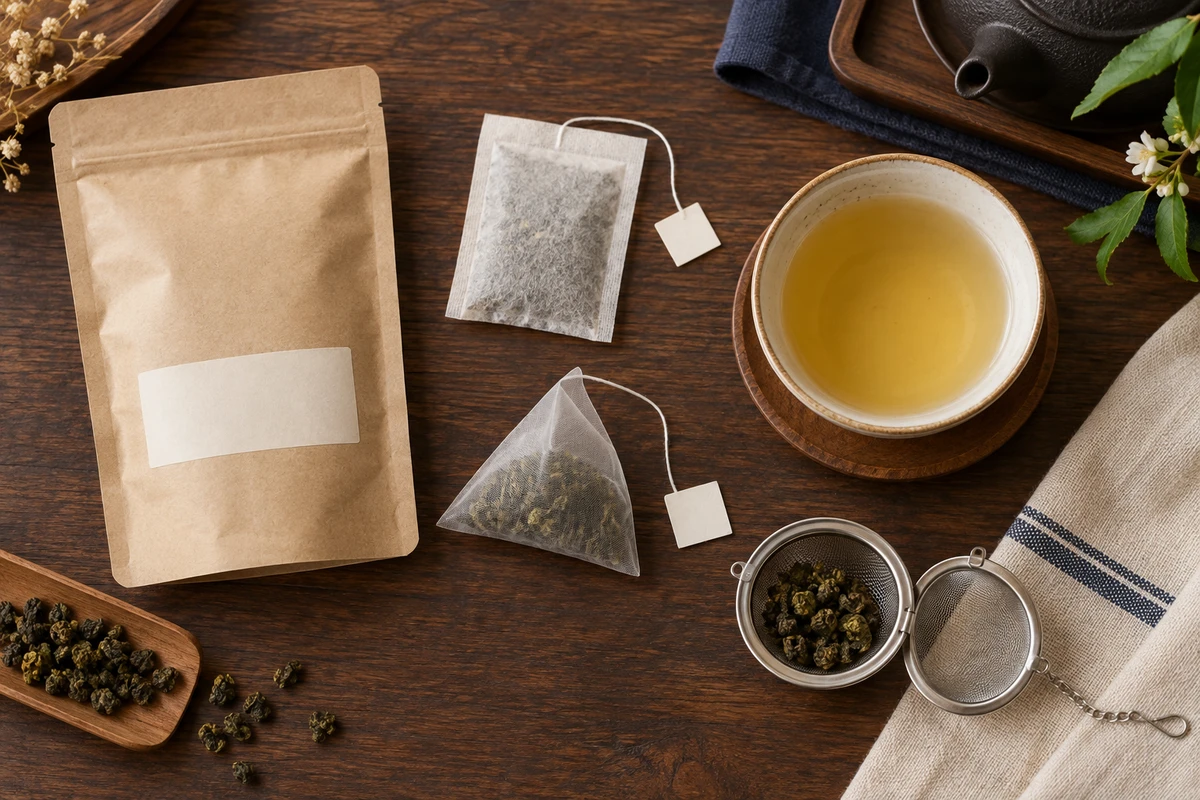
Make the controllable parts of brewing steady
For a first cup, keep the cup volume fixed and follow the package time and temperature. If the tea is too strong or astringent, shorten steeping before changing everything else. When information is unclear, keep the package, photograph the label and ask the brand before buying again. Pausing for a clear answer is a perfectly reasonable choice.
Questions readers often ask
Are paper tea bags automatically plastic-free?
No material conclusion should be drawn from the word “paper” or from appearance alone. A bag may be composite, and seams or coatings can differ. Use verifiable current material and use information; do not add a plastic-free claim where it is not documented.
Should I stop drinking tea bags because of the headline number?
The number deserves context, but it cannot by itself answer an individual health question. Based on current knowledge, BfR considers a health risk from microplastics in food unlikely, while also noting that the effects on the intestinal barrier and human body cannot yet be fully assessed. You may reduce uncertainty by prioritising transparent labels, following use conditions or choosing loose tea. For personal medical concerns, speak with a qualified health professional rather than using this article as diagnosis.
What material is in ABoxTik tea bags?
This article makes no material, heat-resistance or plastic-free claim for any ABoxTik item. Check the current tea-bag category, the product page, package or customer service before purchase; the mixed tea-bag gift set should likewise be checked for current content and information.
Make room for clarity before the next cup
Choose clarity, not a slogan
A tea bag can be a welcome pause in a busy day. If material matters to you, read the label, ask about the use conditions or choose another brewing route that feels more comfortable. Explore ABoxTik’s tea bag selection for tea styles, while treating the current product page and package as the final source for product details.
Sources
- Hernandez et al. (2019), Environmental Science & Technology (accessed 2026-09-29)
- Canga et al. (2024), Chemosphere (accessed 2026-09-29)
- German BfR (2025): assessment of the tea-bag microplastics study (accessed 2026-09-30)
- Taiwan FDA: 2020 survey of microplastics released from food-contact products (accessed 2026-09-30)
- WHO: Microplastics in drinking-water (accessed 2026-09-29)
- EFSA: Microplastics and nanoplastics in food (accessed 2026-09-29)
- European Commission: food-contact-material legislation (accessed 2026-09-29)