
Tea Knowledge
Mountain Rhyme Tea: Observable Clues in High-Mountain Tea
A mountain impression is easier to explore when it becomes a few clear observations. Let the cup offer a clue before the vocabulary arrives.
“Mountain rhyme” describes an overall impression of high-mountain tea, often discussed through aroma, texture and the sensations that remain after swallowing. It is not a single measurable flavour, and tasting it cannot prove a tea’s precise origin. A useful first step is to note what happens before, during and after a sip, alongside the brewing conditions.
If the phrase makes tea sound like a secret society, leave the password at the door. One familiar aroma word and one description of mouthfeel are enough to begin. This guide turns an elusive expression into a personal observation card, so a later infusion has something clear to compare.
What does mountain rhyme mean in a cup?
People may use the expression for a combination of floral aroma, a fine or rounded texture, lingering sweetness or a clear finish. Different drinkers may be noticing different parts of the experience. Ask where the impression appears: above the cup, as the tea moves in the mouth, or after swallowing. Naming the moment makes the description more useful than simply declaring that a tea has plenty of mountain character.
Taiwan’s official tea flavour-wheel material provides shared vocabulary for describing impressions, progressing from broad families towards more specific comparisons. It helps organise what someone notices; it does not require an imagined aroma to complete the picture. The tea aroma guide offers a practical companion, while tea categories help keep the basic terms in view.
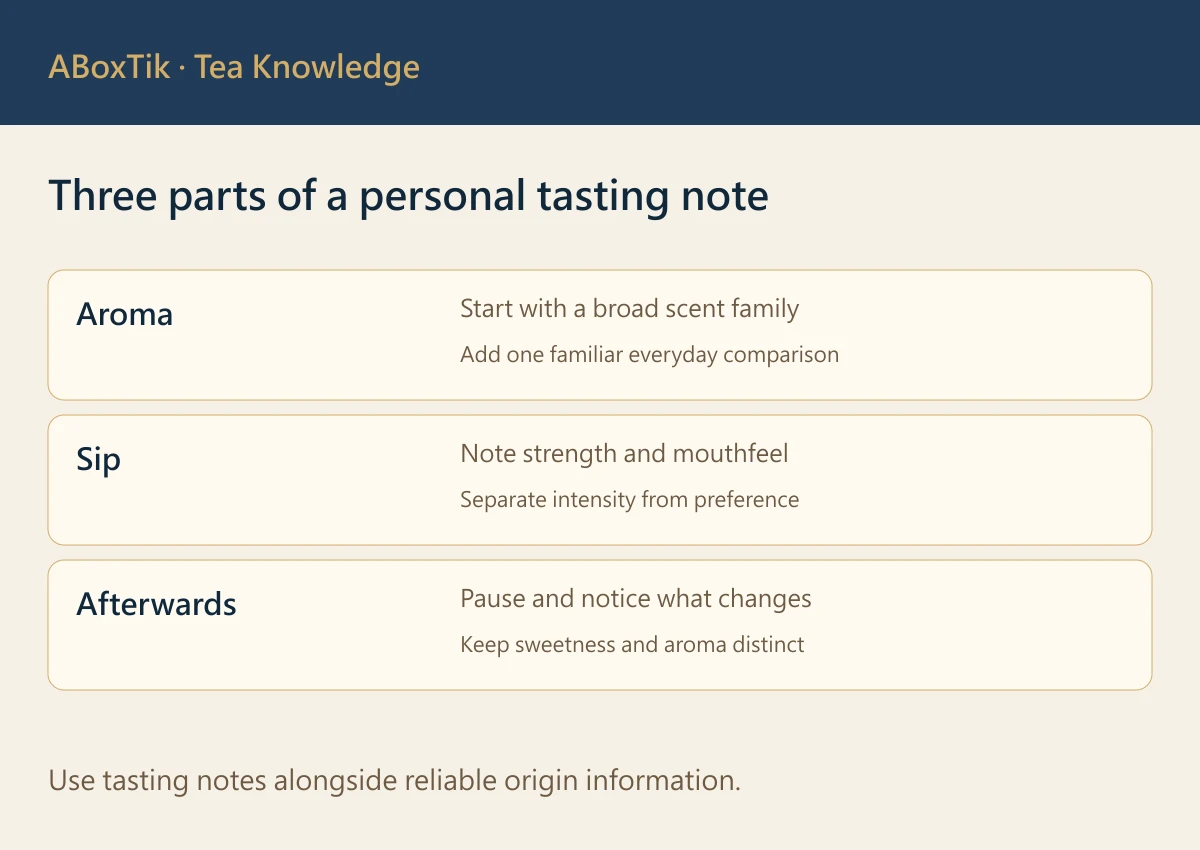
Start broadly: floral, fruity, sweet-smelling or roasted. Add a familiar comparison only if it comes naturally. A note such as “soft floral aroma as the tea cools” tells a friend more than a long list copied from a wheel. Uncertainty belongs on a good tasting card too.
Check the tea information before the tasting
Growing region, cultivar, harvest season, processing, roast and storage can all contribute to the cup. Record the available details rather than allowing a striking aroma to fill in missing origin information. The Taiwanese tea overview explains the wider relationship between place and craft; this article concentrates on observing the brewed tea.
The high-mountain tea quality checklist addresses buying information and quality questions. Use it alongside sensory notes, with each doing its own job. An enjoyable finish is a preference; a batch record is information about the product. Neither needs to impersonate the other.
Choose comparable vessels, the same water and measured amounts. Follow the tea’s instructions, then write down the actual temperature and time. If a cup is overwhelmingly strong, shorten the next infusion before deciding it lacks subtlety. Sometimes the tea has simply been handed a microphone at full volume.
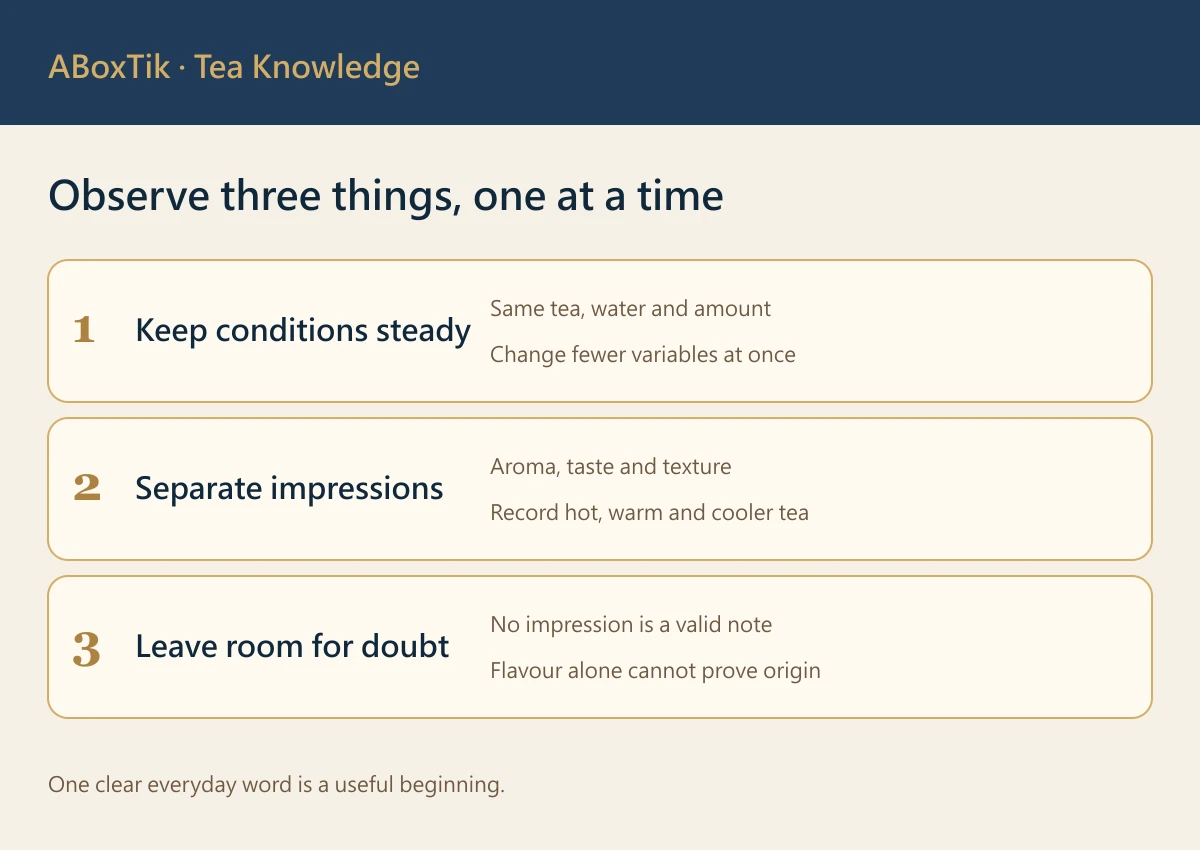
Observe before, during and after a sip
Before drinking, notice the aroma above the cup. During a small sip, consider strength, texture and any drying sensation. After swallowing, pause and see what remains. Treat these as separate fields rather than asking one dramatic word to describe the whole sequence. Taste at a comfortable temperature and let the cup cool naturally.
Keep the first note short: perhaps “floral before the sip, rounded in the middle, clear afterwards”. These are examples of a note’s structure, not a promised profile for every high-mountain tea. On the next infusion, check which impressions return and which change. A difference is worth recording even when there is no obvious explanation.
For company, let everyone write a first impression before comparing notes. The aim is to notice the range of attention around the table, not to vote out the person who missed a flower. Jinxuan and Green Jade provide further reading on cultivar-linked descriptions, while the actual tea still deserves its own observation.
Use two rounds to make a comparison clearer
In the first round, record a measured water volume, leaf amount, vessel and steeping time. Use the package guidance as the starting point. In the second, change just one condition, such as infusion time. Alternatively, observe the same cup as it cools; identify that as a temperature comparison rather than a separate brewing experiment.
If comparing two teas, use a consistent method and avoid naming one the answer in advance. Alternate the tasting order on a later round. Visible tea names, expectations and differences in temperature can influence a home comparison, so use the exercise to understand personal preference rather than announce an origin test.
| Keep steady | Round one | One next change |
|---|---|---|
| Tea, water and vessel | Aroma before a sip | Adjust infusion time |
| Measured leaf and water | Texture during the sip | Or compare as it cools |
| Notes about the batch | Sensation afterwards | Check what repeats |
The basic brewing guide helps keep the operation simple. A two-tea bag set may offer a convenient format for sharing, while a multi-tea gift box can provide a selection. Check the actual contents rather than assuming all teas in a collection share the same roast or cultivar.
Keep sweetness, salivation and lingering aroma distinct
A sweet impression, moisture in the mouth and an aroma returning after swallowing are different observations, even if they overlap during one sip. Write them separately when possible. It is perfectly acceptable to leave one field empty; a tasting sheet is a memory aid rather than a checklist of sensations that must occur.
A drying sensation also deserves its own note. Consider whether it changes with strength, time or temperature before attaching a grand conclusion to the tea. The aroma observation guide can add context when it is publicly available; for an immediately useful exercise, simply pause between sips and record the sequence in ordinary language.
If a note only appears after someone else suggests it, keep that detail too. Next time, write the first impression before reading a product description. This modest change can make a shared conversation more interesting without pretending that the home tea table has become a laboratory.
Why flavour alone cannot verify origin
An attractive mountain impression does not establish a precise growing location. When origin matters to a purchase, check the supplier’s stated region, batch details and supporting product information. Leave an unanswered field open rather than filling it with a romantic story. Sensory descriptions help people communicate; documentation answers a different question.
Nor does a high price or a more elevated place name tell every drinker what to enjoy. Some people prefer brighter floral notes, others a deeper roast or a fuller texture. The light and roasted tea guide separates useful style choices, and oolong processing gives background without turning one style into a quality ranking.
For the next tasting, take one practical question: which impression would you like to notice more clearly? It could be the aroma as the cup cools or the finish after a shorter steep. That question gives attention somewhere useful to go, instead of asking the tea to deliver a mysterious performance.

Follow ABoxTik: make room for a clear observation and a comfortable cup.
Let an impression become a clue
The next high-mountain tasting can be simple: note the tea, keep the brewing conditions clear and describe one moment before adding a more specific word. A useful observation does not have to sound impressive.
Choose a tea selection for sharing that fits the occasion and check its actual contents. ABoxTik invites a patient conversation with the cup, with enough space for a friend to notice something different.
Related reading
Sources
Sources checked 18 October 2026.