
Tea Knowledge
Why the Lugu Dong Ding Tea Region Matters: Place and Roasting Craft
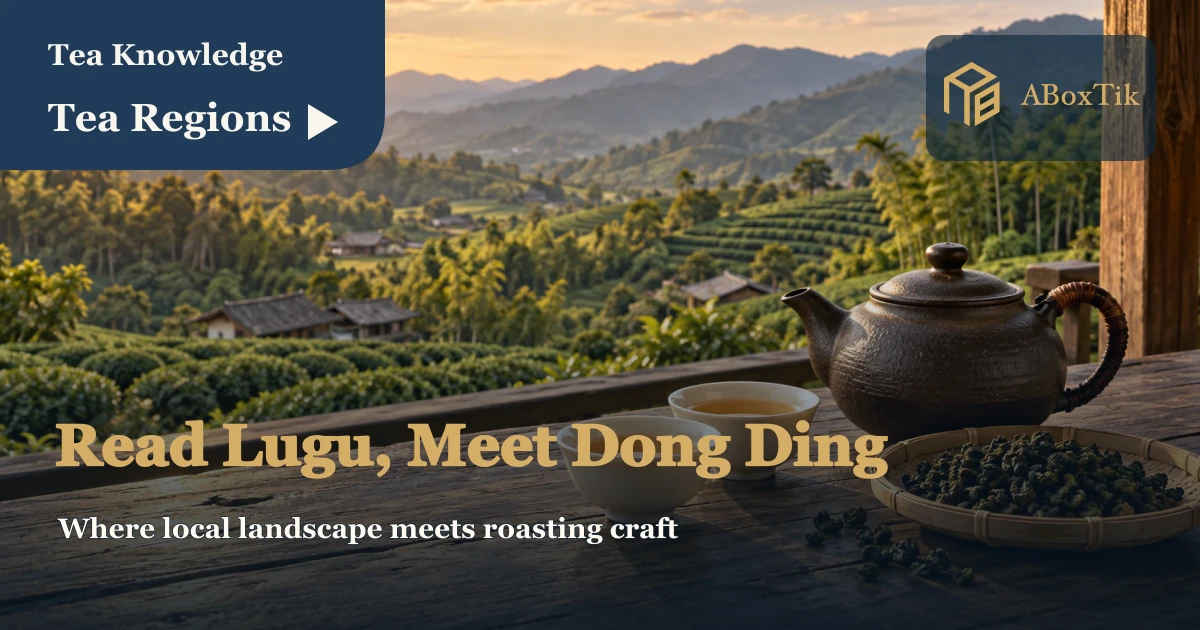
A tea region carries more than a mountain name. It carries people who have learned to work with weather, leaves and heat.
The Lugu Dong Ding tea region matters because local growing conditions, tea-making experience and roasting culture meet here in an important chapter of Taiwan oolong. Start by separating place, cultivar and processing style. A map becomes easier to use when it is not asked to answer every question about flavour.
Perhaps a Dong Ding tea first caught your attention through its warm aroma, or simply through the wish to refill the cup. This article explores the relationship between place and craft, alongside the broader Dong Ding oolong introduction. Keep the actual product’s details for brewing and buying decisions. The teapot has no attendance register for mountain names.
Place the Lugu Dong Ding tea region on the map
Lugu is in Nantou County. Dong Ding is a place name important to the area’s tea culture, rather than a separate tea cultivar. Anthropological work discussing the traditional region refers to Zhangya on Dong Ding Mountain and nearby Fenghuang and Yonglong communities. When reading an area name, notice whether the author means a growing location, a community or a tea style sold in the market.
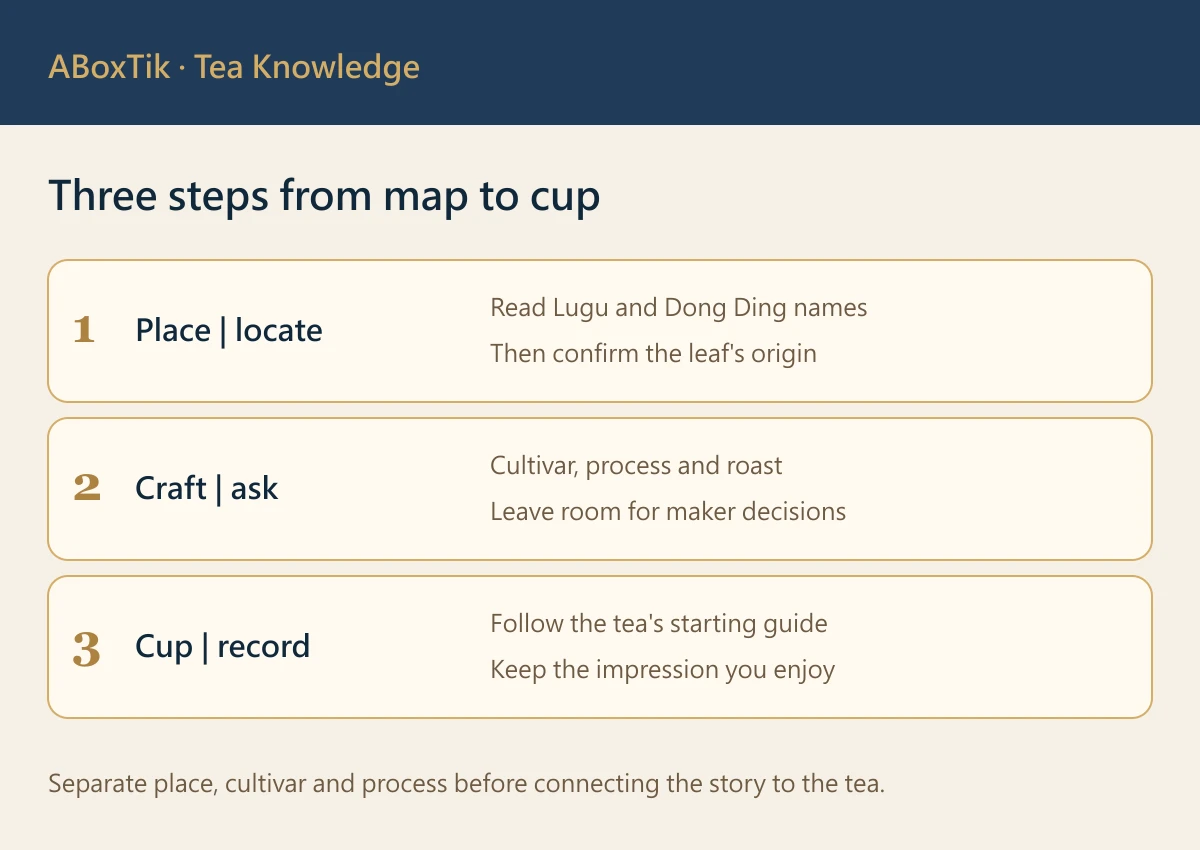
For a packet labelled Dong Ding, ask next about the leaf’s actual origin, cultivar and processing. These details may share a package, but none needs to stand in for the others. Taiwan tea regions provides the wider map, and reading high-mountain tea quality helps place elevation among several useful details.
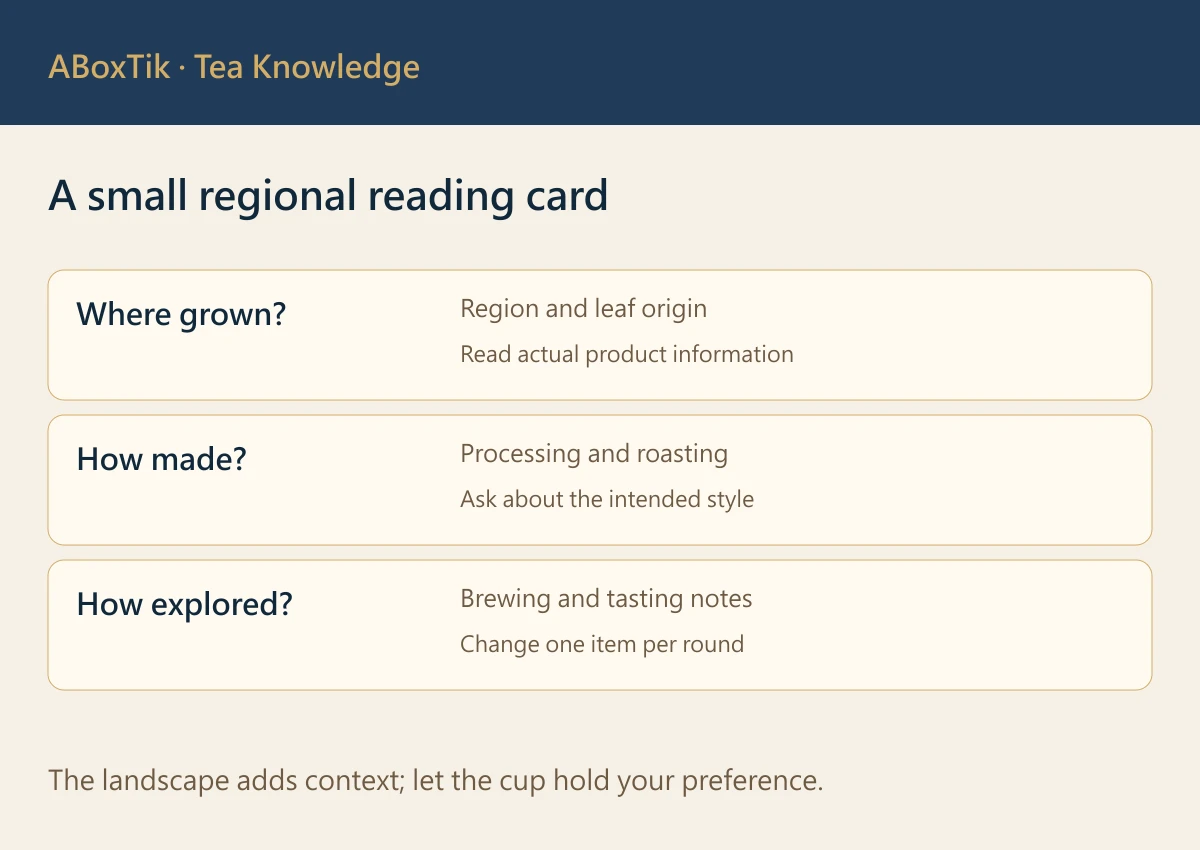
Try a three-field card: where it grew, which cultivar it uses and how it was made. Fill what is known and turn the remaining fields into questions. This gives a clearer route to the tea than arranging mountain names into a league table.
Read the environment alongside the maker’s decisions
Lugu Township’s speciality introduction describes a hilly, rainy and misty growing environment and places tea-making and roasting skill alongside it. Terroir is useful as a description of conditions faced by the plant and maker. A place name alone cannot supply a complete tasting sheet for every garden and season.
To understand a particular aroma, follow the material and process: cultivar, harvest information, leaf handling and later roasting. Taiwan tea, place and craft connects these elements, while the tea-roasting process explains the later handling of finished leaf.
Leave room for ordinary work in the picture. Gardens need attention, leaves need handling and weather does not arrive on schedule merely because the brochure has a lovely photograph. Understanding craft means making space for those practical decisions as well as the view.
Follow local memory and industry development on separate lines
Local introductions often tell a story of Lin Fengchi bringing tea plants to the area. The exact start of tea production at Dong Ding—and of planting small-leaf tea cultivars for oolong production—remains unsettled in the available historical record, so this should be read as a local origin account rather than a fixed chronology. A fuller understanding also follows cultivation, exchanges of technique, household production and market change. Keeping the origin story and the development process on separate lines preserves local memory while allowing the industry to have more than one beginning.
Shuenn-Der Yu’s fieldwork on Dong Ding tea-making examines the interaction of household producers, practical skill and modern equipment. It offers a useful perspective: tradition is more than an image of everything once being done by hand. Tools can change while people continue to learn how to read leaves and choose the right moment to act.
For another side of the story, read Taiwan competition-tea context and tea evaluation. These add questions about assessment and buying information. They are parts of the picture rather than a single award standing in for the history of a whole region.
Roasting connects the material with an intended style
The township’s Dong Ding introduction discusses Qingxin oolong, oxidation and roasting together. Read earlier leaf processing and later roasting as connected stages. Both participate in the finished tea, so a dark dry leaf should not be used to identify one universal manufacturing routine.
When a description mentions roasted or mature aroma, treat it as a direction for exploration. Ask for this batch’s roast information, storage advice and brewing guidance. Observing roasted aroma helps with sensory language, while light and roasted Taiwan tea helps organise preferences without asking the nose to inspect an entire hillside.
A helpful craft question is: what did the maker wish to preserve, and what did the later treatment aim to adjust? That often opens more discussion than roasting duration alone. Time matters, but equipment, leaf condition and observation also belong to the work.
Bring the place back to a manageable tasting note
Choose a tea with clear information and start with its supplied directions. Record name, origin, cultivar, leaf, water, temperature, time and vessel. Put aroma and texture in another field, so an imagined Dong Ding character does not fill the page before the cup has even been tasted.
A smelling order makes a useful small reference, and oolong water-temperature guidance provides background for adjustment. Change one item in the next round and keep the others stable. If the vessel changes, record that too rather than letting it quietly disappear from the comparison.
Two questions are enough afterwards: what would I keep, and what would I try next? Write your own impression before reading someone else’s tasting language. A gongfu routine or an ordinary mug can both support attentive drinking. The region is a map that accompanies the cup, not homework due before the kettle boils.
Share the region through useful product information
Before buying, check origin, cultivar, process, pack size and storage guidance. If an award is part of the offer, look for organiser, year, class and the product’s connection to the result. For a gift, combine a short regional story with directions the recipient will actually use.
Tea storage helps look after the next cup once the packet is opened. To compare several everyday Taiwan teas, review the current Classic Taiwanese Tea four-box set and two-box tea-bag gift set. Choose from the actual tea names and formats, then connect each to its own place and processing information.
Conversation can stay simple: which part of this aroma would you like to meet again, and what sort of afternoon would suit it? A friend need not recite a regional chronology. Leave the story in the conversation and the preference in the cup; both become easier to enjoy.

Follow ABoxTik | Read the place with care and leave a warm moment for the cup.
Let the Lugu Dong Ding tea region become part of an everyday cup
Read Lugu through geography, craft and local life; read a particular tea through its material, method and infusion. Taiwan tea regions is a welcoming next step for placing it in the wider landscape.
For a convenient everyday selection, start with the current contents of the tea-bag gift set. Choose a tea worth brewing again, and give its regional story another quiet moment with the next refill.
Related reading
- Dong Ding oolong: add the basic tea context.
- Tea roasting: read the later processing stages.
- Taiwan tea regions: place Lugu on the wider map.
Sources
- Lugu Township Office: Dong Ding Oolong Tea
- Shuenn-Der Yu (2013): Craftsmanship, Technology and Modernity of Taiwan Dongding Oolong Tea Production
Sources checked 15 October 2026.