
Tea Knowledge
Tea Garden Biodiversity: How to Read What a Garden Shows
A tea garden is more than rows of tea bushes. Slow down long enough to look, and the ground cover, shade and small visitors begin to describe how a place is cared for.
Tea garden biodiversity concerns the living things, habitats and management around the tea bushes. Begin with insects and other arthropods, ground cover, shade and soil records, then ask when and how the observations were made. These details turn an attractive green scene into a place that can be understood.
Those indicators help us look beyond the tea bushes. When choosing tea, start with verifiable origin, batch and certification information. When drinking it, keep terroir and making alongside the story rather than letting the story drink the tea for you.
Read biodiversity as field observation, not an adjective
Biodiversity concerns different living things and the places in which they live. A butterfly near a tea bush is a welcome sight; it is not, by itself, a score for an entire garden. The Ministry’s indicator framework separates wildlife, insects and arthropods, weed cover and soil microbes. That separation is useful because each question needs its own record, method and time frame.
For tea drinkers, it suggests a calmer order of questions. What origin and management information is available for this batch? Is there a traceable label or certification? If an environmental statement is made, does it describe one practice, one survey, or a verified system? Organic Tea vs TAP Tea in Taiwan is a helpful next read for keeping certification names and evidence in their proper places.
This does not put ecology against sensory enjoyment. Why Taiwanese Tea Is Special shows how place, cultivation and craft meet in a cup; biodiversity simply asks us to notice more of the garden before the leaf reaches the tea table.
Insects and arthropods: read the method before the finding
Insects, spiders and other arthropods shift with weather, season, surrounding vegetation and sampling position. A meaningful finding therefore needs to say when, where and how observations were made. A Ministry knowledge-base study of tea gardens in Wuhe used four-season surveys and several sampling methods to compare friendly and conventional management. It is a useful example of how a study observes a site, not a scorecard that can be copied onto every tea garden.
When a description says that a tea garden has many insects, three gentle follow-up questions improve the picture: which groups were recorded, which season was included, and whether the record is long-term or comparative. It may sound like bringing a notebook to a picnic, but it is more reliable than turning a pleasant natural scene into a promise.
Honey-scented tea is especially easy to turn into a straight line from leafhopper to aroma to environmental claim. How Honey-Scented Tea Develops offers useful context, while the cultivar, harvest, making and actual product information still deserve their own lines on the page.
Ground cover: notice the floor and the trade-offs of managing it
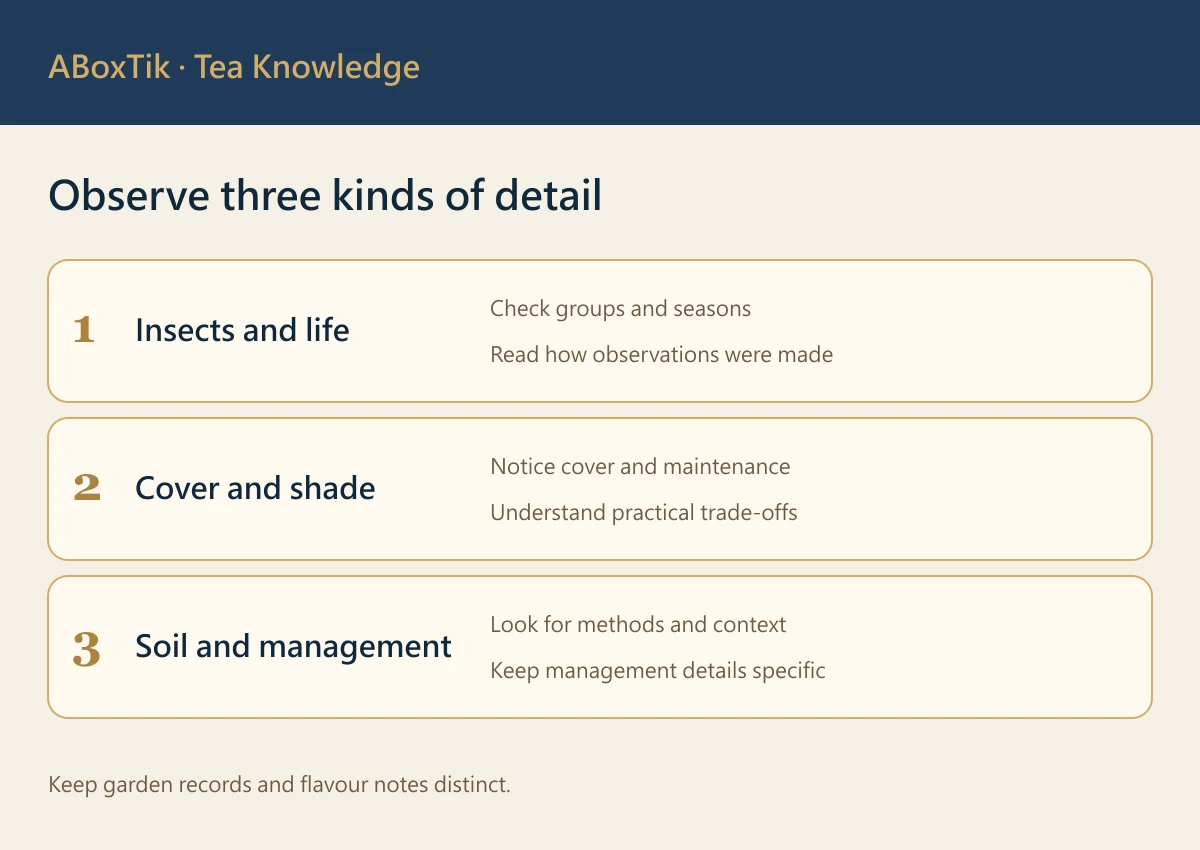
The soil between tea rows is not stage scenery. Species, height, seasonal growth and treatment of ground cover can affect access, water management, pest observation and the rhythm of garden work. The official framework includes weed cover as an observation area; it does not ask us to romanticise every plant. It asks for records that can be understood in context.
If a garden discusses ground-cover management, look for specifics: which areas are retained, what practice is used, and whether monitoring accompanies it. The phrase ‘natural cultivation’ alone does not tell the whole story. Tea Traceability and Certification can help organise the information worth checking.
Ground cover does not translate directly into one aroma in the cup. For aroma practice, start with How to Smell Tea and Floral Aroma in Tea. Clear sensory language is more useful than a tidy but unsupported explanation.
Shade is a growing condition as well as a view
A study preserved in the Ministry’s agroforestry knowledge collection examined light, temperature, humidity, tea shoots and composition at differently shaded positions in a mixed-tree tea garden in Lushan. It illustrates how tree cover changes growing conditions, while also noting that location, cultivar and conditions complicate comparisons.
When reading a garden description, note the tree species, the distribution of shade and how retained areas fit alongside working paths. Ask about observations at that site before connecting a shadow with a particular flavour. A large tree begins an interesting conversation; the records around it help make the conversation useful.
Soil microbes matter, but a slogan cannot replace a method
Soil microbial diversity is another official indicator, yet it is not something a visitor can fully assess by lifting a handful of soil. Sampling depth, season, analytical method and comparison baseline all affect a result. Without those conditions, ‘the soil is full of life’ remains a description that needs more information.
This does not make soil less important. It makes better questions possible. Are soil tests, management records or improvement plans retained? Does a result concern one plot, one season or a longer series? Naming the scope allows good news to stand on its own evidence.
Environmental information and food-safety information should also be read separately. Tea Pesticide Residue Testing concerns reports and batches; a garden landscape or environmental narrative cannot take the place of a test report.
Make a four-part garden observation card
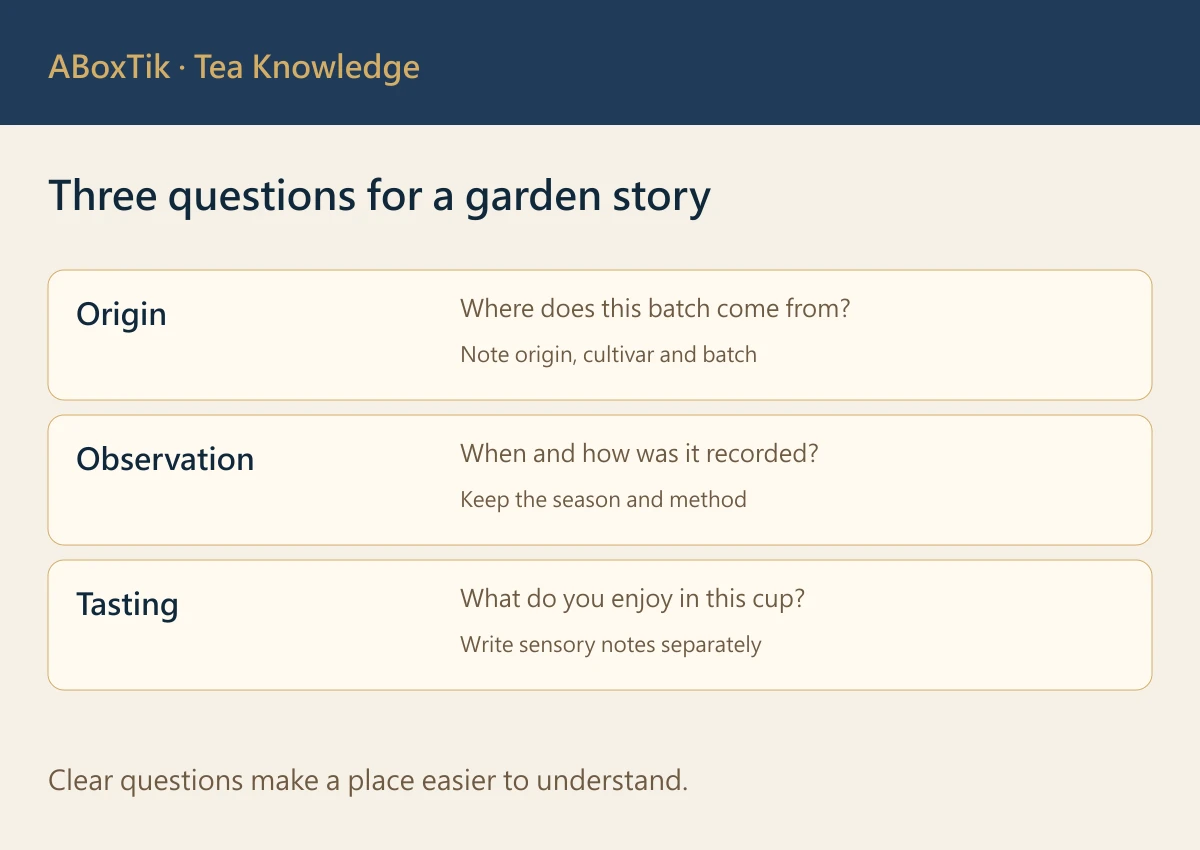
You do not need to become a field ecologist to organise what you read. Make four columns: origin, cultivar and season; verifiable management or certification information; the subject, timing and method of any survey; and your own brewing observations. Separating them prevents a report, a brand narrative and a personal tasting note from borrowing each other’s authority.
| Observation | Useful question | Do not rush to conclude |
|---|---|---|
| Living things | Which groups and which season? | One species represents the whole ecology |
| Ground cover | How is it managed and recorded? | Greener ground is automatically better |
| Soil | What method and comparison are used? | Microbial diversity is visible to the eye |
| Tea batch | What are its origin, processing and labels? | A garden story guarantees quality |
If information remains incomplete, leave the space honestly blank. This is not an exam, and the tea will not hide its aroma because one box has no answer.
From garden to tea table: keep terroir, craft and storage together
Garden conditions are part of a tea’s background; processing, packing, transport and storage also shape the finished tea in your hands. Use A Guide to Taiwan Tea Regions for geographic context and Oolong Oxidation and Processing for the making side. Both offer more useful leads than a vague assurance that a tea comes from a ‘good environment.’
After opening, follow the product’s storage guidance and protect tea from heat, moisture and strong odours. How to Store Tea covers the everyday details. They are quiet steps, but they continue caring for the tea after it has left the garden.
Let verifiable information lead the choice
To compare a range of Taiwanese teas at home, review the current contents of the Classic Taiwan Tea Four-Box Set or the Two-Box Tea Bag Gift Set and choose a format that suits your equipment and routine. If a tea gift is part of the occasion, How to Choose a Tea Gift Box starts with the recipient and practical questions.
The most appealing part of biodiversity may be that it improves the questions we ask: what was observed, how do we know, and what remains to be learned? With that patience, terroir has room to unfold in the cup without being asked to wear an oversized label.

ABoxTik begins with the terroir, craft and everyday enjoyment of Taiwanese tea, inviting a slower reading of both evidence and experience.
Give the tea-garden story room for detail
Start with verifiable origin, batch and certification information, then let garden observations provide context instead of a shortcut to judgment.
Next time you brew, leave one line for the tea name, one for your brewing conditions and one for what you do not yet know. Keeping that last line is a sound tasting practice.
Related reading
Sources
- Ministry of Agriculture Knowledgebase: ecological contribution indicators for organic tea gardens
- Ministry of Agriculture Knowledgebase: Wuhe tea-garden ecological survey research
- 農業知識入口網:混植林木茶園茶葉性質之初探
Sources checked 19 October 2026.