
Tea Knowledge
What Is a Fairness Pitcher? Serving Tea with Ease

The last stretch of a pot of tea deserves a little composure.
What does a fairness pitcher do? In practical terms, it receives a finished infusion before you pour it into cups. That pauses contact between the leaves and the liquor, and gives each person a cup from the same mixed batch. It is not an exam prop for a gongfu tea table. When one person is drinking and tea goes straight from vessel to cup, it may not be needed at all.
Its usefulness appears when the end of a brew needs a little care: the first cup should not be much lighter than the last, the leaves should not keep steeping while everyone finds a seat, and the person pouring should not have to negotiate all three problems at once. This guide looks at timing, capacity, pouring, drips, and cleaning without turning a calm tea break into a ceremony test.
A fairness pitcher does two simple jobs: pause extraction and even the liquor
Tea leaves continue to interact with water until the liquor is poured away. Emptying a completed infusion into a fairness pitcher separates the prepared tea from the leaves; pouring from that pitcher then gives every cup tea from the same blended liquor. Tea sensory evaluation also decants brewed liquor for observation. The useful lesson is modest: collect the liquid first, then take time to look, smell, share, or taste it.
Evenness is not a promise that every sip becomes identical by formula. It reduces the more obvious difference caused by order: who receives the first part of the pour and who receives the final, sometimes stronger part. During a sequence of Taiwan gongfu tea brewing, that lets attention stay on water and timing instead of on a tiny social puzzle at the end of every infusion.
For one person, a pitcher is optional when a gaiwan or pot can be poured directly into the drinking cup and the tea will be enjoyed promptly. Bring it out when you want to compare two small cups, pause the leaves, or share. A table does not become less hospitable because one vessel stayed in the cabinet; it only needs to suit the people around it.
When should you decant? Let the number of people and the purpose of the brew decide
For two or more drinkers, a fairness pitcher is often the easiest route. When the infusion is ready, pour the pot or gaiwan out as fully as is comfortable, then divide it among the cups. While someone reaches for a snack or the conversation changes direction, the leaves do not have to keep steeping in the original vessel. It creates a clear ending for one infusion, not a rule designed to make anyone anxious.
It is also useful when comparing aroma and flavour within the same brew. Mix the liquor in the pitcher, then pour two small cups: one to observe while warm, and one to revisit after a short rest. That keeps the comparison focused on temperature and perception rather than on cup order. How to smell tea aroma offers a gentle next step if you want to slow the observation down.
Conversely, direct pouring is entirely sensible for a small quantity you will drink at once. Ask two quiet questions: do the leaves need to stop steeping now, and do several people need similarly brewed cups? When neither answer is yes, leaving out a piece of washing-up is a perfectly good decision.
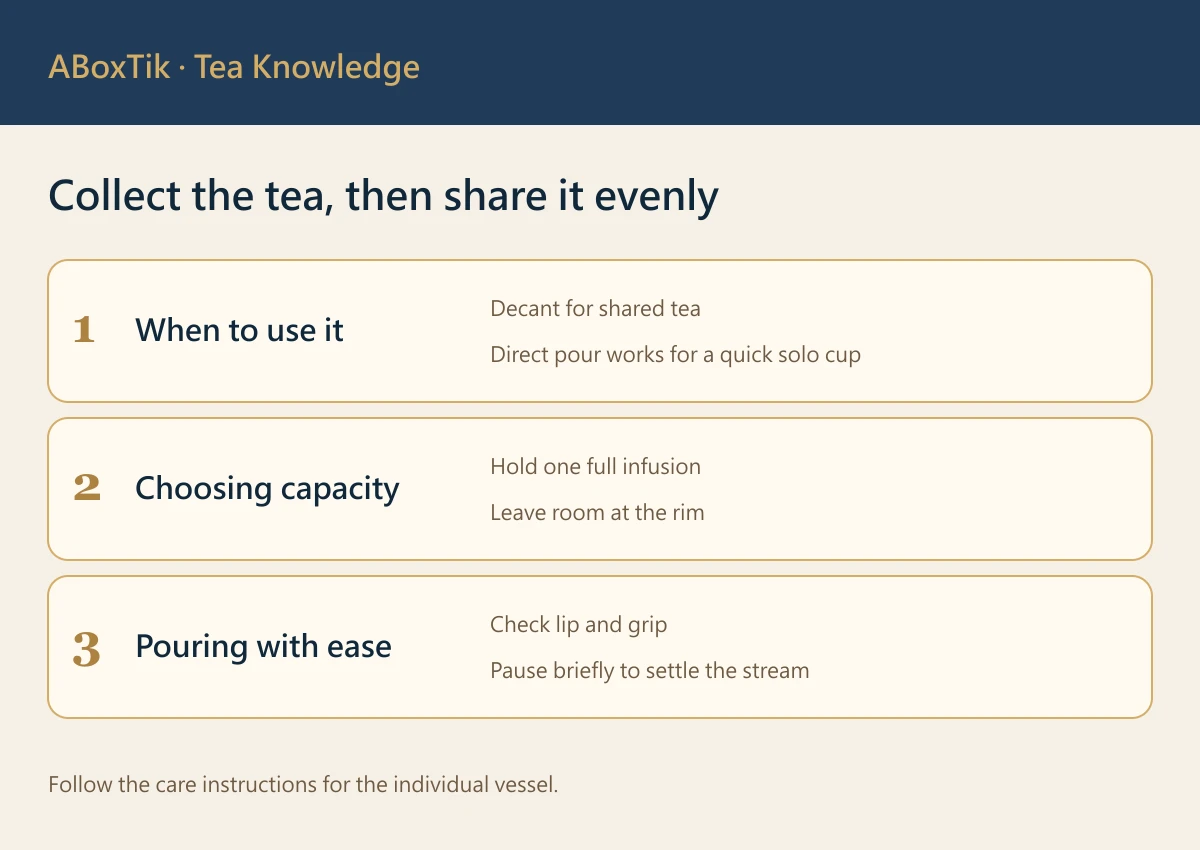
Choose capacity by one full infusion, with room left for a steady pour
Start with the amount your usual gaiwan or teapot releases in one infusion, then allow a little empty space above it. A fairness pitcher does not need to be filled to the rim. Headroom makes it steadier to move and less likely to turn a tablecloth into an accidental map of tea. For two small cups, look for a vessel that holds both portions plus a little margin; move larger only when you regularly serve more people.
Bigger is not automatically better. A large pitcher that is always nearly empty can feel heavy and occupy useful space on the tea tray. A pitcher that is too small may require a second transfer, which reintroduces the very order difference you meant to avoid. If you are uncertain, measure the combined volume of your commonly used cups once. It is a refreshingly low-drama way to shop.
Capacity also belongs to your brewing rhythm. If you use steeping-time adjustment principles across several infusions, a pitcher that receives the whole pour lets the next round begin without hurry. For tea outside the home, a travel tea gear checklist can help you decide whether a smaller, lighter form suits your actual bag and table.
Pouring and drips: inspect the rim and the grip before making material claims
Whether a fairness pitcher feels easy to pour often comes down to the shape of its lip, how concentrated the stream is, and whether you trust your grip. Lift an empty example and imagine the route from a half-full pitcher to a small cup. Will fingers meet a hot surface? Can you control the tilt? Where is the final drop likely to go: back into the pitcher, onto the tray, or along the outside of the rim? These plain questions matter more than a glamorous product name.
Material, wall thickness, and form can change handling, but material alone does not guarantee heat retention, easy cleaning, or a drip-free pour. Check the maker’s dimensions and care notes for the exact vessel, then use the teapot and teaware materials guide to understand broader considerations. A fairness pitcher’s job is deliberately uncomplicated: carry finished tea steadily to the cups.
If the final drop keeps creating hesitation, pause for half a second after pouring, let the stream settle, then return the pitcher upright. It is a useful movement, not a performance. The cups matter too: tea cup shape and tasting experience can help you consider how cup form and handling fit the rest of the table.
A practical serving sequence for one finished infusion
First, place the cups where they can be reached and leave a clear place to set the pitcher down. Second, when the tea is at the point you want, pour the contents of the pot or gaiwan into the fairness pitcher in one comfortable movement. You do not need to shake out a heroic final drop; the aim is simply not to leave a substantial amount of liquor with the leaves.
Third, hold the pitcher securely and pour in a small, continuous stream. With several guests, give each cup a little first, then return to bring them to a similar level. This is usually easier than filling the first cup completely. Fourth, pause before setting the pitcher down so the lip can collect itself. A clean small cloth nearby is a kind solution when there is no tea tray.
Fifth, decide whether to re-steep only after the current cups have had their moment. Observing later infusions can help if you are curious about leaf changes from round to round. For a relaxed hosting rhythm, Taiwan tea hospitality offers ideas that leave room for people as well as tea. The pitcher supports the process; the shared time remains the point.
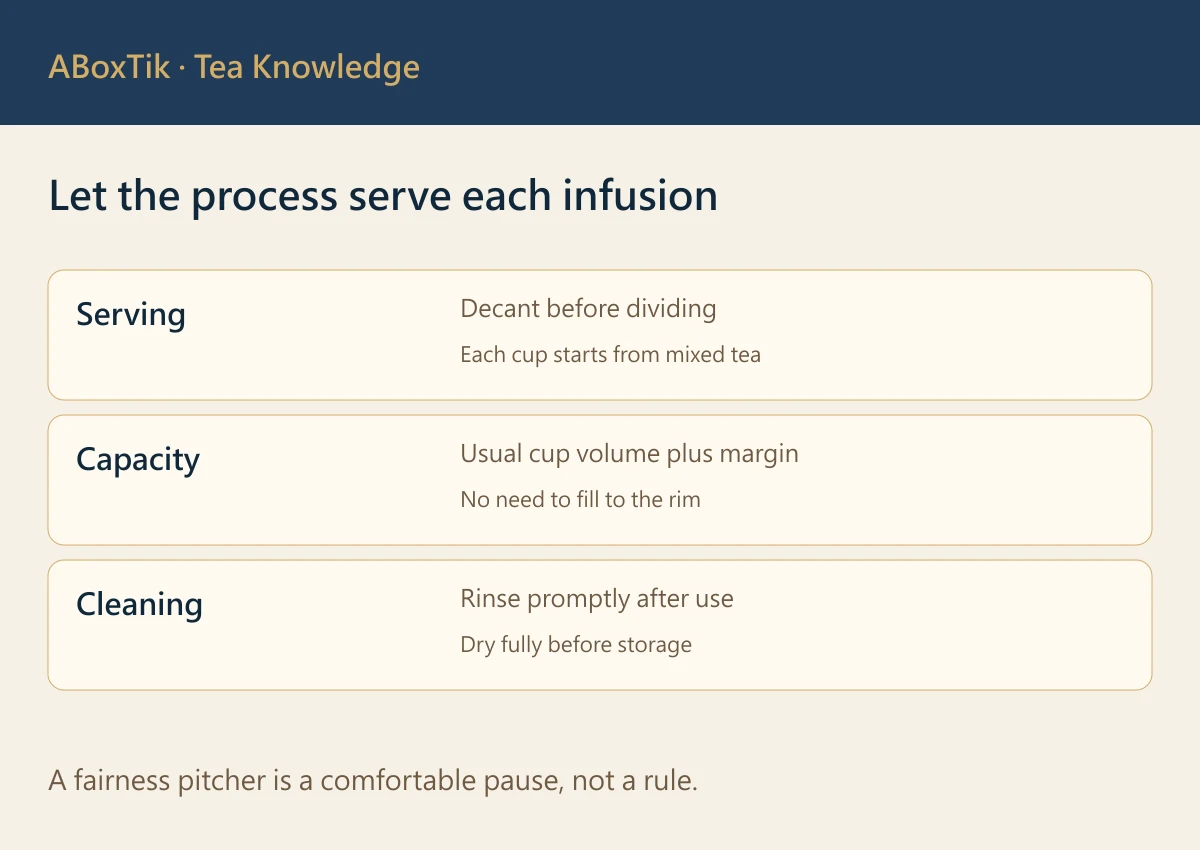
Cleaning is straightforward: rinse promptly, dry fully, follow the vessel’s instructions
After use, rinse away remaining tea before it dries inside the pitcher. That small, timely action does most of the routine work. If visible tea film or oil is present, follow the care directions for the specific material and maker. Different vessels tolerate different treatment, so inherited advice is less useful than the information that came with the piece in your hand.
Let the inside and outside dry before storage, paying attention to the rim, pouring edge, and base. If a vessel includes a lid, strainer, or silicone part, dry separable pieces individually so moisture is not shut inside. There is no mysterious shortcut here; it simply means that the next tea session does not begin by cleaning up the previous one.
Keep the pitcher and cups where they are easy to reach, so brewing does not require setting up a miniature stage. Revisit the gongfu brewing flow when you want to organise the wider sequence, and see tea storage essentials when the leaves themselves need attention. Clean vessels and well-kept tea each look after a different part of the next cup.
Pick a pitcher for your real tea table, then let it work quietly
For solo tea, a comfortable grip, easy cleaning, and enough capacity for one infusion are a generous starting brief. For regular sharing with two or three friends, add capacity and serving speed to the comparison. Gaiwan users can imagine the height and angle of their pour; teapot users can check whether the pitcher comfortably receives the pot’s stream. Every choice is serving your own table, not answering for someone else’s.
A fairness pitcher is a dependable messenger: it gathers prepared tea, then gives everyone a similar starting point. With tea-bag sharing formats, it can make sharing aroma and texture easier; with different Taiwanese tea styles, it can give each guest tea from the same portion of the infusion. For each tea, follow the information on the current product page and package.
For other flavour directions, mixed tea-bag selections and a Taiwanese tea selection offer different places to begin. What makes Taiwanese tea special can then connect the cup in front of you to a wider story of place and craft. Choose a pitcher you will want to use often, pour the tea well, and sit down. That is enough.

Taste tea with ABoxTik
Let serving tea become a comfortable pause
A fitting fairness pitcher does not prescribe how tea must be enjoyed. It simply gives the end of an infusion a steadier place to land. Start with the vessel you use, the number of people who sit with you, and the corner of the table most likely to catch a drip; those answers are more useful than chasing terminology.
At ABoxTik, we believe tea can be carefully considered without making anyone tense. Pour the liquor, leave time for aroma and conversation, and take the next sip when it feels right. The best usefulness of a vessel is often this quiet kind.
Related reading
- Return to Taiwan gongfu tea brewing
- Compare gaiwan and teapot
- Explore tea cup shape and tasting experience
Sources
- Tea and Beverage Research Station: Introduction to tea sensory evaluation
- National Palace Museum Southern Branch: Tea Culture
Sources checked 19 October 2026.