
Tea Knowledge
Japanese Tea Ceremony and Taiwan Tea Settings
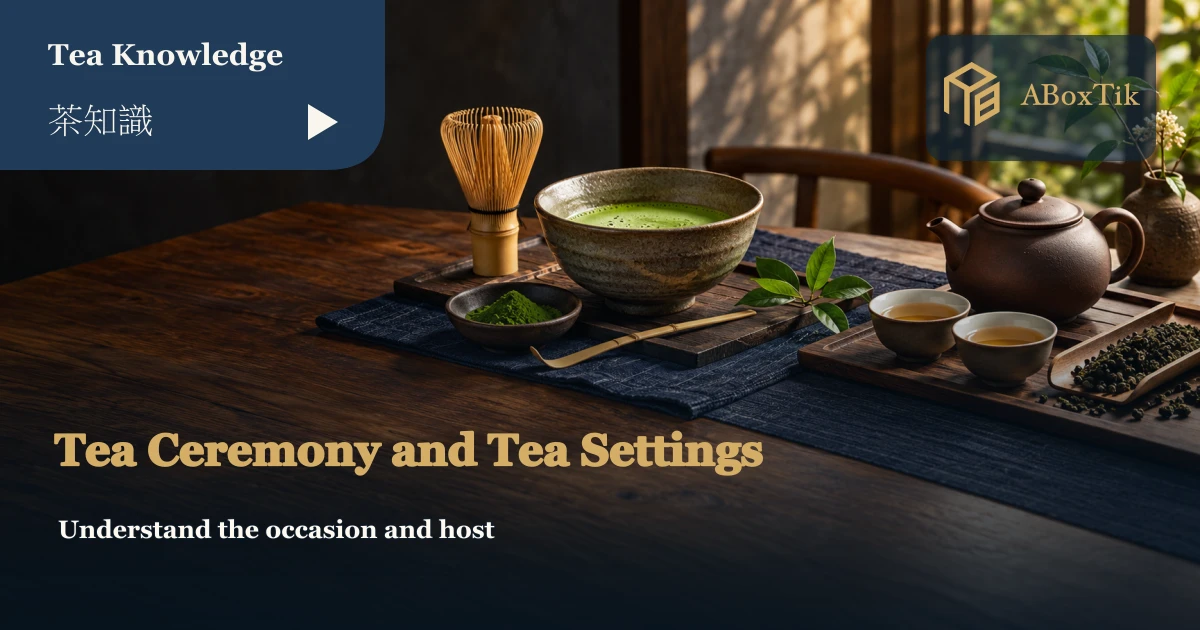
First notice how a gathering cares for people; then look at how its utensils are arranged.
Japanese chado and Taiwanese tea settings cannot be reduced to “formal Japan, relaxed Taiwan.” A useful comparison can place Urasenke’s published principles beside contemporary Taiwanese everyday hospitality, looking at preparation, host–guest interaction, utensils and purpose. Formal events, teaching sessions, home brewing and performances each have their own arrangements.
For a first invitation, identify the event and who will guide it before memorising a supposedly universal set of gestures. This guide offers a reading framework, leaving both places room for more than one way to share tea.
Define the settings before comparing the cultures
Japan has different schools and everyday tea practices; Taiwanese settings include homes, tea houses, classes, evaluation and designed events. Country names are too broad to explain one gathering. Compare what the actual event is doing and what participants are invited to experience.
Here, Urasenke’s own statements provide a specific example. The Taiwanese side focuses on contemporary everyday leaf-tea hospitality. One school does not represent all Japan, and a single photograph does not establish rules for every Taiwanese tea setting.
Taiwanese tea hospitality and gongfu and Taiwanese brewing arrangements offer further contexts. Where an event has its own theme, follow that explanation before importing a national comparison.
Urasenke’s example: principles behind the preparation
Urasenke presents harmony, respect, purity and tranquillity as guiding principles. Its seven rules also address drinkability, seasonal consideration, readiness and attention to fellow guests. These show that movements and utensils can be connected to care for people and the particular occasion.
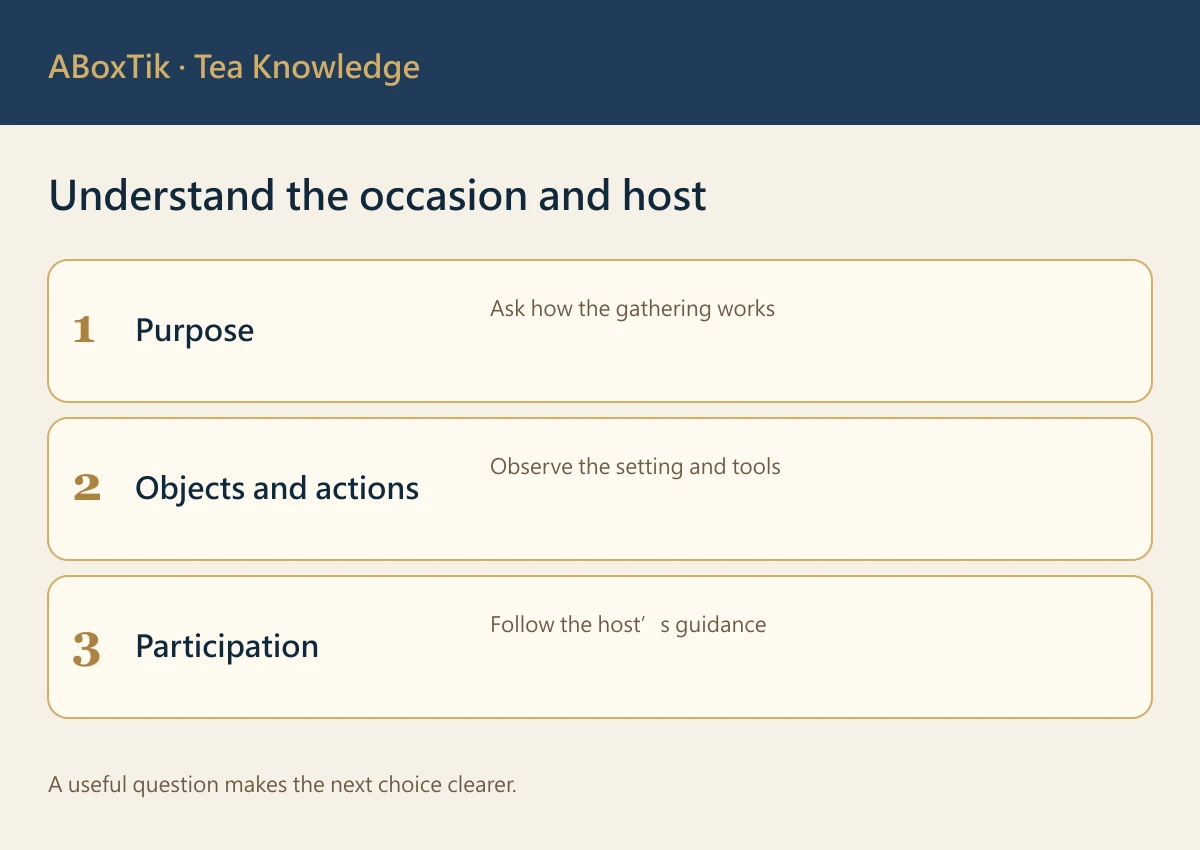
A visible sequence need not be read as appearance alone. Ask what a step serves. In a class or experience session, follow the teacher; for a formal gathering, learn how the host wants guests to participate. The setting supplies the relevant detail.
This article is not a step-by-step lesson in a school’s procedure. Reading an introduction differs from training. Recognising the principle and listening to the host is already a worthwhile preparation for a first visit.
An everyday Taiwanese example: tea as a route into conversation
Homes and tea houses can use many arrangements: repeated loose-leaf infusions, individual tea bags or a shared pot. The example here concerns everyday hosting that adapts to people, utensils and preferences. It does not imply that Taiwanese tea events lack defined procedures.
National Chengchi University’s tea hospitality lesson includes asking guests which tea they would like. That is a useful reminder to establish whether tea is wanted before delivering its introduction. Style introductions and light and roasted directions can make the choice easier to answer.
Everyday need not mean careless. Timed pouring, comfortable portions, clear table space and asking before refilling can support conversation. Utensils do not all need to report for duty at once; the guest’s immediate need can arrive first.
Read utensils as working objects within an event
In a specific chado gathering, objects and their arrangement may connect with season, theme and practice. A contemporary Taiwanese setting can also use utensils, textiles, flowers and space to develop a theme. Similar appearances need not share identical meanings, and different appearances do not establish a total absence of exchange.
Begin with concrete observations: powdered or leaf tea, preparation, presentation and distribution. Counting utensils alone reveals little. Gaiwans and teapots, porcelain brewing and utensil choices and utensil materials provide everyday functional background.
Ask before photographing, touching or moving objects. An attractive table still contains hot water and things someone values. Appreciation can move closer without the hands necessarily accompanying it.
Four fields for a comparison that retains its setting
| Field | Urasenke reading example | Everyday Taiwanese hosting example |
|---|---|---|
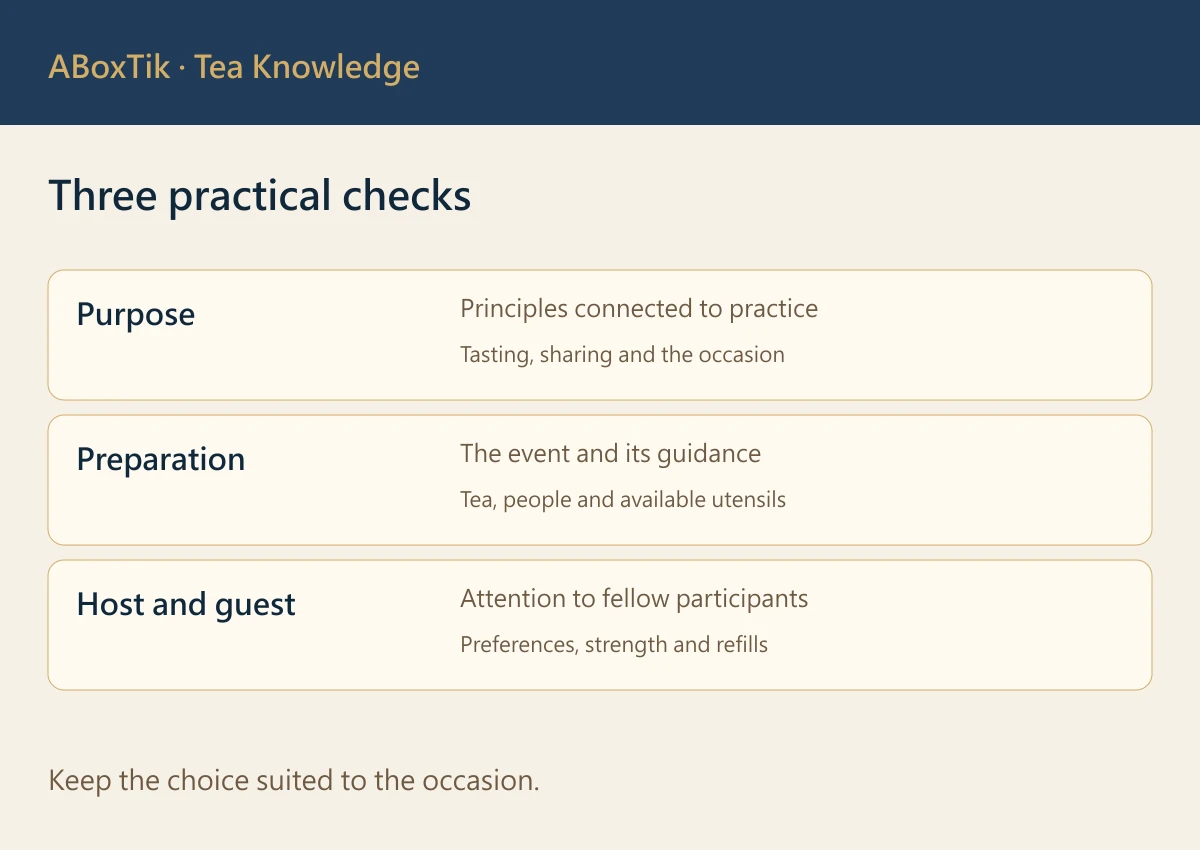
| Purpose | Principles connected to practice | Tasting, sharing and the occasion |
| Preparation | The event and its guidance | Tea, people and available utensils |
| Host and guest | Attention to fellow participants | Preferences, strength and refills |
| Objects | School and event context | Function and designed arrangement |
The table compares the two examples defined here, not entire countries. A formal Taiwanese gathering or an everyday Japanese tea visit requires its own notes about purpose and handling. Do not let a convenient table overwrite the scene in front of you.
Aroma and observing bitterness, astringency and strength help record the drink itself. “At this event, the host arranged…” is both more precise and more generous than “people from this country always…”.
Three practical questions before a first visit
Ask about the event type, any clothing or carrying requirements and whether first-time guests receive guidance. Once there, find out where to sit, when questions fit and whether photography is welcome. Listening for a moment is preferable to guessing a gesture in an attempt to look experienced.
When the host introduces a tea or object, attend to the detail being offered. If a smaller portion is needed or another cup is unwelcome, say so politely. Participation is not a competition to finish every serving, and bringing a the tea gift box guide is a separate choice guided by the actual invitation.
Afterwards, note one detail that made someone comfortable and one question still worth asking. A pause, a clear table or a considerate invitation can travel home more usefully than deciding which country has more ritual.

Tea, one box at a time
Bring understanding home instead of ranking cultures
At ABoxTik, comparison is an invitation to understand. Notice how an action considers another guest and how a particular tea is introduced; that observation can make the next gathering more thoughtful.
Explore the actual teas in the Classic Taiwanese Tea selection and use the hosting guide for a small everyday table. Make room for people first and let the tea unfold at its own pace.
Related reading
- Arrange an everyday tea gathering
- Understand utensils and brewing rhythm
- View the Classic Taiwanese Tea selection
Sources
- Urasenke: four principles and seven rules
- Urasenke official English introduction to chado
- National Chengchi University: Serving Tea for Guests
Sources checked 20 October 2026.