
Tea Knowledge
Ice-Melt Tea vs Cold Brew: Time, Aroma and Taste

Ice can melt slowly, and the question can be unpacked at the same pace. Describe the method first, then let aroma and taste answer in their own words; the cup does not need to referee a terminology contest.
The practical difference in ice-melt tea vs cold brew is how water meets the leaves. In this article, ice-melt extraction is a working description for water from melting ice gradually contacting the leaves or dripping slowly through them. Cold brew means the leaves remain immersed in cold or refrigerated water. Ice extraction is not presented here as a standardized tea term, and neither method guarantees a particular aroma or taste.
A clean sealed bottle makes cold brew easy to record. Equipment that holds ice, guides water and collects liquor under refrigerated conditions allows a focused ice-melt trial. Use the cold-brew ratio and timing guide for immersion details, and the everyday tea-brewing guide for hot brewing, water and equipment. This page stays with method, time, aroma and taste, so four techniques do not hold a committee meeting in one pot.
Ice-melt tea vs cold brew: define the water path
Ice extraction can describe different equipment and procedures. Here it covers only melting ice gradually contacting tea leaves, or meltwater dripping through a leaf bed and collecting below. If ice and leaves share one vessel, record whether contact becomes immersion. The short name does not replace the water path.
Cold brew adds cold or refrigerated water to leaves, which remain immersed until tasting and removal. Taiwan’s Ministry of Agriculture gives whole-leaf examples at 1:50 and 4 degrees Celsius. Those figures belong to that immersion setup; they do not predict melting speed or an ice-melt result. A Taiwan FDA description of industrial cold extraction uses a closed extraction vessel for packaged tea, which does not define this home ice-melt method.
Rapidly chilled hot tea, prepared tea served over ice and ice-drip coffee answer different questions and are outside this comparison. The tea-storage guide concerns dry leaves, not the keeping time of a finished drink. For cultivar, place and craft, visit why Taiwanese tea is distinctive.
Compare the water path, the clock and repeatability
Cold is not a complete recipe. Immersed leaves normally remain in water; melting or dripping contact changes with melt rate, water path, leaf-bed shape and collected amount. Cold brew needs start and leaf-removal times. An ice-melt note also needs ice mass, melt start, drip observations and final volume.
| Question | Ice-melt or slow-drip setup in this guide | Cold-brew immersion |
|---|---|---|
| Water contact | Meltwater gradually contacts or passes through leaves; the route may shift | Leaves remain immersed in cold water |
| How time is recorded | Start of melting, drip pattern, collected volume and total duration | Water added, refrigeration, tasting and leaf-removal time |
| Main variables | Ice mass and size, temperature, water path, leaf bed and final volume | Leaf and water amounts, temperature, leaf form and immersion time |
| Repeatability | More conditions may change together, so fuller notes are needed | Easier to repeat after vessel and proportions are fixed |
| Aroma and taste | Must be observed for the actual tea and setup; the name predicts neither | Also depends on tea, proportion, time and temperature |
| A useful starting point | You have stable refrigerated collection equipment and want a small recorded trial | You want a simple vessel and a repeatable baseline |
Immersion leaves fewer controls to supervise for tomorrow’s bottle. Ice melt has a purpose when the water path itself is the question. Choose the process your equipment can support. The aroma observation sequence helps describe dry leaf, cold liquor and a slightly warmer sample without predicting the result.
Compare aroma and taste without giving low temperature a script
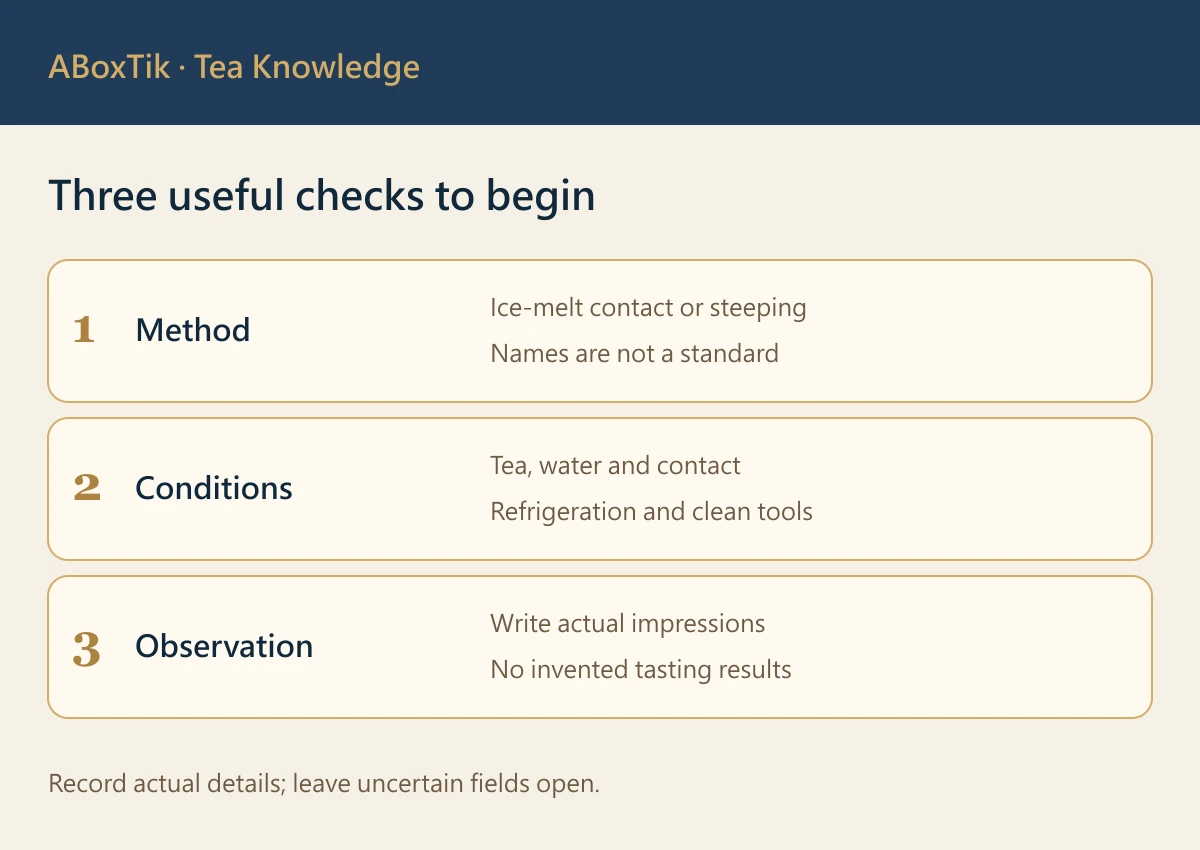
Low-temperature tea may present aroma differently from hot tea, but ice melt is not automatically more fragrant, cold brew is not automatically sweeter, and neither is reliably less bitter or astringent. Cultivar, processing, leaf size, quantities, water, contact, time and tasting temperature all contribute. If a sample warms slightly, record that too.
Use five fields: aroma clarity, first-sip strength, bitterness, astringency and finish. Refreshing gives little direction; quiet aroma, comfortable strength and a drying finish offers more. It remains one observation, not a certificate. The light and roasted tea guide organizes aroma words without ranking styles.
Use leaves from the same package and align finished volume, cups and tasting temperature as far as practical. Record the ice mass and liquor collected. Contact still differs, so the result answers only this setup. The high-mountain tea quality guide keeps origin beside harvest, processing, storage and the cup when the tea changes.
Make cold brew stable and the ice-melt path visible
For cold brew, use a clean sealed container and potable water. Follow the package or established guide, add leaves and refrigerate immediately. Set a reminder, taste and remove the leaves when suitable. Sleep is not a timer, and long room-temperature standing is not a shortcut.
For ice melt, confirm that food-contact parts are stable, washable and collect under refrigerated conditions. Weigh the ice; record size, leaf position, start time and final volume. Watch for one narrow channel through the leaves. If the device cannot work reliably in the cold, use refrigerated immersion instead of an unattended extended run.
Keep the first batch small, without sugar, milk or fruit. The equipment and water guide helps with setup. For tea bags, read the weight and package directions. The pyramid tea-bag guide explains leaf space, while bag shape promises no extraction result.
For the first side-by-side round, change only one question
Decide what you want to learn. Are you examining two patterns of water contact, or simply looking for a convenient drink to prepare for the next day? The first question needs tea, package, finished volume and tasting conditions recorded. The second can give more weight to equipment, reminders and cleaning. If those aims are not separated, the conclusion may be merely that one cup tasted better, with no clue about how to prepare it again.
A practical card can include tea and batch, dry-leaf amount, ice or water amount, vessel, refrigeration, start and finish times, finished liquor volume, tasting temperature and the five sensory fields. In the next round, alter just one item, perhaps leaf-removal time for immersion or the way leaves are spread for the melting setup. Changing the tea, ice, vessel and proportion together creates a lively afternoon but a rather shy answer. The kitchen sink will also appreciate a restrained trial.
If choosing a tea feels like another variable too many, begin with the aroma note sequence and a familiar tea with clear information. The current Jinxuan oolong product page can provide tea and preparation details, but this article does not predict which aroma it must show under either method. Keep proportions, example immersion times and leaf removal with the dedicated cold-brew guide rather than building a second general rule here.
Store the finished tea promptly: cool conditions are not sterility
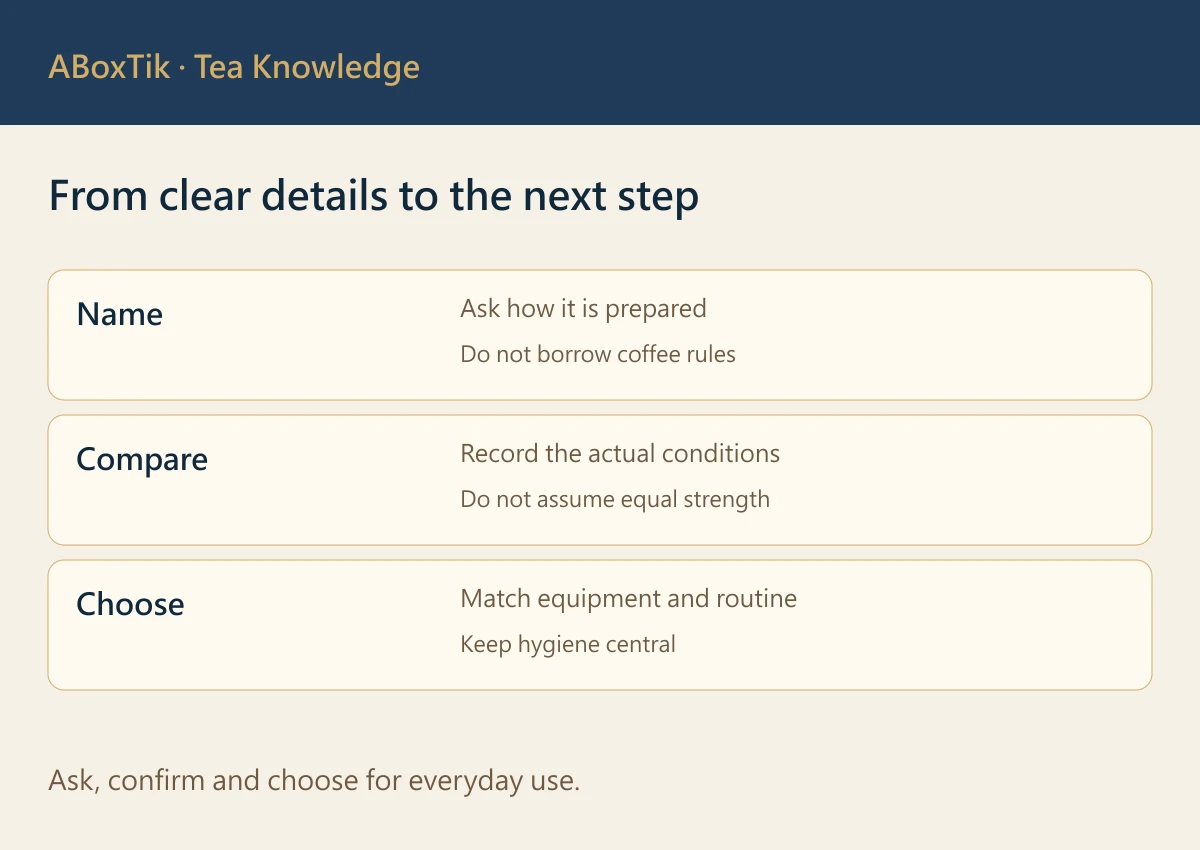
For either method, begin with clean hands, a clean vessel, a clean filter and potable water. Seal and refrigerate the finished tea promptly, and consume it without unnecessary delay. Time away from refrigeration and the surrounding conditions still matter. If the drink develops an unusual smell, souring or another sign of spoilage, do not drink it. These are basic handling steps; they do not make either home method sterile.
The ice-melt arrangement adds collection and drip parts, and every connection becomes another place to clean. Ice should be made from potable water and stored away from strong food odors. After use, wash and dry the equipment according to its instructions. Return the dry leaves to the light, moisture and odor precautions in the tea-storage guide. The prepared liquor and the dry tea each have their own way home.
When preparing tea for someone else, add a short label with tea name, preparation time, method and a refrigeration reminder. That is more considerate than leaving a mysterious special ice extraction in the refrigerator. The introduction to Taiwanese tea reconnects the cup with cultivar and craft when curiosity continues. Clear information does not remove the romance; it simply makes the next meeting with the tea easier to arrange.

Follow ABoxTik | Keep the method clear, and leave both composure and discovery for the next cup.
Choose the method you can care for today
For a first low-temperature tea, refrigerated immersion is the simpler baseline. Once leaf amount, water, time and impressions are easy to record, add the water path of melting ice as one new variable. For a modest comparison, check the current contents of the classic Taiwanese tea four-box selection. If single-cup convenience suits the day, the two-box tea-bag gift provides current product and package information. Those pages offer choices; they do not nominate a flavor champion for either method.
One action is enough for this round: label the bottle with the method, start time and planned leaf-removal or completion time. When you drink it, leave five short notes for aroma, strength, bitterness, astringency and finish. Ice will melt and terminology may continue to wander. A process you can repeat and an observation you can state honestly are the parts worth carrying into the next cup.
Related reading
- The tea aroma guide separates cold aroma from a slightly warmer observation.
- Cold-brew proportions and time holds the specific refrigerated immersion references.
- Jinxuan oolong offers current product information for a familiar starting point.
Sources
- Taiwan Ministry of Agriculture Food Education Platform: A Guide to Cold-Brewing Tea
- Taiwan Ministry of Agriculture: Is Cold-Brew Tea Safe?
- Taiwan Food and Drug Administration: Drug and Food Safety Weekly, Issue 681
Sources checked 16 October 2026.